TRUMP, TRADE & FOREIGN POLICY — Free Fact Zone (FFZ).

Trump and Trade 3


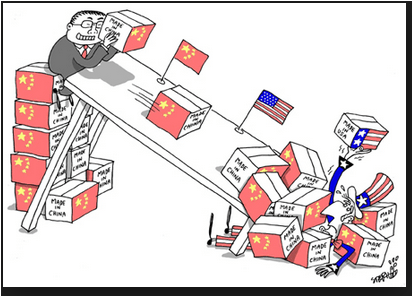
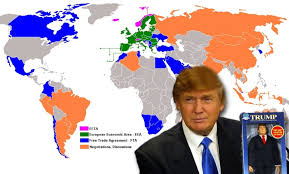
     ‘The Donald’ aka ‘The Trade Trickster’ disparages current trade agreements, ongoing trade negotiations, globalization, US trade policy, U.S foreign policy, and US national security policy. Hope this doesn’t reflect his education at the Wharton School which he constantly reminds us of.

    I’ve written before as to his wildly delusional views on these issues. But here are some additional thoughts:

  • Protectionism undermines the future growth of the U.S.
  • Much of increased foreign competitiveness is due to innovation in production and smart machines.
  • Protectionism is an irrelevant remedy for increased competitiveness of foreign firms.
  • The real focus should be on structural upgrades in the political – economic system in the U.S. This ecosystem needs to have both greater public investment and greater private investment and innovation.
  • These upgrades includes changes to trade adjustment assistance legislation, skills training, and retraining at all levels. This requires greater cooperation between governments of all levels (federal, state and local) and firms of all sizes.
  • Many US multinationals are merely piling up great amounts of dollars in offshore accounts. They are not reinvesting these trillions of dollars into the US economy or workplace.
  • To boot these firms don’t pay either US or foreign taxes on these funds. Some of our most highly successful firms, in particular technology and pharmaceutical firms, are guilty of this.
  • Chaotic policies enunciated by Trump would call into question the role of US leadership in the global system.
  • Trump’s call for renewed waterboarding and killing of families of terrorists would wreak havoc on the US military and US leadership in the world.
  • It’s already clear many of our closest allies are mocking The Donald as being out-of-touch with the political and economic global system today.

My conclusion is that while Trump may know something about real estate and hotels, although even that has been called into question for a long time, the world is different from the world of real estate deals in New York or the world he grew up into in Queens in the 1950s and 1960s. Which he doesn’t seem to have transcended and to be stuck in. Not even the Wharton School could get him to understand reality and how it changes.

      For The Donald trade policy, foreign policy and national security policy are fact free zones informed only by his own inner being. This is not good for anyone not even him.


Leave a comment

National Security & Chinese Investment

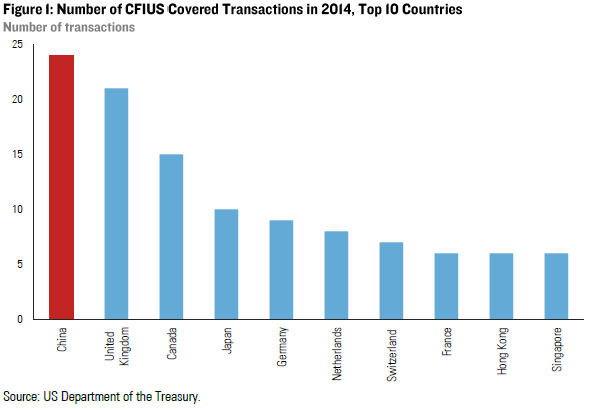
CFIUS 1 (China 2015)


CFIUS 2 China (2015).png


The most recent data from CFIUS concerning Chinese investment in the U.S. discloses the following:


  • China had the most “covered transactions” (mergers and direct investments) for the latest data period (2014) that is reported by CFIUS in its new annual report released in 2016 — greater than the U.K., Canada, Germany, Netherlands or Japan.


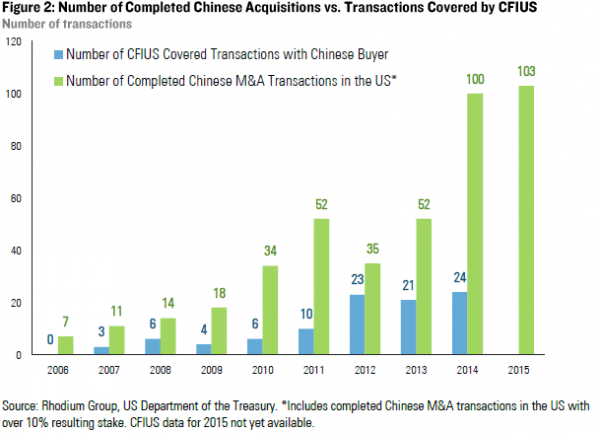
  • 1/4th of all completed Chinese transactions were mergers and other acquisitions 


  • There were twice as many completed transactions in 2004 than the prior year.


Simply put this data continues the narrative that Chines investment into the US. is huge and growing. This is continuing in 2016 with massive new investments as part of China’s outward investment strategy.  Chinese corporations want to diversify away from domestic investment in a slowing China. This can be seen by such investments into U.S. real estate including hotel chains and its corporations.

  I conclude from the above data that such investment, even if reviewed for national security implications, are extremely important for continuing merger deals and health of the U.S. economy. This despite the fact that there is growing popular resentment of such deals and investments. Not unlike the earlier period of Japanese investment into the U.S.

     The national security reviews or the threat of them have not slowed the investment and commercial drivers of such investment. My take is that this is good for the U.S. economy and economic development in the U.S. generally. It provides new capital and new global markets for U.S. firms.


Leave a comment

Protectionism & Presidential Powers — Are Trade Powers Limited?

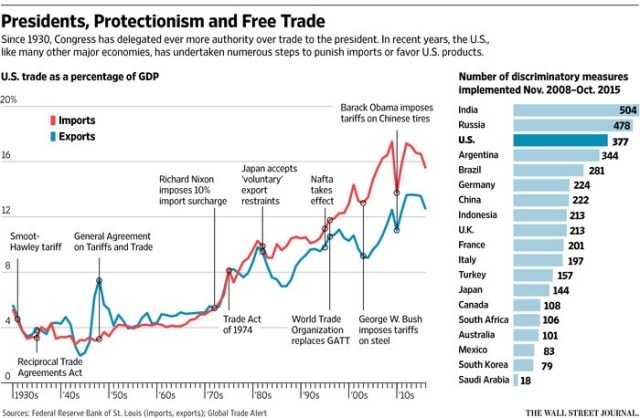
Chart.Trade, Exports, Imports and Laws, Treaties, Actions (WSJ March 19, 2016).


   Yes, Presidential trade powers are very broad. But they are delegated powers by the Congress. They are limited by the U.S. Constitution Article 1, Section 8, Clause 3. This gives exclusive authority to the Congress to regulate global trade. What Congress gives it can take back.

    In addition to the Constitution’s restriction on the Presidential powers in foreign trade, U.S. actions are also significantly limited by our membership in the World Trade Organization.

      Specifically, the WTO’s dispute resolution process is aimed at restricting unilateral trade restrictions. When such national actions are reviewed they can be found as inconsistent with our trade obligations.  If not removed multilateral trade sanctions by the WTO may be authorized and imposed by a member state who brought the action in the WTO. The U.S., as almost all other countries, have an excellent record of complying with the international review over the last 20 years.

      Here are some additional thoughts:

  • But for the WTO review of protectionist measures of the last 20 years, and potential for such review, such measures would have certainly  been more extensive.  They certainly would have restricted global trade growth.
  • Creating protectionist walls around trade is self-defeating.
  • The growing protectionist sentiment within the U.S. and abroad is disconcerting.
  • But the answer to globalization and technologically-driven trade and investment is better enmeshing  yourself in the global ecosystem. If you don’t you may never work again. This is essentially a question of developing a global mindset and relevant skills. Constant dismay and dissent is not going to help. It’s also self-defeating
  • Better trade enforcement of existing rules and international obligations is part of the answer. The Congress provided for this, in part, in its recent legislation (Trade Enforcement Act 2015). This new legislation puts trade enforcement leadership squarely within the USTR. The U.S. has been very effective in bringing enforcement actions in the WTO. It has been the most aggressive.
  • On the state and federal level policies should be enacted to help particularly in export promotion and increasing foreign direct investment. 90% of the world’s consumers live outside of the United States. Foreign operations in a state drives greater exports. State actions have a great influence in promoting trade and economic development. They are indispensable.
  • In addition universities need to develop programs focusing on the global system and develop the mindset and skills to participate in it. This should be a top priority. This is especially true of public universities that live off state funding and are obligated to residents  and state taxpayers.


  ……. “Powerful Pair: Protectionism and the Presidency.” Wall Street Journal (March 10, 2016).

Leave a comment

Trump & Trade Wars — No Doubt About it.

           Trump and Trade 1

— BACK TO THE FUTURE — Herbert Hoover & Trade Wars — No Doubt About it.

    Trump akaTrump the Trade Mister” poses a huge risk to U.S. trade and economic growth. He would have at his disposal huge delegated trade powers under existing legislation. He could cause great damage to the U.S. in its global trade relations and its domestic economy generally. No doubt about it. The potential for wrongdoing is tremendous.

     Here are a several points made by recent editorials with a few  by me:

  • The pace of global economic growth continues to tumble and this is bad for U.S. growth.
  • Trade global growth of below 2% is now well below GDP for the first time since 9/11.
  • The paradox of trade politics is when things are bad people take it out on trade. It is clear many have turned against globalization and the liberal economic order as a result of popular frustration. Those benefiting from trade are always more diffused than those injured by it.
  • It was the Republican President Herbert Hoover who signed Smoot-Hawley in 1930 that escalated the stock market crash and slowdown into a global trade war and the Great Depression. This of course led directly to World War II.
  • It wasn’t until FDR and his Secretary of State Cordell Hull slowly rebuilt the global trading system pursuant to the Congressional Reciprocal Trade Agreement Act of 1934 that eventually led to the Bretton-Woods system, GATT and now the WTO.
  • Congress delegated under this act (RTAA)  huge unilateral powers to the President. These powers are still  in place and form the basis of executive actions in U.S. trade relations today. This is the way we carry on our global trade relations.
  • Congress has exclusive authority to regulate trade under Article 1, Section 8, Clause 3  of the U.S.  Constitution. The President has delegated authority  by Congress today and this is at the disposal of a new President. Although at times this can be challenged in the federal courts and in the WTO.
  • Four trade remedy tools, among others, have  been delegated to the President including  Super 301 (‘Retaliation‘), Section 232 (National Security), Section 201 (‘Safeguards’) and ‘Currency Manipulation.’  They all provide authority to unilaterally impose trade restrictions may in fact be considered invalid under our international obligations.
  •  These provisions are in addition to a host of other statutes concerning trade and investment that can hamper global trade relations. Such as CFIUS and its national security reviews of foreign investment.
  • Needless to say, the President has tremendous powers to terminate trade negotiations (TPP, TTIP), trade agreements, bilateral, regional and multilateral ones. This may violate our international obligations but such treaty termination is within the unilateral powers of the President and is binding as domestic law.

     So what’s the bottom line?

     Trump has no understanding of international economic history.  This despite the fact that he went to Wharton, which he constantly reminds us of, and of which I’m sure Wharton would like to forget.

     Unfortunately, Trump would have at his disposal, as President today, powerful unilateral measures authorized by Congress that can poison our trade relations and send us back to the future.


Leave a comment

Non-Compliance & Retaliation in the WTO — What’s the Data? — Any Surprises?

                                    Intl Law  


In the recent report of the Dispute Resolution Body of the WTO, in its annex entitled “Overview of the State of Play,” there is a chart listing cases brought under Article 22.2 of the Dispute Settlement Understanding. It enumerates cases that resulted in WTO authorization of ‘retaliation.’ This is important and it is unfortunate this data is buried so deep.

What is shown by the data?

Out of almost 500 cases filed in the first 20 years of the WTO (1995-2015) only 10 cases resulted in authorization by the WTO of retaliation. Not very many.

Actually, it is even less than you see. One case was brought by different parties. Technically they were counted as two separate cases. In fact, they really aren’t. Another case authorization was given twice. If you combine those cases and consider them as one you have only 8 cases. What gets even more interesting is that a number of those cases where authorization was given, retaliation was never implemented.

Which countries had retaliation authorized against it? The U.S. leads with 4 such cases and the EU with 2 such cases. (Canada and Brazil with one each in the same case.)

So where does that leave us as to the question of non-compliance and retaliation of WTO decisions?

Well the answer is pretty clear. Out of 500 cases filed (request for consultations) only 8 cases resulted in authorization for retaliation. and less were even implemented. While this is not the whole story it does indicate a pretty good rate of compliance. And not unexpectedly it’s the U.S. and the EU who bore the brunt of retaliation. And in these cases it’s those two countries that requested such authorization against each other.

But this makes sense. The volume of trade between the U.S. and the EU is huge. As trade flows increase disputes increase. That’s only natural.  It is not the absence of  disputes that characterizes a legal system. But it’s the way they are resolved. The WTO has a good story to tell about resolving global trade disputes and having the offending measures lifted. In fact, an excellent story to tell.


Leave a comment

Is the Iranian hostage agreement good diplomacy and law?


India & U.S.

Op-Ed in the Richmond Times-Dispatch (Sunday) (January 31, 2016)


CARTER AND OBAMA

   Malawer:

       By Stuart S. Malawer, JD., Ph.D. Richmond Times-Dispatch


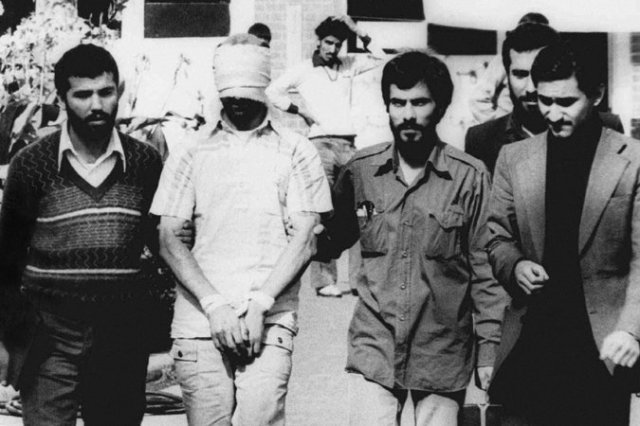
On Jan. 21, 1981, freed hostage David Roeder arrived at Rhein-Main U.S. Air Force base in Frankfurt, Germany. Roeder was one of the 52 Americans held hostage in Iran for 444 days. The consequences of their captivity and release are still relevant today.

The transfer of $1.7 billion to Iran to secure the release of the hostages this month coincided with the implementation day of the Iranian nuclear agreement and the lifting of economic sanctions.

This raises unfortunate and lingering memories of the way President Jimmy Carter negotiated the first Iranian hostage agreement of the early 1980s. The result was the release of 52 American hostages 444 days after their capture in the American Embassy in Teheran in 1979.

This hostage situation was one of the earliest forms of state-supported terrorism in which the United States negotiated to get the hostages back. This terrorism was in clear violation of public international law and international diplomatic agreements.

In particular, the first hostage-release raised the dual questions of whether the payment for the release made diplomatic sense and whether it was lawful under U.S. and international law. These same two questions can be asked about the 2016 payment.

***

In both cases, payments by the United States in the 1980s and in 2016, were made to secure the release of hostages.

In 1979, international executive agreements were used that established arbitral proceedings in The Hague. These agreements were concluded under the president’s authority to conduct foreign affairs and to settle diplomatic claims. Such authority was upheld by the U.S. Supreme Court in Dames & Moore v. Regan in 1981.

Thus, in the early historical evolution of international terrorism, both Presidents Carter and Ronald Reagan, as well as the Supreme Court, upheld constitutional and international legal constructs that allowed this diplomatic arrangement to end the hostage crisis, but with uncertain implications for encouraging future episodes.

This was despite the fact that Article 52 of the Vienna Convention on the Law of Treaties, governing coercion and duress on a state during the treaty-making process, requires uncoerced state consent. It declares that a “treaty is void if its conclusion has been procured by the threat or use of force in violation of the principles of international law embodied in the Charter of the United Nations.”

Needless to say, attacking a U.S. embassy and holding diplomatic hostages is a grievous use of armed force against the diplomatic premises and personnel of the United States in violation of long-standing customary international law and the Vienna Convention on Diplomatic Relations.

***

In 2016, President Obama has used similar executive agreements to free the latest hostages, but no new arbitral proceedings have been authorized. In fact, the recent payment was made for the purpose of settling earlier arbitral proceedings in connection with the initial hostage release.

In 1982, I wrote in the MIT-published International Security Review:

“The Hostage Accords, their negotiation and implementation, raise questions concerning international law, constitutional law, and foreign policy. Specifically, questions arise, among others, concerning the validity of the accords under international and constitutional law, of foreign policy relating to the authority of the President, and of renouncing the Accords as a matter of foreign policy. … (T)hese three questions have not been satisfactorily assessed, let alone answered.”

The new Iranian hostage agreement raises the same questions today — some 35 years later, unfortunately.

Are we now paying the price of this Carter-Reagan model in a newer era of global relations and law in which weaker nations and ever-expanding and changing terrorist groups exercise asymmetrical power, where less powerful states and non-state actors can significantly impact more powerful states such as the United States?

Does this traditional approach to law and diplomacy, adopted again by President Obama in January of this year, now act as a form of moral hazard that further encourages even more destructive actions by state-sponsored terrorists and non-state actors?

Does this legal and diplomatic approach make for good domestic or global public policy in the 21st century? For the United States and other democratic nations?

Needless to say, the above questions, as well as more specific legal and diplomatic questions, require much further, detailed exploration.

But, at this point, my quick conclusion is the following: On balance, especially given some hindsight since the early 1980s, both hostage deals made sense in their immediate diplomatic contexts and both were lawful (under both constitutional and international law).

But both deals raise disturbing questions concerning their impact on international law and global diplomacy as we go forward in this newer era in which state-sponsored terrorism is more full-blown and in which non-state-supported terrorism is accelerating, as demonstrated by ISIS and company.


Stuart S. Malawer, J.D., Ph.D., is Distinguished Service Professor of Law and International Trade at George Mason University in Fairfax. Contact him at StuartMalawer@msn.com. His website is GlobalTradeRelations.net.
 

Leave a comment

2016 Iranian Hostage Exchange for $1.7b and President Carter’s 1980 Hostage Accords — Diplomatically & Legally Correct — Maybe, But are They Good Precedent Today?

Iranian Hostages (1979)

2016 Iranian Hostage Exchange for $1.7b and President Carter’s 1980 Hostage Accords — Diplomatically & Legally Correct — Maybe, But are They Good Precedent Today?

     The transfer of $1.7 billion dollars to Iran to secure the release of the Hostages this month coincided with implementation day of the nuclear agreement and lifting of economic sanctions.

      This raises the unfortunate and lingering memories of the way President Carter and then President Reagan dealt with the first Iranian Hostage agreement of  the early 1980s.  That resulted in the release of our hostages after 444 days after their capture in the American Embassy in Teheran in 1979.

     In particular, the first hostage release raised the dual questions of whether or not it made diplomatic sense and whether it was lawful, under either U.S. law or international law. These same two questions can be asked about the new 2016 payment.

     In both cases payments were made to secure the release of the hostages. In 1979-1980 international executive agreements were used which established arbitral proceedings in the Hague. They were concluded under the president’s authority to conduct foreign affairs and to settle diplomatic claims.

     In 2016 such agreements were used but no new arbitral proceedings authorized. In fact, the recent payment was made on the grounds of settling earlier arbitral proceedings going back to the initial hostage release.

     Both President Carter and Reagan as well as the Supreme Court continued to uphold the constitutional and international legal construct for this diplomatic arrangement.

     However, are we now paying the price of this model in a newer era of international relations and international law?

     Does this traditional approach to law and diplomacy, adopted again by President Obama, in January this year, now act as a means of encouraging even more such actions by all parties?

     Does this law and diplomatic approach make for good domestic or global public policy in the 21st century? For the U.S. and other nations?

     The above and more specific legal and diplomatic questions certainly are needed of further and more detailed exploration.

     But at this point my quick conclusion is the following ….. On balance, especially with some hindsight since the early 1980s, both hostage deals make diplomatic sense and both are lawful (under both Constitutional and international law). 

      But they raise disturbing questions concerning their impact on international law and global diplomacy as we go forward in this newer and full-blown era of state-sponsored terrorism and the acceleration of non-state supported terrorism (ISIS and company). 

Leave a comment

Obama’s & Carter’s Iranian Agreements — Same Open Questions?

     BN-BG043_bellin_P_20140126113503[1]

     Now that the new Iranian – U.S. agreements are being implemented, that resulted in the freeing of US hostages by Iran as well as settlement of various financial issues, it is instructive to look back at the President Carter’s Iranian Hostage Accords of the early 1980s. They concluded the first Iranian Hostage Crisis of 1979 that resulted in the release of 52 hostages held for 444 days. Here’s an excerpt from an article of mine published, in 1982, after the first Iranian hostage crisis ……………..


The Hostage Accords with Iran were entered into by the Carter Administration in its closing days.

In exchange for the transfer of the 52 American hostages, the United States agreed to freeze the property of the former Shah, to revoke all trade sanctions with Iran, to withdraw its case from the World Court, to transfer the frozen Iranian assets out of the country, to terminate claims against Iran pending in U.S. courts, to transfer all  such claims to an international arbitral tribunal (whose decisions would be funded by an escrow account), and to terminate various claims of all hostages and related parties  against  Iran.

The Hostage Accords, their negotiation and implementation, raise questions concerning international law, constitutional law, and foreign policy. Specifically, questions arise, among others, concerning the validity of the accords under international and constitutional law, of foreign policy relating to the authority of the President, and of renouncing the Accords as  a matter of foreign policy …. [T]hese three questions have not been satisfactorily assessed, let  alone answered.

…. Agreements concluded without freely given state consent violate the national sovereignty of states, the integrity of the international legal system, and that of all law-abiding states. The enforcement of such agreements, which may not be even legally permissible under the Vienna Convention, constitutes a fraud on the world community, sets an abysmal legal and diplomatic precedent, and undermines the already weak fabric of a very diverse and divisive community of nations.


     There is a parallel between the Carter and Obama Iranian agreements dealing with their hostage crises, which are separated by more than 35 years. Certainly not a perfect parallel, but still one that leaves open the same set of questions. I suspect these questions will be looked at much more closely as we go through this election year.


Leave a comment

Litigation and Trade — Litigation Continues to be Critical.

                             Intl Law


     Legal proceedings continue to be a critical aspect of global trade relations. The Supreme Court, NAFTA panels, and WTO dispute resolution system have all seen new activity the first few weeks of the new year.


  • Money Laundering & NY condos. The US Treasury Dept. is now monitoring sales to the global rich in NY and Miami. “US Will Track Secret Buyers.” New York Times (Jan. 14, 2016). 


  • TransCanada’s NAFTA action under the investment dispute provisions (ISDS), as to Keystone Pipeline. “$15b Keystone Case.” 360Law (Jan. 12, 2016).


  • WTO trade sanctions for Canada & Mexico authorized against US in labeling dispute (COOL) — an agricultural restriction hiding as health and consumer information provision. “Sanctions Against the US.” WTO News (December 21, 2015).
Leave a comment

Update on WTO China Litigation in the WTO — 2015 — Few Cases.

 China and U.S. Trade

    The U.S. brought two cases against China in the WTO in 2015. One involves China’s VAT tax and its exclusion of domestically-produced aircraft and the other export subsidies for goods produced in special zones. China brought no cases against the U.S.

     China did bring a case against the EU concerning poultry restrictions and Canada brought one against China concerning antidumping duties on pulp imports from Canada.

      What does this mean?

     Clearly the initiation of new cases by China and cases against China has slowed down.  But cases are being filed.

      It is hard to make many judgments beyond this. However, I would say that the dispute resolution system of the WTO continues to serve as the principal mechanism for resolving China trade disputes ……. 

         ….. and that’s good.


….. 2015 Report of the USTR on China’s WTO Compliance (USTR 2015).

….. WTO Disputes by Country (www.WTO.org 2016) (“China”)


Leave a comment