RSS Feed
-
Recent Posts
- GEOPOLITICS AND GEOECONOMICS — U.S. Tariffs and Refunds — The Saga Continues.
- UPDATE — Refund of Trump’s Tariffs — Really Tricky & Messy — Court Order Refunds, Now — Tariffs to Increase from 10% to 15% (More Trump Resistance).
- Global TV Interviews — Dr. Stuart Malawer (2026).
- Refund of Trump’s Tariffs — Really Tricky & Messy.
- Trump’s Tariffs Declared Illegal by the Supreme Court — His Actions are Illegal Under U.S. and International Law.
Archives
- March 2026
- February 2026
- January 2026
- December 2025
- November 2025
- October 2025
- September 2025
- August 2025
- July 2025
- June 2025
- May 2025
- April 2025
- March 2025
- February 2025
- January 2025
- December 2024
- November 2024
- October 2024
- September 2024
- August 2024
- July 2024
- June 2024
- May 2024
- April 2024
- March 2024
- February 2024
- January 2024
- December 2023
- November 2023
- September 2023
- August 2023
- June 2023
- April 2023
- March 2023
- February 2023
- January 2023
- December 2022
- November 2022
- October 2022
- September 2022
- August 2022
- July 2022
- June 2022
- May 2022
- April 2022
- March 2022
- February 2022
- December 2021
- October 2021
- August 2021
- June 2021
- May 2021
- April 2021
- February 2021
- January 2021
- December 2020
- November 2020
- September 2020
- August 2020
- July 2020
- June 2020
- May 2020
- April 2020
- March 2020
- February 2020
- January 2020
- November 2019
- September 2019
- June 2019
- April 2019
- January 2019
- November 2018
- October 2018
- September 2018
- June 2018
- May 2018
- March 2018
- February 2018
- January 2018
- December 2017
- November 2017
- October 2017
- September 2017
- August 2017
- July 2017
- June 2017
- May 2017
- April 2017
- March 2017
- February 2017
- January 2017
- December 2016
- November 2016
- October 2016
- September 2016
- August 2016
- July 2016
- May 2016
- April 2016
- March 2016
- February 2016
- January 2016
- December 2015
- November 2015
- October 2015
- September 2015
- August 2015
- July 2015
- June 2015
- May 2015
- April 2015
- March 2015
- February 2015
- January 2015
- December 2014
- November 2014
- October 2014
- September 2014
- August 2014
- July 2014
- June 2014
- May 2014
- April 2014
- March 2014
- February 2014
- January 2014
- December 2013
- November 2013
- October 2013
- September 2013
- August 2013
- July 2013
- June 2013
- May 2013
- April 2013
- March 2013
- February 2013
- January 2013
- December 2012
- November 2012
- October 2012
- September 2012
- August 2012
- July 2012
- June 2012
- May 2012
- April 2012
- March 2012
- February 2012
- January 2012
- December 2011
- November 2011
- October 2011
- September 2011
Categories
Meta
-
Are Export Controls the New Foreign Policy? Indeed, Are National Security Concerns Now Central to U.S. Trade Policy?

Good opinion piece by Thomas Friedman argues we are now taking on China and Russia and export controls is the critical instrument the U.S. is utilizing. And this new American foreign policy and national security strategy is focusing on semiconductor chips. In particular, he discusses the new set of export regulations that clearly targets China. Biden’s new annual national security strategy report released last weel clearly targets both China and Russia.
So, the question I have is the following: Are export controls the new foreign policy? Yes, in part. They are clearly coming into their own as central to implementing U.S. national interests and national security goals in a new era of global politics – where both China and Russia are the major concerns. Robust implementation of our trade laws generally is necessary to implement our foreign policy. Indeed, changes to CFIUS focusing on China, the recent adoption of computer chip subsidies, and tax credits for e-cars clearly indicate that a broader security – related trade strategy has become a central focus of U.S. foreign policy. (My concern now is how consistent are some of these policies with our obligations under the WTO as well as do they risk political and trade retaliation?)
“Thomas Friedman — China and Russia. (Oct. 12, 2002).
National Security Strategy Report. (Oct. 2022).
“How U.S. is Choking off China from Technology.” (Oct. 14, 2022).
“Trade has Become a Weapon.” (Oct. 14, 2022).
“Biden’s Trade Assault on China.” (Oct. 20, 2022).
The New “Economic Patriotism” in U.S. Trade Policy.
Trump’s toxic trade policies are well and alive. They are being furthered by Biden’s policies today, especially those now pushing industrial promotion in the name of national security and “economic patriotism.” The role of the Department of Commerce and CFIUS have become much more important during the Biden administration.
The dynamics of globalization have changed over the last twenty years and the geopolitical landscape has dramatically evolved. We do need a rebalancing of domestic / national security needs, especially those emerging since the global Covid pandemic, with the dynamic growth factors of global commerce. This includes assessing more carefully the inflationary impact of the U.S. dollar valuation on its exports.
However, many of the recent U.S. trade and investment policy responses have not been thought through sufficiently. Countries are already talking about protesting these protectionist policies by the Biden administration as being in violation of WTO trade rules and subject to WTO litigation. We’ll see.
Here are a few recent articles discussing the above.
“Investors are learning to Love Industry Again.” Financial Times (Oct. 3, 2022).
“U.S. Said to Plan New Limits on Tech Sent to Chinese.” Wall Street Journal (Oct. 4, 2022).
“Recent Legislation Expands Role of Government in Private Markets.” Wall Street Journal (August 13, 2022).
“GOP Needs to Leave Trump Behind on Trade.” Wall Street Journal (Oct. 3, 2022).
“Raimondo Drives Industrial Policy.” Wall Street Journal (Sept. 6, 2022).
“Post-Neoliberal Era Brings New Business Rules.” Financial Times (October 10, 2022).
Foreign Investment in Virginia — Why the Low ranking?

The inaugural special report on foreign investment in the U.S. by the Financial Times has just been released. Ranks the top cities. None are in Virginia. Six are in North Carolina. Seems to be a wakeup call for Virginia. The methodology focuses on workforce and talent, business environment, quality of life and openness. I am surprised about the absence of Virginia from this important ranking.
“The Best Cities for Foreign Invesment.” Financial Times (October 5, 2022).
U.S. Trade Policy (Biden and Trump) — Harmful and Back to the Future?
Trump’s toxic trade policies are well and alive. They are being furthered by Biden’s policies today, especially those now pushing industrial promotion in the name of national security and “economic patriotism.” The role of the Department of Commerce and CFIUS have become much more important during the Biden administration.
Recent U.S legislation expands support for semiconductors, restricts U.S. sales of chips to China, and further tightens both outward U.S. investment and inward investment into the U.S.
Yes, the dynamics of globalization have changed over the last twenty years and the geopolitical landscape has dramatically evolved. We do need a rebalancing of domestic / national security needs, especially those emerging since the global Covid pandemic, with the dynamic growth factors of global commerce. This includes assessing more carefully the inflationary impact of the U.S. dollar valuation on its exports.
However, many of the recent U.S. trade and investment policy responses have not been thought through sufficiently.
Some U.S. policies today echo those of the 1930’s and are disturbing. There is a sentiment today in the United States that is somewhat similar to the fearful and protectionist ones held by many in the 1980’s toward ‘Japan Inc. ‘ This is clearly an unfortunate throwback.
Countries are already talking about protesting these protectionist policies by the Biden administration as being in violation of WTO trade rules and subject to WTO litigation. We’ll see.
Here are a few recent articles discussing the above.
“Investors are learning to Love Industry Again.” Financial Times (Oct. 3, 2022).
“U.S. Said to Plan New Limits on Tech Sent to Chinese.” Wall Street Journal (Oct. 4, 2022).
“Recent Legislation Expands Role of Government in Private Markets.” Wall Street Journal (August 13, 2022).
“GOP Needs to Leave Trump Behind on Trade.” Wall Street Journal (Oct. 3, 2022).
“Raimondo Drives Industrial Policy.” Wall Street Journal (Sept. 6, 2022).
“Post-Neoliberal Era Brings New Business Rules.” Financial Times (October 10, 2022).
What is the Growing Role of States in U.S. Foreign Policy and Global Trade? — Federalism Really Important.

The role of states in U.S. foreign policy has often been overlooked generally and especially in international trade relations. A new article in Foreign Affairs discusses the role of states within today’s political reality. I’ve always believed this is an over-looked topic. States have often been active in promoting international trade given the federal government’s inaction. This new article offers a number of interesting observations. While not agreeing with all of them I do think it’s useful to provide some excepts.
- According to the most common understanding of the federal system—the U.S. government is the country’s preeminent source of policy direction and bears sole responsibility for foreign affairs. Together with lawmakers in Congress, the president and senior executive branch officials are viewed as the key agenda-setters on U.S. leadership and how it is exercised in a tumultuous world.
- By outward appearance, the expansion of federal powers in the twentieth century has given Washington the advantage in the federal-state balance.
- And thanks to their sizable economies, the largest states can make decisions that have an impact beyond their own borders. All this has meant that the federal system is far more adaptable, and states far more powerful, than has generally been recognized.
- But states do more than test new policy; they also fill in existing policy gaps when the federal government stalls.
- Despite their growing role in domestic policy, states may appear to have little sway in foreign affairs, where nation-to-nation diplomacy and hard power reign supreme.
- As states assert their interests even more actively in the coming years, they will have a variety of tools to choose from. For one thing, they can count on broad public support.
- The growing power of states is already reshaping U.S. foreign policy. As states experiment with policies that the rest of the country isn’t ready to support, they can exert an immediate impact abroad: California’s zero emission vehicle policy, for example, was a blueprint for a similar scheme in China.
- The potential for state-led action is large. Already, states have pledged adherence to international climate change treaty provisions and are forming agreements with foreign governments to achieve sustainability goals.
- States seem likely to take the lead include supply chain resilience and industrial policy coordination; regional trading arrangements; long-term research and development partnerships; international standard setting, as, for example, in environmental regulations; and new forms of international diplomacy.
- Foreign governments can strengthen their long-term relationships with the United States, regardless of who is in power in Washington, by building ties with individual states and their dependent cities.
- Leaders in major states should also plan for the possibility of severe or prolonged federal dysfunction.
- At its best, the constant interplay between the states and the federal government can provide a powerful strategic advantage to the United States. States can contribute to continued U.S. leadership on the most vital international policy challenges of our time, as well as ensure the resilience of the U.S. system, helping to preserve and defend democratic institutions and practices.
- What no one should ignore is that U.S. states have the power as well as the motivation to both challenge Washington and shape the global policy agenda. State policymakers and leaders of countries large and small must consider the United States a vast entity with presumed national interests but also as an archipelago of powerful, competing jurisdictions, with certain shared ties, as well as an array of divergent interests and values.
“Federalism and Foreign Policy.” FOREIGN AFFAIRS (Sept. – Oct. 2022).
State Funding of International Trade for State Economic Development — Very Critical, Especially Now.

This piece was published by me and John Milliken earlier this year. I thought it would be worthwhile to emphasize the continuing necessity to fund the international trade activities of the Commonwealth of Virginia. Being global is critical for doing well economically. State activities are essential to promoting international transactions and state economic development, especially in this volatile and very uncertain economic environment.
…………………………………………………….
Five times since 2007, including the past two in which it published its survey, CNBC has ranked Virginia the best state in which to do business. Kudos in particular go to our educational system and workforce, according to the network. And we must keep investing in both.
But to make Virginia even more attractive to companies seeking to establish or to expand, we must start with sites.
In recent years, Virginia has lost out on an estimated $55 billion in capital-investment projects, more than $235 million in potential state revenue and nearly 40,000 direct jobs because we lacked shovel-ready sites or existing buildings.
That is a major problem, when consultants seek locations where construction can be completed in 12 to 18 months.
It’s not that we do not have options. In 2019, the Virginia Economic Development Partnership and a trio of top engineering firms identified and analyzed over 450 development sites for cost, technical feasibility, available workforce and other key factors. Virginia is believed to have the best site-intelligence of any state now, but not the money to prep them for businesses eager to set up shop.
To those of us who live in densely populated Northern Virginia, it is hard to imagine large, undeveloped land areas. But others in the commonwealth have them. We have a Virginia Business Ready Sites Program (VBRS) that simply awaits funds to stand up a handful of megasites and 10 to 20 midsize ones, with 50,000 new direct and indirect jobs in the offing.
Other states, including Georgia and North Carolina, are not waiting for Virginia and have appropriated funds for this purpose. If our Southern neighbors can step up to the plate, surely Virginia, where firms already want to locate because we are “the best to do business,” should, too.
Fortunately, Gov. Northam included $150 million in his final budget proposal for VBRS. The legislature should adopt that recommendation.
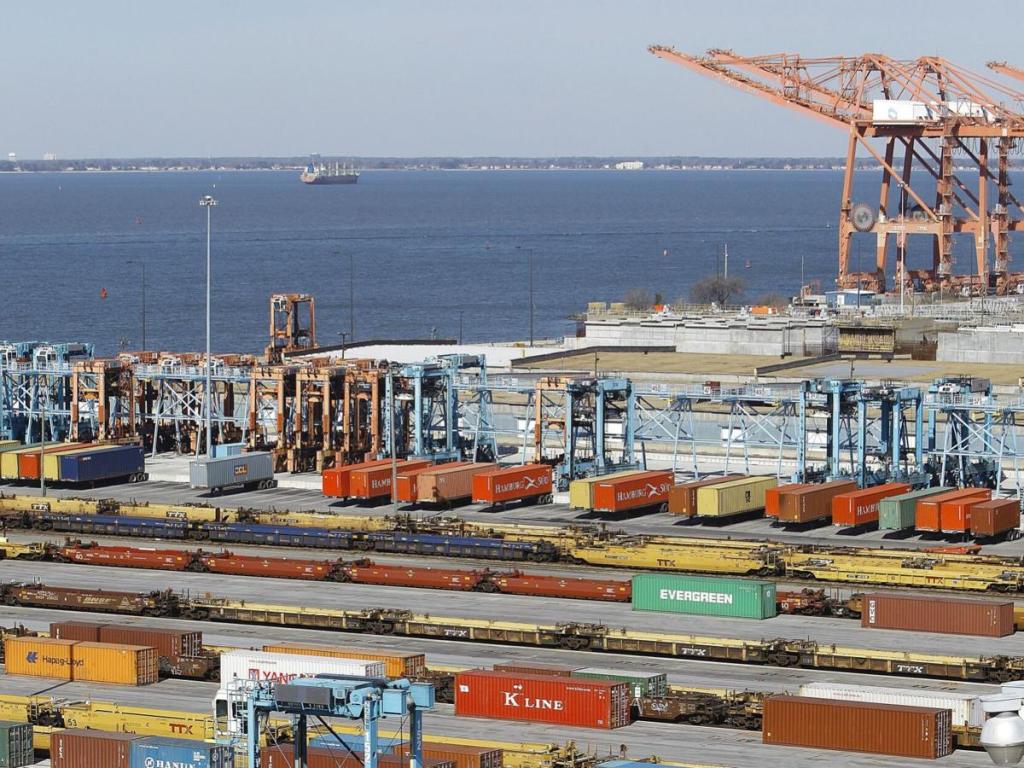
With 95 percent of the world’s population and 76 percent of the planet’s gross domestic product outside the U.S., the commonwealth – with its state-of-the-art marine terminals and deep-harbor channels – is best positioned for global trade. Norfolk International Terminal (NIT) and Virginia International Gateway are modern, state-of-the-art facilities and together make Virginia the fifth largest container port in the country, and one without supply-chain backups. Offshore wind interests are leasing land at the state-owned, but long vacant, Portsmouth Marine Terminal. More supply-chain firms are on the way to service Dominion Energy’s Coastal Virginia Offshore Wind project off Virginia Beach and others along the East Coast.
Many nations are looking to America to manufacture goods, including ones that the pandemic has highlighted, like pharmaceuticals, PPE, medical devices and supplies, in addition to agriculture and electronic products.
For example, new federal policies are encouraging the establishment of new chip-manufacturing facilities to counter China’s competition.
The Shenandoah Valley, Southside and Roanoke/New River/Lynchburg, in particular, are export anxious. However, they require the support of elected officials in denser Northern Virginia, Central Virginia and Hampton Roads. Timely funding now will bring economic development to rural areas, allowing them to better stand on their own financial feet.
The Virginia International Trade Plan, the brainchild of a bipartisan committee, is in place. Gov. Northam included funding for it in his outgoing biennium budget. We hope Gov. Youngkin, whose business bona-fides are well established, and the legislature will unite around our natural and manmade advantages and approve that funding. We also urge Richmond to advance a capital expenditure of $260 million to upgrade the north yard at NIT, to complement an earlier expansion of its south one.
With his experience in global investment, Gov. Youngkin surely understands the critical interconnection of state economic development and the global economy. It’s important for him to lead foreign-trade missions, to build political and popular support, and to urge General Assembly action to promote trade and foreign investment.
As we begin 2022 with a fresh set of elected leaders, let’s unite and right the ship, so to speak, and make Virginia the gold standard in international commerce. With the 12th largest population and 13th biggest gross state product (GSP) in the nation, Virginia should not be 41st and 44th in the nation in exports per capita and exports as a share of GSP, respectively.
Milliken is a former Virginia Secretary of Transportation and current chairman of the board of the Virginia Port Authority. Malawer is Distinguished Service Professor of Law and International Trade at George Mason University. Each serves on the bipartisan Virginia International Trade Advisory Committee.
Update on Virginia Trade — Doing Really Well — Need to be Global for a Thriving State Economy.
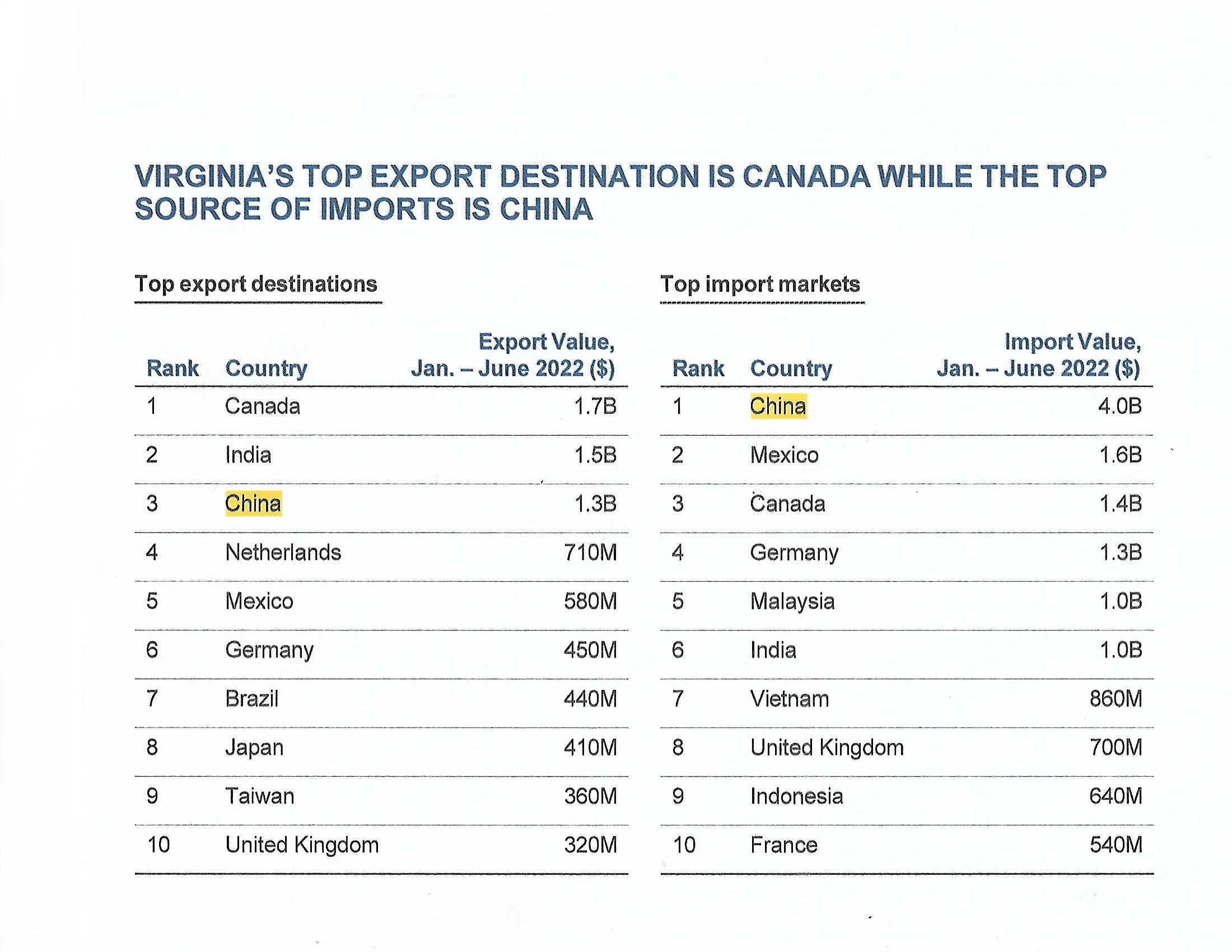
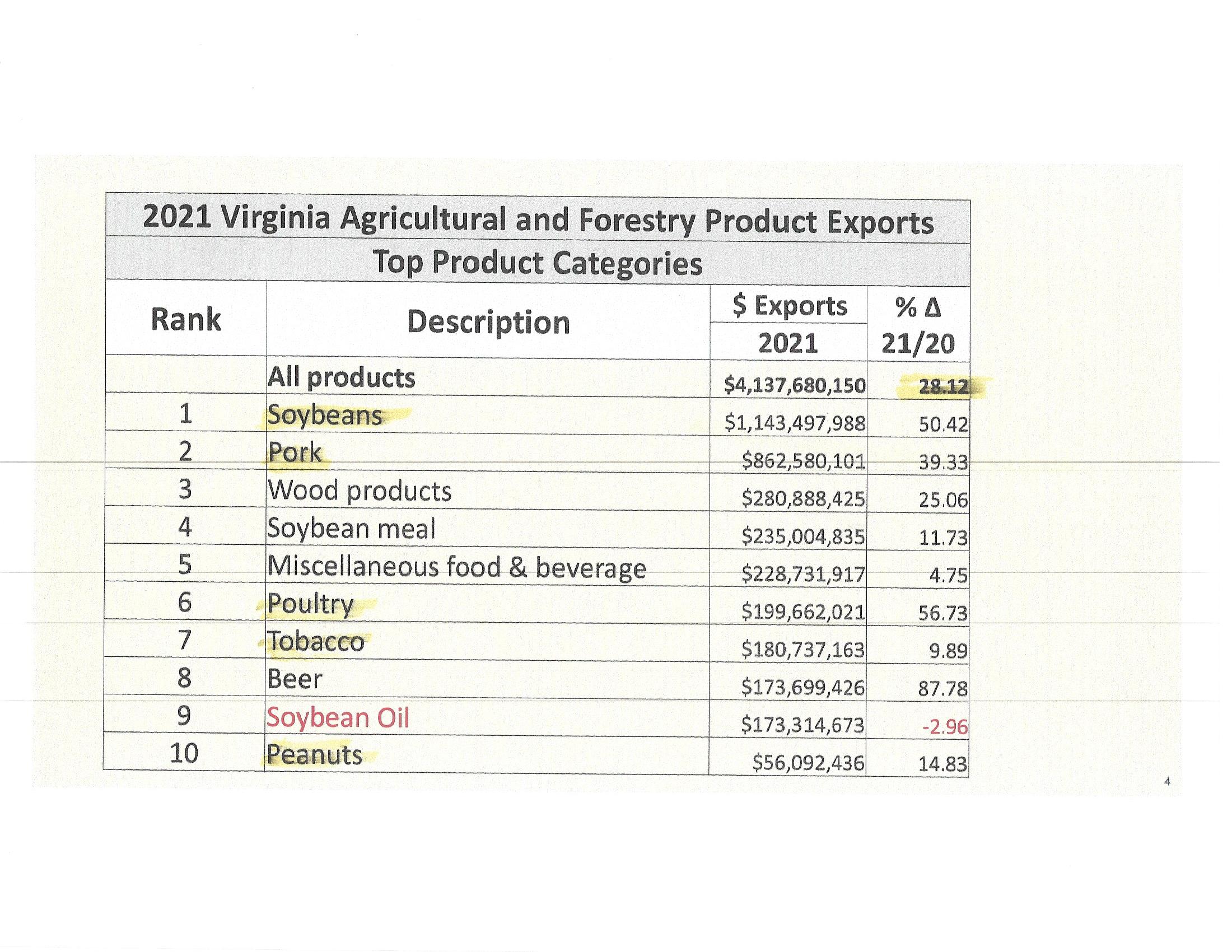
China is Virginia’s third largest export market and is largest importer into Virginia. Virginia’s agricultural exports have increased year-over-year. (Major export commodities — soybean, pork, poultry, peanuts and tobacco.) So, what can be said? You need to be global to have a flourishing state economy. Trade with China is important, but Virginia transactions are broad and throughout the world. (Charts below are from the Virginia Economic Development Partnership and the Virginia Dept. of Agriculture.)
Chinese Farm Purchases in U.S., U.S. Outward Investment Controls and U.S. Audits of Chinese Firms — Issues Obscured by Global Politics but Crucial.
Three Important China Trade Issues, not well known. Obscured by global politics. But these are critical. (1) Chinese purchase of farmland under 1978 Agricultural Foreign Investment Disclosure Act. (2) Restricting outward investment to China. (3) Requiring audits of Chinese listed firms on US public markets.
To be competent in understanding and conducting global commerce and trade today it is essential to understand not only the global and national security issues, but U.S. regulatory ones. To me, these business and trade transactions are often in apparent conflict with the broader political trends in the U.S., but sometimes not. Business has a way of going its own way. Nevertheless, these transactions and issues are subject to broader national and international politicization of commercial relations.
A good piece appeared in the Wall Street Journal today as to one of the above issues — foreign (Chinese) purchase of U.S. farmland. Here are a few excerpts:
- U.S. Department of Agriculture data show that Chinese ownership of U.S. farmland leapt more than 20-fold in a decade, from $81 million in 2010 to $1.8 billion in 2020. Beijing hasn’t outlined a strategy, but large-scale state backing for these investments indicates there is one.
- We don’t know the full extent of Chinese investment in American farmland. Farm sales are disclosed under a little-known 1978 law called the Agriculture Foreign Investment Disclosure Act, or Afida, which requires investors in American farmland to report property purchases to the USDA.
- Then there’s the problem of complex corporate structures that help Chinese investors obscure ownership and evade scrutiny.
- The U.S. has recently imposed sanctions against Chinese tech firms such as Huawei and Megvii as threats to national security. These successes offer a few lessons.
- Congress should authorize the USDA to cut through byzantine ownership structures and find the true foreign owners of farmland. The recently introduced Farmland Security Act of 2022 would require the department to release all data on foreign investments in American agriculture.
- The agriculture secretary should be added to the Committee on Foreign Investment in the U.S., which reviews flows of foreign money into sensitive businesses such as surveillance-camera equipment and semiconductors.
One additional comment. The Biden administration’s trade policies as of today are non-trade or untrade policies. Its push for the Indo-Pacific Economic Framework (IPEF) is merely a cover for not signing the revised Trans-Pacific Partnership. The administration is not proposing any new tariff actions nor market access arrangements. But focusing on promoting non-trade domestic political interests.
“China is Buying the Farm.” Wall Street Journal (Sept. 9, 2022).
A New Globalization is Emerging — Now What?
Historical challenges have recently arisen attacking “globalization.” These challenges to traditional U.S. trade policy come from the liberal, conservative, protectionist and national security communities in the U.S. This development has been supercharged by the global pandemic and Russia’s invasion of the Ukraine, with China looming over this debate. A recent article in the Financial Times raises similar concerns worldwide. This is now a critical new development in U.S. politics, where trade has become a toxic topic and there has been, in fact, a convergence of views of the two major political parties. We’ll see how this develops. To me, this definitely represents a major change in the political ecosystem as to all issues of trade and investment in this decade. Clearly the era of post-War and post-Cold War globalization is changing. Here are some excerpts from the Financial Times article:
- Rising nationalism, is threatening the dense network of economic ties built up over the last three decades. The enemies of globalization can be found across the political spectrum, from the nationalist right to the anti-capitalist left. Over the past two years, the pandemic and the Ukraine war have demonstrated how vulnerable international trade is to unexpected shocks.
- A decade ago, protectionism was still a dirty word in US politics. But the Trump administration started a trade war with China and the Biden administration has kept the tariffs in place. A bipartisan consensus in the US is now pushing for policies to reduce economic dependence on China and to repatriate key industries.
- The invasion of Ukraine has not just made it seem imprudent to rely on political rivals for key economic inputs, it has also allowed the west’s national security establishment to seize the moral high ground from the free traders.
- The US has long had rules that can restrict inward investment on national security grounds. The Chips Act creates new rules that will restrict outward investment, discouraging US firms from making semiconductors in China.
- National security hawks believe that globalization meant that the western democracies naively sponsored the rise of hostile rivals such as Russia or China. Leftwing critics associate the “neoliberal” era of globalization with widening inequality and environmental degradation.
“Enemies of Globalization.” Financial Times (August 31, 2022).


You must be logged in to post a comment.