Resource Nationalism and Nationalization in Latin America? — Will this lead to a Trade War?

Three Questions: Is resource nationalism and nationalization back in Latin America? Will this cause a trade war? What will foreign investors do in light of these developments?
 Here are some recent trade and investment items:
…. Argentina expropriated the Argentine subsidiary YPF of Spain’s Repsol.
…. Bolivia expropriated the Spanish owners of TDE (electricity transmission).
…. The EU warns Argentina that the foreign investment of European companies is fully backed by the EU and warns of a trade war over nationalization.
…. This same warning is intended implicitly to go to Bolivia also, obviously.
…. Yet, Brazil is welcoming Sovereign Wealth Fund investment from Abu Dhabi (Mubadala Development Company)  into its leading commodity and shipping conglomerate (EBX).
What are the lesson here? Very easy …………..
…. Nationalization is coming back into style in some Latin American countries where economic development has lagged.
…. This may lead to serious global trade disputes.
…. These disputes may eventually be heard by the WTO and the World Bank (ICSID).
…. This is the obviously linkage between financial investments and the trade system.
…. Unfortunately, the WTO does not have juridical competence over international financial disputes.
…. But still foreign investors persist in a market that is dynamic and growing.
…. Brazil is growing. Bolivia and Argentina are basket cases.
…. Bad economies make for bad investment environments.
…. This general situation in Latin America needs to be closely monitored as the global economy increasingly struggles. Hopefully, this will not be the start of a global trend.
Posted in Global Trade Relations | Tagged , , , , , , , , , , , , , , , , | Leave a comment

Tax Havens, Foreign Corruption and Bank Secrecy — One Big Global Problem — Better U.S. Corporate Oversight Needed.

Recent developments concerning disclosure of Apple’s alleged sheltering of $7 trillion dollars in offshore tax havens and Wal-Mart’s foreign bribery scandal in Mexico raise three inter-related issues: tax havens, foreign corruption, and offshore banking secrecy.
Together these issues  feed into grave global problems concerning illegal financial transactions, funneling funds to outlaw states and non state actors, providing cover for massive investor fraud, and financing transactions impacting fiscal stability of the global financial system.
What is the solution? In part the solution is to adopt more aggressive U.S. legislation applicable to U.S. and foreign firms in their conduct of international transactions.
This legislation should provide for more corporate financial transparency and general disclosure. This would assist in the greater enforceability of corporate law and corporate responsibility globally. This more stringent U.S. legislation is in the economic and national security interests of the United States as well as in the interests of U.S. investors and corporations.
This national approach does not rule out global and multilateral efforts by the OECD, G-20, G-8 or others, but those take time. Unilateral actions by the United States in this economic and business spere are warranted.
The global community will follow our lead, eventually. Just look at the way U.S. policies (the enactment of the Foreign Corruption Practices Act) toward global corporate corruption in the late 1970s led to international action by the OECD in the late 1990s. The same is happening to a limited degree now concerning the tough U.S. financial and tax policies toward Switzerland, UBS and Credit Suisse.
Enron, Bernie Madoff, the Great Recession and now Apple and Wal-Mart make tax havens, foreign corporate corruption and global bank secrecy simply intolerable in this ever-globalizing world. Not only do they distort global trade flows they also negatively impact the U.S. domestic system and those of other countries.
It’s good policy and good law for the United States to legislate good corporate behavior and to enforce vigorously corporate responsibility globally.
Posted in Global Trade Relations | Tagged , , , , , , , , , , , , , , , | Leave a comment

Global Taxation of High-Tech Firms — States, Federal Government and Foreign Countries are Losers.

Apple is the latest high-tech corporation targeted by the press for its aggressive tax strategies that leave states, the federal government and foreign countries with less tax payments than from traditional corporations such as Wal-Mart.

Apple routes its transactions trough no-income tax states such as Nevada as well as low-income countries globally. This is made more possible because of the digital nature of its products and intangible income (such as license fees).

The impact is not only on the U.S. and other countries but on cash-strapped states facing budget stress. “How Apple Sidesteps Billions in Taxes.” New York Times (April 29, 2012).

The question that emerges is whether or not the issue of global taxation of multinationals will become a serious issue this election season.

This is a serious question of corporate tax policy.  The issue of global taxation of multinationals raises the general issue of corporate responsibility owed to states and countries where companies do business. 

Global tax avoidance by high-tech multinationals and others impact local governments and national governments. The policy solution calls for new U.S. legislation and global cooperation (G-20 and OECD) to attack tax havens and bank secrecy responsible for distortion of tax and income flows. 

Will the presidential nominees and Congress confront this issue this year or next? Not very likely, but perhaps.

Posted in Global Trade Relations | Tagged , , , , , , | Leave a comment

Wal-Mart and Global Corporate Bribery — It’s about Our Values, Economic Development and U.S. Global Leadership.


Wal-Mart is the latest multinational corporation now facing allegations of  illegal payments to foreign government officials. This raises issues of corporate responsibility, economic growth, our values, and U.S. global leadership.
This case involves questionable corporate payments under both U.S. and Mexican law by Wal-Mart to help expand its stores in Mexico. Other recent allegations, among many others,  involve bribing Chinese officials to allow U.S. films to be shown and by U.S. firms to promote real estate investments in China.
“Wal-Mart Covered Up Bribery, Report Says.Washington Post (April 22, 2012); Vast Mexico Bribery Case Hushed Up by Wal-Mart.New York Times (April 22, 2012); “Wal-Mart Corruption in Mexico.” (CNBC video April 23, 2012).
Enacted in 1977 the FCPA makes it unlawful to bribe a foreign government official to obtain or retain business. U.S. parent corporations may be liable for their foreign subsidiaries. In 1998 the legislation was extended to foreign corporations within the U.S. 
You have criminal fines and disgorgement of profits. People go to jail. Indictments alone can lead to a prohibition of doing business with the federal government. Convictions can lead to a prohibition of getting export licenses. Private actions under RICO can lead to treble damages.  These are very unpleasant sanctions that can kill a corporation
Justice Department prosecutions under the Foreign Corrupt Practices Act(FCPA) have grown greatly under both the Bush the Obama administrations, justifiably so. The U.S. Chamber of Commerce has been aggressive in trying to change the foreign corruption law.
Many others have argued that nothing should be done to make the U.S. less than a leader, as it is now, in the ethical conduct of international business. In fact, they argue that the law should be broadened. ”Bribing Foreign Officials.Washington Post (2.27.12).
The OECD has multilateralized the earlier unilateral approach of the U.S. from the post-Watergate era. The OECD Convention was based upon the FCPA. That action by the OECD in a sense validated the earlier U.S. unilateral action in this sphere of global trade relations and international economic politics. In fact, the 1999 OECD Convention in many ways is even stronger and broader than the FCPA.
The OECD claims most major countries as  signatories to the anti-bribery convention, now including the Russian Federation. While India and China are not signatories they have participated in the OECD deliberations. The U.K. and South Africa have recently adopted new domestic legislation concerning foreign corruption. 
There seems to be a global convergence of norms concerning global business bribery, based upon the OECD and the earlier U.S. legislation. This convergence weakens significantly the position of those, for example the U.S. Chamber of Commerce, who contend that enforcement of U.S. law would restrict the competitiveness to U.S. firms doing business globally.
It is important to note that the federal legislation was enacted after various states had adopted their own international commercial bribery laws or expanded the common law notion of commercial bribery. This shows the interesting nature of federalism and the role of states in global trade, as often being a head of the federal government in confronting global obstacles.
The passage of the FCPA was a great success story for the U.S. view of  the necessity of ethical international transactions. In fact, the OECD is now pressuring the U.S. to further limit its “facilitation exception,” which U.S. courts have already done to a significant degree.
So the question is will there be a federal investigation and prosecution of these latest allegations of bribery and corruption by a U.S. multinational abroad?
And what about U.S. firms in China, India and elsewhere?
For a good review of FCPA cases (2007-2011), countries and companies involved see my recent collection of charts and excerpts from the USDOJ document (“Lay Person Guide“). Malawer, “Corrupt Practices Prosecutions.” (April 2012). See also the Lay Person Guide from the USDOJ.
 These  documents indicate the absolute aggressive prosecutions by the USDOJ, extensive extraterritorial application of FCPA, and the huge criminal fines involved.
At the bottom of all this is the broader question of the responsibility of corporations in both the U.S. and the global system. It’s really about values and who we are.
Is the United States exceptional or isn’t it? U.S. firms have refused to pay bribes and U.S. global commerce has expanded exponentially over the last few decades.
Wal-Mart and others may will begin to see the domestic consequences of their overseas criminal or almost criminal actions. Shareholders will most likely start to hold ineffectual board members responsible. Whistleblower and shareholder litigation is always possible and the “business judgment rule” may not always be a viable defense. Hopefully, some board members may even be energized to become proactive  to implement their statutory and fiduciary duties. 
Domestic government agencies, both local and national, may well become more vigilant tin assessing the corporation’s business proposals and activities. Global actions have domestic consequences.
Once your brand or reputation is ruined, it is ruined. You don’t want to be known as the Enron of retailing. You don’t want ever to link the name Wal-Mart with Watergate. It isn’t a good idea.
The fact is that most people and governments around the world understand the insidious and dysfunctional nature of both domestic and international bribery at all levels.  Bribery has a terrible impact on economics development and true economic competitiveness.
The issue of corporate bribery in international transactions is an area that the U.S. should retain its global leadership and move forward aggressively.
Posted in Global Trade Relations | Tagged , , , , , , , , , , , , , , | Leave a comment

Wal-Mart and Foreign Corruption — Where is the Corporate Responsibility; Where is the Federal Prosecution?

Wal-Mart is the latest multinational corporation now facing allegations of  illegal payments to foreign government officials.

 This case involves questionable corporate payments under both U.S. and Mexican law by Wal-Mart to help expand its stores in Mexico.

 “Wal-Mart Covered Up Bribery, Report Says.Washington Post (April 22, 2012);  “Vast Mexico Bribery Case Hushed Up by Wal-Mart.New York Times (April 22, 2012); “Wal-Mart Corruption in Mexico.” (CNBC video April 23, 2012).

Justice Department prosecutions under the Foreign Corrupt Practices Act(FCPA) have grown greatly under both the Bush the Obama administrations, justifiably so. The U.S. Chamber of Commerce has been aggressive in trying to change the foreign corruption law.

Many others have argued that nothing should be done to make the U.S. less than a leader, as it is now, in the ethical conduct of international business. In fact, they argue that the law should be broadened. “Bribing Foreign Officials.Washington Post (2.27.12).

So the question is will there be a federal investigation and prosecution of these latest allegations of bribery and corruption by a U.S. multinational abroad? And what about U.S. firms in China and elsewhere?

For a good review of FCPA cases (2007-2011), countries and companies involved see my recent collection of charts and excerpts for the USDOJ document (“Lay Person Guide“). Malawer, “Corrupt Practices Prosecutions.” (April 2012). These  documents indicate the absolute aggressive prosecutions by the USDOJ, the extensive extraterritorial application of FCPA, the huge fines and countries involved.

At the bottom of all this is the broader question of the responsibility of corporations in both the U.S. and the global system. It’s really about values and who we are.

 The fact is that most people and governments around the world understand the insidious and dysfunctional nature of bribery at all levels and its terrible impact on economics development.

Posted in Global Trade Relations | Tagged , , , | Leave a comment

New Model Bilateral Investment Treaty — Upholding International Law and Good for U.S. Firms.

The USTR released the revised 2012 model of the “Bilateral Investment Treaty.” This is the first revision since 2004 during the Bush administration. It builds on the traditional position of the U.S. toward investment treaties and builds upon it.

 It contains important policy changes and policy positions.  “U.S. Concludes Review of Model Bilateral Investment Treaty.USTR News (April 20, 2012). “Text of Model BIT Agreement.” (USTR 2012).

For example, it includes new provisions concerning the environment (Article 12) and labor (Article 13). Most importantly, it reaffirms the primacy of customary international law concerning minimum standards for treatment of foreign corporations and expropriations (Annex A and Annex B).

 In particular, it confirms that customary international law “results from a general and consistent practice of States that they follow from a sense of legal obligation … (and that the customary international law minimum standard of treatment of aliens refers to all customary international law principles that protect the economic rights and interests of aliens.”

This reaffirmation is particularly noteworthy in describing the U.S. adherence to customary international law and its methodology. This revised model is particularly important to encouraging a more open and liberalized global investment environment.  This is a great benefit for U.S. firms.

Posted in Global Trade Relations | Tagged , , | Leave a comment

The Supreme Court and International Law — An Unclear Future …..

The Supreme Court ruled yesterday that the “Torture Victim Protection Act of 1991” only applies to individuals and not corporations. (Mohamad v. Palestinian Authority). This was based on the interpretation of the term “individuals.” This was a technical but a correct decision by Justice Sotomayor. This leaves corporations and other foreign actors off the hook for acts of foreign torture.
The Supreme Court previously asked for additional briefs in Kiobel v. Royal Dutch Petroleum. It wants to consider  whether under the Alien Tort Statute anyone at all can be sued for violating international law when the actions occur outside of the United States.  This is even though the “Supremacy Clause” declares treaty law as the supreme law of the land and prior Supreme Court decisions have held the customary international law to be part of our law.
This latest case has the potential of being the most troublesome. It could finally provide an opportunity for the conservative justices to aggressively apply their well-know antagonism toward all things international law.
In the long run one saving grace is that the Congress can amend the two above existing statutes to allow the application of international law to foreign acts of terrorism and human rights violations.
But given the deadlock in the Congress I wouldn’t count on this anytime too soon. That’s why there is a big murky cloud over the role of the U.S. in promoting international law.
Posted in Global Trade Relations | Tagged , , , , , , , | Leave a comment

Promoting Services and Protecting Intellectual Property Rights — Three Important Developments (TPP, Notorious Markets and ACTA).

The USTR Ron Kirk argues in the Wall Street Journal today that the Obama administration believes the service sector can do more business abroad. He argues that’s why the Trans-Pacific Partnership negotiations focuses on services and investment as its cornerstones. “Rethinking ‘Made in America’.” Wall Street Journal (April 18, 2012).

This is also why the USTR started to publish, in 2010, “Notorious Markets” separate from the annual Special 301 reports. This report focuses on identifying physical and Internet marketplaces where infringing goods and services are sold. The most recent report was released in December 20, 2011. “Results of Special 301 Review of Notorious Markets.” USTR News (December 20, 2011) and “Review of Notorious Markets.” USTR Release (December 20, 2011).

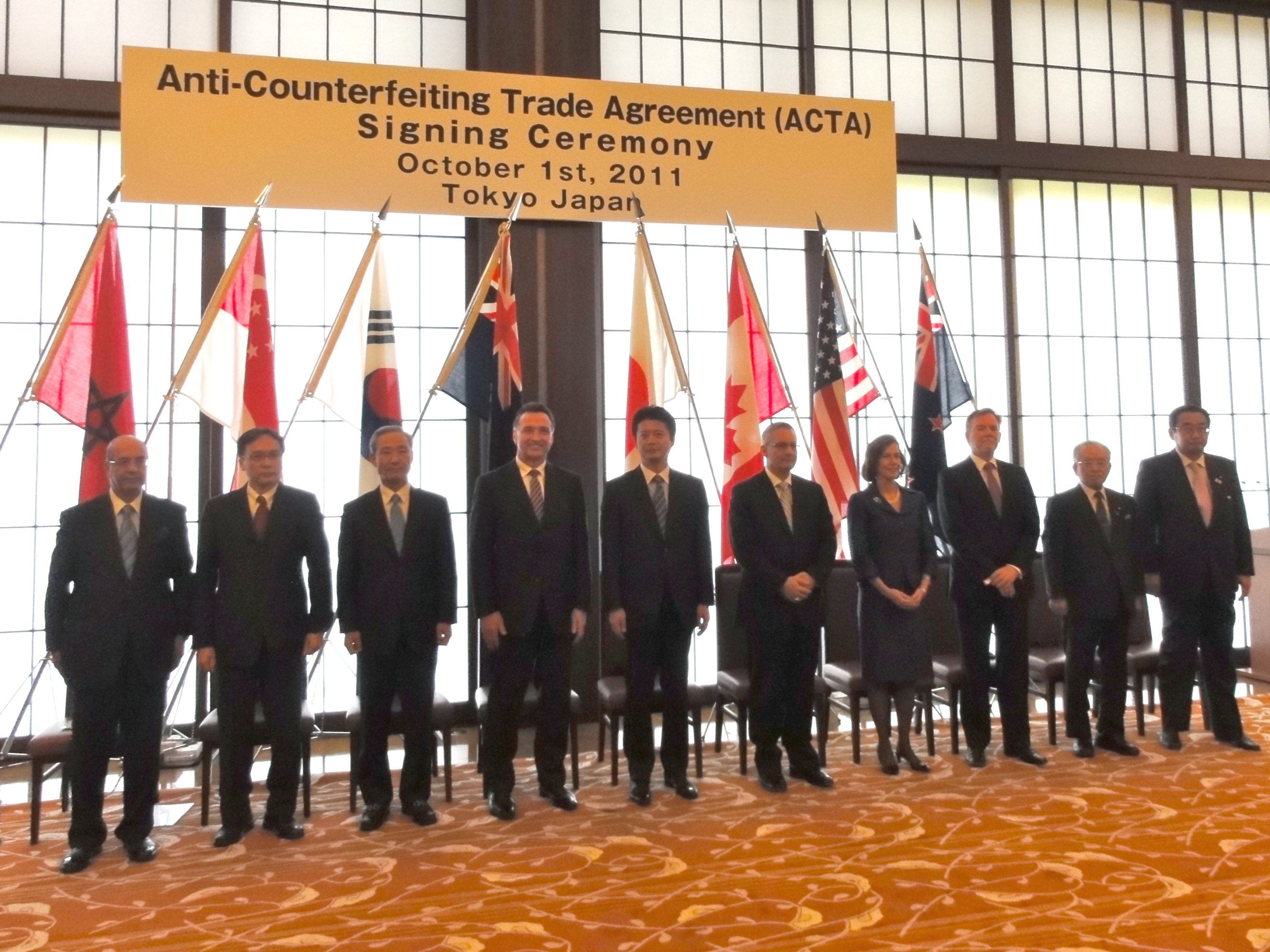
The plurilateral agreement, the Anti-Counterfeiting Trade Agreement (ACTA)was signed in October 2011.  Its aim is to further enforcement of intellectual property rights. ”ACTA attempts to deepen international cooperation. This agreement will come into force when additional diplomatic steps are taken. ACTA (USTR website).

Posted in Global Trade Relations | Tagged , , , , , , , , | Leave a comment

U.S. Extraterritoriality and Corporate Governance and Global Transactions — More Aggressive U.S. Action.

Here’s a presentation and a PowerPoint I gave recently concerning the extraterritorial application of U.S. international economic legislation and regulation impacting a wide variety of  U.S. international transactions.
Areas concern, foreign corruption, reexport controls, trade sanctions, foreign tax and banking disclosures, antitrust price-fixing, foreign boycotts, and corporate governance (Sarbanes-Oxley and Dodd-Frank).
The importance of this is often illustrated by the failure of many of our multinational firms, especially high-tech ones relying upon intangible transactions involving patent and licensing fees, from paying corporate taxes due to their global transactions being routed through multiple tax havens.
The list grows as does aggressive U.S. enforcement actions. These are parallel to stronger enforcement actions in the world of import remedies and market access by the Obama administration.
Malawer, “Extraterritorial Rules of the Road.” (2012).
Posted in Global Trade Relations | Tagged , , , , , , , , | Leave a comment

Unilateral Action and Changing International Rules — Reagan and Obama — An Untold Story.

Recently gave a short presentation on Eric Holder’s legal defense of the Obama administration’s policies concerning military commissions and targeted killings. But my main point was how unilateral actions by the U.S. can help change outdated international law rules. In fact, there is an untold story here that links President Reagan’s foreign policies challenging international law with those of President Obama’s.
But this is somewhat at odds with President Obama’s focus generally on legal rights and responsibilities of states, preference for developing institutional linkages globally, and support of multilateral institutions.
The above seems to be core aspects of President Obama’s underlying approach for his evolving architecture for global  governance and foreign policy-making. This approach stems from his law school teaching and realpolitik as a politician and national executive in charge of foreign policy, military affairs, and national security
President Obama’s emphasis on developing domestic and international law in light of the national interests of the U.S. in the post-Cold War and post-9/11 eras is a continuing story — with more interesting developments to occur, most likely. Law always needs to develop to take account of a wide-range of newer realities and in context of our underlying values.
 Malawer, “Changing International Law to Conform to Newer Global Realities & National Interests — From Reagan to Obama — The Untold Story.”  (April 4, 2012).
Posted in Global Trade Relations | Tagged , , , , , , | Leave a comment