







RSS Feed
-
Recent Posts
- More Trump Threats — Expanding the Tariff & Trade Wars — Useless?
- Trump’s New Tariff & Trade War — More Useless Threats?
- Tariffs Refunds, New Trump Tariffs and More Litigation.
- Update: New Trump Trade War — Another Useless War.
- New Trump Trade War — Just What We Need — Another Useless War — What About the Midterms?
Archives
- August 2026
- July 2026
- June 2026
- May 2026
- April 2026
- March 2026
- February 2026
- January 2026
- December 2025
- November 2025
- October 2025
- September 2025
- August 2025
- July 2025
- June 2025
- May 2025
- April 2025
- March 2025
- February 2025
- January 2025
- December 2024
- November 2024
- October 2024
- September 2024
- August 2024
- July 2024
- June 2024
- May 2024
- April 2024
- March 2024
- February 2024
- January 2024
- December 2023
- November 2023
- September 2023
- August 2023
- June 2023
- April 2023
- March 2023
- February 2023
- January 2023
- December 2022
- November 2022
- October 2022
- September 2022
- August 2022
- July 2022
- June 2022
- May 2022
- April 2022
- March 2022
- February 2022
- December 2021
- October 2021
- August 2021
- June 2021
- May 2021
- April 2021
- February 2021
- January 2021
- December 2020
- November 2020
- September 2020
- August 2020
- July 2020
- June 2020
- May 2020
- April 2020
- March 2020
- February 2020
- January 2020
- November 2019
- September 2019
- June 2019
- April 2019
- January 2019
- November 2018
- October 2018
- September 2018
- June 2018
- May 2018
- March 2018
- February 2018
- January 2018
- December 2017
- November 2017
- October 2017
- September 2017
- August 2017
- July 2017
- June 2017
- May 2017
- April 2017
- March 2017
- February 2017
- January 2017
- December 2016
- November 2016
- October 2016
- September 2016
- August 2016
- July 2016
- May 2016
- April 2016
- March 2016
- February 2016
- January 2016
- December 2015
- November 2015
- October 2015
- September 2015
- August 2015
- July 2015
- June 2015
- May 2015
- April 2015
- March 2015
- February 2015
- January 2015
- December 2014
- November 2014
- October 2014
- September 2014
- August 2014
- July 2014
- June 2014
- May 2014
- April 2014
- March 2014
- February 2014
- January 2014
- December 2013
- November 2013
- October 2013
- September 2013
- August 2013
- July 2013
- June 2013
- May 2013
- April 2013
- March 2013
- February 2013
- January 2013
- December 2012
- November 2012
- October 2012
- September 2012
- August 2012
- July 2012
- June 2012
- May 2012
- April 2012
- March 2012
- February 2012
- January 2012
- December 2011
- November 2011
- October 2011
- September 2011
Categories
Meta
-
State Incentives for Economic Development — Corporate Welfare? The Debate We Haven’t Had — Any Federal or International Legal Issues? Maybe.
The New York Times recently published a series of front-page articles on state and local incentives and economic development. This series was the culmination of a 10-month investigation into economic incentives awarded by hundreds of cities, counties, and states.
Perhaps the most invaluable contribution of the series is its extensive interactive databases about the companies, states, and sectors involved, including per capita expenditures, percentage of state budgets going to incentives, and an extensive listing of the types of incentives (tax refunds, loan guarantees, tax credits, and more).
Article # 1 — “Companies Seek Tax Deals.” New York Times (December 2, 2012).
Article # 2 — “Texas and Industry Bonanza.” New York Times (December 3, 2012).
The New York Times investigated several recent high-profile cases from Michigan to Texas. It concluded that there is a significant degree of cronyism involved in awarding these incentives, and they place a large drain on state and local budgets, often without much to show for themselves.
The articles highlight the lack of a national debate on this widely used approach to economic development during the ongoing economic crisis.
While focusing on the political and business aspects of incentives and not as much on economic theory or historical cases, this series emphasizes one topic that has been argued over through the years: Whether these incentives represent “beggar-thy-neighbor” policies, corporate welfare and if they come at the expense of other priorities, including improving workforce training and developing better employment conditions, such as wages and benefits.
The New York Times series contend that long-term benefits may be at least as likely to come from investing in public universities and infrastructure projects as from supporting corporate relocations. That large corporations have the ability to lobby for declining tax dollars and then follow the best incentive offers where they may appear.
There is a broad range of state and local incentives, including among others: corporate income tax credit, state tax refunds, various tax exemptions (for example, local personal property and property taxes), cash grants, loans and loan guarantees.
To me state incentives need to be carefully assessed in terms on competing economic interests, expected outcomes, and measurable metrics.
One needs to delineate between state support of domestic corporate relocations and foreign ones. One needs also to consider state support of export promotion, especially of small and mid-size firms, as distinct from corporate relocation.
Unfortunately, in 2006, the Supreme Court declined an opportunity to rule on the use of state incentives for economic development under the interstate and foreign commerce clause. This, however, really is a major issue of federalism that needs to be decided by the courts.
The extensive interactive data sets in the New York Times series can let policy makers assess and compare the impact of economic and fiscal incentives on state budgets, taxes, and corporate policies, including relocation and expansion. For example, they make clear the relation of incentives to actual job creation.
It should be emphasized that this debate is particularly important when comparing the value of incentives for corporate relocation within the United States against that of recruiting new foreign direct investment into the United States (“Greenfield investments”).
Is there a more valid reason to offer economic incentives to foreign companies not located here than to firms already located in the United States? Is it preferable to fund export promotion rather than domestic corporate relocation and thus avoid the beggar-thy-neighbor dilemma?
By the way, the World Trade Organization (WTO) recently ruled that state and local incentives given to Boeing in the state of Washington are illegal subsidies that violate U.S. global trade obligations.
I look forward to more rigorous assessments of state incentives and economic development in our rapidly globalizing and hyper-competitive world. Taxpayers and society deserve closer government and public scrutiny of these state programs in order to support more sustainable economic development.
From my personal observation, as a board member of the Virginia Economic Development partnership, the range of incentives available in Virginia, at both the state and local levels, are an essential element of economic development. This along with a favorable regulatory business environment constantly drives Virginia to be ranked as one of the most business friendly states in the United States. One that leads in job creation.
Virginia state incentives are definitely free of the political cronyism that The New York Times reported on in Texas.
Proper procedures, continuing oversight, specific performance metrics, and constant evaluation are essential to successful state actions in awarding and monitoring a broad range of state incentives aimed at economic development and job creation.
Earlier post discussing similar issue ………….. Malawer, “State Incentives and Global Trade.” (January 9, 2012).
Posted in Global Trade Relations
Tagged cronyism and state incentives, infrastructure investments, large corporation lobbying, legality of state incentives, management of state incentives, metrics and state incentives, property tax abatement, public works investment, range of state and local economic incentives for economic development, sales tax reduction, state and local incentives, state and local subsidies, state incentives and economic development, state incentives data bases, state incentives or corporate welfare, state universities and state support, Texas state incentives, transparency and state incentives, types of state and local incentives, Virginia economic development, WTO and local subsidies
1 Comment
U.S. – EU Free Trade Agreement, Sovereign Debt and New Global Landscape — New DNA in Trade Relations?
Here are three items concerning the EU (and the U.S.), the multilateral trading system, and Argentina (sovereign debt restructuring) indicating how global trade issues are changing every day and how important they are to be understood by policy makers in a legal, business and political perspective.
….The WTO Director-General discusses the new DNA of the global trading system as encompassing a changing landscape of geo-political shifts and technological advances. This new world includes the emergence of a range of new state actors who are not “policy takers” but makers in a multi-polar world. He also discusses global value chains (“Made in the World“) involving trade in intermediate goods and the rise of regulations as a non-tariff barrier. This calls for new ways of measuring trade. Lamy, “Future of the International Trading System.” WTO News (November 26, 2012).
….The EU and the U.S. are in very early stages of perhaps discussing a bilateral free trade arrangement, in light of the failure of DOHA. This primarily involves non-tariff barriers (NTBs) involving the impact of regulatory actions on actual trade flows.”Trade Deal Between U.S. and Europe.” New York Times (11.26.12).
…. A U.S. federal court has held against Argentina in its sovereign debt restructuring since it did not have a “Collection Action Clause” (CAC) in its sovereign debt. This is really a simple matter of contract law and a choice-of-law clause. The court interpreted the “pari passu clause” (“on equal footing“)
to protect non-consenting bondholders — new debt cannot be senior to existing debt. “Markets: An Unforgiven Debt.” Financial Times (Nov. 28, 2012). “Sovereign Debt.“ Financial Times (11.26.12). “Courts and Argentine Brinksmanship.” New York Times (Nov. 28, 2012).
Posted in Global Trade Relations
Tagged "collection Action Clause", "pari passu" ("equal footing") clause, changes in the multilateral trading system, choice-of-law clauses, global investment, international contracts, international finance contracts, non-tariff-barriers and regulatory actions (health and safety), regulatory impact on trade transactions and trade flows, sovereign debt litigation, sovereign debt restructuring, U.S. - EU Free Trade Agreement
Leave a comment
Dramatic New Trade Developments, They Keep Happening.
Developments keep happening demonstrating how global trade is dramatically changing and encompassing a broad range of newer topics.
For example, the issue of foreign corporate corruption continues to get top treatment by the U.S. Dept. of Justice, U.S. – Russia trade relations are becoming more intertwined with human rights concerns, trade statistics and data are confronting the need for more accurate measurements of actual added values in global supply chains rather than merely relying upon the final price in the “country-of-origin approach,” and aggressive foreign bank disclosure requirements by aggressive U.S. tax collectors to limit tax evasion and bank secrecy.
The following are some recent developments ………….
…. A new detailed guide to the Foreign Corrupt Practice Act has been released by the Dept. of Justice and the SEC. A Resource Guide to the U.S. Foreign Corrupt Practices Act (USDOJ and SEC, November 2012). “Speech by USDOJ AAG on FCPA.” USDOJ News (Nov. 16, 2012) discussing “global anti-corruption mission” of criminal division.
…. One of the first acts of the lame duck session of Congress after President Obama’s reelection was the passage of a trade bill and the Magnitsky bill. This allows the U.S. to take advantage of Russia’s accession to the WTO and changes the Jackson-Vanik Amendment. But it would authorize new human rights restrictions (visa sanctions) aimed at Russia. “Lawmakers Pass Russia Trade Bill.” Wall Street Journal (WSJ 11.17.12).
…. Four new interactive databases are now provided by the WTO (ITC and UNCTAD) concerning market access. “WTO Launches New Market Access Interactive Tool.” WTO News (Nov. 19, 2012).
…. An overly extraterritorial tax regime is being imposed by the U.S. on foreign banks to report U.S. accounts or face a 30% withholding tax on income or gains to be paid to those banks from the U.S. “U.S. Offshore Crackdown Brings Planning Worries.” Financial Times (11.20.12).
State Universities and Economic Development — A New Top Priority, Long Overdue.
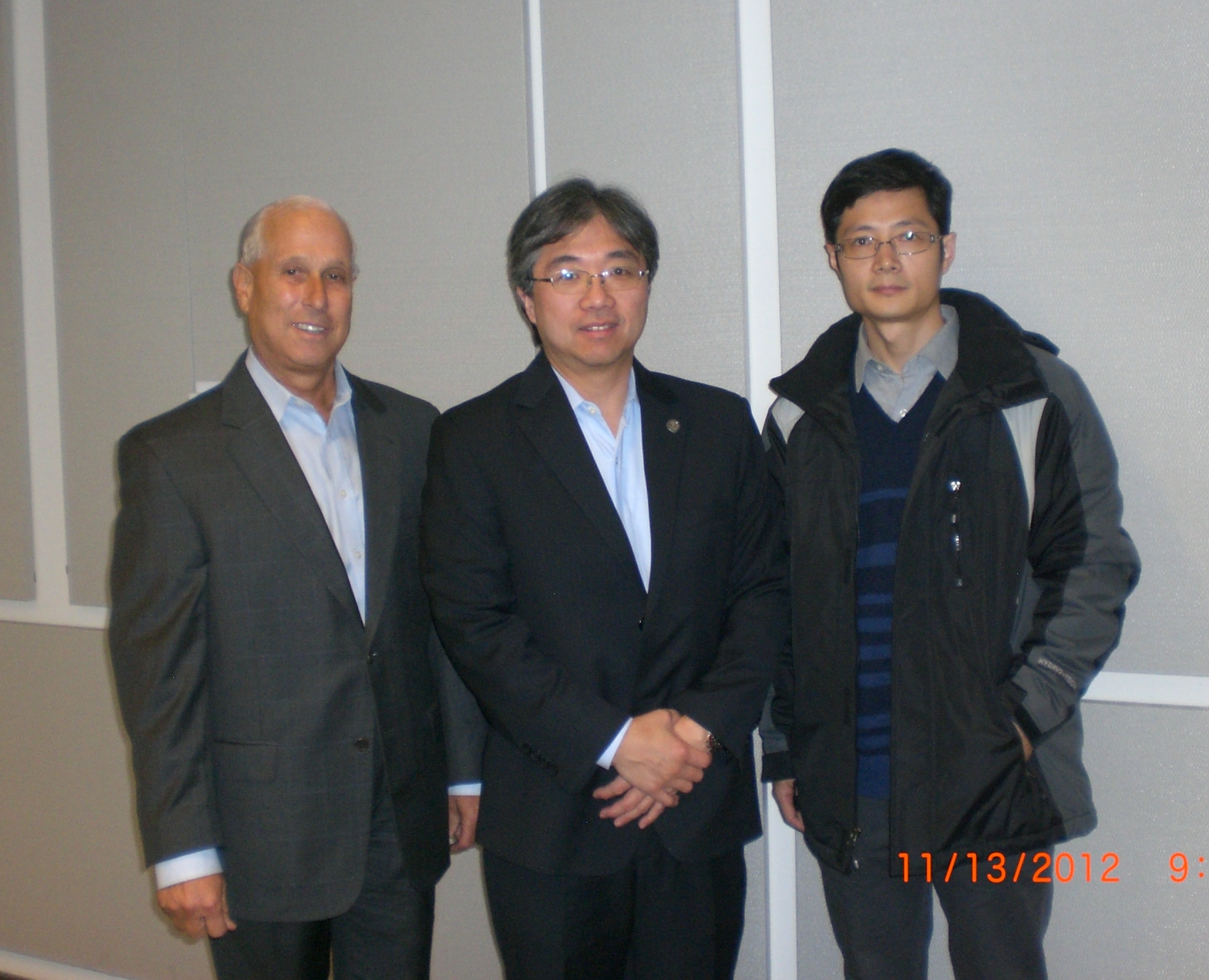
Professor Stuart Malawer (left) and Visiting Scholar Dr. Li Fenning, Wuhan University of Technology (right), with Jim Cheng, Secretary of Commerce and Trade, Commonwealth of Virginia, discussing trade and investment strategies for increasing China – Virginia commercial relations. At George Mason University (School of Public Policy) (November 2012).
State universities are beginning to acknowledge that economic development should be a critical part of their mission. Historically, land grant colleges recognized this but in reality this has not been a top priority for a long time. States are beginning to demand that public universities become more proactive in fostering economic development and job creation. Governors of many states are demanding greater accountability of public universities while searching for greater investment and business contacts worldwide.
I was glad to be able to arrange a meeting recently between a Visiting Scholar of international economic law from China here at George Mason University (School of Public Policy) and Virginia’s Secretary of Commerce and Trade. They discussed strategies to increase Chinese investment in Virginia in order to promote greater economic development and job creation. Leveraging international aspects of state universities to help foster state economic development is long overdue.
National Security and Direct Investment — Canadian Style — Same as U.S.?
Petronas, Malaysia’s state-owned oil company, is battling the Canadian government to allow its proposed $5.3bn acquisition of Progress Energy Resolution. Also waiting approval is China’s CNOOC’s proposed $15bn acquisition of Nexen, another Canadian company.
The issues raised by the Canadian government are in many ways similar to those raised by the U.S. government concerning foreign takeovers by Asian companies — there’s a potential risk to national security and economic protectionism.
To me this issue of national security and foreign direct investment raises serious concerns testing the openness of Western economies to foreign investment by foreign state-owned companies or those with ties to a foreign government, particularly those located in Asia.
In part, the answer is for the United States, Canada and others, is to require the boards of the foreign corporations to have independent directors and sufficient regulatory reporting requirements as to corporate policies, finances and identity of shareholders, to provide corporate transparency to the host state.
Trade, direct investment, economic development and jobs are increasingly dependent on these global transactions, especially those emanating from Asia and other emerging markets. They need to be encouraged and not stymied by unnecessary restrictions amounting to economomic protetionism. They could be addressed by sensible public policies addressing corporate governance and disclosure in today’s global environment.
U.S. – China Litigation in the WTO — What Does the Record Show for Obama and Bush?
U.S.-China trade relations have become a leading foreign policy and trade issue in the 2012 presidential campaign, as demonstrated by the candidates’ statements throughout the presidential debates.
What does the WTO data show?
President Obama’s administration has filed more cases against China in four years than the Bush administration did in its eight years. Obama has already filed 8; Bush filed a total of 7.
Interestingly, the Obama administration has focused on aggressively targeting China through WTO litigation.
President Obama filed 8 cases against China, out of a total of 11 WTO cases filed by his administration. President Bush’s administration filed 7 cases, out of a total of 24 WTO cases filed by his administration.
However, it is noteworthy that the Obama administration has filed fewer total WTO cases than either the Bush administration or the Clinton administration. (Obama filed 11; Bush filed 24; Clinton filed 68.) The Obama administration’s data covers only four years, not the eight years by President Clinton or President Bush. The Clinton administration’s data, in addition, only covered six years of actual WTO membership; the WTO didn’t exist until 1995.
Any conclusions?
It is clear that the Obama administration has focused forcefully on WTO litigation against China. However, its total litigations against other countries have significantly decreased. Throughout the history of the WTO, from 1995-2011, the most litigation occurred in 1997 (50 cases), and the least occurred last year, in 2011 (8 cases).
Are countries violating the global trade rules less frequently? Perhaps the decrease in filed WTO cases demonstrates a greater acceptance and better understanding of the WTO global trade rules.
Filing cases in the WTO and litigating them in that global forum is more beneficial than taking aggressive unilateral actions. It is much more likely to be effective and viewed as legitimate under the umbrella of international law as determined by an international panel.
The WTO data discloses significant trends and comparisons for serious policy discussions for the remainder of this presidential campaign and beyond.
Malawer, “U.S. – China WTO Cases — Bush & Obama Administrations Compared.” (Sept. 20, 2012).
New Trade Developments and the U.S. — Careful Examination Needed.
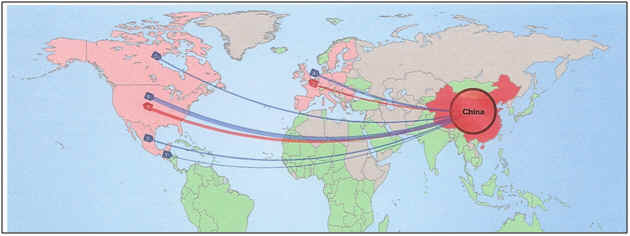
A host of new trade developments recently have raised issues of U.S. national interests, national security, foreign investment, and issues of U.S. regulations. The represent a very dynamic and fluid situation that bears carefull examination in this election season and during this global slowdown.
….. President Obama ordered a Chinese firm to divest ownership in four wind farm projects under the CFIUS legislation and national security provisions of the Defense Production Act. “Obama Orders Chinese Company to End Investment at Sites Near Drone Base.” New York Times (Oct. 28, 2012). This raises fears concerning the U.S. approach to foreign business and investment liberalization even though Chinese acquisitions in the U.S. has reached already a record high of almost $8 billion. “Blocked Project Raises Fears Over U.S. Approach to Foreign Business.” Financial Times (Oct. 2, 2012).
….. The Director-General of the WTO Lamy is not concerned about the rise of U.S.-China trade cases in the WTO. He considers increased litigation as a function of greater trade volumes. Trade friction normally increases as trade volumes increase, and litigation increases with trade friction. This is a normal process and is dealt with effectively by the WTO’s dispute resolution system, so he contends. “Lamy Dismisses Rise in in U.S. – China Disputes.” Financial Times (Oct. 1, 2012).
….. The Supreme Court previously held that the presumption against extraterritoriality (or the presumption of territoriality) was not overcome in the reading of §10b(5) fraud cases in civil actions where you have “3-F” — a foreign issuer, foreign investors and foreign trading (even if the deceptive statements were made in the U.S.). Now the issue before the Supreme Court this term is if this precedent applies to criminal cases. This rule could of course be changed by Congress. “U.S. Justice in Collision with Foreign Fraud.” New York Times (Oct. 4, 2012).
….. A new congressional report concludes that the expansion into the U.S. of Huawei Technologies and ZTE, Inc. (two Chinese telecom companies) would pose a national security threat. (But has found none so far.) This report is likely to add to tensions with China. But the report also comes from a Republican controlled committee during the presidential campaign. “China Tech Giant Under Fire.” Wall Street Journal (Oct. 7, 2012). China has of course lashed back with cries of protectionism. “Huawei Fires Back at the U.S.” Wall Street Journal (Oct. 8, 2012). (Congressional Report of Oct. 8, 2012). CNBC Video — Huawei (Oct. 9, 2012).
….. A recent Wall Street Journal op-ed attacked President Obama’s trade war with China concerning solar panels and auto exports as being derived from his cronyism. “The Dumbest Trade War.” Wall Street Journal (10.13.12).
….. This is a good pair of articles discussing China – U.S. trade and economic relations. The first argues that attacks by the U.S. presidential contenders are counter-productive and miss the real challenges. The second argues that we are in a new capitalist cold war with China and CEO’s need to overcome their taboo about speaking out against Two Articles on U.S. – China Trade and Economic Relations — Real Challenges or a New Cold War. Washington Post (10.14.12).
….. Mexico filed an action against China in the WTO concerning China’s subsidies of production and exports of clothing and textile products. Mexico argues these measures appear to involve both prohibited and actionable subsidies that are inconsistent with China’s obligations under the Subsidies and Countervailing Measures Agreement, GATT 1994, the Agreement on Agriculture, and China’s Accession Protocol. Recently Mexico has greatly increased its exports to the U.S. and is a major market for U.S. exports. “Mexico Has Filed Dispute Against China.” WTO News (Oct. 15, 2012). Mexico is supplanting China to an important degree in manufacturing exports to the U.S. because of cheaper wage costs. “Mexico: China’s Unlikely Challenger.” Financial Times (9.20.12).
….. Regulation (for example, different standards for mobile networks), private corporate restraints (antitrust violations), and tariffs all hold back trade. Generally, only tariffs and certain non-tariff barriers violate WTO rules. “Pernicious Regulations and Trade.” Financial Times (Oct. 16, 2012).
….. China is a focal point in the Romney and Obama presidential campaigns. “China and Its Trade Practices.” New York Times (10.16.12). “China Fumes Over Debate Bashing.” Wall Street Journal (10.18.12). “Better Ways to Deal with China.” New York Times (Oct. 24, 2012).
National Security and Chinese Investment — Presidential Politics?
Two recent actions by the United States, one by President Obama and another by the House Intelligence Committee raise the issue again of China – U.S. trade relations and national security.
….. President Obama ordered a Chinese firm to divest ownership in four wind farm projects under the CFIUS legislation and national security provisions of the Defense Production Act. “Obama Orders Chinese Company to End Investment at Sites Near Drone Base.” New York Times (Oct. 28, 2012). This raises fears concerning the U.S. approach to foreign business and investment liberalization even though Chinese acquisitions in the U.S. has reached already a record high of almost $8 billion. “Blocked Project Raises Fears Over U.S. Approach to Foreign Business.” Financial Times (Oct. 2, 2012).
….. A new report from the House Intelligence Committee concludes that the expansion into the U.S. of Huawei Technologies and ZTE, Inc. (two Chinese telecom companies) would pose a national security threat. (But has found none so far.) This report is likely to add to tensions with China. But the report also comes from a Republican controlled committee during the presidential campaign. “China Tech Giant Under Fire.” Wall Street Journal (Oct. 7, 2012). China has of course lashed back with cries of protectionism. “Huawei Fires Back at the U.S.” Wall Street Journal (Oct. 8, 2012). (Congressional Report of Oct. 8, 2012).
The question that obviously arises is this just election year posturing or do these actions really portend more restrictive U.S. policies toward Chinese direct investment into the U.S.?
Both these actions arise under CFIUS and are based on national security concerns. Yet, at this point no violation of national security or cyberespionage have actually been determined. Very little discussion has been held concerning the impact of these decisions on promoting jobs and a liberalized, open investment environment in the U.S.
Chinese direct investment into the U.S. holds the promise of assisting in economic development. That’s why U.S. governors from many states support aggressive policies to attract such investment from state-owned, private and Chinese investment funds. China has the money and it can help U.S. economic development. There is an unnecessary divide between Washington and the states.
The recent U.S. actions carry with them threats of a possible trade war and tougher conditions on U.S. investment and U.S. firms in China especially technology and telecom firms. To some the dispute with Huawei is really about a foreign producer that is competitive and produces good products at half the cost. The fear is that protectionism is lurking close under the surface of recent U.S. actions. If the U.S. has serious trade and intellectual property rights issues with China it should use the WTO to adjudicate them as it has many times.
Greater transparency as to corporate structure and equity ownership is needed by large Chinese firms, even private ones, especially those that have or had ties to the Chinese government. While concerns of cyberespionage for political and economic gain is to a certain extent reasonable, the solution may involve better verification by the U.S. of foreign products, foreign ownership or government influence.
Unfortunately, there is not a clear set of rules governing investment with China as there is governing trade. The WTO does not apply to foreign direct investment and there is no bilateral investment treaty with China. This situation could be addressed by the new administrations in both Washington and Beijing.
It is necessary for the U.S. to have a more balanced approach fairly assessing the many relevant factors, aside from partisan politics and grabbing of headlines. Trust is developed by mutual actions. Better, cheaper products always tend to win in the domestic and global marketplace. Foreign investment holds the promise of expanding local development. Persuasion and not unilateral actions are preferable as in all relations. Our closest allies in Europe with similar national security concerns have welcomed Huawei, ZTE and Chinese direct investment.
Let’s see what happens after the presidential election when the focus returns fully to the need to increase global trade and U.S. jobs.
Posted in Global Trade Relations
Tagged CFIUS, Chinese investment and sovereign wealth funds, Chinese state-pwner enterprises, Chinese telecom companies, foreign investment into the U.S., Huawei, jobs and foreign investment, national security, private Chinese companies, SOE, states and federal government as to Chinese investment, trade protectionism, transparency and trust, ZTE
Leave a comment
U.S. – China Trade Relations and the Presidential Campaign — Need for Restraint.
U.S. – China trade relations are again becoming a political issue during this campaign season. Here are a few items concerning the recent exchange of comments by the presidential contenders, the recent complaints filed by the U.S. and China on the same day in the WTO, and a good editorial reminding us of the need for restraint.
… A lead Wall Street Journal editorial criticizes Romney’s trade statements as being protectionism and China-bashing. It argues he should know better since cheaper imports creates jobs in the U.S. and often “Chinese” goods represent only the final assembling of them. “Romney’s Trade Pessimism.” Wall Street Journal (Sept. 14, 2012).
… The Obama and Romney campaigns are arguing over who is softer on China and blaming China for outsourcing of U.S. jobs. “Politicize Issues of China and Manufacturing.” New York Times (Sept. 16, 2012).
… China filed an action against the U.S. in WTO concerning A / D duties placed on a wide variety of Chinese imports into the U.S. WTO News (Sept. 17, 2012). On the same the U.S. filed an action in the WTO against China for its subsidies on auto part exports to the U.S. “Obama Challenges China’s Export Subsidies. USTR News (Sept. 17, 2012) and USTR Fact Sheet (Sept. 17, 2012).
… The Obama administration previously filed an action in July against China in the WTO concerning its tariffs on import of U.S. autos. WTO News (July 2012).
Here are three charts I’ve prepared concerning U.S. – China litigation in the WTO and one going back to the Clinton Administration. They clearly show that President Obama has brought more actions against China than President Bush and he has been much more focused in bringing them. But he has filed far fewer WTO actions against other countries and far less than President Bush or President Clinton.
…… “China in the WTO / DSU (2001-2012).” (Chart).
…… “China and U.S. WTO Litigation (2001-2012).” (Chart).
…… “U.S. – China WTO Cases — Bush, Obama & Clinton Administrations Compared.”
To me it would be better if both countries emphasized the benefits of free trade and economic liberalization. That the import of cheaper products into the United States generates significant domestic employment and that the investment into China by U.S. multinationals assist in the rebalancing of the Chinese economy and meeting Chinese consumption demands. By the way, the Obama administration is to be congratulated on not naming China a “currency manipulator.” The yuan is in fact appreciating. There is simply nothing in the WTO agreements addressing in any manner the issue of currency rates and export subsidies.
The rebalancing of China’s domestic economic objectives with the American rebalancing of our Asian relations should be mutually reinforcing. The exclusion of China from the Trans-Pacific Partnership (TPP) negotiations should be carefully reassessed. A more inclusive and multilateral approach to global trade should be our preferred policy option if possible when confronting geo-political and geo-economic transformative landscapes.
Domestic politics that drive foreign trade policy in both countries should be refocused on the long-term goals and not short-term debating points. We need a sustainable comprehensive relationship encompassing our competitiveness involving trade, business, investment, politics and national security interests. Hopefully, after the selection of new presidents in both countries better policies will prevail. This is what U.S. – China and global trade relations need.
Posted in Global Trade Relations
Tagged benefits of trade and imports, China and U.S trade policies, Chinese subsidies for auto parts exports, Chinese tariffs on auto parts imports, comprehensive U.S. - China relationship, domestic politics and trade policy, dumping, free trade, national security and China - U.S. relations, New WTO actions by China and the U.S., Presidential Campaign, presidential debates, rebalancing China and U.S. policies, subsidies, sustainable comprehensive relationship between China and the U.S., trade liberalization, U.S.-China trade relations
Leave a comment

 Stuart Malawer
 U.S. LAW & GLOBAL TRADE RELATIONS.
You must be logged in to post a comment.