National Security and Chinese Investment — Presidential Politics?

Two recent actions by the United States, one by President Obama and another by the House Intelligence Committee raise the issue again of China – U.S. trade relations and national security.
….. President Obama ordered a Chinese firm to divest ownership in four wind farm projects under the CFIUS legislation and national security provisions of the Defense Production Act. “Obama Orders Chinese Company to End Investment at Sites Near Drone Base.New York Times (Oct. 28, 2012). This raises fears concerning the U.S. approach to foreign business and investment liberalization even though Chinese acquisitions in the U.S. has reached already a record high of almost $8 billion. “Blocked Project Raises Fears Over U.S. Approach to Foreign Business.” Financial Times (Oct. 2, 2012).
 ….. A new report from the House Intelligence Committee concludes that the expansion into the U.S. of Huawei Technologies and ZTE, Inc. (two Chinese telecom companies) would pose a national security threat. (But has found none so far.) This report is likely to add to tensions with China. But the report also comes from a Republican controlled committee during the presidential campaign. “China Tech Giant Under Fire.” Wall Street Journal (Oct. 7, 2012). China has of course lashed back with cries of protectionism. “Huawei Fires Back at the U.S.” Wall Street Journal (Oct. 8, 2012). (Congressional Report of Oct. 8, 2012).
The question that obviously arises is this just election year posturing or do these actions really portend more restrictive U.S. policies toward Chinese direct  investment into the U.S.?
Both these actions arise under CFIUS and are based on national security concerns. Yet, at this point no violation of national security or cyberespionage have actually been determined. Very little discussion has been held concerning the impact of these decisions on promoting jobs and a liberalized, open investment environment in the U.S.
 Chinese direct investment into the U.S. holds the promise of assisting in economic development. That’s why U.S. governors from many states support aggressive policies to attract such investment  from state-owned, private and Chinese investment funds. China has the money and it can help U.S. economic development. There is an unnecessary divide between Washington and the states.
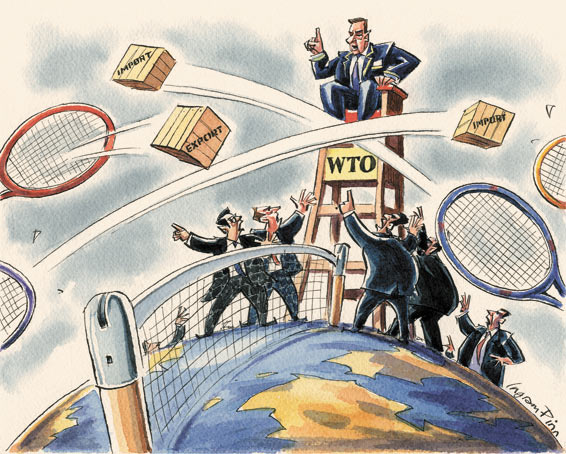
The recent U.S. actions carry with them threats of a possible trade war and tougher conditions on U.S. investment and U.S. firms in China especially technology and telecom firms. To some the dispute with Huawei is really about a foreign producer that is competitive and produces good products at half the cost. The fear is that protectionism is lurking close under the surface of recent U.S. actions. If the U.S. has serious trade and intellectual property rights issues with China it should use the WTO to adjudicate them as it has many times.
Greater transparency as to corporate structure and equity ownership  is needed by large Chinese firms, even private ones,  especially those that have or had ties to the Chinese government. While concerns of cyberespionage for political and economic gain is to a certain extent reasonable, the solution may involve better verification by the U.S. of foreign products, foreign ownership or government influence.
Unfortunately, there is not a clear set of rules governing investment with China as there is governing trade. The WTO does not apply to foreign direct investment and there is no bilateral investment  treaty with China. This situation could be addressed by the new administrations in both Washington and Beijing.
 It is necessary for the U.S. to have a more balanced approach fairly assessing the many relevant factors, aside from partisan politics and  grabbing of headlines. Trust is developed by mutual actions. Better, cheaper products always tend to win in the domestic and  global marketplace. Foreign investment holds the promise of expanding local development. Persuasion and not unilateral actions are preferable as in all relations.  Our closest allies in Europe with similar national security concerns have welcomed Huawei, ZTE and Chinese direct investment.
 

Let’s see what happens after the presidential election when the focus returns fully to the need to increase global trade and U.S. jobs.
Posted in Global Trade Relations | Tagged , , , , , , , , , , , , , | Leave a comment

U.S. – China Trade Relations and the Presidential Campaign — Need for Restraint.


     U.S. – China trade relations are again becoming a political issue during this campaign season. Here are a few items concerning the recent exchange of comments by the presidential contenders, the recent complaints filed by the U.S. and China on the same day in the WTO, and a good editorial reminding us of the need for restraint.
… A lead Wall Street Journal editorial criticizes Romney’s trade statements as being protectionism and China-bashing. It argues he should know better since cheaper imports creates jobs in the U.S. and often “Chinese” goods represent only the final assembling of them. “Romney’s Trade Pessimism.” Wall Street Journal (Sept. 14, 2012).
… The Obama and Romney campaigns are arguing over who is softer on China and blaming China for outsourcing of U.S. jobs. “Politicize Issues of China and Manufacturing.” New York Times (Sept. 16, 2012).
… China filed an action against the U.S. in WTO concerning A / D duties placed on a wide variety of Chinese imports into the U.S. WTO News (Sept. 17, 2012). On the same the U.S. filed an action in the WTO against China for its subsidies on auto part exports to the U.S. “Obama Challenges China’s Export Subsidies. USTR News (Sept. 17, 2012) and USTR Fact Sheet (Sept. 17, 2012).
… The Obama administration previously filed an action in July against China in the WTO concerning its tariffs on import of U.S. autos. WTO News (July 2012).
     Here are three charts I’ve prepared concerning U.S. – China litigation in the WTO and one going back to the Clinton Administration. They clearly show that President Obama has brought more actions against China than President Bush and he has been much more focused in bringing them. But he has filed far fewer WTO actions against other countries and far less than President Bush or President Clinton.
…… “China in the WTO / DSU (2001-2012).” (Chart).
…… “China and U.S. WTO Litigation (2001-2012).” (Chart).
……  “U.S. – China WTO Cases — Bush, Obama & Clinton Administrations Compared.”
   To me it would be better if both countries emphasized the benefits of free trade and economic liberalization. That the import of cheaper products into the United States generates significant domestic employment and that the investment into China by U.S. multinationals assist in the rebalancing of the Chinese economy and meeting Chinese consumption demands. By the way, the Obama administration is to be congratulated on not naming China a “currency manipulator.” The yuan is in fact appreciating. There is simply nothing in the WTO agreements addressing in any manner the issue of currency rates and export subsidies.
     The rebalancing of China’s domestic economic objectives with the American rebalancing of our Asian relations should be mutually reinforcing. The exclusion of China from the Trans-Pacific Partnership (TPP) negotiations should be carefully reassessed. A more inclusive and multilateral approach to global trade should be our preferred policy option if possible when confronting geo-political and geo-economic transformative landscapes.
      Domestic politics that drive foreign trade policy in both countries  should be refocused on the long-term goals and not short-term debating points. We need a sustainable comprehensive relationship  encompassing our competitiveness involving trade, business, investment, politics and national security interests. Hopefully, after the selection of  new presidents in both countries better policies will prevail. This is what U.S. – China and global trade relations need.

Posted in Global Trade Relations | Tagged , , , , , , , , , , , , , , , , | Leave a comment

Counterterrorism and Global Trade — Legal Developments — Need a More Effective Congress and International Law.

In his two books, Jack Goldsmith rationalized the growth of presidential power in the War on Terror, addressing both the Bush and Obama administrations. And of course he tries to justify his actions, with some limited success, while in the Bush Justice Department.
In his 2009 book, The Terror Presidency, Goldsmith notes the string of congressional capitulations during 2001–2008, allowing a more militarized approach to the counterterrorism policies by the Bush administration. However, he notes Supreme Court decisions imposing restrictions on those actions.
In his 2012 book, Power and Constraint, Goldsmith continues his argument that Congress not only failed to restrict the president’s actions but, in fact, generally sanctioned the continuity of Bush-era policies.
Unfortunately, he glosses over the broad rejection by the Obama administration of torture,  waterboarding, and extraordinary rendition  as instruments of U.S. policy. He is dismissive of the very significant role federal courts played in limiting these Bush era-policies while balancing civil liberties with national security.
But most interestingly, Goldsmith extends his argument that it is not only the courts that provide for presidential accountability but the hypergrowth of private organizations, especially by aggressive lawyers.
In a sense, he argues that it is now the courts and these informal groups that functionally provide an accountability mechanism in lieu of an ineffectual Congress.
It is clear that it has been the federal courts that have primarily protected individual rights as enshrined in the Bill of Rights. And this focus on individual rights is what makes America truly exceptional among the countries of the world.
To me it is the balance between the protection of individual rights and the protection of the national security of the United States that is always a work in progress as global events unfurl. We need to get this right and this varies over time. (This applies especially to our developing policies concerning cybersecurity and extensive use of drones.)
It is my sense that the state of counterterrorism policies today is just about right, with the grave exception of the diminished role of federal courts concerning detainees and their legal rights. (I am also concerned about the administration’s continued assertion of the “state secrets privilege.”)
Goldsmith greets the role of courts and private groups with gratifying acceptance but displays an unfounded conservative bias against what these lawyers and organizations advocate: the observance of international law as law of the land. He barely disguises his disgust with the growth of this law that covers many areas once removed from broad rules of conduct.
It is unfortunate that as a law professor he prefers the workings of an ad hoc military commission system in lieu of the well-tested federal court system as to detainees and terrorist trials. Empirical evidence is on the side of the federal courts.
What does this have to do with global trade?
For foreign and military affairs, there is a sharing of power by the president and Congress. However, as to these areas the powers of the president have grown immensely over the years. As for foreign trade, Congress has exclusive authority. While the executive negotiates agreements the Congress has firmly kept control of its authority over accepting these agreements and implementation of them by legislation. This division and differences in powers are basically as the Constitution envisioned them.
For global rules of trade, international law forms the basis—both treaty law and customary international law. For example, the World Trade Organization (WTO) and bilateral trade agreements are supreme law of the land, under Article VI of the U.S. Constitution. Rules concerning expropriations are rules of customary international law. Such laws are the law of the land under Supreme Court precedent, going back to the 1800s.
The problem is that Goldsmith and others resent and reject the notion that customary international law can be expanded and applicable to states without their specific consent—especially the United States—and is often too broadly interpreted.
This they argue represents a challenge to U.S. sovereignty. In fact, this critical issue, which I thought has long been settled precedent, is being reconsidered by the Supreme Court this term.
For example, conservative international lawyers have long-argued the that “Alien Tort Statute” ought to be limited if not disregarded concerning suits against foreign corporations or anyone violating customary international law outside of the U.S. Thus, restricting the application of customary international law within the United States. Many other countries allow such legal actions against foreign corporations. Of course, Congress can explicitly extend the statute to avoid a restrictive reading.
It is interesting to note that the continuity of counterterrorism policies from the Bush to Obama administrations is akin to a similar continuity of aggressive U.S. policies towards China in WTO litigation.
What’s the problem as it relates to trade relations?
This narrow view of customary international law (which I would consider an unjustifiable assault on it) weakens the ability of states to consider a wide range of newer issues; for example, actions by individuals and corporations in collaboration with state sponsors of terrorism and rogue state to gain economic concessions. What about the entire issue of exclusive economic zones in maritime law and the traditional right of states to self-defense and state-sponsored commercial cyber intrusions? A narrow view of customary international law relegates law to a position of inability to meet dynamic changes in the global system.
For example, the European Court of Human Rights now applies international human rights law, under both conventional and customary international law, to corporations. (The court delas with the inter-play of EU law, European Human Rights law, the law of states, and  the impact on corporations individuals.) In a sense giving them protection against state abuse.
This is particularly interesting since the Russian Federation is a member of this regional system and cases against it are numerous. Implicitly that means that corporations are recognized as juridical persons with obligations also.
 Goldsmith’s antagonism with international law generally feeds into a broad reluctance concerning the U.S. involvement with bilateral, regional and international legal arrangements allowing adjudication of newer and growing trade and investment issues with a wide-range of countries. Such involvement is viewed, in part, as a diminishing of U.S. sovereignty.
In conclusion, as to matters of trade, both Congress and international law set the parameters for presidential action. An ineffective Congress and an emaciated view of  international law are unhelpful in today’s world. They are counter-productive to U.S. national interests in meeting the political and economic challenges confronting the U.S. in an interdependent global environment.
Dr. Stuart Malawer is the author of two recent casebooks, U.S. NATIONAL SECURITY LAW (Hein and Company, 2009) and WTO Law, Litigation and Policy (Hein and Company, 2007).

Posted in Global Trade Relations | Tagged , , , , , , , , , , , , , , , , , | Leave a comment

“That Used to Be Us” — Get Back to Our Values, Job Creation and Today’s Global System.

Here are many of the major points that are made in the new book by Tom Friedman and Mike Mandelbaum, THAT USED TO BE US (2012). They have been made before but they should be repeated until they sink in.  The world is interdependent and interconnected. Economic competitiveness and jobs are the critical issues confronting the U.S. today. Effective public policies need to be adopted, now. Better education and better political cooperation are needed, immediately.
… The end of the Cold War ushered in four major challenges: globalization; information technology revolution; budget deficits and national debt; energy and climate demands.
… Americans did not fully grasp the implications of globalization. They didn’t recognize the magnitude of the challenges. They failed to see the profound challenge the end of the Cold War posed.
… No country is prepared to step in to replace the United States as the world’s government.
… Regulations and regulatory bodies provide the vital foundation of trust that fosters innovation and risk-taking.
… The financial and energy sectors suffer from too little regulation.
… The merger of globalization and the IT revolution coincides with the transition from the 20th to the 21st century.
… Better education requires the three C’s – critical thinking, effective oral and written communication, and collaboration.
… There is a direct connection between immigration and innovation.
… The more divided a society becomes, the more likely the wealthy will opt out of paying for public goods.
… The losers from globalization – al-Qaeda and Saddam Hussein – did pose significant security problems.
… We cannot meet our four challenges without a vibrant federal government.
… This decline in values has done as much as political hyperpartisanship to undermine our ability to address our great challenges.
… The anxiety about China’s rise if channeled properly is a healthy concern.
… Declaring that America is exceptional doesn’t make it so.
… American society retains the characteristics that made the U.S. exceptional.
… America not only underappreciated the world it invented, but overinterpreted the events of Sept. 11th.
… What we need is to understand our own history. We need to reconnect with our values.
I wonder how many times the above needs to be emphasized before we understand that only by aggressively engaging in the global marketplace can we ensure jobs for Americans. This is one of our top economic, political and national security objectives.
Posted in Global Trade Relations | Tagged , , , , , , , | Leave a comment

More U.S. – China WTO Trade Litigation …. Not a Trade War and Not Bad for the System.

      Two good assessments appeared yesterday concerning U.S. – China trade litigation in the WTO. They discuss the increased litigation by the Obama administration, the generally positive significance of such WTO litigation, and why it does not evidence a trade war.
…. The following is a good review of  U.S. – China litigation in the WTO. It argues such litigation has become the core of U.S. –  China relations (trade or otherwise). It also contends there has been a seminal shift in U.S. trade policy to emphasize continuous actions to contest perceived Chinese restrictions. “At the WTO U.S. Racks Up Wins Against China.” Washington Post (August 9, 2012).
…. This piece claims that while WTO litigation is expanding, especially between the U.S. and China, its importance is really is in restricting future defensive trade remedies (such as antidumping and subsidies.) However, it notes these trade remedy actions really don’t seriously consider the reality of a global supply chain. “Decommissioning the Misfiring Weapons of Trade Warfare.Financial Times (August 9, 2012).

Posted in Global Trade Relations | Tagged , , , , | Leave a comment

Money Laundering, U.S. Financial Sanctions and Foreign Violations — Why It’s Our Business.

Now it is the New York State’s Department of Financial Services(DFS) that has issued an order threatening the license of Standard Chartered Bank to do business in the state.
It alleges that the British bank schemed with the Iranian government to violate U.S. financial sanctions for nearly a decade.  It contends that the British bank used its New York branch to mask more than 60,000 transactions and thus laundered over $250 billion since 1995. It did this by stripping the true identity of the parties involved in “U-Turn” transactions involving foreign entities utilizing the U.S. clearing system.
What was the British bank’s response? “Who are you to tell us, the rest of the world, that we’re not going to deal with Iranians.”
And this is from one of our closest allies. I suspect the bank is going to face not only possible loss of its license but massive private litigation and criminal prosecution. I guess they will find out who they are dealing with.
This case raises issues of extraterritoriality of U.S. law. This is something the EU has consistently been concerned about. However, the use of the financial system within the U.S. by an entity within the U.S. to conduct financial transfers within the U.S. is not really an issue of extraterritoriality. It is clearly a domestic issue.
Larger questions remain.
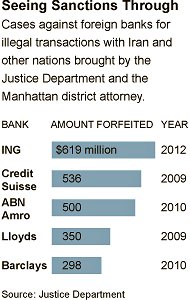
…  Why do global financial institutions (Credit Suisse, Lloyds, Barclays, ING and HSBC) think they can violate U.S. legislation when they act within the United States?
… What is it with the British and foreign banks that they feel that U.S. sanction legislation can be violated? (Think about countries other than Iran such as Mexico, Cuba, Myanmar, North Korea and the Sudan.)
… Is it just the fees in this case or does this instance evidence a systemic issue concerning global finance and U.S. sanctions?
 … Do such corporate actions indicate an ineffective global financial regulatory system based primarily upon national legislation?
… Should the U.S. actually hold individuals criminally responsible or just go after the license to do business of a foreign bank?
Obviously policy needs to catch up with global corporations acting in a multi-jurisdictional world. Global corporate responsibility needs to be reinforced by effective national and international supervision.
There is a blurring of the moral and legal responsibilities of global financial institutions in the pursuit of profit. This is a problem for national and global systems. That’s the challenge we face.
And that’s why this is our business.

                                                New York Times (Aug. 18, 2012)

Posted in Global Trade Relations | Tagged , , , , , , , , , | Leave a comment

ASEAN Trade and Investment with the U.S. — They want it and we need it.

Dr. Stuart Malawer at Petronas Towers (Jakarta, Indonesia) (July 2012)

      After spending the last two weeks giving presentations and discussing global trade and investment strategies with foreign multinationals and financial institutions in Thailand, Malaysia and Indonesia here are some observations and general conclusions.
… Indonesia is clearly the largest and most dynamic economy in Southeast Asia in terms of investment and trade opportunities for U.S. firms.
… Indonesia has just filed an antidumping dispute against the EU in the WTO concerning the EU’s imposition of antidumping duties on the import of chemical related products. There are significant tensions in EU – Indonesian trade relations.
… Indonesia is set to buy Chinese interbank bonds to help diversify its foreign reserve holdings. Indonesia is increasingly sophisticated in its global financial dealings.
… Foreign direct investment in Indonesia has increased 30% in the second quarter from a year earlier. This further evidences the  growth potential of Indonesia.
… Petronas Bhd., Malaysia’s state-owned energy company, has offered to acquire the large Canadian energy company Progress Energy Resources. Global mergers and acquisitions are increasingly instigated by multinationals from outside of the U.S. They are increasingly raising U.S. national security concerns.
(This is along with the recent offer by China’s CNOOC Ltd. to buy Canada’s oil and gas company Nexen Inc. This proposed acquisition is one of the biggest overseas expansion efforts by a Chinese company to date. But since Nexen has assets in the United States it plans to ask CFIUS to review this transaction for national security concerns.)
… Malaysia’s high Standard and Poor’s rating was recently affirmed. This further indicates the growth potential of Malaysia.
… Thailand among other ASEAN nations, such as Vietnam, are extremely concerned about the failure of the recent ASEAN ministerial meeting in Cambodia to adopt rules  addressing the law of the sea issues relating to China’s claims in the South China Sea and East China Sea. In particular, the issue relating to the Exclusive Economic Zone (EEZ) is fiercely debated.
(Unfortunately, the continued U.S. failure to ratify the Law of the Sea Convention doesn’t help the U.S. in mediating this dispute.)
… Concern among these three nations remains, of course, with China as to trade issues.
(The recent split decision in the WTO case brought by the United States over China’s restrictions on electronic payments markets / credit cards indicates the continued central role of the WTO in addressing the trade issues in the region.)
(Indeed, the EU has recently opened an antidumping investigation into China’s solar panel industry and the U.S. has recently imposed newer duties on import of Chinese wind turbine towers.)
… All these countries, including the U.S. and China, continue to oppose the EU’s carbon tax on airlines. This is a growing and unnecessary extraterritorial application of EU regulations.
(There is also continuing conflict over the U.S. extraterritorial application of our trade sanction legislation, most recently with China over the expansion of U.S. sanctions against Iran impacting Chinese banks.)
… The economies of these countries are growing, unlike the slowdown in Japan, South Korea and Taiwan.
… Thailand, Malaysia and Indonesia are very concerned about domestic corruption and have launched major programs to combat it.
Entry Sign to Indonesia.
The following are some conclusions:
… Thailand, Malaysia and Indonesia are focused on trade and investment opportunities in the United States.
… They are very concerned about trade issues with China but as well as with the EU and the U.S. They continue to oppose U.S. trade restrictions in the WTO  and  are concerned about potentially new restrictions on foreign direct investment into the United States.
… The WTO remains a primary vehicle for resolving trade issues for them. Indeed, the WTO is holding its next ministerial meeting in Indonesia this fall.
… Foreign corporate strategies can be effectively formulated to increase trade and investment in the United States by understanding the U.S. marketplace and often the disconnect between federal and state policies. (Firms from these countries want to trade more with the U.S. and invest more into the U.S. marketplace.)
… To me, the most surprising observation is their focus on outward trade and investment transactions are viewed as a means of greater domestic economic prosperity.
… China remains a great concern to these countries but the role of the U.S. in addressing this is not clearly understood and has not been fully articulated as part of U.S. foreign policy. Indeed, U.S. policies have not been seen to be very successful even after the Obama administration’s “pivoting” towards Asia.
(Global geopolitical and military issues between the United States and China seem to be a lesser concern to these countries, except for China’s territorial claims in the South China Sea. These countries are more interested in their own economic development during this global economic slowdown.)
… From the U.S. perspective, increasing trade and direct investment from these countries, especially as they move forward in creating a more integrated ASEAN community, seem to be perfectly consistent with the American need to create jobs and economic development within the United States.
In conclusion, the international business and investment firms in Thailand, Malaysia and Indonesia are united in focusing on outward global transactions geared to both the EU and the U.S. It is in our interest to help nurture these cross-border transactions. 
Thailand, Malaysia and Indonesia are working within the rules of the game (WTO). Better U.S. trade policies (less tendency to rely on restrictions in the name of national security and new bilateral trade agreements) and more effective U.S. foreign policy, especially toward the regional issues in Southeast Asia, are needed. 
 This would help them, the international political system, the multilateral trade system, and the U.S. with our own economic development and job creation. It is also in the interest of U.S. foreign policy and national security.
Better trade, better ties.
Posted in Global Trade Relations | Tagged , , , , , , , , , , , , , , | Leave a comment

U.S. Wins New WTO Case Against China — Electronic Payments Case — Good Domestic Politics, but Good Trade Policy?

A WTO panel has just ruled in favor of the United States in its action against China for violating the WTO services agreement (GATS) concerning China’s restrictions on electronic payment services (EPS) via credit card transactions.
While this was a mixed decision China was found to violate its trade obligations allowing market access to foreign credit card providers. RMB transactions were monopolized by China and foreign providers were not allowed to participate in them. U.S. – China WTO Case Concerning Electronic Payment Services. WTO News (July 16, 2012).
This is an important case for several reasons:
 …. (i) This case is in the context of a long list of cases the Obama administration has aggressively brought against China in the WTO;
 …. (ii) Increasingly regulatory measures (non-tariff measures) are being utilized by China and other countries to restrict trade;
…. (iii) Voters in the United States are increasingly calling for  stronger measures against China.
During this election season it is clear that anxiety over the economy, globalization, China, and outsourcing of jobs will be driving the presidential election.
Actions against China in the WTO makes good sense for domestic politics but unfortunately hold the potential of overshadowing other significant causes of our distress. Those causes need to be seriously confronted in order to be able to fashion effective public policy remedies — impacting both our domestic economy and our global trade relations.
For this presidential election issues of global trade seem to be at the heart of domestic politics. For better or for worse.
Posted in Global Trade Relations | Tagged , , , , , , , , , , , | Leave a comment

JP Morgan (Trading Losses), Barclays (LIBOR fixing) and now HSBC (Money-Laundering) — Better Enforcement Needed — You Think?

What is the recent story with multinational banks? First, JP Morgan (unsupervised trading losses). Next, Barclays (LIBOR fixing). And now  HSBC (money-laundering).

HSBC faces about $1 billion in fines for violating U.S. anti-money laundering controls intended to restrict financing of terrorism and other criminal activities. ING recently agreed to pay $619 million to settle claims for violating U.S. trade sanctions with Cuba and Iran.

U.S. financial regulation reaches not only U.S. financial institutions but also foreign banks impacting the U.S. as well as those relying upon the U.S. financial system.

These inexplicable bank transgressions have all occurred after the 2008 financial crisis and during this long and painful road to national and global economic recovery. These actions surely do not inspire much  confidence in the financial institutions and to a lesser extent in the regulatory oversight here and abroad.

 They seem to be hindering the recovery to a significant extent. How many of us, individuals and corporations, are paying higher interest rates for loans because of the LIBOR debacle.

It is about time we get more serious about managing the very large, global financial institutions. It does not seem that corporate leadership has learned  much over the last few years.

 Better national and foreign regulation is needed, for both economic and national security. Sooner the better.


Posted in Global Trade Relations | Tagged , , , , , , , , | Leave a comment

U.S. files yet another case against China in the WTO — Election year politics and U.S. trade policy issue — Litigation or Negotiation?

The U.S. has filed yet another case against China in the WTO / DSU. This one concerns China’s antidumping and countervailing duties on automobiles from the U.S. Is this election year politics by the administration?

This case raises again the issue of litigation versus negotiation — which is the best means to remove trade restrictions?  This choice has become a major trade policy issue for the United States. And actions against China in the WTO has become a hot topic in presidential politics today. (It’s also a hot topic in the EU, Brazil and elsewhere.)

President Obama’s more aggressive enforcement of trade obligations has become a hallmark of his trade policy along with a renewed emphasis on export promotion and encouragement of greater foreign direct investment into the United States.

 “U.S. Files Dispute against China.” WTO News (July 5, 2012).

Posted in Global Trade Relations | Tagged , , , , , , , , , , , , | 1 Comment