Multinationals & Global Taxation — Avoidance or Evasion? — Let’s Get Real.

Global Tax 50
     Taxation and trade are intricately related. More effective taxation of cross-border transactions of multinational corporations is necessary to ensure growth of global trade and national economic  development. 
   The recent Congressional hearings concerning Caterpillar and its Swiss subsidiary, once again, raises this issue of multinational corporate taxation. 
      Specifically, were these corporate actions by Caterpillar permissible tax planning or willful evasion?
      We have heard this story before.
      U.S. corporations are using foreign subsidiaries to avoid U.S. taxation of corporate income. Usually  through only paper transactions with no real economic justification. These transactions allow  Caterpillar, Google, Amazon, Apple and a host of other multinationals to accumulate billions of dollars of retained capital offshore. Their defense is always that this is allowed by the tax code.
      Really?
     These tax-generated corporate transactions result from abuse of various tax rules concerning transfer-pricing, cross-licensing arrangements, overseas subsidiaries, related corporate groups among a host of other provisions. Lax Internal Revenue Service oversight, lack of litigation and prosecution by the U.S. Dept. of Justice don’t change the nature of these transactions.  They have resulted in billions of dollars lost to the United States in term of tax collection and reinvestment of profits back into the U.S.
      That costs us jobs and economic development here. 
     The usual defense is that the worldwide tax system, as opposed to a territorial one, that is employed by U.S. law is the real culprit as well as the high corporate rates. (Of course, never talking about the real or effective tax rates.)
   It is clear that an international consensus is finally building to address the unsustainable disconnect between global corporate taxation and the realities of today’s world. Recent actions by the G-8 and the OECD are encouraging. This will be a long process. But the popular support across the world has been building as well as the dire needs of national governments for revenues during this long period of economic misery and uncertainty.
      It is obvious that there is a split between multinationals over global taxation and its reform. For example, between Boeing that produces things here and Microsoft that relies upon royalty income abroad from intellectual property. Corporate coalitions are already forming in the U.S.,  such as the Alliance for Competitive Taxation (ACT) and Tax Innovation and Equality (TIE), to oppose any global tax reform, whatsoever.
      Of course, others as the editorial board of the Wall Street Journal, just simply think any tax reform, except reducing rates or doing away with all taxes on foreign source income, are part of a policy “to combat fictional plague of tax avoidance.” Just what you would expect from the Wall Street Journal on this issue.
      Today’s global tax system largely emerged prior to tax havens, bank secrecy, offshore banking, and the digital economy. More than anything else cyber space has clouded the geographical  location of global transactions. Changes brought about by online transactions, cyber space and cloud computing have created significant issues in determining where cross-border transactions take place.  
     Unilateral national regulation as it is today is detrimental to the growth of global trade. The issue of reforming the international tax system under U.S. law in order to better track real economic activity is critically important. I’m just not holding my breath.

 

….. “At Hearing, Caterpillar Defends Tax Practices.” New York Times (April 2, 2014).
….. “Switching Names to Save on Taxes.” New York Times (April 3, 2014).
Posted in Global Trade Relations | Tagged , , , , , , , , , , , | Leave a comment

Global Economic Sanctions — Many of Them by Many Players — But How Effective?

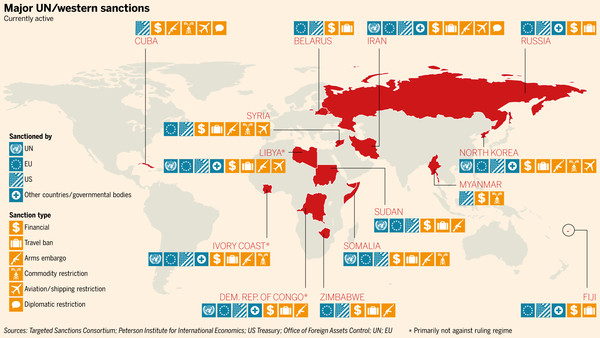
Sanction Map (FT 3.31.14)
       In the last 13 years since 9/11 sanctions for domestic political and foreign policy reasons have exploded worldwide.
     They include financial sanctions, trade and investment restrictions, sanctions on travel, arms embargos, commodity restrictions, financial controls and disclosures, diplomatic sanctions, sanctions on aviation and shipping, among others.
      These sanctions have been imposed by the U.S., the EU, the U.N. and others.
      The real impact and effectiveness of sanctions are open to serious question. Sanctions are often  imposed as a default response when no other action is realistically available. All to often they are authorized to  appease domestic political pressures. They may or may not have realistic chances of  success. They are feel-good measures.
    Rarely do sanctions alter the targeted countries policies.  They impose undue burdens on their domestic populations not their leaders. It’s the U.S. and international business communities that feel the sting  of sanctions and retribution from counter-measures. Unexpected consequences impose new problems.
     My point is very simple. A sanction is an easy answer. But hard to undo.  It’s hard to find much international success.


…. “Sanctions: War by Other Means.” Financial Times (March 31, 2014).


Posted in Global Trade Relations | Tagged , , , , , , , , , | Leave a comment

Foreign Corruption — More Aggressive U.S. Prosecutions? Yes, They are Needed.

Corruption 1
      The U.S. Dept. of Justice should be more aggressive in prosecuting firms for bribing foreign officials.
      Bribery is illegal under U.S. and foreign law. It’s unethical and counter-productive for economic and political development. Forget the U.S. Chamber of Commerce. The OECD Convention of Bribery and actions by all governments should be expanded.
     Corporate officials should do jail time. Bribery results in only more expensive products and services at higher costs. It results in keeping illegitimate and corrupt leaders in power at the expense of developing a viable civil society. It’s regulation would in fact increase competitiveness and global trade. It would put all firms on an even playing field. Corruption is a nontariff barrier to trade and investment.
     By the way illegal and unethical activity abroad often leads to dubious corporate actions domestically. The international response to corruption over the last forty years is something the U.S. actually initiated by its unilateral efforts and legislation in the post-Watergate era of the 1970’s.
     One of the few examples of good unilateral actions by the United States in the global trade area.


………… “Global Bribery Crackdown Gains Steam.Wall Street Journal (March 26, 2014).


Posted in Global Trade Relations | Tagged , , , , , , | Leave a comment

National Interest, International Relations and International Law — Is Power Politics Dead in this Era of Globalization?

     Globe and Conflict (FT)
     The simple answer is that power politics is not dead in this new era of globalization.
      Yes, we have new rules for inter-state relations brought about by globalization.  But calculations of national interests in foreign policy decision-making is done throughout the capitals of the world. The calculations vary and new global rules have not fully evolved or accepted by all. The tensions between economic interdependence and regional relations are still playing out.
    Most importantly, as the  crisis over the Ukraine and the Crimea illustrate, the clash of newer global rules with older national concerns is unsettled. The new international political system is a work in progress. The era of pre-World War I globalization died in August 1914. This new era of  globalization in the early 21st Century is confronting critical challenges. 
     As we approach this August, the one-hundredth anniversary of the outbreak of the Great War, we need to pause and reassess the interplay between national interests, global rules, and globalization. No outcome is historically mandated. Good policy and good leaders will make the difference.
….. “21st-century Power Politics.” Washington Post (March 28, 2014).
….. Article.Globalization — Best of Times (FT 3.26.14))Financial Times (March 28, 2014).
Posted in Global Trade Relations | Tagged , , , , , , , | Leave a comment

Two New U.S. – China WTO Decisions — Who is the Biggest Winner?

         China and WTO
      This week two WTO panels  decided the first two cases involving China – U.S. litigation in 2014. These were two major cases.
     The first case was brought by the United States involving China’s export restriction on rare earths. The second case was brought against the United States involving its 2012 legislation allowing countervailing duties on imports from non-market economies (China) and the issue of ‘double remedies’ (whether both countervailing duties and anti-dumping duties can be levied at the same time).
      The first case was a solid win for the United States. The second case was a split decision. It upheld the U.S. legislation but not ‘double remedies.’
     To me these cases are in a long line of cases involving U.S. – China trade litigation in the WTO. Both parties are submitting their trade disputes to the WTO’s dispute resolution system. This is good. This takes these commercial disputes away from the glare of realpolitik and put them in a more regularized context that leads to peaceful solutions. This is a plus for both China and the U.S. Historically, this is a bigger deal ford the global trading system.


Posted in Global Trade Relations | Tagged , , , , , , | Leave a comment

Investor-State Treaties and Evolution of the Law — Yes, It is a Positive Development.

             Global Investment


     The move by various countries,  both developed and developing such as Indonesia, South Africa and Australia, to redraw bilateral treaties providing for investor-state provisions, should be resisted. The EU should continue to negotiate such provisions within the context of the TPP.
     Investor-state provisions in bilateral trade agreements and investment treaties promote greater foreign direct investment. It takes governments out of the game of bringing actions on behalf of companies and allow private corporate actions. This reduces government friction and promotes the normalization and commercialization of FDI.
      In fact, this approach is a more modern approach to settling transnational disputes than the 19th century prohibition in international relations against giving ‘standing’ to private parties in international arbitration. The now discredited “Calvo Clause.” That approach is dysfunctional and outdated.
     Trade and investment today are conducted by corporations and they should have a viable recourse over contract disputes often involving nationalization and bad state behavior. 
….. “Investor-State Treaties Promote the Law. Financial Times (March 26, 2014).
….. “Indonesia to Redraw Terms for Investors as Litigation Rises.” Financial Times (March 27, 2014).
Posted in Global Trade Relations | Tagged , , , , | Leave a comment

Cybsersecurity — NSA and Huawei — Just National Security?

         Web
      
     NSA hacked into the servers and network equipment of Huawei, the private Chinese telecom firm, to determine its ties to Beijing and to exploit those networks and equipment when purchased by third countries or companies in those countries. Isn’t this the mirror image of our reasons to keep Huawei out of the U.S. and to deny them the right to direct investment under CFIUS? 
     The U.S. government does not want U.S. telecom firms to buy Huawei equipment because it fears they might be used to compromise U.S. networks and to gain access to U.S. government information. Huawei has been shut out of the U.S. market. It is now the second largest supplier of wireless gear in the world. It is second only to Cisco Systems. NSA snooping into Huawei’s produced equipment must be giving foreign buyers some serious concerns.
     I wonder to what extent plain old considerations of international commercial competitiveness is behind this latest action by the NSA and not just legitimate political and national security concerns.
    This is a fair question since the NSA always argues that its actions are only for national security and not for the commercial advantage of the U.S. or a particular U.S. firm. Don’t think China is buying this argument.
….    “U.S. Briefs China on Cybersecurity Policies.” New York Times (April 7, 2014).
……  “NSA Breach Chinese Servers.” New York Times (March 23, 2014).
…… “NSA Accused of Breaching Networks.” Financial Times (March 24, 2014).
…… “Cheap and Now Ubiquitous: Huawei.” Wall Street Journal (March 25, 2014).
…… “Cyberwarfare Force will Grow Significantly.” Washington Post (March 29, 2014).
……  Malawer, “Cyberwarfare — Law and Proposals.” (2010).


Posted in Global Trade Relations | Tagged , , , , | Leave a comment

Trade Agreements (TPP) & Globalization — Is Support for the Them Really on the ‘Wrong Side of History’? Don’t Think So.

Trade and Transparency

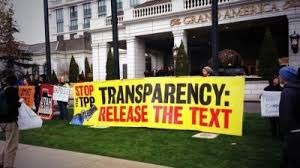
     The recent article by Joseph Stiglitz is a frontal attack on the TPP, trade agreements, and globalization. Very interesting. But very wrong. Trade agreements open trade and bolster economic development. Income inequality within the U.S. does sap the interest in more trade agreements as well as foreign policy generally.
      But it is up to the U.S. trade establishment  to ensure open negotiations that respond to the national interest of the country and then to ensure sufficient enforcement of trade obligations.
      The U.S. is leading the world in trade policy. We are trying to write new rules of global trade though the TPP and TTIP. China and other countries want in because they too want to participate in these new rule-making efforts.
       If done properly the national interests of states and the global trading system will thrive. We’ll be on the right side of history.
….. “On the Wrong Side of Globalization,” New York Times (March 17, 2014).
….. “The U.S. is Trading Up.” Washington Post (April 4, 2014).
Posted in Global Trade Relations | Tagged , , , | Leave a comment

Economic Sanctions and the Crimea — Be Careful What You Wish For.

Russia and WTO

 The Crimea crisis has raised the issue of whether or not economic sanctions have become more important in foreign policy and diplomacy given the increased globalization and inter-connectedness of the global  system. More so since the 2008 Georgia crisis and the increased U.S. experience with the Iranian sanctions. “Crimea: Globalization and Economic Sanctions.Financial Times (March 4, 2014). The United States is thinking about using its new energy (natural gas) production and exports as a trade weapon in its foreign policy and diplomacy aimed at Russia. “Energy and Diplomacy — U.S. & Putin (Crimea).New York Times (March 6, 2014). Some consider sanctions against individuals only are more like painless drone attacks (“Magnitsky” type of illusions) rather than more significant financial sanctions against major financial institutions (government and private). “Londongrad and Financial Sanctions.” Financial Times (March 6,  2014).

However, more serious economic sanctions by either the EU or the U.S. can backfire. Imposing serious consequences not only on Russia but also on U.S. and European firms as well as the international financial system. This seems strange since the EU and the U.S. spent years trying to integrate the Russian Federation into the WTO, the global trade and international financial systems.

Posted in Global Trade Relations | Tagged , , , , , , , | Leave a comment

Politicalization of Trade Continues, Domestically and Internationally.

    
Time Warner
     A great number of recent events have occurred this last month impacting global trade and finance. They include among others: continued aggressive actions of U.S. regulatory agencies concerning foreign banks and auditors, Argentina taking its international bond default case to the U.S. Supreme Court, U.S. investigation of Credit Suisse for promoting tax evasion by U.S. nationals, and continued congressional opposition to granting President Obama ‘Fast Track’ authority in trade negotiations. Yes, trade and international transactions are highly politicized, domestically and internationally. Here are a few of the highlight. 
  • “[A]   revival of the U.S. economy should not be confused with a resurgence   of America’s role … [T]he most important emerging theme in world   politics is America’s slow retreat ….” “Indispensable Americans are Pulling Back.”  Financial Times (Jan. 21, 2014).  This “slow retreat” is certainly evidenced by the      inaction of the Congress to extend “fast-track” authority to  President Obama to the detriment of the U.S. in global trade negotiations.     
  •  The  U.S. regulatory agencies are continuing with aggressive extraterritorial   application of U.S. economic legislation to foreign banks and foreign auditors under the Dodd-Frank legislation. Most recently the Federal  Reserve is about to require foreign banks to increase their capital  requirements and the SEC is about to suspend Chinese auditing affiliates of   U.S. firms for failure to turn over work documents as part of a SEC’s      investigation of Chinese firms. “Exporting U.S. Rules for Banks.”  New York Times (January 23, 2014) and “Judge Suspends Chinese Units  of Auditors.Wall Street Journal (January 23, 2014).      Chinese listed firms  in the U.S. must comply with U.S. audit rules  of the SEC.  China has criticized this ruling and has raised issues    concerning regulation of U.S. multinationals in China. “China Criticizes Auditors   Ruling.Wall Street Journal (Jan. 27, 2104).      
  • The   U.S. Treasury Dept. has released the latest annual report concerning foreign  mergers and national security. CFIUS Annual Report for 2012  December 2013). It shows (p.17) that China is the second-place home   country of an acquiring corporation behind the U.K.  The China-U.S. Trade Law Blog  (Jan. 28, 2014) analyzes the data presented. 
  • The  United States another case  against India in the WTO concerning its      restrictions on the sale of  solar cells and modules to India. “U.S. Files Dispute Against   India (Solar Cells and Solar Modules).WTO News      (Feb. 11, 2014). “U.S. Files Complaint on India  Solar Plans.Wall Street Journal (Feb. 11, 2014).   This case involves U.S. objections to India’s domestic-content      requirements. “New Trade Enforcement Action  Combats Barrier to U.S. Clean Energy Products.” USTR  News (Feb. 19, 2014).
  • A  new book by the WTO “Connecting to Global Markets” (2014)  makes the case that international economic law and international trade rules, especially as they relate to foreign direct investment and   intellectual property rights, impact the ability of developing countries   to engage successfully in the global trading system. “Connecting to Global     Markets” (eds. M. Jansen, M. Sadnia and M. Smeets).WTO  News (Feb. 11, 2014). (PDF of book.)      
  • Argentina   has taken its bond default case under the Foreign Sovereign Immunities  Act to the U.S. Supreme Court. This is a major case concerning   sovereign debt default and debt restructuring in international finance and  global relations. “Argentine Takes Case to U.S.  Supreme Court.New York Times (2.26.14).
  • U.S.   investigations by the U.S. Dept. of Justice and the Congress continue   against Credit Suisse for helping U.S. taxpayers avoid millions of dollars    of taxes by setting up secret bank accounts offshore. (This is a follow up  to earlier issues concerning UBS.) The amendment to the U.S. – Swiss tax  treaty remains unratified. If ratified this would expedite request for  U.S. names for tax evasion (in addition to tax fraud requests) “Credit Suisse and Congress.” Financial   Times (2.26.14); “Credit Suisse Hearing Attacks  Swiss Secrecy.Financial Times (2.27.14).
  •  Some  economists argue that the TPP and TTIP are no big deal. Krugman, “No Big Deal.”  New York Times (Feb. 28, 2014).  This often overlooks some   good economic arguments  to the contrary (job creation and economic  development within states) and certainly overlooks non-economic aspects of   trade and international economic policy. For example, they fail to   acknowledge the importance that multilateral trade negotiations play in  overall U.S. diplomatic and national security policies — they help  maintain the role of the U.S. on the global stage. Often opposition to these agreements are focused on narrow political interest groups within the U.S. and a failure to appreciate the ever-globalization of trade and  public policies. The federal government has an obligation to encourage   greater trade and not withdraw into parochial domestic politics. Malawer,  “Trade: The President and Fast  Track.” Richmond Times-Dispatch (Feb. 16,  2014). 
Posted in Global Trade Relations | Tagged , , , , , , | Leave a comment