






RSS Feed
-
Recent Posts
- Malawer, “Trump’s Tariffs & Refunds — Chaos.”
- UPDATE (Geopolitics & Geoeconomics): U.S. Tariffs and Refunds — The Saga Continues and Continues.
- UPDATE — Refund of Trump’s Tariffs — Really Tricky & Messy — Court Order Refunds, Now — Tariffs to Increase from 10% to 15% (More Trump Resistance).
- Global TV Interviews — Dr. Stuart Malawer (2026).
- Refund of Trump’s Tariffs — Really Tricky & Messy.
Archives
- March 2026
- February 2026
- January 2026
- December 2025
- November 2025
- October 2025
- September 2025
- August 2025
- July 2025
- June 2025
- May 2025
- April 2025
- March 2025
- February 2025
- January 2025
- December 2024
- November 2024
- October 2024
- September 2024
- August 2024
- July 2024
- June 2024
- May 2024
- April 2024
- March 2024
- February 2024
- January 2024
- December 2023
- November 2023
- September 2023
- August 2023
- June 2023
- April 2023
- March 2023
- February 2023
- January 2023
- December 2022
- November 2022
- October 2022
- September 2022
- August 2022
- July 2022
- June 2022
- May 2022
- April 2022
- March 2022
- February 2022
- December 2021
- October 2021
- August 2021
- June 2021
- May 2021
- April 2021
- February 2021
- January 2021
- December 2020
- November 2020
- September 2020
- August 2020
- July 2020
- June 2020
- May 2020
- April 2020
- March 2020
- February 2020
- January 2020
- November 2019
- September 2019
- June 2019
- April 2019
- January 2019
- November 2018
- October 2018
- September 2018
- June 2018
- May 2018
- March 2018
- February 2018
- January 2018
- December 2017
- November 2017
- October 2017
- September 2017
- August 2017
- July 2017
- June 2017
- May 2017
- April 2017
- March 2017
- February 2017
- January 2017
- December 2016
- November 2016
- October 2016
- September 2016
- August 2016
- July 2016
- May 2016
- April 2016
- March 2016
- February 2016
- January 2016
- December 2015
- November 2015
- October 2015
- September 2015
- August 2015
- July 2015
- June 2015
- May 2015
- April 2015
- March 2015
- February 2015
- January 2015
- December 2014
- November 2014
- October 2014
- September 2014
- August 2014
- July 2014
- June 2014
- May 2014
- April 2014
- March 2014
- February 2014
- January 2014
- December 2013
- November 2013
- October 2013
- September 2013
- August 2013
- July 2013
- June 2013
- May 2013
- April 2013
- March 2013
- February 2013
- January 2013
- December 2012
- November 2012
- October 2012
- September 2012
- August 2012
- July 2012
- June 2012
- May 2012
- April 2012
- March 2012
- February 2012
- January 2012
- December 2011
- November 2011
- October 2011
- September 2011
Categories
Meta
-
Trade Taxation and Trade Statistics — Both Need an Upgrade.
Due to rapid advances in trade spurred on by globalization, the information technology revolution, and by pressures unleashed by the 2008 global financial crisis, discussions on reforming global trade taxation and traditional trade statistics are now significantly increasing, rapidly.
….. There is growing pressure worldwide (in the U.S., the EU, and emerging markets) to more effectively and fairly tax multinational corporations and put a stop to aggressively shifting of profits to offshore tax havens via complex inter-company transfers, intellectual property licensing, and cross-licensing. The issues of “worldwide taxation” and “unitary taxation” are now being debated more earnestly.
“Unsafe Offshore.” Financial Times (Jan. 14, 2013).
…..There is an ongoing effort by the WTO and the OECD and others (such as the USITC) to update traditional trade statistics. With the advances in technology and business practices there has been a statistical gap in accurately measuring trade flows, a failure to accurately depict them, and to formulate effective trade policies. Newer methodologies bring into question hundreds-year-old assumptions about the actual nature of trade and trade theories. Three specific observations are often made by critics:
(i) high value-added services are not accounted for accurately;
(ii) importance of intermediate goods are overlooked;
(iii) there is a need to re-define bilateral trade balances in light of revised concepts, newer statistics, and datasets.
In light of this newer statistical approach (“value-added”) the U.S. trade deficit would not be reduced but would be redistributed to other countries such as Japan and Korea. For example, if measured by the value of national content added to exports the U.S. trade deficit with China would be reduced by 25% – 30%.
This value-added statistical / data approach raises a new set of geopolitical issues and questions. Most importantly, it highlights important questions concerning the efficacy of existing foreign policies of the United States especially concerning U.S. – China trade relations; raises questions over the usefulness of trade restrictions generally; further highlights the depth of trade interdependence by focusing on the importance of intermediate goods and services.
Lamy, “Better Statistics and Better Policy.” WTO News (January 16, 2013).
” ‘Made in the World’ Initiative of the WTO.” WTO website (January 16, 2013).
To be effective the need to reform taxation of global trade should be done on both a national and international level. Multilateral efforts and bilateral cooperation are essential.
There is a similar need to revise the statistical measures of global trade and trade theories. Traditional trade theories often do not accurately take into account developments in globalization, the information technology revolution, or the global supply chain.
(Revising and harmonizing international accounting, auditing and reporting standards need to go forward. But that is another story.)
Both of these reform efforts (trade taxation and trade statistics) are necessary to help ensure better public policies (and corporate strategies) in order to promote, hopefully, greater global trade in this decade.
Posted in Global Trade Relations
Tagged "Made in the World", geopolitical issues and newer data methodologies, intermediate goods and services, international accounting and auditing standards, international reporting standards (corporate and financial), multinational corporations and tax and trade policies, OECD, reforming taxation of multinationals, reforming trade statistics, trade policies, traditional trade theories, unitary taxation, USITC, value-added approach to trade, worldwide taxation, WTO, WTO trade statistics
Leave a comment
Global Shipping and Local Economic Development — Post-Panamax Ships.

Global shipping and global trade is confronting a historical change when the Panama Canal expansion is completed next year and the new post-Panamax ships will be looking for ports that can accommodate them.
This potential change in shipping routes and lower costs of shipping goods are leading to heated competition among U.S. ports, especially those on the East Coast (Norfolk, Baltimore and New York). The prize is greater local and state economic development.
This shipping aspect of global transportation is running into the limitations of local transportation infrastructure in the states and locales housing these ports. Specifically, involving rail and road connections as well as offloading and storage facilities.
The states that provide the funding for both port expansion and related transportation improvements will win the battle, boost economic development, and create more jobs
“Post-Panamax Shipping.” Washington Post (Jan. 14, 2013).
Posted in Global Trade Relations
Tagged Global shipping and local economic development, local and state transportation infrastructure and global shipping, local transportation improvements and jobs, lower cost of shipping goods, new shipping routes, ports and economic development, post-Panamax ships
Leave a comment
Commercial Diplomacy, Foreign Policy and National Interests — Legacy of Hilary Clinton’s State Dept.
The commercial diplomacy of Hilary Clinton’s State Dept. may in fact become the greatest legacy of her four years, although this is not generally recognized yet. She has made commercial diplomacy and trade promotion integral to American foreign policy, partially at the expense of the U.S. Dept. of Commerce. This seems to be in tune with the times. Global trade is taking center stage in international relations and American foreign policy.
More than her predecessors, Clinton has argued that commercial diplomacy and trade promotion, long the neglected stepchildren of the foreign policy establishment, are central to U.S. strategic interests. The role of the Department of State in promoting trade has varied over the years throughout the 20th century, depending on Presidents and Congressional interests.
It will be interesting to see how John Kerry as the new Secretary of State and President Obama’s trade reorganization proposals impact this legacy. Hopefully, they will reinforce it. It is clear that commercial diplomacy and trade promotion are essential to U.S. national interests. If anything this decade will see even fiercer global competition between countries and their firms for competitive advantage. Globalization and the information technology revolution continue at a heightened pace.
The name of the game today is “jobs.”
“Business Legacy at the State Dept.” Bloomberg Business (Jan. 10, 2013).
International Law and Overseas Military Contractors — Corporate Liability for Torture? — About Time.
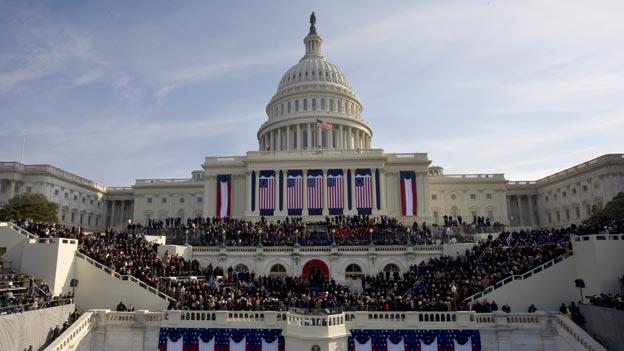
View of the Capital during President Obama’s First Inaugural (Jan. 2009)
Engility Holdings, a military contractor, recently settled a case which alleged torture by its contractors in Iraq in violation of international law. It was a case brought by former detainees. Previous conflicting federal court rulings, in 2009, had left the general issue of liability of military contractors in a combat zone unclear.
Another lawsuit against the contractor CACI International is currently proceeding in the federal court in the Eastern District of Virginia. The Virginia Supreme Court had previously refused to throw that case out. The Obama administration, in 2011, successfully argued before the U.S. Supreme Court that earlier cases were premature and should not be decided. However, the Obama Justice Dept. subsequently argued in Richmond for the present case to go forward.
It is in the interest of the United States to follow international law. It is in the interest of the United States for the Obama administration to be more forceful and consistent in upholding the rule of law against torture. It is good legal policy and good foreign policy. It is also what is required by basic American values and global standards.
As President Obama declared in his Inaugural Address in January 2009, “Our Founding Fathers, faced with perils that we can scarcely imagine, drafted a charter to assure the rule of law and the rights of man ….” In his forthcoming inaugural address, in January 2013, President Obama should make it clear that torture will not be tolerated by the courts of the United States. That liability will be imposed on U.S. corporations no matter where those actions occur.
“Contractor’s Torture Settlement Milestone.” Wall Street Journal (Jan. 10, 2013)
Posted in Global Trade Relations
Tagged CACI International, corporate liability for torture, detainees and international law, Engility Holdings, extraterritoriality of U.S. law against torture by U.S. corporations, inaugral address of 2009, international law and torture, military contractors, rule of law and rights of man, torture
Leave a comment
New Book — “Global Trade and International Law” — Many Issues and Many Approaches.
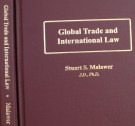
My new book GLOBAL TRADE AND INTERNATIONAL LAW has just been published by William S. Hein and Company (January 2013). This utilizes a multidisciplinary approach in assessing a broad range of international legal and global trade issues. These are issues that confront the United States and the global system currently and have confronted them over many years.
From the Preface by Dr. Peter S. Watson, former Chairman of the U.S. International Trade Commission ………….
“The book treats a wide range of topics, including broad political issues confronting the global system to those confronting individual states and persons. The author’s analysis clearly evidences the unique effect of globalization on all levels of government. He clearly understands inter-connected business and public policy problems within an interdisciplinary construct. He utilizes an interest analysis approach to policy formulation — one steeped in optimism and a belief in the strength of the American system, both political and economic, and the opportunities of global integration.”
Stuart Malawer, Global Trade & International Law (Hein and Company and HeinOnline) (2013).
(Preface and Introduction and Table of Contents)
Global Trade and International Law (ppt) (2013)

International Organizations and International Transactions — Can Global Agreements Help Resolve Conflict Over Sovereign Debt Restructurings and Investments by State-Owned Enterprises?
Two international economic areas have been in the news recently as wrought with conflict and need of a better mechanism to resolve disputes. The first is sovereign debt restructuring as evidenced by Argentina and Greece. The second is the conduct of state-owned enterprises in foreign direct investment as involving Chinese investments recently in Canada and the United States.
What models can be used to further resolve disputes in these two areas (sovereign debt restructurings and foreign investment by SOE’s)?
I would suggest looking at the proposals made by the IMF concerning sovereign wealth funds several years ago that resulted in the “Santiago Principles” of 2008. I would also suggest looking at the older IMF proposals concerning the “sovereign debt restructuring mechanism” (SDRM) of 2002.
Both sovereign debt restructuring and investments by state-owned enterprises (SOE) are essential to global trade today. The first really entails a sort of voluntary transnational bankruptcy proceeding for a nation. The second involves assessing foreign corporate ownership and management in terms of national security interests.
To me the best forum to revive these talks would be in the World Trade Organization. The notion of global trade has evolved gigantically since the GATT in the post-war era. Handling issues of global payments and investments is ripe for a serious assessment and global governance.
The WTO has proven itself in the adoption of a wide range of detailed rules-based agreements and the development of a remarkable dispute resolution system. It is about time that the global trdaing system moves forward to address these newer issues of this decade.
Two New Actions — Communications Satellites and GITMO — A More Assertive President?

Stuart Malawer at the White House (Jan. 2013)
Two very interesting legal developments seem to have been lost in passage and signing of the legislation avoiding the financial cliff, “The American Tax Payers Relief Act of 2012.”
Almost immediately after signing the fiscal cliff measure President Obama signed the National Defense Authorization Act of 2013. Among its numerous provisions it includes two critical ones.
One, allowing the export of communications satellites as commercial rather than as an export-controlled munitions. Two, imposing additional restrictions on transferring detainees from Guantanamo and Afghanistan in which President Obama attached a signing statement declaring that he has constitutional authority to override them.
These two actions indicate a more aggressive post-election policy by the president in promoting two of his goals — global trade and national security.
In particular, these goals have long been stated — reform of export control legislation and closing Gitmo.
Underlying these two actions is the general presidential concern for national security issues. The first, to promote greater exports by defense contractors as a means of lessening the impact of defense budget reductions. Second, reasserting the traditional observance of the rule of law in the war against terrorism.
While some hardliners may object to making communications satellites more readily available in the global marketplace and perhaps reverting back to the federal courts and prisons to deal with detainees from overseas hotspots, it is clear that President Obama is carefully weighting and calibrating national security concerns along with commercial and constitutional interests as we enter the new landscape of this decade. “Communication Satellites and Export Controls.” New York Times (January 4, 2013).
It is now more than twenty years since the Cold War ended and over ten years since 9/11. Global competitiveness and individual rights under the Constitution are making a comeback, somewhat. Keep in mind the participation of the U.S. in wars of the last decade helped drive U.S. competitiveness into the ground. (The defense budget doubled in real terms from 1998 – 2010 and the U.S. spends more on defense than the next 10 countries combined.)
To me it is time to adjust our wartime policies to a new global era where low-grade conflicts are likely to go on for years and where there are new players and new realities in the global marketplace. Global competitiveness of U.S. firms is essential to meet the domestic and foreign policy objectives of the United States. Observing the constitutional rights of all individuals under U.S. authority or control is also a good start.
Promoting exports and playing by the rules are hallmarks of the Obama presidency. Hopefully, this is just the beginning of a more assertive presidential administration in upholding U.S. values and U.S. competitiveness in the construct of viable U.S. national security interests. This could be a part of the real legacy of the Obama years.
Posted in Global Trade Relations
Tagged aggressive presidential actions, American Taxpayers Relief Act of 2013, arms exports and commercial exports, commercial and communication satellites, constiutional rights of detainees, Fiscal cliff legislation, Gitmo, hallmark of the Obama administration, National Defense Authorization Act of 2013, national security and trade, national securiy and export controls, rights and obligations of U.S. action, U.S. defense budget
Leave a comment
U.S. Treaty Practice — Hostage to Unrealistic Demands?
Treaty practice is an essential aspect of U.S. foreign policy. It is particularly important in trade and finance matters — from the WTO to bilateral investment treaties to international antitrust cooperation agreements.
Treaty practice is important also to a host of other areas where the U.S. has not yet acted — such as discrimination against women, disability rights, rights of children, law of the seas (law of the sea tribunal), and cybercrime. Unfortunately, this hesitancy is part of the DNA of the U.S. political system, where many conservatives are reluctant to ratify treaties or implement executive agreements because of unfounded concerns and misplaced and exaggerated emphasis on national sovereignty.
This restrictive treaty attitude is part and parcel of a general conservative disdain for both customary and conventional international law, espoused recently and consistently by the Supreme Court, conservative law professors and neo-cons, despite the clear provisions of the U.S. Constitution.
This is the situation even though the U.S. is the strongest proponent of the rule-of-law approach to foreign policy. Where U.S. administrations have declared consistently that human rights and free-market capitalism are cornerstones of U.S. foreign policy. It was the United states that was the principal architect of the rules-based system of the GATT and the WTO.
Most recently, the flagrant violation of international agreements by Argentina over restructuring of its sovereign debt and rights of private hedge funds as creditors, highlights the potential chaos that disdain for international agreements can bring to global trade and investment systems.
This practice by Argentina reflects its long history of rejecting international solutions to debt obligations and expropriations. It further highlights the necessity of developing more fully a global legal regime comprising both international agreements of the World Bank / IMF as well as domestic laws concerning foreign sovereign immunity.
Other commercial areas ripe for greater development are securities cooperation (as to foreign audits and financial disclosures), bankruptcy where assets are held globally, global taxation of foreign income, and global corruption in government procurement.
Further national and global legal advances are necessary to address the commercial and financial demands inherent in global transactions today, in this ever-increasing cross-border and digital era of commerce. The international trading and legal systems needs to adjust the multi-jurisdictional environment to rapidly expanding global transactions, by the largest and smallest of firms.
Posted in Global Trade Relations
Tagged Argentina, conservative opposition to international law and treaties, executive agreements, foreign soverign immunity, global transactions, international law, multi-jurisdictional world, national sovereignty and treaties, sovereign debt, U.S. Supreme Court, U.S. treaty practice, WTO / GATT legal system
Leave a comment

 Stuart Malawer
 U.S. LAW & GLOBAL TRADE RELATIONS.
You must be logged in to post a comment.