Trump and Ukraine — Beginning to Look Like Munich 2?

             Trump and Ukraine — Munich 2? — Beginning to Look Like it?

Just remember. After the sellout of the Czecks in Sept. 1938 of the Sudetenland, it only took the Nazis 6 months to take the rest of Czechoslovakia. They claimed the Sudetenland was German speaking. Then in another 6 months Nazi Germany invaded Poland — starting World War II. By the way Stalin’s Russia and Hitler’s Germany were allies. Remember the 1939 German-Russian Non-Aggression Pact. Appeasement is never good. ‘Peace for our time!’ as declared by Chamberlain didn’t work out — Lasted only a few months. Gave Germany and Russia time to plot the joint partition and demise of Poland. So much for Russian cooperation.

Leave a comment

Trump’s Tariff Actions — Destructive of U.S. Legal Rules and Global Trading System?

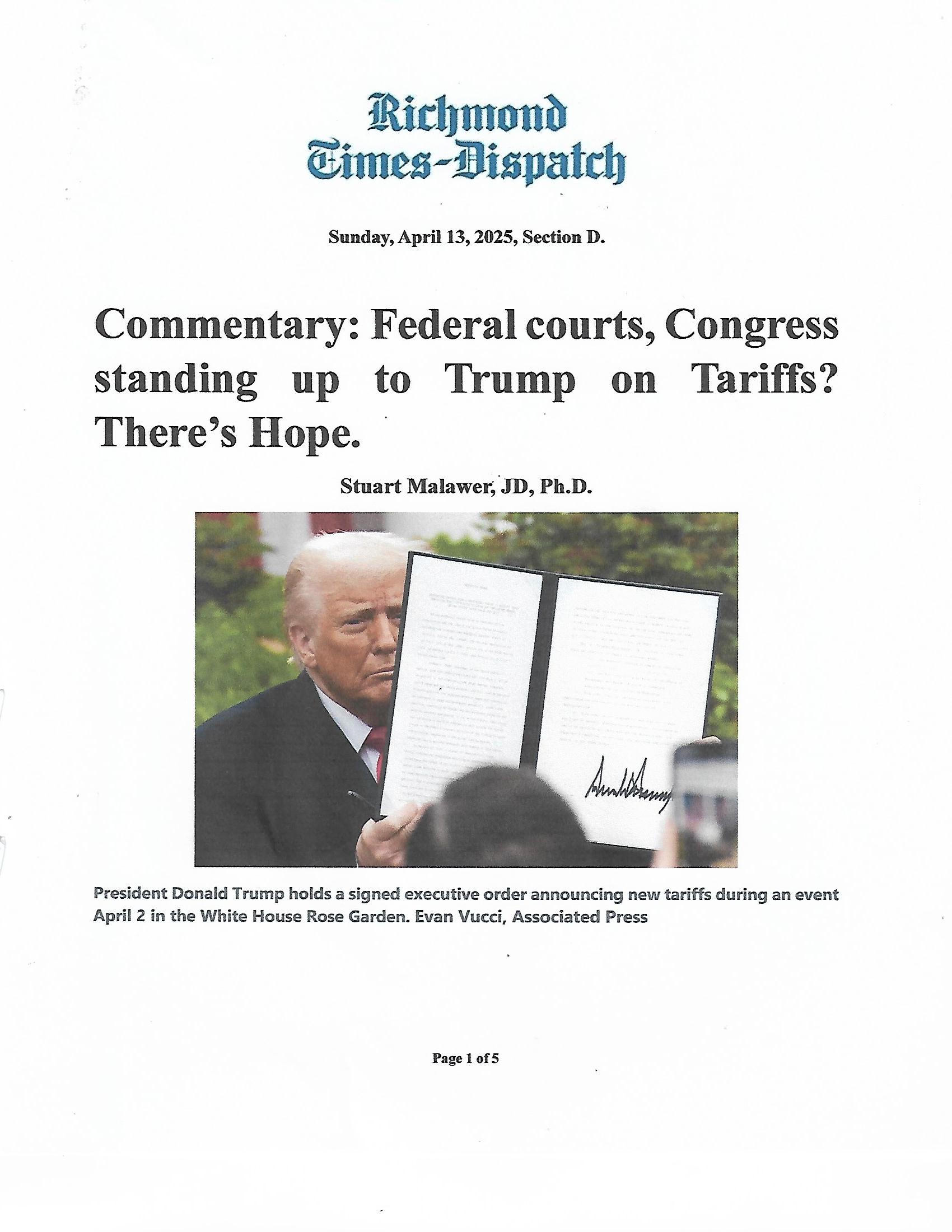
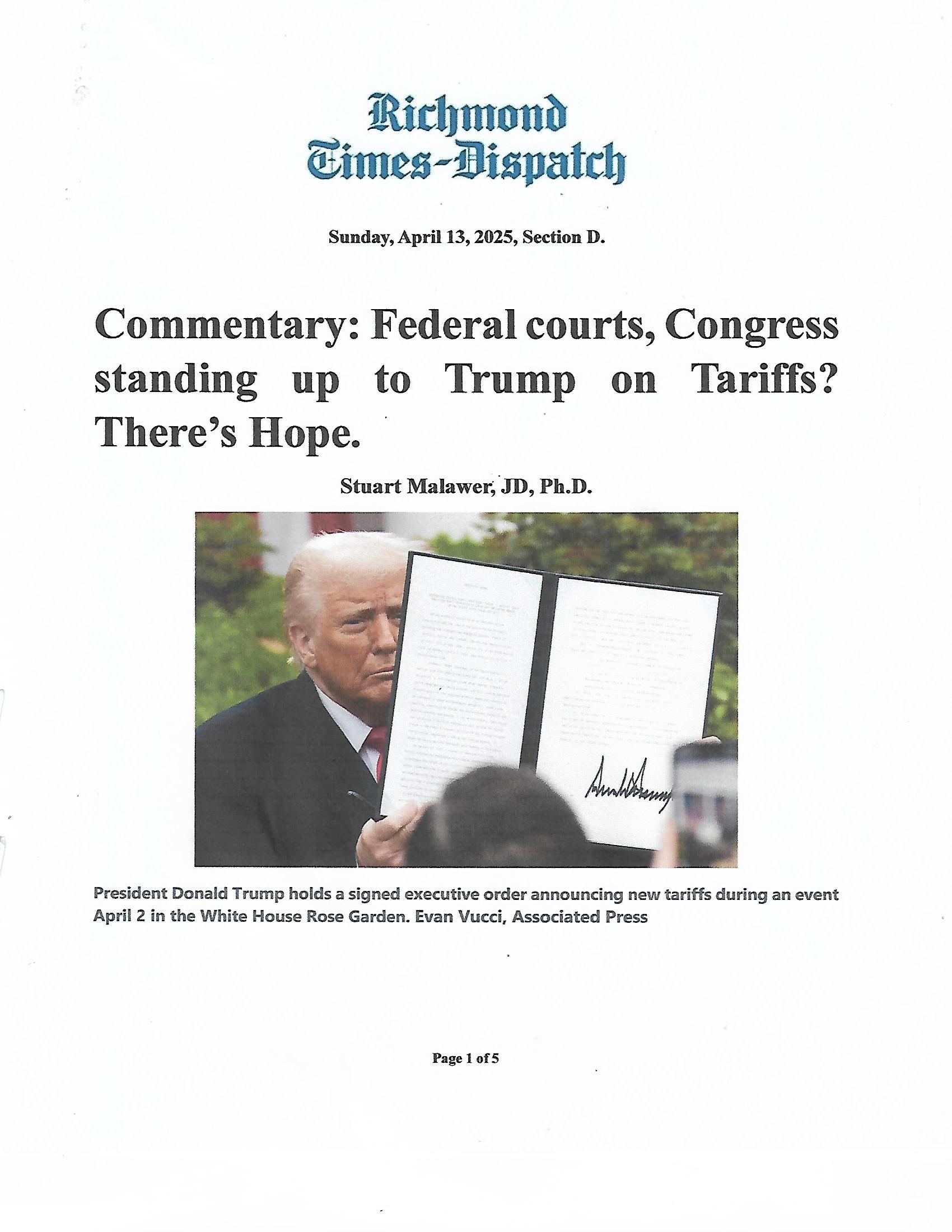
     As we wait for the federal courts to rule o the legality of Trump’s tariffs a few concerning voices are now being heard. One argues if the courts rule against Trump somehow that is bad because it will limit future presidents from acting. Of course, that the whole point. Another concern is that Trump has already killed the existing rules-based system. No, he hasn’t. Countries are fighting back as well as a wide range of American plaintiffs. Trump’s egomaniac efforts to destroy domestic and international rules will not stand. His weaponization of trade and outright banditry (often for his personal and family profit) is outrageous. It’s in no one’s interests. Courts need to declare Trump’s tariff actions as contrary to the Constitution. Stay tuned …………….

………………………………………………

“Judicial limits on the executive today will bind the hands of future presidents tomorrow …. We are days away from a major court ruling on a question that could decide the fate of the global economy: is Donald Trump’s trade war on the world legal? The courts are playing with fire …. The courts have repeatedly blessed these arrangements — until Trump, that is …. Among those representing anti-tariff plaintiffs is a Koch-funded law firm dedicated to “cutting the Administrative State down to size”, along with another libertarian outfit that has led attacks on labor unions and gun safety measures. These groups argue that Congress must prescribe in advance, in exhaustive detail, what specific threats presidents should address in the future, and how they should address them …. Yet libertarian legal doctrines like “non-delegation” and “major questions” are being marshalled not only against Trump’s tariffs, but also against labor …. Ultimately, the better resolution is for courts to step back.” “Trump and Tariff Litigation — Caution.” Financial Times (August 15, 2025).

The global trading system as we have known it is dead. The World Trade Organization has effectively ceased to function, as it fails to negotiate, monitor, or enforce member commitments. Fundamental principles such as “most favored nation” status, or MFN ….  If Washington continues on its current course—defined by unilateralism, transnationalism, and mercantilism—the consequences will be grim …. Yet clinging to the old system and pining for its restoration would be deluded and futile. Nostalgia is not a strategy; nor is hope …. Trade policy has gotten both more credit and more blame than it deserves in the economic debates of recent decades. Critics of the system tend to conflate the effects of globalization with those of trade policy …. Yet such arguments have always been a tough sell politically, since the benefits of trade liberalization are broadly shared but largely invisible …. The United States thus finds itself the subject of a grand experiment in which long-standing assumptions about economics and global trade are being questioned, with significant near-term costs and uncertain long-term benefits. The Trump administration has, in effect, turned the political economy of trade on its head …. A key benefit of open plurilateralism is the flexibility it provides. Not being beholden to holdouts in a system.” “Rules-Based Trade System is Dead.” Foreign Affairs (Sept. / Oct. 2025).

“The Trump administration seems to be catching on to what has been clear for some time: The president’s claim of virtually unlimited, unilateral power to impose tariffs at whatever rate he chooses is in serious legal trouble. Hence the blustery letter Justice Department officials sent Monday to the U.S. Court of Appeals for the Federal Circuit, which heard arguments on President Donald Trump’s tariffs last month. The letter warned of a second Great Depression if the court pared back Trump’s tariff authority …. But the administration might be realizing that its constant invocations of foreign affairs aren’t sufficient to wave off judicial review. It should have worked with Congress and put its trade dealings on a stronger legal foundation. There’s still time to do so.” “Bessent and Tariffs.” Washington Post (Aug. 18, 2025).

“The post-American world economy has arrived. U.S. President Donald Trump’s radical shift in economic approach has already begun to change norms, behaviors, and institutions globally …. This means a worse world for almost everyone. Amid this change, however, China’s immediate economic environment will be the least altered …. There will be opportunities in this new landscape. But they will involve the U.S. economy less and less …. The Trump administration has paved paradise and put up a casino, with what will soon be an empty parking lot.” “New Economic Geography.” Foreign Affairs (Sept. – Oct. 2025).

“This new era will be shaped by weapons of economic and technological coercion—sanctions, supply chain attacks, and export measures …. The problem for the United States is that the Trump administration is gutting the very resources that it needs to advance U.S. interests and protect against countermoves …. U.S. President Joe Biden also used weaponization as an everyday tool of statecraft. His administration took Trump’s semiconductor export controls to a new level …. Such institutional decay is the inevitable consequence of Trumpism. In Trump’s eyes, all institutional restraints on his power are illegitimate. This has led to a large overhaul of the apparatus that has served to direct economic security decisions over the last decades …. The main problem is that as national security and economic policy merge, governments have to deal with excruciatingly complex phenomena that are not under their control.” “Weaponized World Economy.” Foreign Affairs (Sept. – Oct. 2025).

“It’s now commonplace to say Trump’s shakedowns of trading partners and corporations for tax revenue (even entirely leaving aside the issue of his personal wealth) resemble a mafia boss or a crony-capitalist dictator in a developing country. It’s actually worse than that …. It will take a long time for Trump’s roving banditry, particularly his trade deals, seriously to weaken he US economy. About half of its economy is made up of small and medium-size businesses. But the direction is clear.” “Trump’s Roving Banditry.” Financial Times (Aug. 21, 2025).

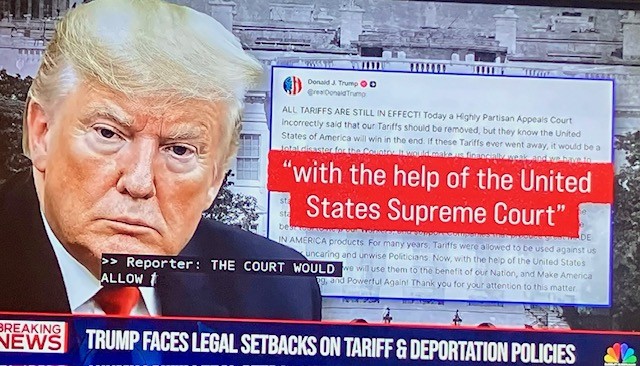
“After a slew of high-profile successes in the U.S. Supreme Court, the Trump administration found key parts of its agenda blocked in federal court this week, with judges criticizing its actions as “unlawful” and “unconstitutional.” Judges issued orders blocking the president’s use of the wartime Alien Enemies Act to speed deportations, the federal deployment of the National Guard for law enforcement purposes in California, the freezing of $2 billion in federal funds to Harvard, and the termination of protected legal status for hundreds of thousands of Haitians and Venezuelans …. The high court has granted the Trump administration’s emergency requests in 17 of 22 cases to date …. The ruling the president has expressed the most concern about was handed down on Aug. 29, when the U.S. Court of Appeals for the Federal Circuit found he had exceeded his authority when he imposed tariffs using an emergency powers statute.“Courts Push Back on Trump.” NBC News (Sept. 6, 2025).

“Mr. Trump this week asked the Supreme Court to hear the legal challenge to his tariffs on a fast track. The best news for the economy would be if the Court takes up his challenge and finds them unconstitutional.” “Trump’s Tariffs – Unconstitutional.” Wall Street Journal (Sept. 6, 2025).


Leave a comment

Trump’s Tariffs & National Security — Continuation of Trump 1.0, but More So — Questionable?

More so than any other president, Trump is using tariffs for non-economic reasons, primarily for national security — but in a very, very broad sense. In fact, he utilizes that rationale for many of his whimsical goals. This is even more pronounced now than during Trump 1.0. The impact of this will not be good for either the U.S. or the global trading system.

Now, he’s imposing an export tax on chips going to China. Guess no one in this administration ever heard of  Article I, Section 9, Clause 5 of the Constitution which states: “No Tax or Duty shall be laid on Articles exported from any State.” This means the federal government is prohibited from imposing taxes or duties on goods exported from the United States.

I guess also the Trump administration has never heard of  Article 8(1) of the 1994 GATTT which states: “All fees and charges of whatever character … imposed by contracting parties on or in connection with importation or exportation shall be limited in amount to the approximate cost of services rendered and shall not represent an indirect protection to domestic products or a taxation of imports or exports for fiscal purposes.”

…………………………….

“President Donald Trump’s freewheeling use of tariffs as a tool of American power may have been more extensive than was publicly known, encompassing an array of national security goals as well as the interests of individual companies …. Administration officials saw trade talks as an opportunity to achieve objectives that went far beyond Trump’s oft-stated goal of reducing the chronic U.S. trade deficit ….  Trump views tariffs as the Swiss Army knife of diplomacy …. A list of supplemental negotiating objectives, U.S. officials acknowledged that potential accords would cover issues, including military basing.” “Trump’s Tariffs and National Security Goals.” Washington Post (Aug. 10, 2025).

“America has flourished under free trade. Don’t upend the world based on exaggerations and lies …. Massive changes in public policy that are transforming the world are being made based on a series of assumptions that are anecdotes, exaggerations and lies …. But the main point is that the churn in the American labor market is huge. These days, on average about 30 million Americans in the private sector lose their jobs annually, and a similar number gain jobs every year. During the years of the China shock, the United States actually gained more than 2 million jobs overall …. In an economy as large and diverse as the United States, there will always be places that are struggling. Part of what makes this a more pressing problem is that Americans now rarely move from places where the economy has collapsed in search of better prospects.  As Yoni Appelbaum notes in his book  Americans used to be highly mobile, always searching for better opportunities. But in recent decades, they have stayed put, hoping that better economic prospects would come to them.” “MAGA and Trade.” Washington Post (August 11, 2025).

“President Trump views tariffs as a toll that he alone gets to set for access to U.S. markets. Now he’s charging fees on U.S. companies for the purported privilege of exporting artificial-intelligence chips to China. Mark this as another step toward government control of private business …. The Commerce Department imposed restrictions on the sale of Nvidia and Advanced Micro Devices AI chips to China this spring in the name of protecting national and economic security …. In any case, this is an export tax that Congress didn’t authorize. Will AMD or Nvidia challenge the political extortion in court? ”“Trump’s Export Tax on Chips,” Wall Street Jornal (August 12, 2025).

“Trump’s zeal for dealmaking knows no bounds …. But in recent days his quid pro quo approach has taken an even more ominous turn …. Chipmakers Nvidia and AMD had agreed to give the US government 15 per cent of the revenues from chip sales in China, in order to obtain export licenses for the semiconductors. This (export tax) is unprecedented: no US company has ever agreed to pay a portion of their revenues to obtain export licensees The legally dubious arrangement underscores that, under Trump, corporate America has entered an era in which business decisions will be dictated less by the invisible hand of the market and more by the heavy hand of the White House …. The cost of Trump’s transactionalism is clear: trading an economy grounded in the rule of law for one ruled by arbitrary deals. Such a system rewards a powerful few, punishes the small and unconnected, and ultimately erodes the stable foundations on which America’s prosperity has long rested. “Trump’s Pay to Play Economy.” Financial Times (August 12, 2025).

The president has threatened more tariffs on Russia and its trading partners and has imposed harsh ones on India and Brazil to try to sway matters of war and politics …. The Trump administration is not the first to impose tariffs on nations for reasons unrelated to trade policy. During the Napoleonic Wars, the United States wielded tariffs against Britain and France for geopolitical reasons …. And after Russia’s full-scale invasion of Ukraine in 2022, he added, the Biden administration imposed tariffs on imports of Russian aluminum …. Although U.S. courts might eventually rule against Mr. Trump’s use of emergency authorities to impose tariffs many businesses around the world have already felt the economic toll.” “Tariff Threats and Diplomacy. New York Times (Aug. 12, 2025).

“ Solicitor General John Sauer and Assistant Attorney General Brett Shumate made this week in a letter to the Court of Appeals for the Federal Circuit. The judges must give the President unilateral power to impose tariffs on any country at any time, or the end is nigh. Better buy gold and put your cash in a mattress. “If a Radical Left Court ruled against us at this late date, in an attempt to bring down or disturb the largest amount of money, wealth creation and influence the U.S.A. has ever seen, it would be impossible to ever recover, or pay back, these massive sums of money and honor,” Mr. Trump wrote Friday on Truth Social. “It would be 1929 all over again, a GREAT DEPRESSION!” …. The letter to the Federal Circuit judges illustrates the Trump style: try to intimidate by exaggerating the impact of a decision he doesn’t like and suggest he’ll blame the judges. We trust the judges won’t fall for it. If they do rule against the President and he appeals, we hope the Supreme Court quickly takes the case. “Trump’s Tariff Letter.” Wall Street Journal (August 13, 2025).

“Trump’s top lawyers  filed a letter on Monday with the U.S. Court of Appeals for the Federal Circuit, which is considering a legal challenge initially brought by small businesses and states. In a letter signed by D. John Sauer, the U.S. solicitor general, the government said a ruling against tariffs would undermine the president on foreign policy, jeopardize his recent trade deals and damage the U.S. economy …. For now, at least, the Trump administration’s plea to the courts illustrated the stakes for the president’s trade strategy, which hinges on his ability to impose or threaten tariffs on a whim, and without the need to obtain the approval of Congress …. The small businesses that sued the government responded on Tuesday. Lawyers for those firms, including VOS Selections, a wine importer in New York, told the court that the president did indeed have other powers to achieve his trade goals — and could, for example, “submit agreements for congressional approval.” “Trump Warns Court on Tariff Case.” New York Times (August 14, 2025).

Leave a comment

A Legal Strategy to Confront Trump’s Tariffs.

A Legal Strategy for Confronting Trump’s Tariffs


Stuart S. Malawer, JD, Ph.D.*


Under Trump, Biden, and now Trump again, U.S. trade policy has veered away from its traditional post-World War II approach—shifting from multilateralism to a focus primarily on national and unilateral concerns. At the center of this shift has been the unprecedented tariff increases by President Trump and a sharp rise in tensions with China. Major litigation has been filed against the Trump tariffs and may prove soon fatal to them.

The average U.S. tariff level in 2017 (at the start of Trump 1.0) was 1.1%; it is now 18.3%. His policy of ‘tariffs by threats’ are highlighted this week by threats to impose 50% tariffs on India, threat to impose broad reciprocal tariffs worldwide, threat to impose 100% tariffs on semiconductor chips and pharmaceuticals and additional tariffs on China. Most recently, President Trump threatened the federal courts not to overrule them. Just astonishing!

Geopolitical risk has become one of the most important factors in the formulation of U.S. trade policy and multinational corporate strategy. President Trump aggressively enacted tariffs based on national security under Section 232 of the 1962 Trade Expansion Act and based upon his national emergency powers under the 1977 International Emergency Economic Powers Act (IEEPA). Most recently, President Trump increased tariffs on India and Brazil to 50% for purely political reasons – primarily because of dissatisfaction with their freely-elected leaders.

President Trump has interpreted his trade and national emergency powers very broadly. Under Section 232 the president may “adjust imports of goods if it is determined that these imports threaten to impair national security.” IEEPA allows “the president to regulate international commerce after declaring a national emergency in response to any unusual and extraordinary threat to the United States which has its source in whole or substantial part outside the United States.”

What is not generally understood is the very broad range of trade statutes that govern the imposition of new tariffs by the president. The Congress has delegated much authority to the President, but the President needs to act within that delegation of authority. Often, the president relies upon more than one statute. Among the more important statutes are those relating to antidumping duties, countervailing duties, safeguard provisions (Section 201), retaliatory actions (Section 301), national security (Section 232), national emergencies (IEEPA), infringement of patents (Section 337), market disruption (Section 406), and agricultural imports (Section 22), among others.

Crucial to the debate over presidential authority is the basic fact that Congress has the exclusive constitutional power to regulate international trade and authorize tariffs (Article I, Section 8, Clause 3). The president has no independent authority over tariffs or trade. Congress delegates this authority to the president, who must act strictly within the bounds of that delegation. This has become a central issue in domestic litigation over a range of tariff actions taken by President Trump.

Unfortunately, Congress has failed to restrict President Trump’s excessive tariff measures. However, court cases have recently been filed in the U.S. Court of International Trade—a specialized federal court located in New York City—challenging several presidential actions. This court has ruled against the president. The case concerning reciprocal tariffs is currently on appeal to the U.S. Court of Appeals for the Federal Circuit. So far, that court has not been impressed by the Trump administration’s arguments.

Additional trade-related cases have been filed in other federal district courts, including the U.S. District Court in Washington, D.C., which has also ruled against the administration. The other cases have been transferred to the U.S. Court of International Trade.
In my view, this kind of domestic litigation may be a principal means of curbing excessive executive action in the trade area.

Surprisingly, these lawsuits filed challenging President Trump’s tariffs have been initiated by small companies and supported by conservative Republican megadonors, conservative attorneys, and several states—not by multinational corporations nor foreign entities. Most of these legal actions challenge the president’s reliance on national emergencies under IEEPA, asserting that the tariffs issued under this statute are invalid. They contend that the statute does not authorize use of tariffs, whatsoever. They argue also that no national emergency exists.

In assessing these claims, appellate courts need to closely examine whether the national emergency rationale is legitimate, whether the statute in question actually permits tariffs, as well as the actual existence of a national security threat. A broader constitutional question is whether some of these actions fall within the president’s expansive diplomatic and foreign affairs powers, where a President does possess broad authority under Article II of the U.S. Constitution.

It is well known that the President Trump has claimed sweeping executive authority on non-trade issues such as immigration and border control. Numerous courts have ruled against the administration. In fact, hundreds of cases have been filed on a wide range of issues, and the administration has lost many at the preliminary stages. Most notably, the administration’s reliance on the 1798 Alien Enemies Act to control immigration has been firmly rejected.

So, where does this leave firms and our trading partners in confronting the Trump administration’s historic use of tariffs—a shift that has reversed U.S. tariff policy back to the Depression-era 1930s—and its excessive reliance on economic threats, which has undermined the post-war international system the U.S. was the leader in building?

There is always the option of litigating trade disputes within U.S. federal courts—even though the Supreme Court has recently used the shadow docket to uphold various presidential actions, at least temporarily. Foreign states and foreign corporations, as well as domestic corporations and other entities, may very well have standing to challenge these actions in U.S. courts.

Countries should also continue to pursue litigation or arbitration through the WTO’s dispute resolution system, despite its weakening over the years due to U.S. resistance. China, the U.S., the EU, and the Russian Federation have previously litigated WTO cases with some notable success. A rules-based global trading system remains in everyone’s best interest.

As an international trade lawyer and professor with a focus on national security, I would personally like to see both China and the U.S. rely more on U.S. domestic legal procedures and WTO mechanisms to manage their trade relations.

The use of national security as a legal justification for trade actions has already been addressed by both federal courts in the U.S. and the WTO. Yes, this kind of domestic and international litigation poses challenges. But it may well offer a viable path forward. There is no downside in trying.

In conclusion, tariffs are no longer an obscure technical issue. Nor are they solely economic. Tariffs have become geopolitical tools. For President Trump, they are instruments to impose his will on other nations—whatever the reason or motivation. What is needed now is a willingness among government and private leaders to pursue a legal strategy.

My belief is that rational actors exist in many countries. Actors who understand that their national interest includes a more effective and fair trading system. It is up to these leaders to work toward better trade relations within a legal framework that promotes the welfare of nations and their people.

From my experience—over fifty years of teaching international trade, national security, and international law—and working with students, foreign scholars, and policymakers around the world, I know that goodwill, combined with a sound legal strategy, might lead to a workable solution and a return to normalcy.

……………………

*Dr. Stuart S. Malawer, JD, Ph.D., is Distinguished Service Professor of Law and International Trade Emeritus at George Mason University (Schar School of Policy and Government). He is the author of books on international business, international trade, international law, and national security. He is the founder and former Director of the Graduate International Transactions Program at George Mason University. He is a member of the Bars of the Commonwealth of Virginia and the U.S. Court of International Trade.


Leave a comment

Litigation and Trump’s Tariffs – Restoring Better Trade Relations.

       Litigation and Trump’s Tariffs – Restoring Better Trade Relations.

                           Stuart S. Malawer, JD, Ph.D.*

Under Trump, Biden, and now Trump again, U.S. trade policy has veered away from its traditional post-World War II approach—shifting from multilateralism to a focus primarily on national and unilateral concerns. At the center of this shift has been the unprecedented tariff increases enacted by President Trump and a sharp rise in tensions with China. The average U.S. tariff level in 2017 (at the start of Trump 1.0) was 1.1%; it is now 18.3%.

Geopolitical risk has become one of the most important factors in the formulation of U.S. trade policy and multinational corporate strategy. President Trump aggressively enacted tariffs based on national-security under Section 232 of the 1962 Trade Expansion Act and based upon his national emergency powers under the 1977 International Emergency Economic Powers Act (IEEPA). Most recently, President Trump increased tariffs on India to 50%.

President Trump has interpreted his trade and national emergency powers very broadly. Under Section 232 the president may “adjust imports of goods if it is determined that these imports threaten to impair national security.” IEEPA allows “the president to regulate international commerce after declaring a national emergency in response to any unusual and extraordinary threat to the United States which has its source in whole or substantial part outside the United States.”

What is not generally understood is the very broad range of trade statutes that govern the imposition of new tariffs by the president. Often, the president relies upon more than one statute. Among the more important statutes are those relating to antidumping duties, countervailing duties, safeguard provisions (Section 201), retaliatory actions (Section 301), national security (Section 232), national emergencies (IEEPA), infringement of patents (Section 337), market disruption (Section 406), and agricultural imports (Section 22), among others.

Crucial to the debate over presidential authority is the fact that Congress holds the exclusive constitutional power to regulate international trade and authorizes tariffs (Article I, Section 8, Clause 3). The president has no independent authority over tariffs or trade. Congress delegates this authority to the president, who must act strictly within the bounds of that delegation. This has become a central issue in domestic litigation over a range of tariff actions taken by President Trump.

Unfortunately, Congress has failed to restrict President Trump’s excessive tariff measures. However, court cases have recently been filed in the U.S. Court of International Trade—a specialized federal court located in New York City—challenging several presidential actions. This court has ruled against the president. The case concerning reciprocal tariffs is currently on appeal to the U.S. Court of Appeals for the Federal Circuit. So far, that court has not been impressed by the Trump administration’s arguments. Additional trade-related cases have been filed in other federal district courts, including the U.S. District Court in Washington, D.C., which has also ruled against the administration.

In my view, this kind of domestic litigation may be a principal means of curbing excessive executive action.

Surprisingly, these lawsuits filed challenging President Trump’s tariffs have been initiated by small companies and supported by conservative Republican megadonors, conservative attorneys, and several states—not by multinational corporations or foreign entities. Most of these legal actions challenge the president’s reliance on national emergencies under IEEPA, asserting that the tariffs issued under this statute are invalid. They argue also that no national emergency exists.

In assessing these claims, appellate courts need to closely examine whether the national emergency rationale is legitimate, whether the statute in question actually permits tariffs as well as the actual existence of a national security threat. A broader constitutional question is whether some of these actions fall within the president’s expansive diplomatic and foreign affairs powers, where he does possess broad authority under Article II of the U.S. Constitution.

It is well known that the president has claimed sweeping executive authority on non-trade issues such as immigration and border control. Numerous courts have ruled against the administration. In fact, hundreds of cases have been filed on a wide range of issues, and the administration has lost many at the preliminary stages. Most notably, the administration’s reliance on the 1798 Alien Enemies Act to control immigration has been firmly rejected.

So, where does this leave firms and our trading partners in confronting the Trump administration’s historic use of tariffs—a shift that has reversed U.S. tariff policy back to the Depression-era 1930s—and its excessive reliance on economic threats, which has undermined the post-war international system the U.S. helped build?

There is always the option of litigating trade disputes within U.S. federal courts—even though the Supreme Court has recently used the shadow docket to uphold various presidential actions, at least temporarily. Foreign states and foreign corporations may very well have standing to challenge these actions in U.S. courts.

Countries should also continue to pursue litigation or arbitration through the WTO’s dispute resolution system, despite its weakening over the years due to U.S. resistance. China, the U.S., the EU, and the Russian Federation have previously litigated WTO cases with some notable success. A rules-based global trading system remains in everyone’s best interest.

As an international trade lawyer and professor with a focus on national security, I would personally like to see both China and the U.S. rely more on U.S. domestic legal procedures and WTO mechanisms to manage their trade relations.

The use of national security as a legal justification for trade actions has already been addressed by both federal courts in the U.S. and the WTO. Yes, this kind of domestic and international litigation poses challenges. But it may well offer a viable path forward. There is no downside in trying.

In conclusion, tariffs are no longer an obscure issue. Nor are they solely economic. Tariffs have become geopolitical tools. For President Trump, they are instruments to impose his will on other nations—whatever the reason or motivation. What is needed now is a willingness among government and private leaders to pursue a legal strategy.

My belief is that rational actors exist in many countries. Actors who understand that their national interest includes a more effective and fair trading system. It is up to these leaders to work toward better trade relations within a legal framework that promotes the welfare of nations and their people.

From my experience—over fifty years of teaching international trade, national security, and international law—and working with students, foreign scholars, and policymakers around the world, I know that goodwill, combined with a sound legal strategy, can lead to a workable solution.

……………………

*Dr. Stuart S. Malawer, JD, Ph.D., is Distinguished Service Professor of Law and International Trade Emeritus at George Mason University (Schar School of Policy and Government). He is the author of books on international business, international trade, international law, and national security. He is a member of the Bars of the Commonwealth of Virginia and the U.S. Court of International Trade.

 

Leave a comment

George Mason University — Global University.

Leave a comment

More Lawsuits, More Tariffs, More Trade Agreements — More Uncertainty for Firms — But Courts Will have the Last Word, Maybe.

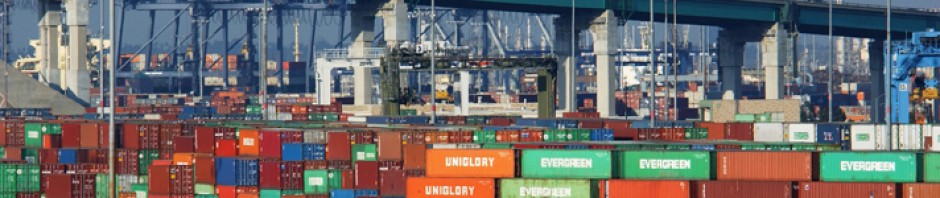
      Number of lawsuits are piling up against the Trump administration. They have lost many and have refused to comply with a significant number. All along negotiating new tariff deals and giving support to the U.S. tech industry. Yet, the global economy is doing well and consumers have not really been hurt yet (but some firms have been). However, U.S. container imports are falling sharply, signaling that rising tariffs may be starting to drag on economic momentum.

     Trump’s transactional approach to trade is a disaster. The federal courts have a good chance of stopping this, hopefully. A major hearing is set for this week and next and of course the Supreme Court will make the final decision — which may very well go against the administration – – knocking out most tariffs and trade agreements fostered by Trump. But the litigation will take time.

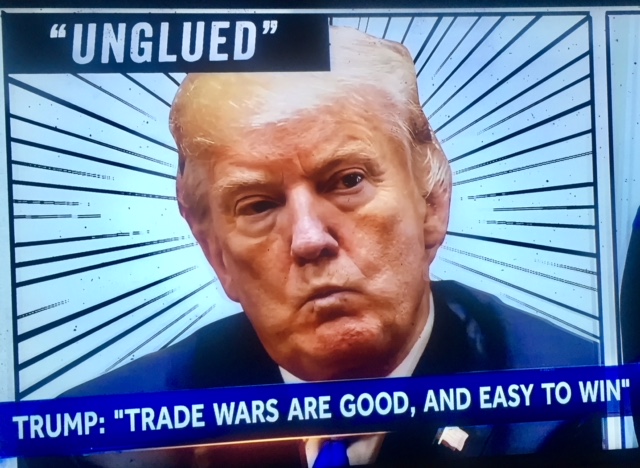
Trump’s tariffs are nothing more than diplomatic shake downs for political gain or just for whim.

………………………………..

“We examined 337 lawsuits filed against the administration since Trump returned to the White House and began a rapid-fire effort to reshape government programs and policy. As of mid-July, courts had ruled against the administration in 165 of the lawsuits. The Post found that the administration is accused of defying or frustrating court oversight in 57 of those cases — almost 35 percent.” “Flouting of Judges Orders.” Washington Post (7.22.25)

“The administration hopes to use the threat of tariffs and access to the U.S. economy to stop multiple countries from imposing new taxes, regulations and tariffs on American tech companies and their products.” “Tariffs Threats to Help Technology Industry.” Wall Street Journal (7.22.25).

“How quickly and completely Trump has transformed the world’s expectations regarding tariffs. In a few short months, the president has normalized tariffs at rates that would have been shocking just months ago. But by threatening even higher levies and holding out the prospect of devastating trade wars, he has somehow made sharply higher tariffs feel like a relief. The reaction is largely due to the incredible uncertainty the president has created with his global trade negotiations. “Highest Tariffs in a Century.” New York Times (7.24.25).

“The Supreme Court says the nondelegation doctrine, which undergirds the separation of powers, “bars Congress from transferring its legislative power to another branch of Government” without providing “an intelligible principle to guide the delegee’s use of discretion.” Today’s president insists that IEEPA grants presidents unbounded discretion in wielding a power that is neither granted to him by the Constitution nor delegable by Congress …. Today’s president is a hare, darting here and there. The judiciary is generally a tortoise, slow because it is deliberative. But you know the fable. And here is a fact: This tariff case could markedly restrain this rampant presidency.” “Tariff Case and Trump Presidency.” Washington Post (7.25.25).

“ Trump has turned the United States into a revisionist power seeking to shatter what remains of the economic order. Thus far, his approach has been needlessly chaotic …. If the Trump administration hopes to salvage a victory from its trade wars, Washington must use tariffs as leverage in pursuit of clear and achievable trade objectives rather than as a blunt tool wielded in pursuit of myriad and mutually incompatible ones …. Trump has demonstrated little interest in adopting a more deliberate, methodical approach to negotiations or to recalibrating his means to meet more achievable ends …. There is an alternative, even more worrisome path the trade wars could take. After tearing up the existing global trade rules, the United States could advance a more nakedly transactional approach in its international economic relations, eschewing any rules or shared norms that might constrain U.S. action.” “Ending the Trade War.”Foreign Affairs (July-August 2025).

“Wall Street analysts are betting hard against Trump’s trade agenda surviving in court. The lawsuits stacking up across the country are gunning straight for the legal base of his tariff powers. And they’re not just hoping to overturn a few decisions; they’re trying to wipe out nearly all of Trump’s recent trade deals by arguing he had no authority to make them in the first place …. At the center of the fight is the V.O.S. Selections v. Trump case, which is about to hit the Federal Circuit this Thursday. That case, along with several others, argues that the POTUS’ use of the International Emergency Economic Powers Act (IEEPA) to impose tariffs is flat-out illegal. The lower trade court already agreed, saying Trump went too far by using a law that doesn’t even mention tariffs. The Court of Appeals paused that decision, but the battle is far from over, since it’s moving toward the Supreme Court …. For months, small businesses and state attorneys have been pushing back against Trump’s trade moves. His administration used IEEPA as the legal shield for a long list of tariffs, including the 10% minimum tariff, the fentanyl-related duties on China, Canada, and Mexico, and the reciprocal tariffs he announced in early April …. The court found multiple instances where Trump had imposed tariffs outside the scope of IEEPA. Another blow came just one day later from a federal court in Washington, D.C. …. And if the Supreme Court does strike the tariffs down, it won’t just be a policy setback. It would take out almost every trade deal announced in the past six months.” “Law Suits Against Trump’s Tariffs.” MSN (7.28.25).

President Donald Trump’s sweeping tariff powers and recent trade deals could soon run into a legal buzzsaw. A federal appeals court is set to hear oral arguments next week in a high-profile lawsuit challenging Trump’s stated authority to effectively slap tariffs at any level on any country at any time, so long as he deems them necessary to address a national emergency. The Trump administration says that that expansive tariff power derives from the International Emergency Economic Powers Act, or IEEPA …. The U.S. Court of International Trade struck those tariffs down in late May, ruling that Trump exceeded his authority under IEEPA …. But the U.S. Court of Appeals for the Federal Circuit quickly paused that decision, keeping the tariffs in effect while Trump’s legal challenge plays out. The case, known as V.O.S. Selections v. Trump, is the furthest along of more than half a dozen federal lawsuits challenging Trump’s use of the emergency-powers law …. Trump will probably continue to lose in the lower courts, and we believe the Supreme Court is highly unlikely to rule in his favor.” “Trump’s Trade Deals and Tariffs on Chopping Block in Court.” CNBC (July 28, 2025).

“Well, that was painful. For the Trump Administration’s lawyer, that is. The U.S. Court of Appeals for the Federal Circuit on Thursday Aug. 31, 2025) heard oral arguments in a challenge to President Trump’s worldwide tariffs (V.O.S. Selections, Inc. v. Trump). Judge after judge doubted the Administration’s arguments. The Administration says the 1977 International Emergency Economic Powers Act grants a President sweeping authority to impose tariffs. The 11 judges were mostly skeptical. Out of the gate one judge pointed out that no President has ever used the emergency law to impose tariffs …. The High Court’s Loper Bright (2024) landmark says that judges shouldn’t automatically defer to regulators’ interpretations of vague laws. The Court’s major questions doctrine also holds that Congress must give the President express authority for actions with economic and political significance …. But the Constitution gives Congress the power to regulate trade. Congress has delegated to the President limited authorities to impose tariffs that typically entail procedural requirements—for instance, up to 15% for 150 days in response to “large and serious” balance-of-payments deficits (Section 122) and on countries with discriminatory trade practices (Section 301) ….  But as the small business plaintiffs argue, the President isn’t a king, and the Constitution doesn’t let him command the trade tides.” “Appeal for Trump’s Tariffs.” Wall Street Journal (August 1, 2025).

“The Post examined 337 lawsuits filed against the administration since Trump returned to the White House and began a rapid-fire effort to reshape government programs and policy. As of mid-July, courts had ruled against the administration in 165 of the lawsuits. The Post found that the administration is accused of defying or frustrating court oversight in 57 of those cases — almost 35 percent.” “Trump and Law Suits.” Washington Post (August 4, 2025).

“We are now in a new world. Even to trade nerds, the complexity of this is just bonkers …. The reciprocal tariffs will raise levies even on economies with new US trade deals, including the EU and Japan. China, the world’s biggest exporter, is separate: its trade war truce with Washington ends on August 12. “Trump’s Tariffs and Global Trade War.” Financial Times (August 7, 2025).

“Several suits claim the president has overstepped his authority …. Trump’s future use of tariffs as a negotiating tool is likely to be determined in the courts, where several states and businesses argue that he lacks the statutory authority to impose sweeping tariffs on all countries that trade with the U.S. …. V.O.S. Selections, Inc. v. Trump On April 14, V.O.S. Selections and four other import companies sued the Trump administration in the USCIT, claiming the president exceeded his statutory authority under the International Emergency Economic Powers Act (IEEPA) by imposing tariffs without congressional authorization …. On April 23, 12 states filed a parallel lawsuit, mainly making the same arguments. So, the USCIT consolidated the two cases, and a three-judge panel ruled on May 28 that the president had no authority to impose across-the-board tariffs under the IEEPA. As a result of the findings, the USCIT issued a permanent injunction against future tariffs.  Learning Res., Inc. v. Trump On April 22, Learning Resources Inc. and hand2mind Inc., two small businesses specializing in educational products, filed a lawsuit challenging the legality of Trump’s tariffs under the IEEPA. A judge from the U.S. District Court for the District of Columbia issued a preliminary injunction on May 29, preventing the Trump administration from collecting IEEPA tariffs from the two plaintiffs. However, the U.S. Court of Appeals for the District of Columbia Circuit (CADC) granted the administration’s request for a stay until it could rule on the case’s merits. (Other cases have been filed in federal district courts and they have been stayed and transferred to the U.S. Court of International Trade.) “Five Court Cases and Trump’s Tariffs.” Supply Chain Dive (August 8, 2025).

President Trump has warned U.S. courts against blocking his tariff policy …. Trump’s comments come as a federal appeals court is hearing arguments on how to handle his tariff policy. Former House Speaker Paul Ryan said that the Supreme Court could end up disqualifying the duties that have been ordered under the International Emergency Economic Powers Act enacted by Congress in 1977.” “Trump’s Tariff Litigation & Trump Warns Courts.” CNBC (August 8, 2025).

President Trump has warned U.S. courts against blocking his tariff policy …. Trump’s comments come as a federal appeals court is hearing arguments on how to handle his tariff policy. Former House Speaker Paul Ryan said that the Supreme Court could end up disqualifying the duties that have been ordered under the International Emergency Economic Powers Act enacted by Congress in 1977.” “Trump’s Tariff Litigation & Trump Warns Courts.” CNBC (August 8, 2025).

“The uneven outcome of the latest round of trade talks has highlighted how the 79-year-old president is increasingly using tariffs not only to meet economic goals but also to advance geopolitical and diplomatic interests …. Trump had shown an inclination to deploy tariffs as a diplomatic negotiating tool in the past …. But Trump’s willingness to impose commercial punishment on countries for strictly non-economic reasons has increased dramatically during the first six months of his second term. The additional levies on India and Brazil come on top of Trump’s move to place extra tariffs on China, Canada and Mexico …. And while post-second world war global trade rules have historically given countries latitude to impose trade restrictions based on national security considerations, trade experts fear that Trump’s moves are especially brazen and could further break down the international trading system …. While the fresh reciprocal tariffs imposed this week are broadly lower than the aggressive duties set in early April, trade experts warn that the deals reached may well be fragile. “Trump’s Tariffs and Diplomatic Shakedowns.” Financial Times (August 9, 2025).


Leave a comment

Two Ways to Stop Trump’s Tariff Chaos — Federal Courts & Coordinated Ally Retaliation.

      What can stop Trump from wrecking the U.S. and global economies because of his unlawful use of the tariff power — authorized by the U.S. Constitution, but only to the Congress to impose — unless delegated and executive actions are within that delegation?  Simple, the federal courts and our allies standing together to respond forcefully (this includes working through the WTO to enforce the most-favored-nation-principle). Tariffs are not the way to go. Unfortunately, our allies are not responding tough enough. Maybe only China is standing up to Trump. But he’s still at it.

……………………………………

“It cannot be said too often that this is nonsensical economics. There is absolutely no reason why bilateral trade should balance. The fact that it does not do so certainly does not show that the surplus country is “cheating” …. So, what is to be done about this madness? First, we should hope that Trump does indeed chicken out again and again and again, though the uncertainty created would still be costly. Second, there must be retaliation — ideally coordinated retaliation — against the US. Third, all members of the World Trade Organization should declare that any trade concessions made to the US will be extended to other members, in accordance with the “most favored nation” principle. Finally, the other members should also abide by their agreements with one another.”  “Trump’s Return to Tariffs.” Financial Times (July 16, 2025).

“One remaining factor that could significantly lower Trump’s tariffs are the challenges that are now proceeding through the legal system. Federal courts have called into question the legal authority that Mr. Trump has used to threaten his global tariffs, and they are expected to rule on that question this fall.” “U.S. Tariffs Hurting Real Economy.” New York Times (July 15, 2025).

America’s trading partners have largely failed to retaliate against Trump’s sweeping tariffs, allowing a president taunted for “always chickening out” to raise nearly $50bn in extra customs revenues at little cost …. Global brands can try and swallow some of the tariff cost through smart sourcing and cost savings but the majority will have to be distributed across other markets, because US consumers might swallow a 5 per cent increase, but not 20 or even 40 …. But despite US tariffs hitting levels not seen since the 1930s, the timidity of the global response to Trump has forestalled a retaliatory spiral of the kind that decimated global trade between the first and second world wars.” “Trump’s Tariffs and the World Relents.” Financial Times (July 17, 2025).

“A common theme running through these global developments is that rivals such as China seem to be faring better in dealing with Trump’s challenge to the global order than are traditional U.S. allies including Japan and European nations. Except for Britain, countries are often finding that the reward for being a loyal partner is a punch in the nose …. Trump took a roundhouse swing at the global economic system when he announced his tariffs April 2. He hit his target, and the system is swinging like a broken piñata. Trump might back down when he sees strength, as in China’s response. But mostly, he’s still punching.” “Playing Nice with Trump, Doesn’t Work.” Washington Post (July 18, 2025).

“One thing that tariffs alone will never do is make the United States an attractive place to innovate. Yes, tariffs belong in our trade arsenal — but as precision munitions, not as land mines that maim foes, friends and noncombatants equally …. Policymakers must recognize that most of our difficulties with China are shared by our commercial allies. We should be acting in unison with the European Union, Japan and the many countries …. Prevent the devastating impacts of job loss from the next major. The scarring effects of manufacturing-job loss have caused America a heap of economic and political trouble over the past two decades ,,,, But when industries collapse, our best response is getting displaced workers into new jobs quickly and making sure the young, small businesses that are responsible for most net U.S. job growth are poised to do their thing. Tariffs, which narrowly protect old-line manufacturing, are terribly suited for this task.” “Next China Schock.” New York Times (July 2025).

Leave a comment

Further Unbridled Presidential Power Grab and Global Chaos — Will Courts and Trading Partners Limit This? ….. Maybe.

     Once again, Trump is trying to steal the show — claiming he has the right to violate the law, make himself the center of attention, and to further cause chaos in a number of domestic and international fields.

     His recent threats of higher tariffs on our closest allies Japan, Korea, Canada (again), copper tariffs, EU and Brazil are the latest example of use of tariffs as his favored economic policy and tool for changing international politics — according to his daily whims. (For example, aiming to change Brazilian elections and Brazilian litigation because he favors the former Brazilian president).

     U.S. courts and Congress have so far failed to stop his illegal threats and coercion violating both U.S. domestic and international trade law.  I fact, it’s getting worse. There seems to be a total collapse of law concerning trade — both on the domestic level in the U.S. and on the international playing fields.

     However, I believe the federal courts and our trading partners (by forming newer alliances and trade patterns) are going to become more proactive and effective in stopping this unbridled extension of executive power. They will help to reorient the trading system and geopolitics to a more predictable and law-based system. Chaos and uncertainty cannot continue.

……………………………………………..

“Whatever comes out of Trump’s “reciprocal tariffs” idea, or indeed his sectoral tariffs on cars and so on, isn’t actually going to work. They won’t close the US current account deficit, they won’t lead to a manufacturing revival, and they won’t replace revenue from federal income tax …. Let’s also recall: Trump’s tactics are extremely random …. And finally, let’s remember he has at least seven targets: reciprocity, revenue, restriction (that is, protectionism), the current account, clientelism, coercion and confusion. At the moment, he’s actually enjoying creating uncertainty and making himself the center of attention.” “Trump an Disorder.” Financial Times (July 7, 2025).

“The Attorney General told tech companies that they could lawfully violate a statute barring American companies from supporting TikTok based on a sweeping claim that President Trump has the constitutional power to set aside laws, newly disclosed documents show …. Shortly after being sworn in Trump issued an executive order directing the Justice Department to suspend enforcement of the TikTok ban and has since repeatedly extended it. That step has been overshadowed by numerous other moves he has made to push at the boundaries of executive power in the opening months of his second administration …. Essentially, legal experts said, Mr. Trump is claiming a constitutional power to immunize private parties to commit otherwise illegal acts with impunity …. Last year, Congress enacted a law that banned the app in the United States unless its Chinese-owned parent company, ByteDance, sold it to a non-Chinese firm.” “Trump Invalidated TikTok Ban.” New York Times (July 6, 2025).

“The Supreme Court last week sharply curtailed the ability of federal judges to block a presidential action nationwide, even if they find it unconstitutional. That followed its decision last year granting the president broad immunity from prosecution for crimes committed in the course of his core duties …. The Senate several days ago rejected a resolution that would have let Congress decide, under its war powers, if President Donald Trump can strike Iran again. And Congress in recent months has repeatedly declined to assert its constitutional authority over spending or tariffs …. The Constitution does not permit the executive branch to unilaterally commit an act of war against a sovereign nation that hasn’t attacked the United States.” “Congress, High Court Cede Power to the President.Washington Post (July 7, 2025).

“Looking through the trade data, is it easy to see how Trump’s tariffs will hurt American businesses and consumers. Imports from Japan last year included $9.9 billion in assorted industrial machines, $7.5 billion in pharmaceutical preparations, and $3.1 billion in medicinal equipment. South Korea sent over $8.5 billion in semiconductors, $7.4 billion in computer accessories, and $3.2 billion in household appliances …. One illusion that’s bursting is that Trump is imposing tariffs in the cause of free trade. He’s imposing tariffs because he likes them as an economic policy. The U.S. average effective tariff rate when Mr. Trump took office was 2.4. As of last month, Trump had cranked that up to 15.6%.” “Tariff Man is Back.” Wall Street Journal (July 8, 2025).

“Yet another aspect is Trump’s extensive use of emergency powers and executive orders. He has made 168 of the latter in just the first few months of this term, bringing his total far above those of his recent predecessors. Trump rules by decree. That is one of the signs of a dictatorship …. Above all, the trade war is not over. The 90-day pause on “liberation day” tariffs is due to come to an end. Deals have not been reached with more than a handful of partners. This economically destructive war on US creditors and, above all, the uncertainty it creates, will continue. The trade war represents an assault on the institutions created by the US after the second world war. It is also damaging US alliances. More broadly, all US commitments are in doubt.”  “Trump’s Assault” Financial Times (July 9, 2025).

“There remain two rather large missing pieces in the international response. One is a positive rather than a passive policy reaction from other governments. The other is that multinational businesses are finding ways round the US tariffs in the short term but otherwise largely holding back from permanently moving their investments to restructure supply chains. A prolonged period of destructive uncertainty about trade policy from the US may change their minds.” “Trump’s Tariff Shambles.” Financial Times (July 11, 2025).

Instead of viewing tariffs as part of a broader trade policy, President Trump sees them as a valuable weapon he can wield on the world stage …. But while Trump spoke about tariffs off and on before becoming a presidential candidate, he usually described his broader grievance about trade in terms of other countries or companies “ripping off” the United States. It is since Trump became a candidate in 2015 that he has talked about tariffs in earnest, describing them as a tool that he could easily deploy to rebalance the country’s economic footing.” “Trump’s Tariffs – A power Tool, Not Trade Tool.” New York Times (July 11, 2025).

“President Trump’s threat for a 50% tariff on Brazilian imports expanded his use of punitive duties over matters that have nothing to do with trade, breaking with more than a half-century of global economic precedent …. And on Thursday evening, in a new letter to Canada’s leader, Trump said the U.S. will impose 35% tariffs on some Canadian imports starting Aug. 1, citing the fentanyl crisis among other grievances with the country …. Trump’s moves have shaken the global trade order established in the 1940s, when market economies sought to put tariffs and trade among them on a stable footing …. Trump’s approach carries legal risks. In May, the U.S. Court of International Trade struck down many of the president’s tariffs, saying they weren’t justified by the emergency legal authority that he cited. An appeals court will hear the case on July 31, a day before Trump’s so-called reciprocal tariffs are scheduled to go back into effect on Brazil and scores of other nations.” “Trump Employs Tariffs as Political Cudel.” Wall Street Journal (July 11, 2025). 

“Six months into his new administration, Trump’s assault on global trade has lost any semblance of organization or structure …. The resulting uncertainty is preventing companies and countries from making plans as the rules of global commerce give way to a state of chaos ….Yet even reaching a trade deal may not diminish uncertainty.” “Trump’s Whims & Rules of Global Trade.” New York Times (July 12, 2025).

“The move showed Mr. Trump’s new willingness to use tariffs to settle political scores, regardless of questions of legality, because of their sheer power to cause economic destruction and impose intense political pressure …. And in recent months, Brazil had been a winner in the global tariff war. Its beef exports to the American market doubled and its coffee shipments increased by over 40 percent in the first five months of the year, as threats of tariffs by Trump on other major exporters like China and Vietnam made Brazilian products more attractive.” “Tariffs and Brazil’s Prosecution.” New York Times” New York Times (July 12, 2025).

“The first world war smashed that complacency apart. Protectionism, populist politics and nationalism exploded, causing globalisation and free-market ideas to unravel. Instead, in the interwar years commerce became subordinated to statecraft …. After 1945, there was another pendulum swing. Western governments embraced the ideas advanced by Keynes that the state should use public finances and institutions to manage domestic demand cycles — and allies collaborated around institutions such as the IMF and World Bank to boost global trade and financial links. This rejected the zero-sum vision of commerce and finance that had dominated in the interwar years …. Then, in the 1980s, another shift occurred: leaders such as Margaret Thatcher and Ronald Reagan rejected the domestic agenda of Keynes and instead embraced the free-market ideas …. Now, with Trump, we see a backlash against 1980s neoliberal economics, coupled with a rejection of the spirit of internationalism …. Thus when Joe Biden became president in 2021, he not only retained many of Trump’s tariffs but embraced activist industrial policy ….
The Trump team, however, is taking this to new extremes. They operate with a “zero-sum” mentality and an obsession with power politics that was arguably last seen in the 1930s. And this is not just playing out with tariffs but could soon affect the sphere of finance too …. Geopolitical competition means we are seeing a return to strategic statecraft …. All countries are going to need to get much better at thinking strategically, about . . . their approach to using every lever of the state … Many cling to the hope, after all, that the eruption of geoeconomics in the west will be a temporary phenomenon, likely to end when Trump leaves office. And it is far from clear that the rest of the world will follow the US into greater mercantilism and isolationism. “Global Trade and Geopolitics.” Financial Times (July 12, 2025).

Trade chaos is forcing America’s allies closer together, and further from the United States …. We’re living in turbulent times, and when economic uncertainty meets geopolitical volatility, partners like us must come closer together …. In hard times, some turn inward, toward isolation and fragmentation.” “Trade Chaos and Allies Moving Closer Together.New York Times (July 14, 2025).

Leave a comment

Dr. Malawer & Global TV Interviews on Trump’s Tariffs.

     Recent global TV interviews by Dr. Malawer on Trump’s Tariffs.

Some Global TV Interviews on Trump’s Tariffs (2025)

Stuart S. Malawer, JD, Ph.D.  (July 1, 2025).

Leave a comment