RSS Feed
-
Recent Posts
- Supreme Court and Tariffs — Updates — Decision Soon, but Uncertain.
- Malawer, Foreign Studies and Global Trade (1990 – 2025).
- Farmers and Trump’s Tariffs and Bailout Proposal — Still Farmers Support is Very, Very Tenuous.
- Trump’s Farm Proposals (Bailout) — The Real Issue is Not Tariffs (nor China), but Domestic Politics & the Upcoming Midterm Elections.
- Tariff Decision and Refunds Soon — Maybe.
Archives
- January 2026
- December 2025
- November 2025
- October 2025
- September 2025
- August 2025
- July 2025
- June 2025
- May 2025
- April 2025
- March 2025
- February 2025
- January 2025
- December 2024
- November 2024
- October 2024
- September 2024
- August 2024
- July 2024
- June 2024
- May 2024
- April 2024
- March 2024
- February 2024
- January 2024
- December 2023
- November 2023
- September 2023
- August 2023
- June 2023
- April 2023
- March 2023
- February 2023
- January 2023
- December 2022
- November 2022
- October 2022
- September 2022
- August 2022
- July 2022
- June 2022
- May 2022
- April 2022
- March 2022
- February 2022
- December 2021
- October 2021
- August 2021
- June 2021
- May 2021
- April 2021
- February 2021
- January 2021
- December 2020
- November 2020
- September 2020
- August 2020
- July 2020
- June 2020
- May 2020
- April 2020
- March 2020
- February 2020
- January 2020
- November 2019
- September 2019
- June 2019
- April 2019
- January 2019
- November 2018
- October 2018
- September 2018
- June 2018
- May 2018
- March 2018
- February 2018
- January 2018
- December 2017
- November 2017
- October 2017
- September 2017
- August 2017
- July 2017
- June 2017
- May 2017
- April 2017
- March 2017
- February 2017
- January 2017
- December 2016
- November 2016
- October 2016
- September 2016
- August 2016
- July 2016
- May 2016
- April 2016
- March 2016
- February 2016
- January 2016
- December 2015
- November 2015
- October 2015
- September 2015
- August 2015
- July 2015
- June 2015
- May 2015
- April 2015
- March 2015
- February 2015
- January 2015
- December 2014
- November 2014
- October 2014
- September 2014
- August 2014
- July 2014
- June 2014
- May 2014
- April 2014
- March 2014
- February 2014
- January 2014
- December 2013
- November 2013
- October 2013
- September 2013
- August 2013
- July 2013
- June 2013
- May 2013
- April 2013
- March 2013
- February 2013
- January 2013
- December 2012
- November 2012
- October 2012
- September 2012
- August 2012
- July 2012
- June 2012
- May 2012
- April 2012
- March 2012
- February 2012
- January 2012
- December 2011
- November 2011
- October 2011
- September 2011
Categories
Meta
-
Trump and the Supreme Court — Will His Last Line of Defense Hold? Maybe Yes, But Maybe Not.
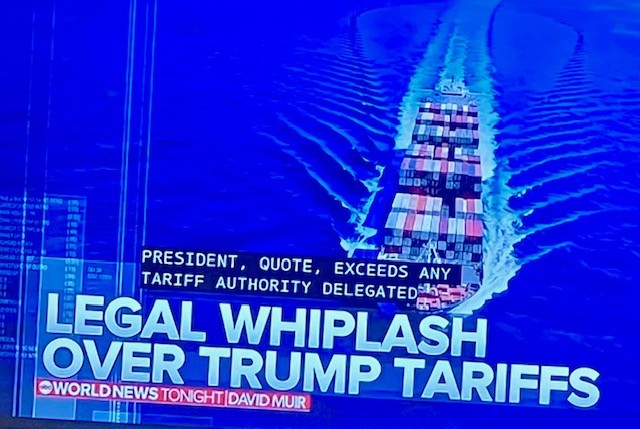
More on the role of courts — the Supreme Court and Trump. Is the Supreme Court Trump’s last and best hope of defense against a myriad of lawsuits? Yes. But success is not certain — over tariffs or other abuse of executive power — including use of illegal force on the high seas — in violation of U.S. and international law. Speculative investors are already buying up potential tariff refund claims 10 cents on the dollar — believing that Trump will lose the tariff case in the Supreme Court.
However, the Trump administration has won a recent appeals decision concerning his China tariffs under Section 301 (‘Retaliation’) from his first term and has recently imposed new Section 232 tariffs (national security) this week, Trump continues to double-down aggressively even in light of increasing opposition. Not unexpected. But surely to increase the chaos for the U.S. and international legal and political systems ……….
……………………………………….
“While President Donald Trump’s aggressive use of executive power has resulted in a flurry of lawsuits, administration officials have won a series of high-profile victories at the Supreme Court …. But only a small number of the more than 300 active lawsuits filed against the Trump administration have made it to the Supreme Court. The White House has won 18 times at the Supreme Court since Trump took office and is on a 15-case winning run …. So far, the Trump administration has asked the Supreme Court to weigh in on an emergency basis 28 times …. It has lost only two …. The Supreme Court has granted Trump administration requests to block lower court rulings in more than 70% of cases brought by the administration that were decided via the shadow docket …. Big cases are on the horizon, including a consequential showdown on Trump’s ability to unilaterally impose tariffs on imported goods.” “Trump’s Supreme Court Victories.” NBC News (Sept. 22, 2025).
“But who will draw that line? …. Before the Gulf of Tonkin, there was Havana Harbor. In 1898, America embraced war and imperialism because, well, “Remember the Maine!” The U.S. battleship supposedly was blown up by a Spanish mine. Its sinking has long since been ascribed to an accidental internal explosion.” “Trump Sinks Boats.” Wall Street Journal ((Sept. 21, 2025).
“The tariffs fall into two buckets. The first, known as the “trafficking” tariffs, apply to goods from Canada, China, and Mexico – countries that, in Trump’s view, have not taken sufficient measures to stop the flow of fentanyl into the United States. The second, known as the “reciprocal” tariffs, impose tariffs ranging from 10% to 50% on products from almost all nations. Three separate challenges followed their imposition. The first, filed in a federal court in Washington, D.C., came from two small, family-owned businesses, Learning Resources and hand2mind, that make educational toys and products. They say that the tariffs will cost them $100 million in 2025 – almost 45 times as much as they paid in tariffs the previous year. Two other challenges to the tariffs were filed in the Court of International Trade, which is in New York. A separate group of five small businesses brought one suit. One of the plaintiffs, Terry Cycling, which makes women’s cycling apparel, says that the tariffs could cost the company as much as $1.2 million in 2026 – “an amount,” it contends, “that is simply not survivable for a business of its size.” The second suit, brought by a group of 12 states, led by Oregon, contends that the tariffs have increased the costs that the states must pay to buy “equipment, supplies and parts, many of which are imported from other countries” – for example, specialized research equipment for their public universities. Both U.S. District Judge Rudolph Contreras and the Court of International Trade agreed with the challengers that the tariffs exceeded Trump’s power under IEEPA. Learning Resources and hand2mind then came to the Supreme Court in June, asking the justices to take up the case without waiting for the U.S. Court of Appeals for the District of Columbia Circuit to rule on the government’s appeal. On Aug. 29, the U.S. Court of Appeals for the Federal Circuit, which hears appeals from the Court of International Trade, ruled that Trump did not have the power to impose the tariffs. By a vote of 7-4, it said that imposing “tariffs of unlimited duration on imports of nearly all goods from nearly every country with which the United States conducts trade” is “both ‘unheralded’ and ‘transformative.’” Reasoning that “[t]he Executive’s use of tariffs qualifies as a decision of vast economic and political significance,” the majority explained that the government was therefore required to “‘point to clear congressional authorization’” for its actions – which, the majority concluded, it could not do. The Trump administration came to the Supreme Court on Sept. 3, asking the justices to take up the case. Both the small businesses and the states maintained that the lower courts’ rulings were correct, but they agreed that the court should grant review – which it did on Sept. 9. The court fast-tracked the case, as well as the case brought by Learning Resources and hand2mind, which it had also granted, and scheduled oral arguments for Nov. 5.” “Tariff Case.” SCOTUS blog (Sept. 19, 2025).
“Wall Street investors are buying up claims to potential tariff refunds, betting that the Supreme Court will strike down Trump’s signature economic policy and require the government to disgorge tens of billions of dollars that companies have paid this year in import taxes …. A handful of hedge funds and specialized investment firms are offering importers around 20 cents for every dollar they paid in Trump’s “reciprocal” tariffs and roughly 5 cents per dollar for levies on Canadian, Mexican or Chinese goods stemming from the president’s ire over fentanyl trafficking …. The Supreme Court within months could join two lower courts in ruling some or all of the IEEPA tariffs illegal, which would deal the White House a major political setback. The nation’s highest court has agreed to hear a pair of related cases with oral argument scheduled for Nov. 5.” “Investors and Trump Tariff Refunds.” Washington Post (9.25.25).
“On September 25, 2025, the U.S. Court of Appeals for the Federal Circuit (“CAFC”) issued its decision upholding tariffs imposed during President Trump’s first administration pursuant to Section 301 on goods imported from China.” “Section 301 Trump Tariffs Upheld from First Term.” Husch Blackwell (Sept. 26, 2025).
TRUMP’S TARIFFS AND MORE CHAOS.

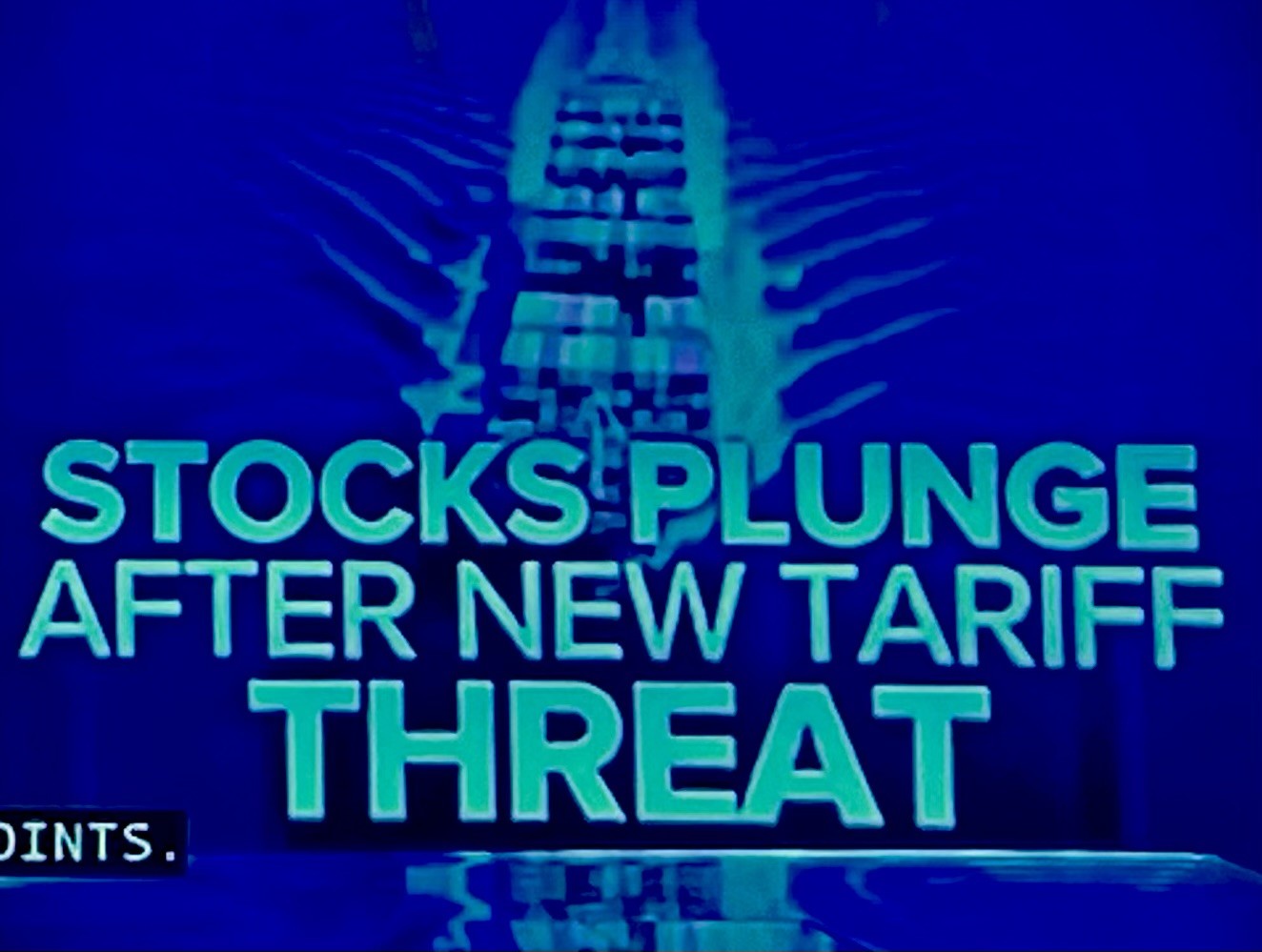
Trump’s tariffs and trade policies continue to cause chaos — domestic and international. U.S. farmers have lost a great percentage of their exports and now many farmers risk failure and bankruptcy. For example, soybean farmers have lost significant export sales since the high under the Biden admiration. Their imported inputs such as fertilizer, seeds and machinery have significantly increased in cost. Soybean sales to China last year were $12.6 billion, for this year so far (2025) — $0.
A wide range of trade disputes continue with China, Japan, Korea, India, Indonesia, Vietnam, the EU, the UK, Brazil, Canada, Mexico, Venezuela and Columbia. Trump threatens additional sanction on Russia, Iran and so forth. The list grows almost daily, if not hourly, depending on Trump’s whims and crony influence by family and friends — including his new tech, finance and crypto bros.
…………………………………….
“The Trump administration is drawing up plans to use tariff revenue to fund a program to support US farmers as they head into harvest facing falling export sales …. The move follows mounting pressure from farm groups after China curbed purchases of new crop US soyabeans and as tariffs have pushed up costs for fertilizer, machinery and other imported inputs …. Trump administration is reinstating a vision of “trading America” not seen since Alexander Hamilton at the end of the 18th century …. US agrifood exports were the highest ever in dollar terms during Biden’s presidency from 2021 to 2024 …. Trump’s aggressive tariff agenda has targeted Beijing, prompting steep retaliatory duties on US products, including up to 34 per cent on American soyabeans.” “Trump’s Tariffs to Provide Bailouts for Farmers Hurt by Retaliatory Tariffs.” Financial Times (Sept. 19, 2025).
“China stopped buying soybeans from America in May, placing a retaliatory tariff on the bumper crop after President Trump increased levies on goods from China …. Soybeans are the single largest American export to China in terms of value, $12.6 billion worth last year. But as the fall harvest gets underway across the country — 9 percent of planted beans had been harvested as of last week — the country that bought 52 percent of all American soybean exports last year is completely absent.” “Soybeans to China this Year – $0 – Last ear $12.6 Billion.” New York Times (9.26.25).
Supreme Court and the Tariff Case — Restricting Presidential Abuse — Maybe.
Click to access Malawer.Trump,_Courts_and_Congrss_RTD_4.13.25_.pdf
The Supreme Court will be hearing Trump’s tariff case this November. Trump’s tariffs can lead to an additional 100,000 unemployed. His most recent tariff actions have caused total chaos in trade relations with Korea and Japan as well as other countries including India, China and the EU (over Russian oil purchases). They have already amounted to essentially billions of a new sales tax on U.S. firms and consumers. They may need to be refunded if the Supreme Court denies the validity of his tariffs. They have also resulted in significant less employment in various industries and inflation in the U.S.
If Trump’s tariff actions are upheld, this will result in one of the biggest business tax increases ever. The Supreme Court will be reviewing the president’s emergency actio0n within the context of several pieces of legislation, most notably IEEPA (1977). This is probably the most important tariff case ever and crucial to Trump’s outrageous tariff actions this year.
Here’s the two cites to the lower courts and appeals court decisions against Trump and these tariffs. Keep in mind this is actually only one case of many challenging Trump’s historically abusive attempts at extending presidential authority in a broad range of areas. Trump constantly threatens federal judges and courts. (He also berates foreign and international courts — such as the International Criminal Court — but that’s another story.)
His total disdain for the U.S. legal system is further evidenced by his unfounded multi-billion-dollar lawsuits against the New York Times and Wall Street Journal for reporting on his business failures. Keep in mind also that Trump’s limited success on the shadow or emergency docket concerning provisional measures does not mean much in projecting success on the merits in the pending tariff case.
Of course, the Republicans in the House continue to block any actions against Trump’s tariffs, but the Democrats in the Senate have been somewhat successful in bringing resolutions to a vote and passing them. (Led by Senator Kaine of Virginia.) We’ll see more shortly.
………………………………………………….
V.O.S. SELECTIONS, INC.
Trump’s Tariff Case (Court of International Trade) (2025). https://www.cit.uscourts.gov/sites/cit/files/25-66.pdf
Trump’s Tariff Case (U.S. Court of Appeals for the Federal Circuit) (2025). https://www.cafc.uscourts.gov/opinions-orders/25-1812.ERRATA.9-2-2025_2566341.pdf
…………………………………………….
“For the president, the power to issue limitless tariffs is at the heart of his second-term vision, from trade to foreign policy …. When Trump unveiled his initial slate of punishing tariffs he fashioned the announcement as a critical moment in a dawning global trade war …. His gambit could be in peril, after the Supreme Court agreed to hear a case challenging the legality of Trump’s actions. Now his administration is confronting the potential loss of a powerful tool at the heart of his second-term strategy, one that has allowed the president to force concessions from companies, allies and adversaries …. But judges have repeatedly ruled against Trump, with one panel of judges finding that the president did not possess “unbounded authority” to impose tariffs, especially without the approval of Congress. While the courts have not always choked off the emergency powers law as a way of imposing any tariffs, the judges in each of the cases have still found the president’s duties to be a step too far …. Tariffs aren’t free and, contrary to the administration’s persistent claims, Americans pay them.” “Tariffs and the Pending Supreme Court Case.” New York Times (Sept. 11, 2025).
“In the span of 24 hours last week, Trump managed to roil both South Korea and Japan, two longtime allies that less than two months earlier had said they would invest a combined nearly $1 trillion in the United States in exchange for lower tariffs. U.S. immigration officials raided the construction site of a major Hyundai-LG plant in Georgia, a flagship project by two of South Korea’s most prominent companies. Hundreds of South Korean citizens were arrested and detained …. On the same day, Trump signed an executive order enacting a trade deal he had struck with Japan in July, committing Japan to invest $550 billion in the United States. The order codified the reduced automotive tariffs that Tokyo had desperately sought. However, it came with a memorandum of understanding between the two countries stating outright that Trump, not Japanese officials, will select how the $550 billion will be invested in …. In both Japan and South Korea, increasingly vocal leaders in government and business feel their countries were strong-armed and are questioning whether it still made sense to comply with Trump’s demands.” “Japan and Korea Fury Over Tariffs.” New York Times (Sept. 12, 2025).
“Trump has often claimed that foreign exporters, not Americans, pay tariffs. In fact, importers (such as retailers) remit the duty to the government. They can, in theory, persuade exporters to absorb some or all of the tariff, or pass it along to their customers. While who ultimately pays can’t be known precisely, several economists estimate that American businesses paid 50% to 60% of Trump’s tariffs to date, with the balance split roughly between exporters and consumers …. So if the Supreme Court gives Trump what he wants, tariffs could end up as one of the biggest business-tax increases in decades, wiping out the tax benefits for expensing capital investment in this year’s Republican tax and spending law. “Tariffs Case and Massive New Powers.” Wall Street Journal (Sept. 12, 2025).
“The U.S. Constitution doesn’t have a general emergency authority. Instead, we have a web of laws that give the president special powers in specific circumstances. Trump has relied upon that web of laws in a systematic way that none of his peacetime predecessors did …. Trump has used 10 emergency declarations to justify hundreds of actions. Consider: The Alien Enemies Act of 1798 empowers the president to quickly deport foreigners during a war or an invasion — but doesn’t say what an invasion is. The International Emergency Economic Powers Act of 1977 says the president can take action against an “unusual and extraordinary threat.” But the trade deficit Trump cites as the reason for his tariffs is usual and ordinary. An appeals court said last week that tariffs imposed by executive order were illegal, but Trump is appealing to the Supreme Court …. This isn’t like the most naked seizures of power in modern history, such as the Nazi takeover after the Reichstag fire in 1933. “ “Trump’s Declaration of Emergencies.” New York Times (Sept. 12, 2025).
“Trump administration prevailing much more often (in the Emergency or Shadow Docket) than its predecessor had — 84 percent of the time, compared with 53 percent for the Biden administration …. In the 17 cases in which the Biden administration sought emergency relief from the Supreme Court over four years …. By contrast, in the 19 cases in which the court has ruled on applications from the second Trump administration …. Rulings on emergency applications filed by the government, moreover, tend to present the same essential questions: how much deference is due the president and whether temporarily blocking a government program challenged as unlawful would cause more harm than letting it proceed …. The emergency docket presents a different portrait of the court, one in which partisan affiliations map onto voting patterns quite closely, reinforcing the declining public confidence in the court reflected in opinion polls …. It is premature to draw larger conclusions about how the second Trump administration will fare at the Supreme Court. Its many victories arising from its second-term initiatives have so far all been in the context of emergency applications for interim relief, and it may face serious headwinds when the court considers cases on the merits. The justices agreed to hear challenges to Trump’s sweeping tariffs, and legal experts say he could well lose …. Partisan politics plays out far more in the emergency applications than in the merits cases.” “Supreme Courts Emergency Rulings – Show Split.” New York Times (Sept. 14, 2025),
“President Donald Trump’s rebukes of judges and courtroom prosecutors have extended far beyond the United States’ borders in his second term in office, as he and his officials question the fairness of an increasing number of foreign nations’ domestic court systems …. Trump had also invoked sanctions against the International Criminal Court, which the administration has accused of illegitimately asserting jurisdiction and abusing its power …. Trump trying to undermine anything that places limits on what states can do, whether it’s a limit on what a state can do to its own country, or a limit on how states can be judged internationally. Trump wants to undermine the power of institutions that would put a check and balance on a single national leader.” “Trump Opposes Foreign & International Courts Also.” Washington Post (Sept. 14, 2025).
“The federal Court of International Trade (CIT) surprised most of us in May by ruling against the deceitfully named “reciprocal tariffs”, saying that the International Emergency Economic Powers Act (IEEPA) under which they were imposed wasn’t meant for that purpose — though the duties remained in place pending further action. Two weeks ago the Court of Appeals for the Federal Circuit, ignoring Trump’s bizarre warning that striking the tariffs down would destroy the country, upheld the ruling, though again left them in place for now. Last week the Supreme Court decided it would take up the case with great haste and would hold hearings in the first week of November …. It was clear from the beginning of his administration that Trump had little regard for domestic and international trade law …. The specialist Court of International Trade and the appeals court focused precisely on interpretations of statute, and specifically whether the IEEPA was designed to delegate decisions over tariffs to the president. Given that the first section of the US constitution says that the power to impose tariffs is given to Congress …. Both courts decided that IEEPA does not so delegate, and therefore it cannot be used to impose tariffs. At the point the case moves on to the Supreme Court, the trade lawyers shift a bit to the side and the constitutional lawyers edge into the spotlight. The current Supreme Court justices are not collectively a courageous bunch, and Trump has deliberately raised the stakes with his hysterical claims about the judgment destroying the US. More concretely, permanently striking the tariffs down will mean giving up revenue and refunding the money taken in so far. The Committee for a Responsible Federal Budget, a non-profit organisation that analyses US fiscal policy, says that revenue from Trump’s tariffs is now pushing above 1 per cent of GDP. A negative Supreme Court judgment would reduce the projected revenue gains from an estimated $2.8tn by the end of 2034 to $800bn. That’s a big chunk of money to find from somewhere else.” “U.S. Tariff Litigation.” FT—Trade Secrets (Sept. 15, 2025).
“The Republican-led House moved again to relinquish Congress’s power to weigh in on Trump’s tariffs, even as Democrats in the Senate prepared to force votes challenging his trade war …. It was the latest instance in which House Republicans, many of whom have spent much of their career opposing tariffs as a matter of principle, have given up their power over trade …. Democrats in the Senate, where the minority has more tools at its disposal have made more headway in forcing tariff votes through the national emergencies statute. Senator Tim Kaine, Democrat of Virginia, intends to bring forward two resolutions in the coming days to terminate the emergencies Trump declared to justify tariffs on Canada and Brazil.” “Republicans, Congress and Trade – Update.” New York Times (Sept. 19, 2025).
It’s Not Just Tariffs — Are Trump’s Actions Unconstitutional? Where are the Courts and the Congress?
The Trump administration continues to erode the power of Congress, trampling on its constitutional prerogatives in ways large and small. Rather than the tariff policy, the key question is how much the courts will serve as a lasting check on an administration committed to materially reshaping the domestic and international economic orders. So far so good. Litigation has proven the only effective response to Trump to date. We’ll see. By the way, domestically, Trump has instituted state-owned corporate shares and profit-sharing with the government and rang in cronyism in economic policy and government actions.
Federal judges are frustrated with the Supreme Court for increasingly overturning lower court rulings involving the Trump administration with little or no explanation. Congress is doing nothing. A few former Republican senators have objected.
His tariffs are causing domestic harm and more is to come. The billons of questionable tariffs already collected may be ordered refunded. They were really a national sales tax to fund Trump’s bloated budget, tax bill and increased deficits. The Supreme Court will be hearing the historical tariff case in November and a decision may be reached by the end of the year.
Worst of all, countries are not following us. They are moving on.
…………………………………..
“The Supreme Court agreed Tuesday to quickly hear the Trump administration’s bid to save its sweeping global tariffs, setting the stage for a final ruling on a cornerstone of the president’s economic agenda. The court in a brief order said it would hear the case in early November, a schedule that could deliver a ruling before the end of the year. It will be the first time the high court has decided on the legality of a major policy from Trump’s second term …. The trade case raises little-explored questions about the president’s unilateral power over the economy. Trump has said that a 1977 law gives him broad powers to impose baseline levies of 10% on virtually every nation—and much higher rates for countries that don’t cut deals with the U.S., as well as an additional set of tariffs for Canada, China and Mexico …. Several courts so far have found that the law, the International Emergency Economic Powers Act, doesn’t authorize Trump to do these things …. Several cases about Trump’s authority in other spheres could land on the Supreme Court’s docket in the new term that starts in October.” “S.Ct. Fast Tracks Tariff Case.” Wall Street Journal (Sept. 9, 2025).
“The Trump administration continues to erode the power of Congress, trampling on its constitutional prerogatives in ways large and small. Through it all, Republicans in charge have mostly shrugged — and in some cases, outright applauded — as their powers, once jealously guarded, diminish in ways that will be difficult to reverse …. What is different now is the degree of disdain Mr. Trump has shown for Congress — and the willingness of G.O.P. leaders to defer to him even when it means undercutting their coequal branch of government ….. There’s absolutely no question the president doesn’t have the power to take airstrikes on boats outside U.S. waters with no authorization of war …. This president believes he’s above the law. He doesn’t believe the law applies to him. He doesn’t believe the Constitution applies to him, and if we act like that’s normal, then we just encourage the continued illegal constitutional behavior …. The Trump administration also has dismantled government agencies and offices created by Congress.” “Trump Tramples Congress and it Doesn’t Do Anything.” New York Times (Sept. 7, 2025).
“Rather than the tariff policy, the key question is how much the courts will serve as a lasting check on an administration committed to materially reshaping the domestic and international economic orders. This issue is likely to be tested many times in the coming months and years, with an answer that has significant consequences for many around the world and remains uncertain.” “Significance of Tariff Ruling.” Financial Times (Sept. 4, 2025).
“Federal judges are frustrated with the Supreme Court for increasingly overturning lower court rulings involving the Trump administration with little or no explanation, with some worried. In rare interviews with NBC News, a dozen federal judges — appointed by Democratic and Republican presidents, including Trump, and serving around the country — pointed to a pattern they say has recently emerged …. Lower court judges are handed contentious cases involving the Trump administration. They painstakingly research the law to reach their rulings. When they go against Trump, administration officials and allies criticize the judges in harsh terms. The government appeals to the Supreme Court, with its 6-3 conservative majority. And then the Supreme Court, in emergency rulings (Ghost Docket), swiftly rejects the judges’ decisions with little to no explanation. Emergency rulings used to be rare. But their number has dramatically increased in recent years.” “Federal Judges Criticize Supreme Court.” NBC News (Sept. 4, 2025).
“Much of what is blamed on trade these days has more to do with technological changes, inadequate social policies, and macroeconomic imbalances in big nations such as China and the US. But the trading system itself does need reform. Built for interdependence not over-dependence, too many members today are overdependent on the US for market demand and on China for critical supplies. This is not a recipe for global resilience …. Another area where members need more creativity is the WTO’s dispute settlement system. It remains the only trade dispute resolution mechanism with global reach, although its appellate body has been paralyzed since 2019. Under the radar, though, more and more members are still using the system to resolve disputes.” “Stress Test for Global Trade.” Financial Times (Sept. 5, 2025).
“But something else has changed, too. We are no longer in the muzzle velocity stage of this presidency. We are in the authoritarian consolidation stage of this presidency. I want to be very clear about what I am saying here. Donald Trump is corrupting the government — he is using it to hound his enemies, to line his pockets and to entrench his own power. He is corrupting it the way the Mafia would corrupt the industries it controlled. You could still, under Mafia rule, get the trash picked up or buy construction materials. But the point of those industries had become the preservation and expansion of the Mafia’s power and wealth. This is what Trump is doing to the government. “Trump’s Power Grab.” New York Times (Sept. 8, 2025).
“One reason that other nations are not raising their own tariffs is that Trump’s policies are not delivering the promised benefits …. The most telling evidence that countries are not merely putting a brave face on a bad situation is that they are not raising tariffs on other trading partners. They are rejecting Trump’s approach to trade even in relationships in which they hold the upper hand …. Other nations continue to pursue the example established by the United States decades ago because they continue to see trade, managed judiciously, as a path to greater prosperity. The Trump administration, by rejecting this global consensus, has damaged both the American economy and American global leadership.” “On Trade – The World is Moving On.” New York Times (Sept. 8, 2025).
“Reviewing the pending litigation regarding Trump’s use of the International Economic Emergency Powers Act (IEEPA) to impose tariffs on the world. The administration has now lost this argument twice—once in the Court of International Trade (CIT) and once in the Court of Appeals for the Federal Circuit (CAFC), and it is worth looking at those decisions and their implications. Of course, everybody knows that neither decision is the last word, since the administration has appealed to the Supreme Court. Meanwhile, the tariffs stay in effect, so nothing has really changed on the ground and will not change until the Supremes render their verdict. CAFC decision was 7-4, with judges appointed by presidents of both parties on each side. The decisions largely turned on whether IEEPA permits the use of tariffs in addressing an emergency, even though the word “tariffs” is not mentioned in the statute. That absence is sufficient for some people, but the main argument has been over whether other words in the statute, notably “regulate . . . importation,” encompass tariffs. Based in part on the legislative history of IEEPA, the CIT decided that Congress intended to limit presidential power, not expand it, thus confirming “that the words ‘regulate . . . importation’ have a narrower meaning than the power to impose any tariffs whatsoever.” The decision also pointed out that Congress had, prior to IEEPA, included Section 122 in the Trade Act of 1974, which explicitly gave the president limited authority to impose tariffs to deal with trade imbalances—the very emergency Trump cited. The CAFC also determined those words were insufficient, saying, “the statute bestows significant authority on the President to undertake a number of actions in response to a declared national emergency, but none of these actions explicitly include the power to impose tariffs, duties, or the like, or the power to tax.” The CAFC further elaborated that “whenever Congress intends to delegate to the President the authority to impose tariffs, it does so explicitly, either by using unequivocal terms like tariff and duty, or via an overall structure which makes clear that Congress is referring to tariffs. Both courts were careful to say that they were addressing the specific tariffs targeted in the lawsuits—the trafficking tariffs related to fentanyl imposed on Canada, Mexico, and China, and the “Liberation Day” tariffs imposed on everybody else—and were not deciding that IEEPA precluded all tariffs. This was particularly evident in the CAFC decision, where the four dissenting judges concluded the statute did permit tariffs, and the president was properly exercising his authority, and four of the judges in the majority concluded that the statute did not permit any tariffs. The majority, however, agreed with the CIT that IEEPA did not permit the particular tariffs in question. The difference seems to be rooted in how expansive a view one takes of congressional intent and legislative draftsmanship. For some, words like “regulate . . . importation” were sufficient to conclude tariffs were authorized, but for the majority, they were not. Much of the argument turned on how to interpret a previous case, known as Yoshida II, in which the predecessor court to the CAFC affirmed President Nixon’s action imposing tariffs in response to a balance of payments crisis. The government argued that the decision validated Trump’s action, but the courts noted that the tariffs addressed in Yoshida II were limited in time, scope, and amount in contrast to the Trump tariffs, which led both courts to the conclusion that while IEEPA might permit some tariffs, it did not permit these tariffs. That reasoning allowed both courts to largely avoid the messy constitutional question of how and to what extent Congress can delegate its powers under Article I of the Constitution. The argument that Congress cannot delegate its fundamental powers, particularly on what the Supreme Court has called “major questions,” without providing clear guidance and limitations, and whether IEEPA runs afoul of that doctrine remains to be decided.” “Supreme Court and Trump Tariff Litigation.” CSIS (Sept. 8, 2025).
“The United States government has already collected tens of billions of dollars from President Donald Trump’s “reciprocal tariffs.” But that money — and a lot more — could end up being refunded if the Supreme Court agrees with lower courts that many of the levies on imports from other countries are illegal. How much could that end up being? Anywhere between $750 billion to a whopping $1 trillion, warned Treasury Secretary Scott Bessent in a declaration filed with the Supreme Court last week.” “Tariff Refund?” CNBC (Sept. 8, 2025).
“Tariffs are a core Congressional power,” the court wrote in its decision, saying Trump was intruding on the legislature’s prerogatives without clear authorization from lawmakers …. Similar battles are unfolding in courts across the U.S. Challenges to a host of aggressive actions by Trump are being framed largely about the reach—and limits—of presidential power. But in turn, many of the cases are also about the power of Congress, and how they are decided could have long-term ramifications for the legislative branch …. More than 100 lawsuits against the Trump administration involve core questions about congressional authority. In one batch, states, recipients of government grants and fired workers are challenging the White House’s attempts to hollow out the Education Department, the Consumer Financial Protection Bureau and a dozen other government entities. Their cases all have similar central arguments: Trump can’t unilaterally dismantle agencies created and funded by Congress …. The president has already notched some clear wins at the expense of Congress, including in his efforts to fire a range of high-ranking government officials whose jobs Congress had sought to protect from political interference. The Supreme Court in several cases has allowed Trump to proceed with the dismissals for now, a signal that it is likely to overrule past precedent that said such officials could only be fired for cause. In the tariff cases so far, judges have sided firmly with Congress, saying lawmakers never gave the president the broad authority he claims. Cases about the gutting of government agencies remain in early stages …. In the tariff litigation, former Republican Sens. George Allen of Virginia, John Danforth of Missouri and Chuck Hagel of Nebraska urged judges to rein Trump in. Congress’s power over taxation and commerce, they said, was “a structural safeguard of democratic accountability.” “Trump’s Powers and Congress.” Wall Street Journal (Sept. 9, 2025).
“Whether Americans realize it or not, the Trump administration is trying to engineer a radical reconstruction of capitalism in the United States. The new model looks more like China’s, which allows private-sector development but emphasizes government ownership and control …. Commerce Secretary Howard Lutnick has suggested that in addition to Intel and Nippon Steel, Washington could buy into military contractors such as Lockheed Martin, Boeing and Palantir. The White House has pushed chip makers like Nvidia and AMD to give a share of revenue from sales in China to the U.S. government, providing it a stake without formal ownership …. the Trump administration is handing out or imposing deals arbitrarily and retroactively. The danger is evident …. This is how authoritarian economies function. Success depends less on building products that meet people’s needs and more on cultivating connections with the state.” “Trump is Copying China.” New York Times (Sept. 13, 2025).
“A legal resistance led by a patchwork coalition of lawyers, public-interest groups, Democratic state attorneys general, and unions has frustrated Trump’s ambitions. Hundreds of attorneys and plaintiffs have stood up to him, feeding a steady assembly line of setbacks and judicial reprimands for a president who has systematically sought to break down limits on his own power. Of the 384 cases filed through August 28 against the Trump administration, 130 have led to orders blocking at least part of the president’s efforts, and 148 cases await a ruling …. The groundwork for these victories was laid before Trump was even reelected, in a series of summits in 2023 and 2024. Universities hosted symposiums. Organized labor held private meetings. International experts, who had been studying Hungary’s Viktor Orbán, warned that Trump would move quickly and try to overwhelm his opponents. “We needed to flood the zone with rule-of-law shock and awe.” The plan that emerged was not focused on centralizing a response, but on running a barrage of coordinated efforts. Attorneys general would represent states, advocacy groups such as Public Citizen and the ACLU would focus on their areas of expertise, and the unions would gather stories from their members and identify plaintiffs who could show harm. Atop this infrastructure, new organizations took shape, bringing in tens of millions of dollars to pay for it all …. these legal struggles against Trump are just the opening minutes of a much larger battle. “He did not win that round. We did not win either,” he told me, “But we held our own, and that in itself is a victory …. The Supreme Court, which has so far appeared more favorable to Trump than district courts, could ultimately tilt the scorecard in the president’s favor, as the justices begin to consider the substance of the legal questions presented by Trump.” “Legal Resistance Against Trump – So Far Only Viable Resistance.” The Atlantic (Sept. 2025).
“The Alien Enemies Act and the Major Questions Doctrine …. Somin explored whether the Trump administration’s use of the Alien Enemies Act to deport alleged members of the Tren de Aragua drug gang violates the major questions doctrine, which “requires Congress to ‘speak clearly’ when authorizing the executive to make ‘decisions of vast economic and political significance.'” Courts can and should rule against” the administration’s interpretation of the Alien Enemies Act based on the “text and history of the law alone,” but that the major questions doctrine adds further weight to the idea that the administration’s interpretation of the act is wrong.” Scotus Blog (Nov. 14, 2025).
International Law & Blowing Up Boats on High Seas — Really?
Trump’s total disdain for international trade law, law generally and now international law of the sea, law of war and domestic law concerning the U.S. military and assassinations is glaringly highlighted — by his blowing up a motorboat on the high seas and killing all aboard. You can detain them and the boat if in U.S. territorial waters and perhaps arrest them. You just cannot blow up a boat on the high seas and kill them. It’s that simple. Period. Where were the Defense Dept. lawyers? Really an abuse of executive authority. This was not self-defense and there is no declared war. If Trump can’t respect this very basic set of rules, what is the hope of him respecting U.S. law and our international agreements? None.
…………………………………………..
“By ordering the U.S. military to summarily kill a group of people aboard what he said was a drug-smuggling boat, Trump used the military in a way that had no clear legal precedent or basis, according to specialists in the laws of war and executive power …. That raises the question of whether Trump has legitimate authority to tell the military to summarily kill people it suspects are smuggling drugs — and whether the administration allowed career military lawyers to weigh in. It’s difficult to imagine how any lawyers inside the Pentagon could have arrived at a conclusion that this was legal rather than the very definition of murder under international law rules that the Defense Department has long accepted …. As a matter of domestic law, a longstanding executive order bars assassinations, and the Uniform Code of Military Justice bars service members from committing unlawful killings. As a matter of international law, the Pentagon has accepted that “murder” is prohibited everywhere.” ”Killing on the High Seas.” New York Times (Sept. 5, 2025).
Trade Adjustment Assistance — Never Worked — Especially From Reagan to Trump.
“Trade Adjustment Assistance was supposed to help people whose jobs were threatened by overseas competition, but Congress eroded its support starting in the 1980s. For decades, policymakers have grasped that public support for trade was fragile. The benefits were obvious — economic growth, export opportunities for American companies and lower-priced goods for consumers. But workers in factories were certain to lose their jobs …. In 1962, Congress passed the Trade Expansion Act …. The program, known as Trade Adjustment Assistance, was expanded in 1974. By the end of that decade, the federal government was spending $1.6 billion a year to provide training and additional unemployment aid to 500,000 workers, most of them in the auto industry …. The election of Ronald Reagan as president in 1980 brought suspicion against government assistance for individuals. Spending shrank …. Existing government programs designed to cushion the effects of economic dislocation are, for the most part, out of date, ad hoc and inadequate …. President Trump’s election and re-election have resonated in part as a rebuke of international trade. He has drastically increased tariffs …. One of the problems in the United States is that we’ve never made a full commitment to labor market adjustment programs.” “Trade Adjustment Assistance.” New York Times (Sept. 1, 2025).
Legal Strategy for Confronting Trump’s Tariffs — Trump Loses Appeal & Illegality of Tariffs Upheld.
THE VIRGINIA-PILOT
Embrace a litigation strategy
to confront Trump’s tariffs
By Stuart S. Malawer | Guest Columnist
PUBLISHED: August 31, 2025.
Under Presidents Donald Trump, Joe Biden and now Trump again, U.S. trade policy has dramatically shifted from its traditional post-World War II approach of multilateralism to one centered on national security and unilateral priorities. At the core of this transformation are the unprecedented tariff increases imposed by Trump and the resulting surge in trade tensions with China, India and other major partners. Significant domestic litigation has been filed challenging Trump’s tariffs, and these cases may ultimately prove fatal to them.
Trump’s trade policies have serious implications for Virginia’s economy. Exports and foreign investment are fundamental to the commonwealth’s economic development strategy. During Trump’s first term, China’s retaliatory tariffs severely impacted Virginia’s agricultural exports. Such retaliation is now repeating itself. As U.S.-China trade tensions escalate, the threat to cargo activity at the Port of Virginia and throughout Hampton Roads has increased.
Today, more than 1,200 foreign-owned firms operate in Virginia, employing more than 50,000 people. However, the establishment of new foreign subsidiaries and employment by international firms appear to have declined this year, likely due to trade uncertainty stemming from Trump’s renewed tariff threats. Ending the “de minimis” exemption this week marks Trump’s largest new tariff yet, carrying major implications for e-commerce, shipping and consumer inflation.
What can be done? One option is for affected parties to litigate trade disputes in U.S. federal courts. Foreign states, foreign corporations and domestic businesses should consider this strategy to challenge Trump’s tariffs.
Central to the debate over the legality of Trump’s tariffs is a constitutional reality: Congress holds the exclusive power to regulate international trade and authorize tariffs (Article I, Section 8, Clause 3). The president has no independent constitutional authority in this area. Congress delegates tariff authority to the president under specific statutes, and any presidential action must be within the limits of that delegation.
Unfortunately, Congress has failed to rein in Trump’s aggressive use of tariffs. However, a case has been filed in the U.S. Court of International Trade challenging several of these measures. This court has already ruled against the president. The case is now before the U.S. Court of Appeals for the Federal Circuit, which so far has expressed skepticism toward the administration’s arguments. The case continues to be heard and is likely headed to the Supreme Court. True to form, the Trump administration has warned the court not to rule against it.
Interestingly, lawsuits challenging Trump’s tariffs have not been spearheaded by multinational corporations or foreign governments. Instead, they have been brought by small U.S. companies, supported by conservative Republican donors, attorneys and several Democratic states. These cases argue that the president’s reliance on “national emergencies” as justification is legally unsound because no such emergency exists. The administration has also resorted to questionable national security claims, most recently expanding tariffs on steel imports from close allies Japan and Korea to 50%.
Trump’s sweeping claims of executive authority extend beyond trade to immigration, border security and other areas. Courts have repeatedly ruled against him. Hundreds of cases have been filed across the policy spectrum, and the administration has lost many at early stages.
So where does this leave businesses and U.S. trading partners facing Trump’s historic use of tariffs — a reversal of decades of trade liberalization, pushing U.S. policy back toward the 1930s? From my perspective as an international trade lawyer and professor with a focus on national security, both companies and foreign governments should increasingly turn to U.S. legal processes as part of their trade strategy.
Tariffs today are no longer a technical detail of trade law. They have become geopolitical weapons. For Trump, tariffs are a blunt instrument to achieve a wide-range of policy goals, regardless of the economic or diplomatic cost. This represents a return to the protectionist policies of the 1930s. What is needed now is leadership that embraces a legal strategy suited for the realities of the 21st century.
Stuart S. Malawer, JD, Ph.D., of Great Falls is a distinguished service professor of law and international trade emeritus in the Schar School of Policy and Government and the founder and former director of the Graduate International Transactions Program at George Mason University. He is a member of the bar of the commonwealth of Virginia and the U.S. Court of International Trade.
TRUMP’S TARIFFS DECLARED ILLEGAL BY APPEALS COURT — Impairs Trump’s Tariffs and Trade Agreements — Supreme Court May Uphold — Maybe Not.
The fate of Trump’s tariffs will now be up to the Supreme Court. It may mindlessly uphold them, but maybe not. I don’t think so. This is the question that will be tested many times over the next few months if not years. Not only as to tariffs but to a wide range of really very questionable and aggressive and ever-expanding executive actions. The use of the ‘ghost docket‘ by the Supreme Court to stay presidential actions has been severely criticized by a large group of federal judges. We’ll see …….
…………………………………………


You must be logged in to post a comment.