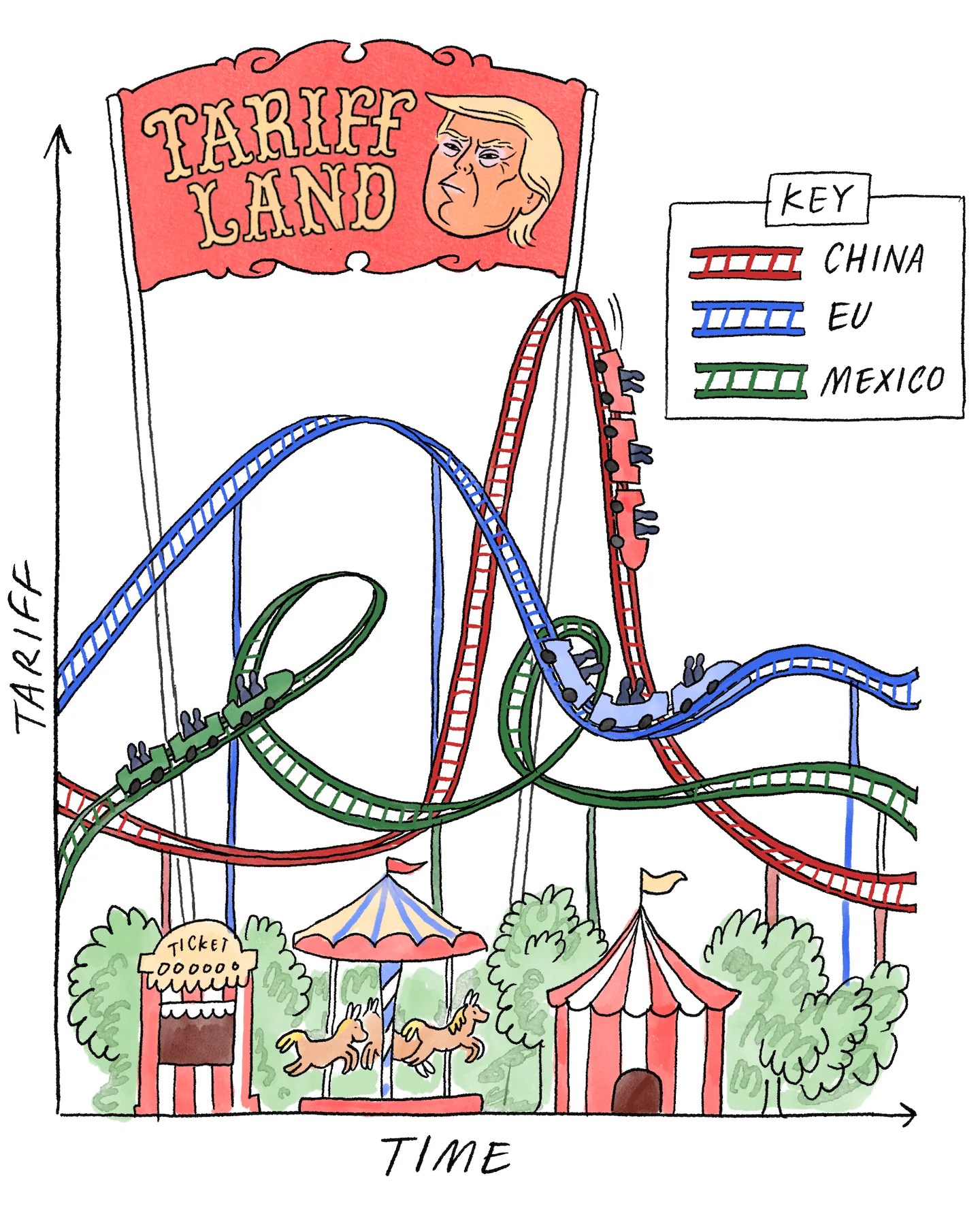
Immediately after the Supreme Court invalidated Trump’s IEEPA tariffs he imposed new tariffs under Section 122 of the Trade Act of 1974, which allows tariffs for balance-of-payments reasons. This is now being litigated in new cases. Trump’s earlier tariffs have resulted in a surge of tariff fraud by importers. So it seems that Trump is continuing his weaponization of tariffs — for who knows for what real purposes– and involving obvious and unforeseen consequences.
………………………………………………….
“Increases in tariffs have raised the incentive to avoid them, especially since penalties for breaking the law are rare. Some U.S. companies …. The Trump administration is trying to step up efforts to combat trade fraud, but it is still woefully outmatched by the challenge …. Altering the valuation of Chinese goods means that U.S. statistics may exaggerate a recent trend in which trade with China appeared to be declining. On paper, the U.S. trade deficit with China and imported Chinese goods both plummeted by nearly a third last year.” Swanson, “Fraud and Escaping Tariffs.” New York Times (April 7, 2026).
“States and small businesses challenged the 10 percent tax on many imports that President Trump imposed after the Supreme Court struck down a previous slate of tariffs …. The legal war over President Trump’s tariffs is far from finished. A little more than a year after Trump rolled out an initial slate of punishing yet illegal duties, his administration returned to court on Friday to defend the new 10 percent tax that the president has imposed on most imports. Trump announced the wide-ranging tariffs in late February, hours after the Supreme Court struck down the original, country-by-country rates that had served as the bedrock of his global trade war. Much as before, he applied the duties in a novel way, using a little-known portion of a decades-old trade law that no other president had ever invoked. The result was a new legal drama with familiar stakes …. Trump imposed his new tariffs under Section 122 of the Trade Act of 1974, which allows the president to apply a tax on imports of up to 15 percent for 150 days. Those duties are subject to strict limits: The president may tax imports only temporarily, as a way of dealing with “large and serious United States balance-of-payments deficits” and situations that present “fundamental international payments problems” …. From the beginning, Mr. Trump had envisioned the across-the-board tariff as a way to buy time for the administration to conduct investigations into countries’ trade practices. It launched those inquiries using another provision of the same 1974 law, known as Section 301, which allows the president to impose tariffs if the government determines another nation is behaving unfairly.” Romm, “Trump End Heads to Court.” New York Times (April 10, 2026).


 Stuart Malawer
 U.S. LAW & GLOBAL TRADE RELATIONS.
You must be logged in to post a comment.