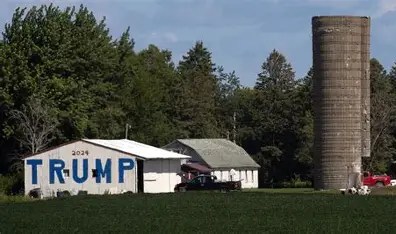
The American farmer is facing the greatest harm in the U.S. economy because of Tramp’s Tariffs and China’s retaliatory actions. The questi0n is — Why on earth do farmers continue to support the president? Is this placing cultural issues above economic interests?
Trump’s promise of a multi-billion-dollar bailout for farmers is similar to what happened in Trump One. But many farmers will still go bankrupt. U.S. taxpayers will continue to pay huge amounts for these new farm subsidies. This may be made a lot worse if the Supreme Court orders the repayment of billion of Trump’s tariff to U.S. importers and businesses.
To me, Trump is exploiting the resent of farmers as he is exploiting the resentments of the working class who is feeling left behind. We’ve seen this before with other presidents — exploiting domestic grievances and then some restrictive trade actions. But it seems much worse this time.
……………………………………………….
“Punishing Chinese tariffs that prompt painful retaliation. American farmers on the brink of bankruptcy. A multibillion-dollar bailout to keep farmers afloat …. The need for federal farm aid demonstrates the limits of Trump’s trade agenda …. The tariffs have pushed up costs for American farmers, who are facing higher prices for fertilizer and equipment …. We have an export-dependent industry, we’ve angered its biggest customer, and, boom, now we’re bailing out the export-dependent industry …. Farmers have long been a reliable voting bloc for Trump, making them a rich target for retaliation …. Trump has discussed funneling tariff revenue to farmers, but it is not clear that he has the legal authority to do so without congressional authorization.” “Farmers in Peril and Trump Bailout.” New York Times (Oct. 7, 2025).
“Exports of American soybeans to China have collapsed this year, with no new orders logged in recent months ahead of the prime autumn export season …. Beijing also has imposed a 23% retaliatory tariff on American soybeans in response to Trump’s tariffs on Chinese imports this year …. But the plight of America’s farmers is a reminder that the destruction of a trade war is mutually assured and not inflicted solely by one side on the other.” “Tariffs and Soybeans.” Wall Street Journal (Sept. 29, 2025).
“The Trump administration is drawing up plans to use tariff revenue to fund a program to support US farmers as they head into harvest facing falling export sales …. The move follows mounting pressure from farm groups after China curbed purchases of new crop US soyabeans and as tariffs have pushed up costs for fertilizer, machinery and other imported inputs …. Trump administration is reinstating a vision of “trading America” not seen since Alexander Hamilton at the end of the 18th century …. US agrifood exports were the highest ever in dollar terms during Biden’s presidency from 2021 to 2024 …. Trump’s aggressive tariff agenda has targeted Beijing, prompting steep retaliatory duties on US products, including up to 34 per cent on American soyabeans.” “Trump’s Tariffs to Provide Bailouts for Farmers Hurt by Retaliatory Tariffs.” Financial Times (Sept. 19, 2025).
“China stopped buying soybeans from America in May, placing a retaliatory tariff on the bumper crop after President Trump increased levies on goods from China …. Soybeans are the single largest American export to China in terms of value, $12.6 billion worth last year. But as the fall harvest gets underway across the country — 9 percent of planted beans had been harvested as of last week — the country that bought 52 percent of all American soybean exports last year is completely absent.” “Soybeans to China this Year – $0 – Last ear $12.6 Billion.” New York Times (9.26.25).
“Will Donald Trump’s protectionist trade policies deliver the objectives his voters hope? The answer is: no. The most important objective of all has been to create a great number of new manufacturing jobs. This is the promise held out to former industrial workers and the ruined places in which many of them live. Unfortunately, it is fraudulent. Trump is governing in the interests of himself, but also of the plutocracy whom many of these people blame, not altogether wrongly, for their plight …. We cannot doubt that deindustrialization has created big social and political problems. Indeed, if we contrast the decline in opportunities in industry for less-educated men with the rise in the share of the population with tertiary education, we can see a driver of today’s right-wing populism. Trump and others like him are among the consequences. They have been quite brilliant at exploiting the resentments of the “left behind” …. The tragedy is that populists offer no solutions. They merely exploit the anger and frustration of the declining working classes for their own benefit and that of selfish plutocrats. “ “Trump’s Tariffs and Job Creation.” Financial Times (Oct. 8, 2025).
“It is an odd part of the modern history of international trade that US high-handedness, with its demands for unilateral concessions, is not new. Prior to the second Trump administration, the most recent US use of broad unilateral tariffs, the Nixon 10 percent ad valorem import surcharge in August 1971 and American demands for unilateral trade concessions, provoked the creation of the first multilateral round of trade negotiations, to address non-tariff trade barriers more comprehensively in the Tokyo Round. Through its use of unilateral trade measures under Section 301 of the Trade Act of 1974, in the 1980s, the US again provoked the rest of the world trading nations to found the Uruguay Round of multilateral trade negotiations, which yielded high quality trade agreements and the creation of the World Trade Organization.” “International Progressives and Global Trade.” PIIE (Oct. 8, 2025).
“Farmers are on the front line of U.S. trade policy. Until the last four years, the United States regularly had a trade surplus in agriculture—not enough to offset the large deficit in manufactured goods, but a bright spot nonetheless. The fact that the surplus has turned into a deficit, and one which is growing, has become a source of consternation for farmers …. Farmers are first in line when it comes to trade retaliation. Despite the current deficit, the United States remains a major exporter of corn, wheat, soybeans, sorghum, cotton, pork, beef, poultry, and numerous fruits and vegetables. Those are easy targets for countries seeking to retaliate against U.S. tariffs or other actions they don’t like because most of those products can be found elsewhere. That is a big problem right now, thanks to China …. It appears the administration will do the same thing it did in Trump 1.0—bail out the farmers with federal cash. “Down on the Farm.” CSIS (Oct. 8, 2-25).


 Stuart Malawer
 U.S. LAW & GLOBAL TRADE RELATIONS.
You must be logged in to post a comment.