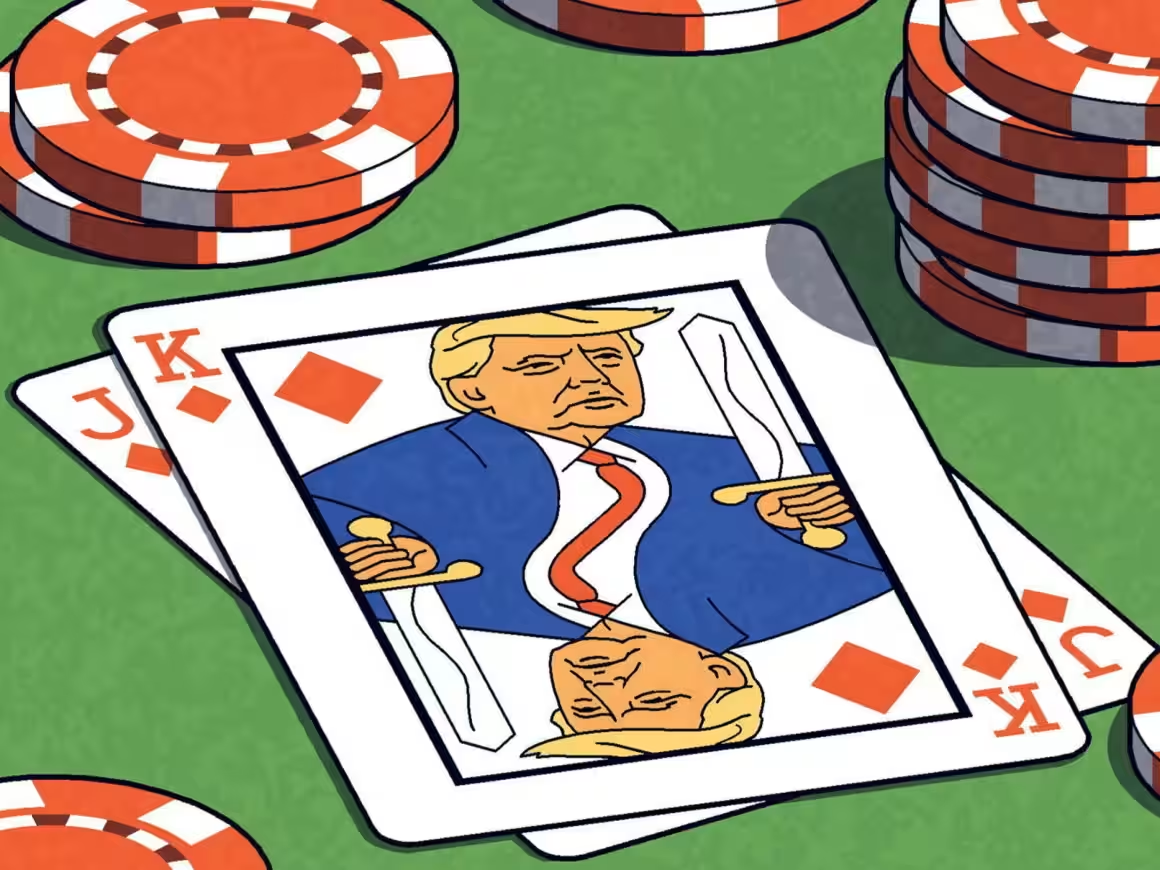
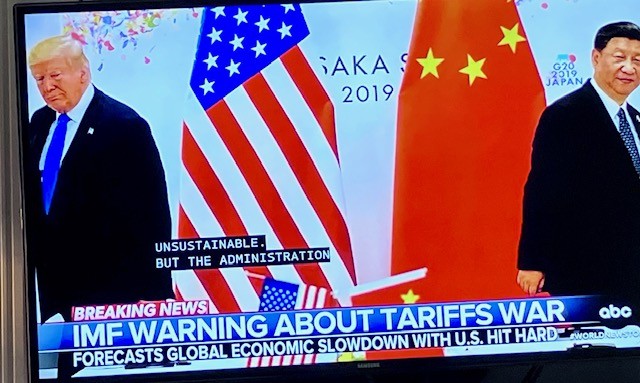
What can stop Trump from wrecking the U.S. and global economies because of his unlawful use of the tariff power — authorized by the U.S. Constitution, but only to the Congress to impose — unless delegated and executive actions are within that delegation? Simple, the federal courts and our allies standing together to respond forcefully (this includes working through the WTO to enforce the most-favored-nation-principle). Tariffs are not the way to go. Unfortunately, our allies are not responding tough enough. Maybe only China is standing up to Trump. But he’s still at it.
……………………………………
“It cannot be said too often that this is nonsensical economics. There is absolutely no reason why bilateral trade should balance. The fact that it does not do so certainly does not show that the surplus country is “cheating” …. So, what is to be done about this madness? First, we should hope that Trump does indeed chicken out again and again and again, though the uncertainty created would still be costly. Second, there must be retaliation — ideally coordinated retaliation — against the US. Third, all members of the World Trade Organization should declare that any trade concessions made to the US will be extended to other members, in accordance with the “most favored nation” principle. Finally, the other members should also abide by their agreements with one another.” “Trump’s Return to Tariffs.” Financial Times (July 16, 2025).
“One remaining factor that could significantly lower Trump’s tariffs are the challenges that are now proceeding through the legal system. Federal courts have called into question the legal authority that Mr. Trump has used to threaten his global tariffs, and they are expected to rule on that question this fall.” “U.S. Tariffs Hurting Real Economy.” New York Times (July 15, 2025).
” America’s trading partners have largely failed to retaliate against Trump’s sweeping tariffs, allowing a president taunted for “always chickening out” to raise nearly $50bn in extra customs revenues at little cost …. Global brands can try and swallow some of the tariff cost through smart sourcing and cost savings but the majority will have to be distributed across other markets, because US consumers might swallow a 5 per cent increase, but not 20 or even 40 …. But despite US tariffs hitting levels not seen since the 1930s, the timidity of the global response to Trump has forestalled a retaliatory spiral of the kind that decimated global trade between the first and second world wars.” “Trump’s Tariffs and the World Relents.” Financial Times (July 17, 2025).
“A common theme running through these global developments is that rivals such as China seem to be faring better in dealing with Trump’s challenge to the global order than are traditional U.S. allies including Japan and European nations. Except for Britain, countries are often finding that the reward for being a loyal partner is a punch in the nose …. Trump took a roundhouse swing at the global economic system when he announced his tariffs April 2. He hit his target, and the system is swinging like a broken piñata. Trump might back down when he sees strength, as in China’s response. But mostly, he’s still punching.” “Playing Nice with Trump, Doesn’t Work.” Washington Post (July 18, 2025).
“One thing that tariffs alone will never do is make the United States an attractive place to innovate. Yes, tariffs belong in our trade arsenal — but as precision munitions, not as land mines that maim foes, friends and noncombatants equally …. Policymakers must recognize that most of our difficulties with China are shared by our commercial allies. We should be acting in unison with the European Union, Japan and the many countries …. Prevent the devastating impacts of job loss from the next major. The scarring effects of manufacturing-job loss have caused America a heap of economic and political trouble over the past two decades ,,,, But when industries collapse, our best response is getting displaced workers into new jobs quickly and making sure the young, small businesses that are responsible for most net U.S. job growth are poised to do their thing. Tariffs, which narrowly protect old-line manufacturing, are terribly suited for this task.” “Next China Schock.” New York Times (July 2025).


 Stuart Malawer
 U.S. LAW & GLOBAL TRADE RELATIONS.
You must be logged in to post a comment.