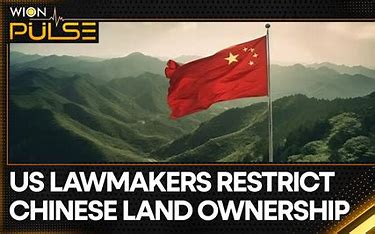
Chinese investment in U.S. farmland has now become a political issue. The relationship between state and federal law concerning foreign ownership of farmland has now become a constitutional issue as well. Local land use requirements, especially foreign ownership, have been traditionally a matter of state and local law. Federal cases are already being filed contesting new state restrictions as violating separation-of- powers and blatant racism — and a misuse reliance on national security. A recent piece in the Wall Street Journal and New York Times highlight this emerging issue.
-
“More than three dozen states have enacted or are considering laws restricting land purchases by Chinese citizens and companies, arguing that such transactions are a growing threat to national security …. State lawmakers have been especially worried about Chinese investment in agricultural land and territory near military installations ….. Chinese interests own less than 1 percent of foreign-held agricultural land in the United States …. Civil rights groups have challenged these laws in federal court on grounds that they violates the Equal Protection Clause and the Fair Housing Act, and that they undercut the federal government powers on foreign affairs …. These laws recalled the alien land laws from the early 20th century, which effectively prohibited Asian immigrants from buying farmland and, in some cases, homes in many states.” “When Buying a Home Is Treated as a National Security Threat.” New York Times (May 7th, 2024).
-
“From Florida to Indiana and Montana, an expanding array of local proposals, bills, laws and regulations aim to block Chinese individuals and companies from acquiring land, winning contracts, working on research, setting up factories and otherwise participating in the U.S. economy …. Virginia Governor Youngkin says he opposed the Ford plant for electric-vehicle batteries because he didn’t want to allocate Virginia taxpayer money to support Chinese technology …. Gov. Youngkin said issues such as land use are state-level decisions, in Virginia’s case sometimes affecting national-security assets …. The land issue is particularly knotty. The federal government says Chinese entities are the registered owners of under 1% of the foreign-held agricultural land in the U.S., with 87% of that owned by five companies. …. Florida has legislated some of the most far-reaching China decoupling …. To detractors, the anti-China measures can be unnecessary, poorly conceived and ineffective political grandstanding, sometimes even racist or unconstitutional …. Several efforts have faced legal challenges. “States Take On China in the Name of National Security.” Wall Street Journal (April 29, 2024).


 Stuart Malawer
 U.S. LAW & GLOBAL TRADE RELATIONS.
You must be logged in to post a comment.