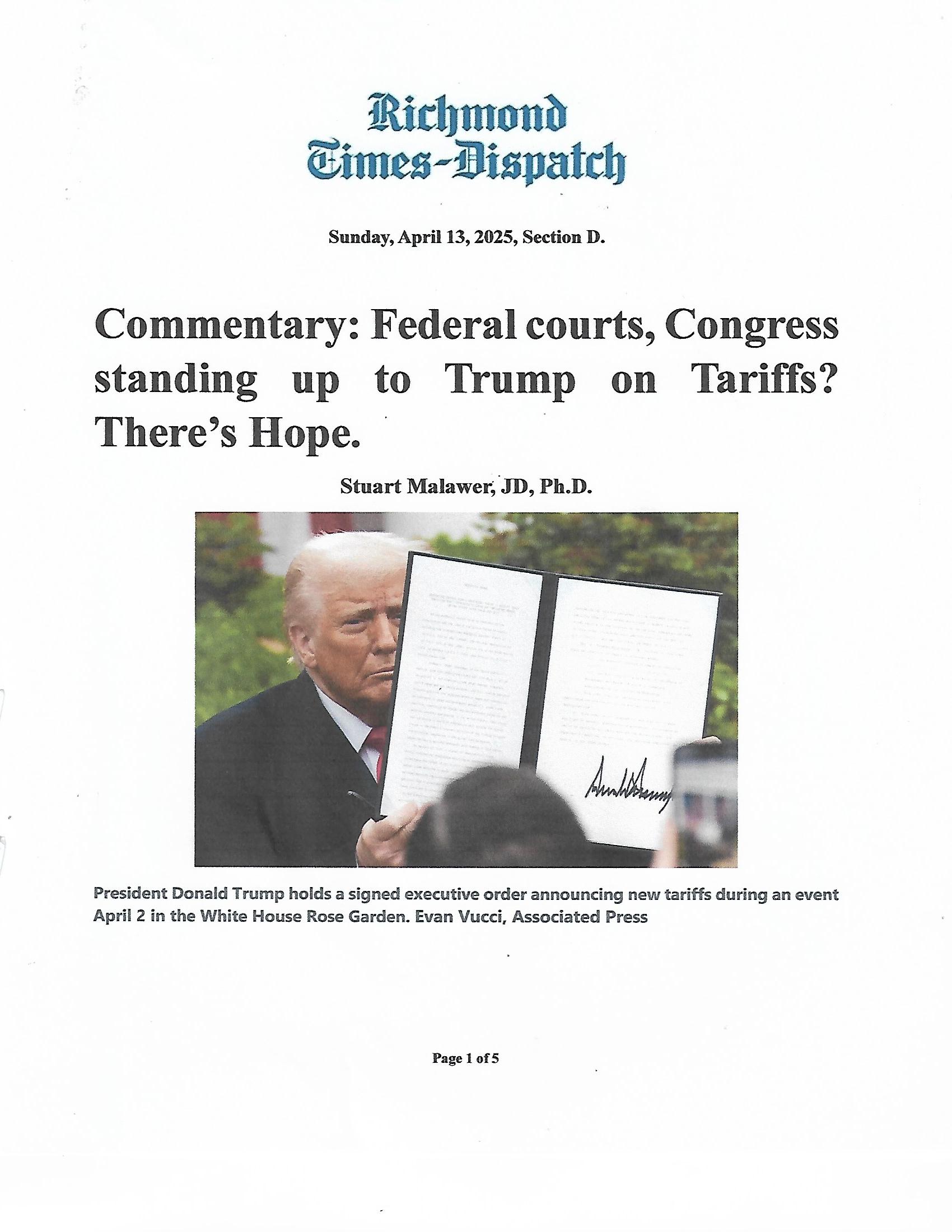
Two recent updates. One, a recent New York Times study has concluded that the federal appeals judges nominated by Trump have overwhelmingly voted for him to overrule lower court judges. Second, the Supreme Court has not yet ruled in the pending case concerning Trump’s reciprocal tariffs, but he continues to threaten disaster (Greenland and the use of other statutory authorities). If Trump loses, he has other statutory provisions he can utilize — but they are more restrictive and require administration studies and actions.
To me, the suspicion is that the Supreme Court, may well overrule the lower courts. We’ll see soon enough ………….
……………………………………………………
“President Trump promised to fill the appeals courts with “my judges.” They have formed a nearly united phalanx to defend his agenda from legal challenges …. President Trump has found a powerful but obscure bulwark in the appeals court judges he appointed during his first term. They have voted overwhelmingly in his favor when his administration’s actions have been challenged in court in his current term.” “Trump’s ‘Superstar’ Appellate Judges Have Voted 133 to 12 in His Favor.” New York Times (1.12.26).
“Company executives, customs brokers and trade lawyers are bracing for a potential fight over obtaining perhaps $150 billion in refunds from the U.S. government for duties already paid by importers if Trump loses. However, some companies anticipate that even if the court invalidates Trump’s tariffs, Trump will not make it easy for them to get refunds. It’s not in the government’s DNA to give back money. And Trump would not want to give back money. ‘“ US Supreme Court: No ruling on Trump tariffs Friday.”Reuters (Jan. 9, 2026).
“The Greenland episode puts in sharp relief how open-ended Mr. Trump’s claim of tariff emergency authority is. He can declare an emergency on his own, he can decide which countries and goods he can hit with the border taxes, and at what rate. This means he can use tariffs essentially whenever he wants for whatever reason he wants. Congress gave him no such expansive power under IEEPA or any other statute. Tariff apologists will say the Greenland tariffs show the uses of border taxes for foreign policy, but the taxing power is Congress’s under the Constitution unless expressly delegated to the President. U.S. trade rep Jamieson Greer said Monday that if the Supreme Court overturns Mr. Trump’s tariffs, the President will quickly rely on other tariff authorities. But those delegations are more limited on what goods, for what reason, and for how long they can be imposed.They don’t allow tariffs for any emergency that Mr. Trump conjures for whatever political purposes he desires.”“Trump Tariff Editorial.”Wall Street Journal (Jan. 20, 2026).
“The president can draw on other powerful tariff laws that allow him to impose import taxes on various products or countries’ exports. But those laws typically require either an investigation, a report to be prepared, or an economic or national security rationale, meaning Mr. Trump would have less flexibility to threaten tariffs at a whim. … Mr. Trump had other alternatives, like Section 301, which he used in his first term to impose tariffs on Chinese exports, and which had survived many legal challenges. The president could also impose tariffs using Section 232, a national security statute, Section 122, a legal authority that relates to balance of payments issues, or Section 338, which allows the United States to respond when another country uniquely discriminates against it.” “Trump’s Response to S. Ct. Loss.” New York Times (January 20, 2026),
“The president’s quick reversal on tariffs over Greenland was another sign of his willingness to rip up the international order …. What he left in his wake was another destabilizing moment in global trade. And as those moments pile up, they are having their own effects — including increasing doubts about the value of cooperating with the president …. Adding more uncertainty to the picture is the fact that the Supreme Court is reviewing Mr. Trump’s use of an emergency law to issue many of his tariffs. If the Supreme Court rules against Mr. Trump, that could usher in another period of volatility as many of the president’s tariffs are struck down but then replaced with other levies …. The past year suggests that what Mr. Trump respects the most is a forceful response from a country able to wield economic damage to the United States, like China, not an effort toward cooperation. The president also appears to see little downside to the “madman theory” of foreign policy.”“Trump and Trade Chaos.”New York Times (January 22, 2026).
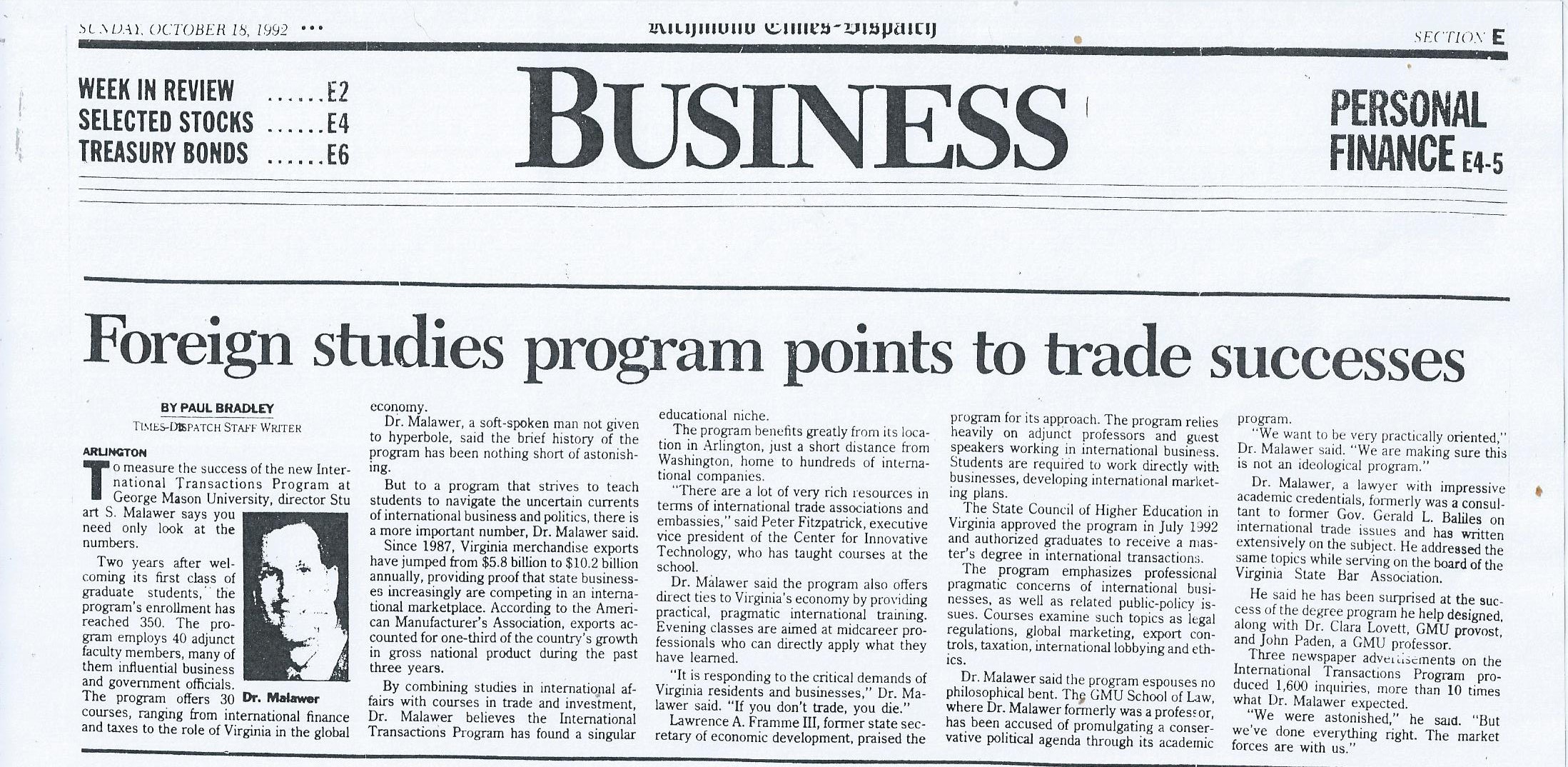
35 Years ago (1990) I was named the Director of the new Graduate International Transactions Program here at George Mason University. It soon became one of the largest graduate programs at GMU and its most innovative. Its focus on global trade continues today is even more important — for Virginia and the US.
Trump’s proposals for a $12b bailout of U.S. farmers is a purely domestic policy play — after disastrous election losses (especially in Virginia) and low ratings in various polls. However, his recent reduction of tariffs on beef coning into the U.S. is inconsistent with his going after the farm vote (especially cattle ranchers). His essential concern now is to reposition himself for the critical midterm elections, so as not to lose the Congress. The farmer’s support is very tenuous.
“Red-state farmers continue to struggle under damaging inflation and the fallout of President Donald Trump’s tariff policies, especially with China …. Trump announced this month that he will use $11 billion to bail out farmers from “trade market disruptions and increased production costs that are still impacting farmers.” For farmers, trade groups and industry advocates, however, the bailout marked a tacit admission that a year’s worth of Trump policies have upended their industry and threatened their livelihoods. Still unclear is whether policies that have hurt farmers will also sour the relationship between the president and one of his most loyal and politically symbolic constituencies …. But Trump’s far-reaching tariffs on foreign imports — and reciprocal levies against some U.S. products — have blunted those hopes. Tariffs on countries including Canada and China, and on specific goods such as steel and aluminum, translated into rising costs for tractors, combines and fertilizer. Even more damaging was the escalating trade war with China, a country American soybean producers have relied on to import the bulk of their crops. Reciprocal tariffs swelled well into the triple digits …. For soybean farmers, market losses due to the ongoing trade conflict with China are only exacerbating financial problems …. Trump did not appear to be concerned about his standing with U.S. farmers.” “Trump and Farmers.”Wall Street Journal (12.26.25).
“One of the least surprising news events of the year happened last week when the White House announced a $12bn bailout for the American farmers who have been clobbered by Trump’s tariff war. This is, of course, exactly what happened in his first administration, taking from the agricultural sector one minute and giving it a handout the next. Essentially the president took away farmers’ work and put them on welfare. The most salient example is US soyabean exporters, whom China has boycotted in retaliation for Trump’s tariffs on Chinese goods. Foreign Policy magazine has a very good piece summing up the current situation. It quotes Chris Barrett, agricultural economist at Cornell University, who says the $12bn is nowhere near enough to compensate for total farm losses, which he estimates exceed $40bn.” Trump’s Farm Bailout.”Trade Secrets (Financial Times) (12.15.25).
My interview on CGTN on December 10, 2025. Trump’s proposals for a $12b bailout of U.S. farmers is a purely domestic policy play — after disastrous election losses (especially in Virginia) and low ratings in various polls. However, his recent reduction of tariffs on beef coning into the U.S. is inconsistent with his going after the farm vote (especially cattle ranchers). His essential concern now is to reposition himself for the critical midterm elections, so as not to lose the Congress. The farmer’s support is very tenuous.
“Red-state farmers continue to struggle under damaging inflation and the fallout of President Donald Trump’s tariff policies, especially with China …. Trump announced this month that he will use $11 billion to bail out farmers from “trade market disruptions and increased production costs that are still impacting farmers.” For farmers, trade groups and industry advocates, however, the bailout marked a tacit admission that a year’s worth of Trump policies have upended their industry and threatened their livelihoods. Still unclear is whether policies that have hurt farmers will also sour the relationship between the president and one of his most loyal and politically symbolic constituencies …. But Trump’s far-reaching tariffs on foreign imports — and reciprocal levies against some U.S. products — have blunted those hopes. Tariffs on countries including Canada and China, and on specific goods such as steel and aluminum, translated into rising costs for tractors, combines and fertilizer. Even more damaging was the escalating trade war with China, a country American soybean producers have relied on to import the bulk of their crops. Reciprocal tariffs swelled well into the triple digits …. For soybean farmers, market losses due to the ongoing trade conflict with China are only exacerbating financial problems …. Trump did not appear to be concerned about his standing with U.S. farmers.” “Trump and Farmers.”Wall Street Journal (12.26.25).
“One of the least surprising news events of the year happened last week when the White House announced a $12bn bailout for the American farmers who have been clobbered by Trump’s tariff war. This is, of course, exactly what happened in his first administration, taking from the agricultural sector one minute and giving it a handout the next. Essentially the president took away farmers’ work and put them on welfare. The most salient example is US soyabean exporters, whom China has boycotted in retaliation for Trump’s tariffs on Chinese goods. Foreign Policy magazine has a very good piece summing up the current situation. It quotes Chris Barrett, agricultural economist at Cornell University, who says the $12bn is nowhere near enough to compensate for total farm losses, which he estimates exceed $40bn.” Trump’s Farm Bailout.”Trade Secrets (Financial Times) (12.15.25).
“The Trump administration asked a federal court to reject a request from dozens of companies seeking to suspend the final processing, or “liquidation,” of tariff payments, as importers race against deadlines that could affect their ability to secure refunds. In a filing last week, the DOJ opposed a Thursday request from dozens of companies for an injunction to halt tariff processing ahead of a Supreme Court ruling on duties Trump imposed under the 1977 International Emergency Economic Powers Act. “Court of International Trade, DOJ and Companies ‘s Tariff Liquidations.” Trade Secrets (Politico) (12.15.25).
“I don’t really understand it politically, he has just alienated a bunch of ranchers,” said Bolton, who warned that allowing more foreign farm goods into the US would put Trump on a collision course with some of his most ardent backers. “He would turn us against him,” Bolton said. “And we are his biggest supporters.” Ranchers — most of whom live in states that voted overwhelmingly for Trump in 2024 — have in recent weeks found themselves at odds with their president as he has railed against the high price of beef on social media.” “Trump’s Beef Tariff Reduction Alienates Ranchers.”Financial Times (December 20, 2025).
The Supreme Court may very well decide the tariff case before Xmas or not. We’ll see. Trump’s tariff actions are now being contested by an increasing number of countries and also larger companies. Trump has backed down in many of his confrontations. Companies have already sued in the Court of International Trade to get refund of the billions of collected tariffs — in case the Supreme Court orders such refunds. Raising the question of liquidation on refunds. Large companies are now pursuing such refunds, not just smaller ones. (Costco has just filed an action in the Court of International Trade.) The oral argument during the hearing on the tariff case before the Supreme Court touched upon the issue of refunds. Trump’s tariff policy has been totally chaotic and non-productive, on so many levels. We’ll know soon …………….
……………………………………………………………………………………
“Justice Amy Coney Barrett (looking) ahead at the possible repercussions of a ruling for the challengers. Specifically, she asked Neal Katyal, who represented a group of small businesses at the November hearing, to “tell me how the reimbursement process would work. Would it be a complete mess? … It seems to me like it could be a mess.” …. Barrett’s exchange with Katyal raises a number of questions about what would happen if the court strikes down the tariffs. First and foremost is whether importers that have already paid the tariffs – totaling more than $200 billion so far this year, the Trump administration announced on Monday – would be entitled to refunds. And if they are, how might that refund process work? There are no clear answers, but history and several of the Supreme Court’s past decisions may provide some guidance …. A “friend of the court” brief filed in support of the challengers by several trade policy researchers recounted another scenario in which the federal government had refunded tariffs. The researchers pointed to Congress’ renewal of the Generalized System of Preferences, a program intended to encourage economic development in poorer countries by allowing them to export some products to the United States at lower tariff rates, in March 2018, months after the program expired on Dec. 31, 2017. Congress made the renewal of the program retroactive to Jan. 1, 2018, and required the government to issue refunds of the tariffs paid during that period on merchandise that would have otherwise been eligible under the program. “In response,” the researchers wrote, “CBP issued” a message “providing for the automatic processing of such refunds for all importers who had” complied with certain administrative requirements. “If instructed by the Court to do so,” the researchers contended, “CBP could use such a system to refund most of the IEEPA tariffs.” …. Even as importers wait for a decision from the Supreme Court, some of them have already sought to position themselves to receive a refund if the court determines that the tariffs are invalid. In aruling on Monday, the Court of International Trade turned down a request from a group of importers for a temporary order that would suspend liquidation – the final accounting of money that an importer owes Customs and Border Protection – of entries for which IEEPA tariffs were imposed. The importers argued that without such an order, even if the Supreme Court ultimately strikes down the tariffs, they might not be able to get their money back once liquidation occurs. The CIT explained that the federal government has indicated – both in the case before it and others – that if there is a final decision striking down the tariffs, “‘liquidation will not affect the availability of refunds.’” And having taken this position, the court emphasized, the government cannot later make a contrary argument.” “Tariffs Case and Refunds.”Scotus Blog (2025).
“But big businesses will end up paying the most in tariffs because of the immense volume of goods they import. They have so far been in wait-and-see mode, viewing that as a better strategy than stirring up a feud with the temperamental president …. Big business is now acting on what small businesses felt instantly: Tariffs are taxes on Americans. The largest companies had enough money to absorb some of those costs for a while, but time is running out, and they don’t want to pass them on to their customers.” “Costco’s Lawsuit and Tariff Refunds.”Washington Post (12.3.25).
“From the buy-in-bulk retailer Costco to the canned-tuna company Bumble Bee Foods, some businesses are racing to get in line for tariff refunds, anticipating that the Supreme Court will soon rule against President Trump and force him to return billions of dollars collected on imports…. A ruling against the president could also force the Trump administration to pay back a substantial portion of the roughly $200 billion it has collected in duties since the start of the year. While the Supreme Court offered little indication as to whether it would order such refunds, some businesses have started the legal legwork to obtain them anyway, aiming to beat the rush and recover their full tariff costs.” “Tariff Refunds and Companies Now Suing.”New York Times (12.4.25).
“How did the dispute over the tariffs start? Beginning in February, Trump issued a series of executive orders imposing tariffs. The tariffs can be divided into two categories. The first type, known as the “trafficking” tariffs, targeted products of Canada, Mexico, and China, because Trump says those countries have failed to do enough to stop the flow of fentanyl into the United States. The second category, known as the “worldwide” or “reciprocal” tariffs, imposed a baseline tariff of 10% on virtually all countries, and higher tariffs – anywhere from 11% to 50% – on dozens of them. In imposing the worldwide tariffs, Trump cited large trade deficits as an “unusual and extraordinary threat to the national security and economy of the United States.”One case was filed in the U.S. District Court for the District of Columbia by Learning Resources and hand2mind, two small, family-owned companies that make educational toys, with much of their manufacturing taking place in Asia. Another case challenging the tariffs was brought in the U.S. Court of International Trade by several small businesses, including V.O.S. Selections, a New York wine importer, and Terry Precision Cycling, which sells women’s cycling apparel. What are the laws at the center of the dispute over the tariffs? Article I of the Constitution gives Congress the power to “lay and collect Taxes, Duties, Imposts and Excises,” and it requires that “Bills for raising Revenue shall originate in the House of Representatives.” In issuing the executive orders that imposed the tariffs, Trump relied primarily on a 1977 law, the International Emergency Economic Powers Act. Section 1701 of IEEPA provides that the president can use the law “to deal with any unusual and extraordinary threat, which has its source in whole or substantial part outside the United States, to the national security, foreign policy, or economy of the United States,” if he declares a national emergency “with respect to such threat.” Section 1702 of the act provides that, when there is a national emergency, the president may “regulate … importation or exportation” of “property in which any foreign country or a national thereof has any interest.” Has the Supreme Court addressed this question? The Supreme Court has not weighed in on the president’s power to impose tariffs under IEEPA. United States v. Yoshida International, a 1975 decision by the U.S. Court of Customs and Patent Appeals, is perhaps most relevant to the current tariff debate because of the similarities between IEEPA and the text of the law at the center of that case, the Trading with the Enemy Act of 1917. That case began as a challenge to then-President Richard Nixon’s imposition of a 10% temporary tariff on imports in response to a large trade deficit, which in 1971 was a relatively unusual development in U.S. history. In 1974, the U.S. Customs Court – the predecessor to the Court of International Trade – ruled that Nixon did not have the power under the Trading with the Enemy Act, which allowed the president in the case of an emergency to “regulate … the importation … of … any property in which any foreign country or a national thereof has any interest.” In response to the ruling by the Customs Court, a provision of the Trade Act of 1974 specifically gave the president the power to impose tariffs to “deal with large and serious United States balance-of-payment deficits,” but – at the same time – the law limited tariffs to a maximum of 15% and a duration of five months. The Court of Customs and Patent Appeals reversed the decision of the Customs Court, concluding that Nixon had the authority to impose the tariffs after all. The 10% tariff, the court explained, was a “limited” one imposed “as ‘a temporary measure’ calculated to help meet a particular national emergency, which is quite different from ‘imposing whatever tariff rates he deems desirable.’” What are the challengers’ arguments? The challengers contend that – unlike other laws that directly deal with tariffs – IEEPA doesn’t mention tariffs or duties at all, and that no president before Trump has ever relied on IEEPA to impose tariffs. And the government has not provided an example of any other law, they add, in which Congress used the phrase “regulate” or “regulate … importation” to give the executive branch the power to tax. Interpreting IEEPA to give the president the power to impose unilateral worldwide tariffs would create a variety of constitutional problems, the challengers before the Federal Circuit also contend. First, they write, it would run afoul of a doctrine known as the major questions doctrine, they say, which requires Congress to be explicit when it wants to give the president the power to make decisions with vast economic and political significance. Allowing the president to rely on IEEPA to impose the tariffs would also violate the nondelegation doctrine – the principle that Congress cannot delegate its power to make laws to other branches of government. How did the lower courts rule on these cases? In the cases brought by V.O.S. Selections and the other small businesses as well as the states, the CIT on May 28 ruled for the small businesses and the states, and it set aside the tariffs. The CIT reasoned that IEEPA’s delegation of power to “regulate … importation” does not give the president unlimited tariff power. The limits that the Trade Act sets on the president’s ability to react to trade deficits, the court continued, indicates that Congress did not intend for the president to rely on broader emergency powers in IEEPA to respond to trade deficits. The “trafficking” tariffs are also invalid, the CIT continued, because they do not “deal with an unusual and extraordinary threat,” as federal law requires. Instead, the CIT concluded, Trump’s executive order tries to create leverage to deal with the fentanyl crisis. The U.S. Court of Appeals for the Federal Circuit, which hears appeals from the Court of International Trade, put the CIT’s ruling on hold while the government appealed. By a vote of 7-4, a majority of the Federal Circuit agreed that “IEEPA’s grant of presidential authority to ‘regulate’ imports does not authorize the tariffs” that Trump had imposed. In the case in federal court in the District of Columbia, U.S. District Judge Rudolph Contreras ruled for Learning Resources and hand2mind, agreeing with them that “the power to regulate is not the power to tax.” Contreras’ order was a narrow one, barring the government only from enforcing the tariffs against Learning Resources and hand2mind, and he put that decision on hold while the government appealed. “ “Trump’s Tariffs – Summary of Case.”Scotus Blog (10.30.25).
“This momentous case must either undermine or buttress the Constitution’s architecture: the separation of powers. Six amicus briefs explain why …. The conservative Goldwater Institute and the liberal Brennan Center separately argue that the statute the president says gives him unreviewable power to impose taxes (which tariffs are) … does no such thing …. A brief from a broad spectrum of economists argues: Even if the IEEPA permits imposing tariffs (it has never been so used), tariffs would not “deal with” (IEEPA language) trade deficits. Besides, over the past 50 years, in any given year, most countries have run trade deficits …. A brief from the New York University School of Law’s Institute for Policy Integrity stresses the “major questions” doctrine, which protects Congress from having its words twisted to unintended purposes. It holds that Congress does not cryptically delegate enormous powers. Presidents claiming such delegated powers must cite specific congressional language …. A brief by three Cato Institute researchers refutes the extralegal doomsaying the administration uses, perhaps to compensate for the weakness of its legal arguments …. The administration says tariffs imposed under the IEEPA are indispensable for negotiating agreements with trading partners. But since the IEEPA’s 1977 enactment, 14 regional and bilateral agreements have been reached, without any IEEPA tariffs.” “S. Ct. Tariff Case – Separation of Powers.”Washington Post (11.1.25).
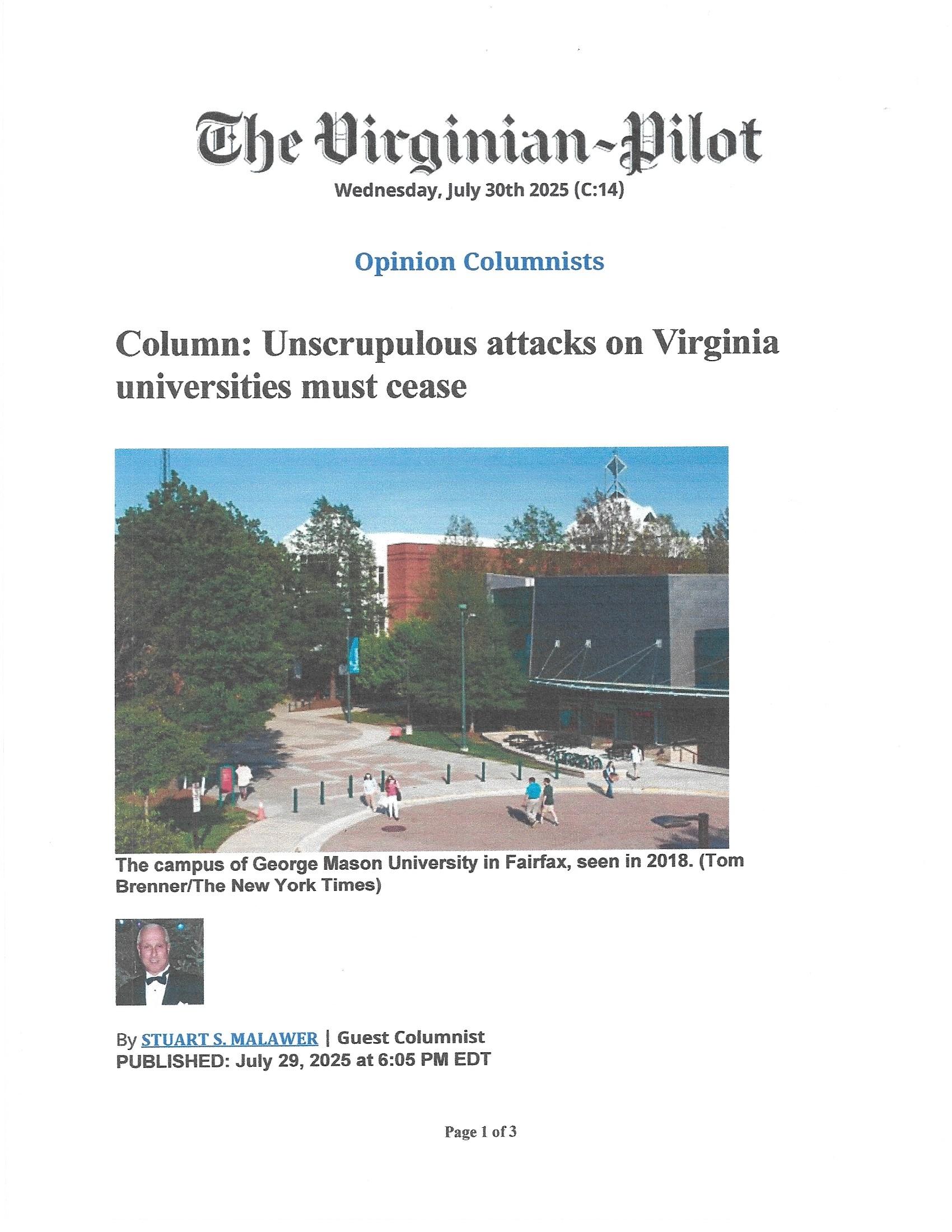
My recent article in the Virginia-Pilot (November 30, 2025).
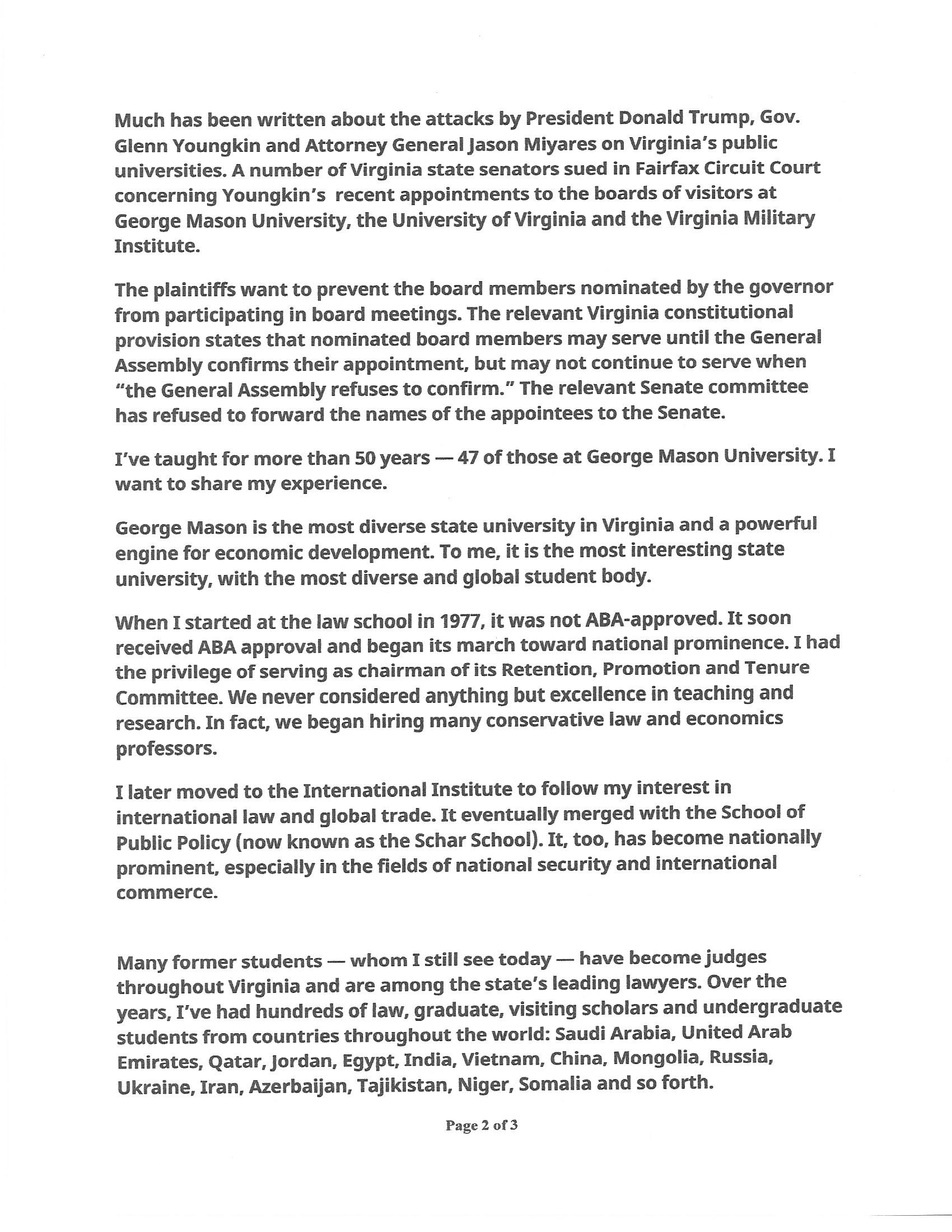
The recent Virginia election has opened a real possibility for restoring stability and integrity to the commonwealth’s public university system. The elections of Abigail Spanberger as governor and Jay Jones as attorney general create an important opportunity to reverse the damaging effects of the President Donald Trump-Gov. Glenn Youngkin-Attorney General Jason Miyares campaign against the boards of visitors and university counsel offices. These efforts must be halted — and will almost certainly be undone. Board members should be respected professionals who provide oversight to the university, not politicized ideologues. Likewise, university counsel should be respected professionals appointed by the university president.
The recent neo-Nazi controversy at the Heritage Foundation has further eroded confidence in the Youngkin-appointed university rectors connected to that institution. Moreover, the Virginia Supreme Court’s decision striking down Youngkin’s appointments to the boards of visitors at George Mason University, Virginia Military Institute and the University of Virginia has effectively dismantled what remains of Youngkin’s educational legacy.
Youngkin, with a smile, embraced Trump’s harsh policies — including those targeting international students — while Miyares enforced them with a snarl. Virginia now has an opportunity to chart a new course and put an end to the inexplicable attacks by the governor and attorney general on the commonwealth’s leading universities. Ultimately, Youngkin’s most enduring legacy may prove to be the blue wave generated in the recent election, which even produced new Democratic gains in rural counties for the first time in memory.
As a former faculty member at George Mason University who taught international law and global trade for more than 40 years in both the law school and the newer public policy school, I am proud of George Mason University and its president for standing firm against both the Trump and Youngkin administrations. A diverse and global student body is essential to a university education today and competing in today’s global economy. This is essential to a broad range of industries in Northern Virginia, Richmond and Tidewater as well as agriculture throughout Virginia.
The new Spanberger administration should be fully prepared to confront the Trump administration in federal court. The federal judiciary has repeatedly shown itself to be a viable — if not the only — battleground for safeguarding the nation from presidential abuses of power and law. This is underscored even more today by Trump’s fierce opposition to the pending Supreme Court litigation seeking reversal of his tariffs, by Trump’s newest proposals to dismantle the U.S. Department of Education and his continuous attacks on foreign students — resulting in declining international student enrollment.
What is needed now is strong legal advocacy from the new attorney general and firm leadership from the new governor, supported by the General Assembly and its newly elected members, to aggressively oppose Trump’s millionaire-inspired educational policies.
It is encouraging that the new governor has already taken a decisive step regarding UVA by calling for a pause in its presidential search under the Youngkin-appointed Board of Visitors.
Virginia’s public universities are essential to the commonwealth’s economic development. They have been a driving force in building a highly skilled workforce and have contributed significantly to Virginia’s long-standing recognition by CNBC as “the best state for doing business” — a distinction earned more times than any other state.
Just as importantly, Virginia’s public universities have played a central role in Virginia’s successful engagement in the global trading system for many decades, attracting new businesses and investment and, in turn, expanding employment and prosperity throughout the commonwealth. In the light of the Trump-induced chaos in both domestic and global politics today, a strong public university system is vital to Virginia and is critical to our national interest.
Stuart S. Malawer, J.D., Ph.D., of Great Falls is a distinguished service professor of law and international trade emeritus in the Schar School of Policy and Government at George Mason University. He is a former gubernatorial appointee to the Virginia Economic Development Partnership Board of Directors and the Advisory Committee on International Trade, and former chair of the international section of the Virginia State Bar.
The recent Virginia election has opened a real possibility for restoring stability and integrity to the Commonwealth’s public university system. The elections of Spanberger and Jones create an important opportunity to reverse the damaging effects of the Trump–Youngkin–Miyares campaign against the Boards of Visitors and university counsel offices. These efforts must be halted—and will almost certainly be undone.
The recent neo-Nazi controversy at the Heritage Foundation has further eroded confidence in the Youngkin-appointed university rectors connected to that institution. Moreover, the Virginia Supreme Court’s decision striking down Youngkin’s appointments to the Boards of Visitors at George Mason University, VMI, and UVA has effectively dismantled what remains of Youngkin’s educational legacy.
Youngkin, with a smile, embraced Trump’s harsh policies—including those targeting international students—while Miyares enforced them with a snarl. Virginia now has an opportunity to chart a new course and put an end to the inexplicable attacks by the governor and attorney general on the Commonwealth’s leading universities. Ultimately, Youngkin’s most enduring legacy may prove to be the blue wave generated in the recent election, which even produced new Democratic gains in rural counties for the first time.
As a former faculty member at George Mason University teaching international law and global trade for over forty years in both the law school and the newer public policy school, I am proud of George Mason University and its president for standing firm against both the Trump and Youngkin administrations. A diverse and global student body is essential to a university education today and competing in today’s global economy. This is essential to a broad range of industries in Northern Virginia, Richmond and Tidewater as well as agriculture throughout Virginia.
The new Spanberger administration should be fully prepared to confront the Trump administration in federal court. The federal judiciary has repeatedly shown itself to be a viable—if not the only—battleground for safeguarding the nation from presidential abuses of power and law. This is underscored even more today Trump’s fierce opposition to the pending Supreme Court litigation seeking reversal of his tariffs, by Trump’s newest proposals to dismantle the U.S. Department of Education and his continuous attacks on foreign students – resulting in declining international student enrollment.
What is needed now is strong legal advocacy from the new attorney general and firm leadership from the new governor, supported by the General Assembly and its newly elected members.
It is encouraging that the new governor has already taken a decisive step regarding UVA by calling for a pause in its presidential search under the Youngkin-appointed Board of Visitors.
Virginia’s public universities are essential to the Commonwealth’s economic development. They have been a driving force in building a highly skilled workforce and have contributed significantly to Virginia’s long-standing recognition by CNBC as “the best state for doing business”—a distinction earned more times than any other state.
Just as importantly, Virginia’s public universities have played a central role in Virginia’s successful engagement in the global trading system for many decades, attracting new businesses and investment and, in turn, expanding employment and prosperity throughout the Commonwealth. In the light of the Trump-induced chaos in both domestic and global politics today, a strong public university system is vital to Virginia and is critical to our national interest.
………………………………………
Stuart S. Malawer, J.D., Ph.D., Distinguished Service Professor of Law and International Trade (Emeritus) at George Mason University. Former gubernatorial appointee to the board of the Virginia Economic Development Partnership and to the Advisory Committee on International Trade. Former Chair of the International Section of the Virginia State Bar.
…………………………………………
“In a loss for Gov. Glenn Youngkin and the state attorney general’s office, the Supreme Court of Virginia will not review a lower court’s ruling that blocked three Virginia universities from seating rejected Youngkin board appointees …. Representing the rectors of George Mason University, the University of Virginia and Virginia Military Institute, state Attorney General Jason Miyares office had asked the state’s high court to overturn a Fairfax County Circuit Court judge’s temporary injunction issued in July. That injunction prevented the rectors from recognizing eight Youngkin board appointees who were not confirmed by a Democratic-controlled state Senate committee …. Senate Majority Leader Scott Surovell tweeted Monday that the state Supreme Court “has affirmed the Senate P&E committees’ authority to reject gubernatorial nominations because MAGA rules don’t work in Virginia where we still have a rule of law that Youngkin and Miyares have to follow.” The political dispute over university governance has hit a fever pitch this year under the Trump administration’s investigations into diversity, equity and inclusion initiatives and alleged antisemitism at the University of Virginia and George Mason University …. George Mason’s president, Gregory Washington, is still in office despite coming under heavy criticism by congressional Republicans and the U.S. Department of Education, which found in August that the university violated federal civil rights law.” “Virginia Supreme Court and Youngkin’s Board Appointments — Governor Loses”Virgina Business (Nov. 18, 2025).
“The Virginia Supreme Court has refused to take up a case that suspended multiple appointees by Gov. Glenn Youngkin from serving on three Virginia university governing boards. Virginia Attorney General Jason Miyares appealed to the court after the Fairfax County Circuit Court suspended eight governing board appointments from serving at George Mason University, Virginia Military Institute and the University of Virginia. The 15-member Senate Committee on Privileges and Elections rejected 22 appointments in the past year and the issue has been one of several that rocked Virginia’s higher education landscape in 2025.” “Virginia Supreme Court and Youngkin’s Board of Visitor Appointments.”Virginia Mercury (Nov. 17. 2025).
“Virginia’s governor appoints the board members at each campus who oversee the state’s public university system, and conservative board members and alumni have engineered efforts to oust leaders of the universities, largely over disputes about diversity initiatives …. Virginia may be an early example of how shifting political control could hobble the White House’s national campaign to change higher education …. The Trump administration also set its sights on George Mason, claiming that its first Black president, Gregory Washington, unlawfully favored underserved minority candidates in hiring and promotion, and demanded that he issue a public apology. Dr. Washington has refused …. On Thursday, Republicans on the U.S. House Judiciary Committee stepped up the pressure campaign against Dr. Washington by releasing a 50-page report that accuses him of unlawfully discriminating against white and Asian job candidates in favor of Black and Latino applicants, and of lying to congressional staff members about the matter. Douglas Gansler, a lawyer for Dr. Washington, strongly denied the accusations.” “Virginia and Higher Ed.”New York Times (Nov. 11, 2025).
“And the rule of law? England was the birthplace of the Industrial Revolution partly because of a legal system that offered protection and predictability. In contrast, Trump has periodically defied lower courts and used the Department of Justice to punish his political opponents …. These three factors (universities, trade and law and immigration) are central to America’s rise as the world’s leading power today. And these strengths are now being systematically undermined, especially universities, trade, the rule of law and recruitment of the world’s best minds …. But decline seems to me more likely if America chokes trade and immigration while stifling universities.”“Universities, Trade and Law – Innovation.”New York Times (11.16.25).
Just to note an anniversary. I edited The FEDERAL REGULATION OF INTERNATIONANL BUSINESS (5 volumes). It was published 45 years ago (1980) by the U.S. Chamber of Commerce in conjunction with Georgetown University (Institute of International and Foreign Trade Law). It was the first comprehensive treatment of the topic — federal legislation, regulation and cases impacting the exploding post-war era of global business. It was updated for many years and widely relied upon by lawyers, policymakers and corporate executives.
The Virginia election has opened up huge possibilities that the election of Spanberger and Jones can restore sanity to the great public university system in Virginia. Trump-Youngkin-Miyares degrading of the Board of Visitors and university counsel offices at Virginia universities need to be stopped and will surely be reversed.
The recent Neo-Nazi dispute at the Heritage Foundation doesn’t help the university rectors from the Heritage Foundation appointed by Youngkin. Needless to say, the recent Virginia Supreme Court decision against the Youngkin appointments to the Board of Visitors at George Mason, VMI and UVa totally demolishes whatever remains of Youngkin’s heritage.
With a smile Youngkin, as a lackey for Trump, copied Trump’s reactionary policies. Miyares did so with a snarl. Finally, we will have a change in the Commonwealth — away from its inexplicable attack by its governor and attorney general on Virginia’s major universities. Youngkin’s legacy is the blue wave in the recent election — carrying even rural counties, for the first time ever.
Proud of George Mason’s and its president’s stand against the Trump and Youngkin administrations. The new state administration should confront the Trump administration in court. The federal courts have proven a very viable battlefield, if not the only one.
We need strong legal advocacy by the new attorney general, strong leadership by the new governor, with the support of the General Assembly and its new members.
It’s good to see that the new governor has already taken a strong stand concerning UVa — calling for pausing its presidential search under the Youngkin-appointed Board of Visitors.
…………………………………………
“The Virginia Supreme Court has refused to take up a case that suspended multiple appointees by Gov. Glenn Youngkin from serving on three Virginia university governing boards. Virginia Attorney General Jason Miyares appealed to the court after the Fairfax County Circuit Court suspended eight governing board appointments from serving at George Mason University, Virginia Military Institute and the University of Virginia. The 15-member Senate Committee on Privileges and Elections rejected 22 appointments in the past year and the issue has been one of several that rocked Virginia’s higher education landscape in 2025.” “Virginia Supreme Court and Youngkin’s Board of Visitor Appointments.”Virginia Mercury (Nov. 17. 2025).
“Virginia’s governor appoints the board members at each campus who oversee the state’s public university system, and conservative board members and alumni have engineered efforts to oust leaders of the universities, largely over disputes about diversity initiatives …. Virginia may be an early example of how shifting political control could hobble the White House’s national campaign to change higher education …. The Trump administration also set its sights on George Mason, claiming that its first Black president, Gregory Washington, unlawfully favored underserved minority candidates in hiring and promotion, and demanded that he issue a public apology. Dr. Washington has refused …. On Thursday, Republicans on the U.S. House Judiciary Committee stepped up the pressure campaign against Dr. Washington by releasing a 50-page report that accuses him of unlawfully discriminating against white and Asian job candidates in favor of Black and Latino applicants, and of lying to congressional staff members about the matter. Douglas Gansler, a lawyer for Dr. Washington, strongly denied the accusations.” “Virginia and Higher Ed.”New York Times (Nov. 11, 2025).
“And the rule of law? England was the birthplace of the Industrial Revolution partly because of a legal system that offered protection and predictability. In contrast, Trump has periodically defied lower courts and used the Department of Justice to punish his political opponents …. These three factors (universities, trade and law and immigration) are central to America’s rise as the world’s leading power today. And these strengths are now being systematically undermined, especially universities, trade, the rule of law and recruitment of the world’s best minds …. But decline seems to me more likely if America chokes trade and immigration while stifling universities.”“Universities, Trade and Law – Innovation.”New York Times (11.16.25).




 Stuart Malawer
 U.S. LAW & GLOBAL TRADE RELATIONS.
You must be logged in to post a comment.