Trump’s Tariffs (China, EU, Mexico & Canada), Little to do with Trade — Broader Goals — More Retaliation, Domestic & International Litigation.

     Trump is now relying on obscure or little used legislation as a basis for this tariff actions and threats. These will undoubtedly result in domestic and international litigation. Most likely making new domestic law addressing the Congress’ exclusive authority to regulate trade and impose tariffs. Trump’s actions will also result in more international litigation (WTO & USMCA). 

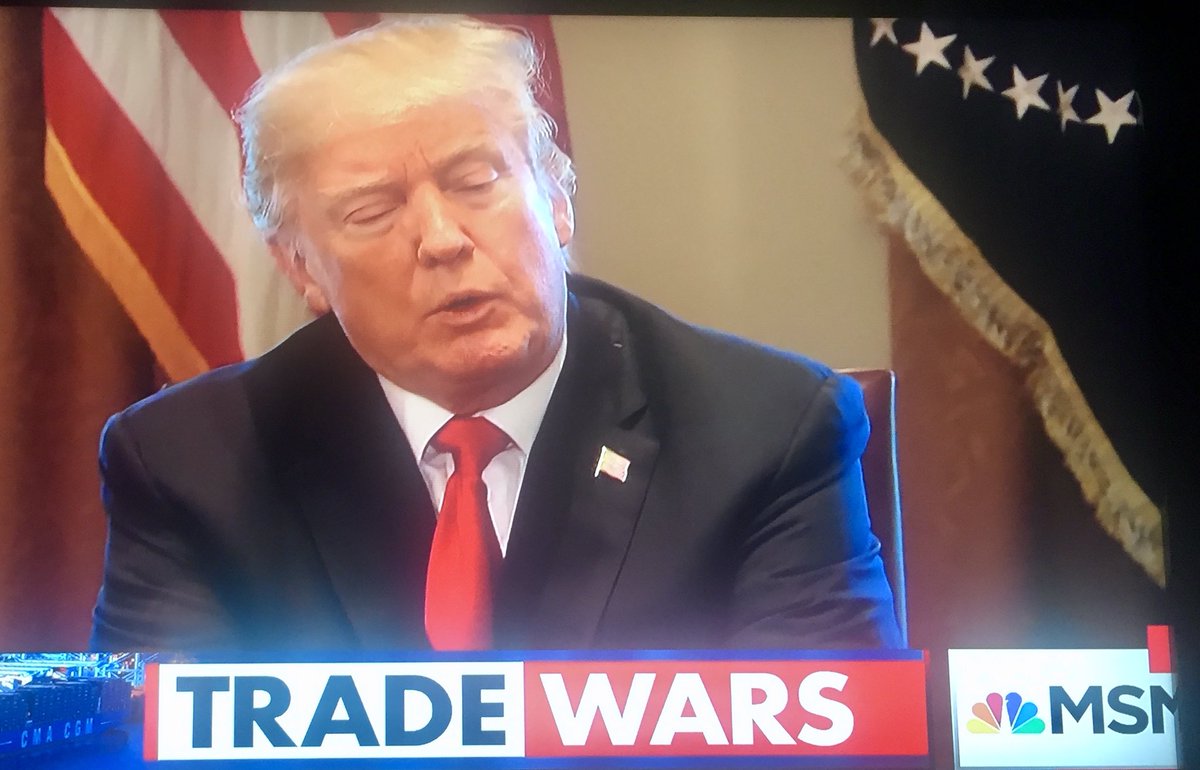
      His most recent tariff actions against China, Mexico and China (and threatening the EU) are kicking off a totally unnecessary trade war — with no real economic or trade objective. Primarily motivated by domestic political concerns to rile up his base — no real national security or trade reasons. Grievances and threats are simply no way to conduct sensitive foreign policy. We don’t need a return to the power politics of the 1930’s.

“In an extraordinary act of unity, 1,028 American professional economists in the spring of 1930 signed a letter urging Congress to reject and President Herbert Hoover to veto the Smoot-Hawley Tariff Act. Yet that June, Congress passed it and the president signed it into law. The Smoot-Hawley Tariff helped turn a stock market rout and a building financial crisis into a worldwide depression and triggered a global trade war that halved American exports and imports …. In sum, tariffs don’t have a predictable effect of reducing trade deficits, and trade deficits aren’t necessarily an adverse economic development. Indeed, trade deficits often arise as foreign investors choose the U.S. as a preferred destination for their capital.” “Economists to Trump.” Wall Street Journal (January 31, 2025).

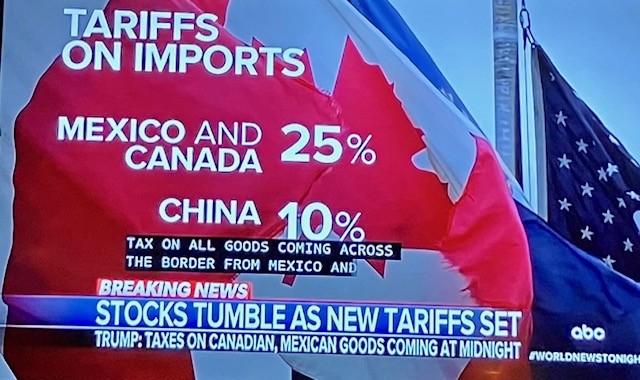
“President Trump will fire his first tariff salvo against those notorious American adversaries . . . Mexico and Canada. They’ll get hit with a 25% border tax, while China, a real adversary, will endure 10%. This reminds us of the old Bernard Lewis joke that it’s risky to be America’s enemy but it can be fatal to be its friend …. Take the U.S. auto industry, which is really a North American industry because supply chains in the three countries are highly integrated. In 2024 Canada supplied almost 13% of U.S. imports of auto parts and Mexico nearly 42%. Industry experts say a vehicle made on the continent goes back and forth across borders a half dozen times or more, as companies source components and add value in the most cost-effective ways …. Tariffs will also cause mayhem in the cross-border trade in farm goods …. Then there’s the prospect of retaliation, which Canada and Mexico have shown they know how to do for maximum political impact. “Dumbest Trade War in History.” Wall Street Journal (Feb. 1, 2025).

Trump has said he will hit the EU with tariffs, adding the bloc to a list of targets including Canada and Mexico and bringing the US to the brink of new trade wars with its biggest trading partners …. Hitting the US’s biggest trading partners with steep tariffs sharply raises the risks of igniting full-blown trade wars just days into Trump’s second term as president. Both Canada and Mexico have prepared packages of retaliatory tariffs and are ready to implement them. The EU has also said it would defend itself with retaliatory tariffs, as it did in Trump’s first term. “Trumps New Tariffs and Trade War.“ Financial Times (February 1, 2025).

“Trump is now wielding tariffs to achieve a broader set of goals than during his first term, when he focused largely on reducing the trade deficit and countering what he described as unfair Chinese trade practices …. Businesses that vigorously fought tariff proposals during Trump’s first term have largely accepted the fact that more are coming. Their hope now is less to persuade the president to abandon his plans than to be smart about implementing them …. Compared with 2018, the global landscape today reflects greater concern over fragile supply chains, geopolitical tensions and structural factors like aging populations and high levels of public debt – all of which could contribute to higher inflation.” “New Trade War.” New York Times (January 26, 2025).

“Strikingly, Trump reached for an obscure, 90-year-old provision in the US tax code to threaten a doubling of tax rates for foreign nationals and companies if their home countries were deemed to have imposed “discriminatory” taxes on American multinationals. …. Yet, outside the US, the threat of a widening array of trade barriers and conflicts over tax policies is weighing on the economic outlook …. “The New Economic War.” Financial Times (January 25, 2025).

Trump has long wielded tariffs as a weapon to resolve trade concerns. But the president is now frequently using them to make gains on issues that have little to do with trade …. Trump is also not limiting himself to the trade-related laws he relied on to impose tariffs in his first term …. Trump has appeared willing to deploy a legal statute — the International Emergency Economic Powers Act of 1977, or IEEPA — that gives presidents broad powers to impose trade and sanctions measures if they declare a national emergency …. The W.T.O. carves out exceptions for its members to act on issues of national security, and governments have used that exception more liberally in recent years when imposing tariffs or limiting certain kinds of trade.” “Trump Tariffs for any Cause.” New York Times (Jan. 29, 2025).

Tagged , , , , | Leave a comment

Trump Threatens New Tariffs & Int’l Taxes — The Newest Onslaught on the Global Economy.

Global Taxes are the new battlefield announced by President Trump during his first week in office. Trump threatens new tariffs and new taxes on foreign companies. His threat of new taxes is the newest threat in his onslaught on the trading system. This relies on a never used obscure tax provision (and is a specific attack on the OECD). He also threatened new tariffs if foreign companies don’t move production to the U.S. Further promoting ‘America First’ and protectionism and immigration policy. This is a major use of economic coercion in U.S. foreign policy for many domestic and non-international goals. Questionable under both domestic and international law — As well as a major divergence of U.S. foreign policy (even beyond many 19th and 20th century U.S. presidents). And a major divergence from the international rules developed since the end of World War II.

“A presidential memo called on federal agencies to remediate “unfair trade practices” and identify “currency manipulators”. Trade pacts with China, Canada, Mexico and all other partners were placed under review” ….  Trump’s proposals could take the average tariff rate on all imports to its highest since the 1930s …. Mexico has overtaken China and Canada to become the largest provider of US imports …. Weaponizing trade to achieve different ends. Trump has linked tariffs to other policy goals, beyond reducing trade deficits. “Trump’s Trade Salvo.” Financial Times (January 22, 2025).

Trump has threatened to double tax rates for foreign nationals and companies in the US to hit back at “discriminatory” levies on American multinationals, in a move that threatens to trigger a global confrontation over tax regimes …. In a memo outlining his “America First” trade policy, the US president referred to an obscure 90-year-old provision of the US tax code — Section 891 — that empowers him to retaliate against foreign countries by imposing punitive taxes on their citizens and businesses in America …. “This [invoking Section 891] is the most extreme option …. Trump also issued a separate policy memo withdrawing US support for last year’s OECD global tax pact, which allows other countries to levy top-up taxes on US multinationals …. Trump’s memo on the OECD also includes investigating “whether any foreign countries are not in compliance with any tax treaty with the US or have any tax rules in place, or are likely to put tax rules in place, that are extraterritorial or disproportionately affect American companies ….The global deal agreed at the Paris-based OECD in 2021 and partly introduced by several countries last year was expected to raise the tax take from the world’s biggest multinationals by up to $192bn a year. Under “pillar two” of the OECD deal, if corporate profits were taxed below 15 per cent in the country where the multinational was headquartered, signatories could potentially charge top-up levies …. We are seeing international taxation moving from a multilateral domain to a bilateral one based on strong unilateral assertions. “Trump and Global Tax.” Financial Times (January 22, 2025).

“Trump is taking aim at a tax scheme cooked up at the Organization for Economic Cooperation and Development (OECD). The first part of the deal, known as pillar one, imposes a surtax on the world’s largest companies and is aimed primarily at American tech and pharma firms. Pillar two creates a minimum global effective tax rate of 15%. Governments such as France or Germany could impose “top-up” taxes on U.S. companies whose tax bills at home are too low …. The global tax deal also gets a veiled mention in a separate executive order on trade. That order instructs officials to examine whether other governments impose “discriminatory or extraterritorial” taxes on U.S. citizens or companies—followed by a menacing mention of section 891 of the tax code. That provision allows the U.S. to double the tax bills of foreign companies or individuals whose governments single out American companies for heavier taxation. It’s the nuclear option of global tax policy.” “End of the Global (OECD) Tax Affair.” Wall Street Journal (January 22, 2025).

“Trump said he planned to put a 25 percent tariff on products from Canada and Mexico beginning on Feb. 1, claiming that the countries were allowing “mass numbers of people and fentanyl” to come to the United States. Trump said he would also put an additional 10 percent tariff on Chinese products by the same date, accusing China of sending fentanyl to Mexico and Canada, which was then crossing into the United States …. Mexico, China and Canada account for more than a third of the goods and services that are imported to or bought from the United States, supporting tens of millions of American jobs. Together, the countries purchased more than $1 trillion of U.S. exports and provided nearly $1.5 trillion of goods and services to the United States in 2023, the last year government data is available …. While tariffs have long been used by the United States as punishment for unfair trading practices, Trump’s first use of them is aimed at an entirely different outcome: tightening American borders against immigrants and illegal drugs.“Trump Tariff Countdown.” New York Times (January 23, 2025).

”Trump — Come make your product in America and we will give you among the lowest taxes of any nation on Earth …. But if you don’t make your product in America … you will have to pay a tariff. Expressing frustration at tariffs the European Union places on American farm products and cars, Trump said the They put tariffs on things that we want to do.” “Trump – Produce U.S. or Tariffs.” Wall Street Journal (Jan. 24, 2025).

“In 1815, as the Napoleonic Wars ended and a fear of cheap grain imports arose, the landowner-protecting British Parliament passed the Corn Laws, imposing tariffs on foreign wheat and maize. This helped some farmers, but the Industrial Revolution was just starting, and workers who had flooded into cities faced shortages and high bread prices. There were many riots …. Why do presidents have the power to tariff anyway? Article I, Section 8 of the Constitution plainly states: “The Congress shall have Power To lay and collect Taxes, Duties, Imposts and Excises. . . . To regulate Commerce with foreign Nations.” In June 1930, Herbert Hoover signed the disastrous Smoot-Hawley Tariff Act, imposing almost 900 duties. After that mistake, in 1934 during the avoidable depression, Franklin D. Roosevelt signed the Reciprocal Trade Agreement Act, enabling presidents to negotiate trade agreements and apply tariffs themselves …. The General Agreement on Tariffs and Trade was created in 1947 and drove massive postwar trade and growth. But, worried about the Soviets, Congress passed the Trade Expansion Act of 1962 and specifically Section 232, which allowed presidents to restrict imports they deemed a threat to national security. Section 301 of the Trade Act of 1974 authorized presidents to impose tariffs on countries that violate agreements or burden U.S. commerce. The International Emergency Economic Powers Act 1977 allows presidents to regulate trade during national emergencies. Congress sure loves giving its power away. No wonder Mr. Trump has a crush on the word “tariff.” “Trump Tariffs.” Wall Street Journal (January 26, 2025).

“Trump is now wielding tariffs to achieve a broader set of goals than during his first term, when he focused largely on reducing the trade deficit and countering what he described as unfair Chinese trade practices …. Businesses that vigorously fought tariff proposals during Trump’s first term have largely accepted the fact that more are coming. Their hope now is less to persuade the president to abandon his plans than to be smart about implementing them …. Compared with 2018, the global landscape today reflects greater concern over fragile supply chains, geopolitical tensions and structural factors like aging populations and high levels of public debt – all of which could contribute to higher inflation.” “New Trade War.” New York Times (January 26, 2025).

“Strikingly, Trump reached for an obscure, 90-year-old provision in the US tax code to threaten a doubling of tax rates for foreign nationals and companies if their home countries were deemed to have imposed “discriminatory” taxes on American multinationals. …. Yet, outside the US, the threat of a widening array of trade barriers and conflicts over tax policies is weighing on the economic outlook …. “The New Economic War.” Financial Times (January 25, 2025).

Trump has long wielded tariffs as a weapon to resolve trade concerns. But the president is now frequently using them to make gains on issues that have little to do with trade …. Trump is also not limiting himself to the trade-related laws he relied on to impose tariffs in his first term …. Trump has appeared willing to deploy a legal statute — the International Emergency Economic Powers Act of 1977, or IEEPA — that gives presidents broad powers to impose trade and sanctions measures if they declare a national emergency …. The W.T.O. carves out exceptions for its members to act on issues of national security, and governments have used that exception more liberally in recent years when imposing tariffs or limiting certain kinds of trade.” “Trump Tariffs for any Cause.” New York Times (Jan. 29, 2025).

Tagged , , , , | Leave a comment

Is Trump the New McKinley on Tariffs & Protectionism?

     I taught global trade law many years. I must say no one was very interested in actual tariffs and I discussed them very little. Except perhaps trying to figure out the Harmonized Tariff Schedule, and only in passing. This sets out the tariff rates for all imported goods. It’s something like trying to figure out the Internal Revenue Code. You need to figure out the classification of the imported product to determine the tariff rate and tariff (tax on the imported goods that the importer pays). Now of course tariffs are the number one international issue for Trump 2.0. Knowing the history of US. tariffs and U.S. presidents is very illuminating — From McKinley to Hoover to Reagan to Nixon. The question now is will Trump be the new McKinley?


“Displaying a somewhat improbable interest in the intellectual history of taxes on imports, Donald Trump has several times cited the 19th century as an inspiration. Specifically, he’s a fan of William McKinley, president from 1897 to 1901. To free-traders, the McKinley tariff of 1890, is almost as notorious as the Smoot-Hawley one — though Smoot-Hawley kicked off a global surge in protectionism while the McKinley tariff came at a time of enormous industrial expansion …. If Trump is a new McKinley, we’re in for some really quite serious long-term protectionism and a reordering of the US economy. This is unlikely to make the US better off …. Reagan pushed forward the development of the international system through the Uruguay Round of trade talks that ultimately helped to create the World Trade Organization …. If Trump undertakes similar unilateral action, he will be very likely to use the International Economic Emergency Powers Act, a law that grew out of the Trading with the Enemy Act employed by Nixon …. Nixon ran a rambunctious administration with abrasive advisers and enjoyed unsettling other governments to force them into concessions.” “Trump Trade 2.0 – From McKinnley to Reagan to Nixon.” Financial Times (Jan. 20. 2025).

Tagged , , , , | Leave a comment

Dr. Stuart Malawer on Int’l Trade & Int’l Law — Op-Eds in Richmond Times-Dispatch (2011-2025).

Dr. Stuart Malawer — Op-Eds in Richmond Times-Dispatch (2011-2025).

Tagged , , , , | Leave a comment

‘Laissez-Faire Globalization’ Needs a Redo (a New Industrial Policy and New China and Global Tax Policies) — So They Say.

     The Biden administration’s trade policy and Trump 1.0 (and now Trump 2.0) focused on redoing U.S. trade policy and developing a newer industrial policy promoting U.S. industry, workers and national security. (So they say …) Clearly, trade policy and in particular tariff policy have undergone and continue to undergo significant rethinking by many in the U.S. Biden’s reassessment was significant.

     This was built upon Trump’s earlier attack on the existing trade policies. The promise of Trump 2.0 seems to be even exponentially greater than both Trump 1.0 and Biden’s policies, especially as to China. Here’s a recent statement of the outgoing Biden’s USTR (Kathrine Tai) on trade policy generally and comments on China and the intertwining of new global tariff threats and new global tax rules. China has instituted new laws concerning retaliation and national security and the U.S. has recently opened a Section 301 investigation into Chinese maritime industry practices.


“The effects of trickle-down policies have become all too clear. They have left working people behind all over the world, pitting those in one economy against those in another as the private sector prioritizes short-term profit …. Laissez-faire globalization has left the United States and other democracies vulnerable and less secure …. China, in particular, is actively intervening in the marketplace to dominate key sectors and to strengthen its ability to coerce others to leverage more favorable political and economic decisions …. Trade policy must work hand in hand with domestic economic policy, not be placed in a separate silo …. Executing a fair competition agenda after decades of laissez-faire policies is not a simple task …. The world is moving past the paradigms of the Chicago school and the so-called Washington consensus, and that gives the United States the chance to shape trade and international economic policy so that it is more equitable for the underserved at home and abroad.”  “Purpose of Trade Policy.” Foreign Policy (Jan. 2025).

A long series of tit-for-tat measures and countermeasures risks growing into an all-out trade war, and this would cause substantial damage to the world economy …. Washington’s long quest to punish China — carried from Trump’s first administration into President Joe Biden’s, and now into a second Trump term — rests on some muddled thinking about the challenge Beijing presents. Gripes about trade and fears stemming from lost U.S. manufacturing jobs have gotten mixed up with concerns about the threat that China’s rise could pose to national security …. This moment calls for increased collaboration to protect a global economy that remains tightly intertwined despite years of brewing hostility between its two dominant powers.” “How Not to Deal With China.” Washington Post (Jan. 13, 2025).

“The imposition of tariffs in response to global tax measures could hamper economic growth by raising operational costs for businesses and increasing prices for consumers …. A key part of the OECD deal is known as the undertaxed profits rule and often referred to as the UTPR, is viewed as discriminatory. The rule allows countries to increase taxes on a local subsidiary of a multinational group if the multinational pays less than 15 per cent of corporate tax in any other jurisdiction. The rule would mean other countries would be able to levy top-up taxes on US companies.” “Tariffs and  Global Tax War.” Financial Times (January 14, 2025).

“A strategy for a world barraged by Trump’s promised tariffs is to ignore them. Incensed as countries might be about U.S. bullying, leaders abroad should look for paths around America and work to rebuild the global trading system …. Rather than shooting themselves in the foot, countries might instead copy one thing China did when it was hit by tariffs during Trump’s first term: It lowered tariffs on imports from other countries. This disadvantaged American exporters and benefited the Chinese economy by attracting cheaper imports from the rest of the world …. This sort of strategy might even temper Trump’s hand. The United States is a big market, but it accounts for only 13 percent of global imports. Many countries could replace lost access to the United States fairly easily.” “Fighting a Trade War.” Washington Post (January 18, 2-25).

In the past, Beijing’s responses were measured. But its words and actions are growing sharper, and the targets of its retaliatory blows are widening to include supply chain vulnerabilities, critical minerals and individual companies …. Likewise, Beijing’s punitive actions increasingly mirror Washington’s …. China has quietly passed its own laws that ban compliance with laws, sanctions or boycotts in other countries. The commerce ministry has the authority to deem commercial decisions as a threat to China’s national security.” “China and Retaliatory Trade Sanctions.” New York Times (January 19, 2025).

“The new Biden investigation, issued by the US trade representative under Section 301 of the Trade Act, lays out how China has used non-market practices to dominate the global maritime industry …. More importantly, there are legitimate national security and commercial supply chain reasons to build more non-Chinese maritime capacity …. Of course, increasing maritime capacity is a long-term, heavy lift. And yet, the success of the Chips Act, which has rebooted US semiconductor production in less than two and a half years, shows that it is possible to create more resiliency and redundancy in critical industries when there is political will.” “Trumps Challenge on Trade.” Financial Times (January 19, 2025).


Tagged , , , , | Leave a comment

TRADE LAWYERS & LOBBYISTS IN TRUMP 2.0 — EXPONENTIALLY IN DEMAND.

     No doubt about it. One of the hottest areas in law and lobbying in D.C. for the next four years will be tariffs and trade.  (Once a backwater of policy issues in Washington.) The domestic and global landscape is about to be changed greatly — greater chaos and unpredictability. More focus on the U.S. domestic economy and national security. The problem is this will generate a great deal more politicalization and rise of lawyers and lobbyists trying to make deals in any which way. One loser will certainly be the formulation and implementation of sound foreign policy.

“Law firms that thrived in the heavy regulatory environment of the Biden administration are quickly pivoting to capitalize on a host of different opportunities presented by a second Trump presidency …. Firms are being inundated by clients calling about Trump’s proposed policy shifts, asking how new tariffs will disrupt supply chains, whether relaxed antitrust and financial enforcement will spur deal activity ….. Trade is among the areas where demand for counsel is increasing quickly. With Trump pledging that he will impose tariffs on Mexico, Canada and China, firms are handling concerns about supply-chain disruptions and restrictions companies might encounter because of the tariffs. Top firms across the U.S. are also bracing for major changes in the antitrust landscape.” “Law Firms, Trade / Tariffs & Trump Landscape.” Wall Street Journal (Jan. 8, 2025).

Tagged , , , , | Leave a comment

Jan. 2025 — Recent Trade Actions Will Provide Trump 2.0 with a Greater Platform for Even More Confrontational Trade Policies.

    Recent developments in the last few weeks leading up to Trump 2.0 indicate strongly that a new era in trade policy is being cemented. Biden’s recent extension of export controls on exports to China concerning technology, his blocking of the Nippon-U.S. Steel merger, and the withdrawal of U.S. corporate support for stable China trade and investment relations indicate clearly that the Trump administration will be able to rely upon these actions in extending even greater confrontational policies toward China and globally — promoting U.S. protectionism and isolationism.


” For more than a decade, the United States has been throwing sand in the gears of world trade. During his first term as president, Trump took the country out of the Trans-Pacific Partnership, emasculated the World Trade Organization’s dispute settlement mechanism, and slapped tariffs on imports from friends and foes …. At the end of his presidency, Biden has decided to block a Japanese company’s acquisition of U.S. Steel …. And now Trump 2.0 is promising tariffs on everybody …. The rest of the world doesn’t want to play ball, however. As the United States walls itself off from the global economy, other countries are instead trying to further entwine economically …. But its protectionism is spurring other countries to join together, to guarantee access to markets.  “U.S. Protective Trade Policies (Protectionism) and Isolationism.” Washington Post (January 10, 2025).

“On Dec. 2, the United States announced a new round of export controls on advanced semiconductors to China, and more restrictions are expected soon …. China, of course, never bought the “small yard, high fence” idea. It does not accept the premise that national security technology controls are distinct from broader economic competition between the two powers, and it could see the wide-ranging implications of these supposedly narrow restrictions. The Biden administration’s attempts at reassurance did not dissuade China from responding with retaliatory measures, including this month’s announcement that China would block the export of certain critical minerals to the United States. Trump, for his part, does not seek to separate economic and security competition and has shown little interest in minimizing disruption or cooperating with allies. His administration is poised to severely curtail trade and investment with China and pressure allies to do the same …. Will Trump’s more confrontational approach work better? His team will need to tackle the same challenges that the Biden administration faced.” “Small Yard, High Fences.” New York Times (Dec. 31, 2024).

“Now, as Trump prepares for his second administration, American companies have largely gone silent about the importance of the U.S.-China relationship. That is because American businesses no longer see China as the land of opportunity. The promise of China’s market has faded as its once-booming economy hits trouble …. Washington has also made it harder for American companies to do business in China via both policies and the political atmosphere …. U.S. companies that have spent a lot of time and money in building businesses in China are no longer inclined to defend those investments with public lobbying campaigns in Washington.” “U.S. Corporations Backing Away from Supporting China.” New York Times (January 2, 2025).

Biden blocked the sale of U.S. Steel to Japan’s Nippon Steel, fulfilling his pledge to keep the storied steelmaker domestically owned. Biden’s decision comes after the Committee on Foreign Investment in the U.S spent months reviewing the $14.1 billion deal for potential national-security risks. the White House required the companies to abandon the deal within 30 days unless Cfius agrees to extend the timeline …. Biden’s rejection of the deal is the latest sign of the U.S. government’s tilt toward protectionist policies to boost homegrown businesses …. Trump levied tariffs on steel imports in 2018 during his first term and has pledged to use tariffs aggressively again in his next administration. Biden expanded requirements for made-in-America metal on government-funded projects and viewed himself as an advocate for blue-collar workers and unions …. On Dec. 23, Cfius members notified the president that it had deadlocked over whether to recommend the deal. That left the decision up to Biden, who months ago said he was against foreign ownership of the Pittsburgh-based company.” “Biden Stops Nippon-U.S. Steel Merger.” Wall Street Journal (Jan. 3, 2025).

“Navarro concluded that with China in the WTO it was now impossible to create the type of level playing field that Ricardo had wanted, because Beijing had rigged the system. America, the piggy bank, will continue to be plundered by a trade deficit that transfers more than half a trillion dollars of American wealth a year into foreign hands . . . [through] industrial espionage, rampant cheating, intellectual property theft, forced technology transfer, state capitalism and currency misalignments …. Several key themes emerge. One, there is a widespread view in the Maga movement, including senior levels of President Trump’s circle, that neoliberal economics has failed and Ricardian economics is no longer relevant. We are in a populist nationalist fight. A second key theme is profound hostility to China, to a point where some Trumpian are reluctant to even see Beijing buy many Treasuries. A third is that if trade flows are reimagined, finance might also need to be, to protect American interests; the so-called Bretton Woods system created by western allies in 1944 to shape global finance might have to be rethought …. “Meganomics and Trump.” Financial Times (1.4.25).

“The US-China trade war is set to return with even greater intensity, likely overshadowing the first iteration …. The World Trade Organization’s dispute settlement system has been paralyzed since 2019 due to the US blocking appointments to its Appellate Body (AB). Despite pledges at the WTO’s 12th Ministerial Conference in 2023 to restore a “fully and well-functioning” system by 2024, progress on restoring the system remains elusive, with ambiguity surrounding the AB’s fate …. As the largest free trade agreement in the world, the Comprehensive and Progressive Agreement for Trans-Pacific Partnership (CPTPP) set a “gold standard” for trade deals from its inception, ironically nurtured and established by the US itself before Trump pulled the US out of its membership. On 16 September 2021, China formally applied to join the CPTPP …. As 2025 unfolds, the global trade system faces significant disruptions from the intensification of the US-China trade war to ongoing reform debates within the WTO and regional trade agreements like the CPTPP.”  “Trade Policy 2025.” Hinrich (Jan. 7, 2025).

“Trade-minded people in Asia need to pay particularly close attention to Trump’s pledge to fundamentally reverse the US’ traditional Asia-facing economic openness, manifested in the team of personalities the president-elect has assembled to manage his foreign policy. Some are neo-conservatives who want to devote more US resources to the projection of American power and take additional steps to constrain the rise of China. But others – including Donald Trump himself – lean isolationist and transactional, and apply “America First” principles when evaluating the question of “what’s in it for the United States?” Donald Trump’s transactional attitude extends into the trade and investment policy realm, reflecting a deep sense of national grievance about America’s trade deficits and dependence on manufactured imports. Trump firmly believes that America’s current external economic situation is “unfair,” and needs to be rectified.“ “American Trade Policy and Asia.” Hinrich (Jan. 7, 2025).

Tagged , , , , | Leave a comment

TRUMP’S TARIFFS — EXPONENTIAL GROWTH OF LAWYERS AND LOBBYISTS.

    There is one certainty. Trump’s tariffs will act as a full employment law leading to exponential growth of lawyers and lobbyists trying to influence government legislation, regulation and policy in this sub-field of trade law. Actually, most lawyers today know very little about this field, but that won’t stop the growth. Demand for any knowledge in this area will grow greatly because of the concerns of domestic and global corporations engaged in global commerce and the related ecosystem of suppliers and other parties.


“The problem is that Trump’s tariff program would energize and empower elites. By directing government to impose levies on allies and adversaries alike, he’d be giving more strength to the swamp monsters he’s supposed to be defeating …. When Washington wants to impose new taxes, including tariffs, the companies and people who would be affected rush to trade associations, public-relations firms and lobbyists for help …. We saw this play out in response to Trump’s tariffs during his first term. When he imposed strict steel and aluminum tariffs in 2018, thousands of U.S. companies lobbied the Commerce Department to end the tariffs or exempt their operations. Some companies exempted from the tariffs lobbied the Commerce Department to keep them in place on their competitors …. As his tariff regime expanded, the number of companies deploying lobbyists in Washington tripled. There were roughly 100 groups lobbying on tariff issues when Trump took office. By June 2018, there were nearly 450. Imagine how many more there will be if his second-term tariff program is as expansive as he’s promising.”  “Tariffs and the Swamp.” Wall Street Journal (12.26.24).


FILE – Peter Navarro raises his fist while speaking during the Republican National Convention, July 17, 2024, in Milwaukee. (AP Photo/J. Scott Applewhite, File)

Tagged , , , , | Leave a comment

My Travels in India.

Several years back. With my wife Sandy Malawer in India. Once on a management program in Mumbai and subsequently in front of the Taj Mahal with Governor Warner’s Trade Mission to India.

Leave a comment

Trade Practice, Lobbying & New Directions Under Trump — Exponentially Expanding.

    As an immediate result of Trump’s election, the future of trade practice, and trade negotiations is that they are expanding and are going in newer directions.  This involves both tariffs and nontariff issues. These are multifaceted and represents a break from the “old order” (pre-Trump). 

      Newer concerns involve a broad range of non-tariff issues relating to national security, foreign policy, international alliances, economic groupings (regional and inter-regional), economic development, international relations and geopolitics. This amounts to a return to a sort of mercantilism. There is a broad rejection of the WTO and its dispute resolution system and almost all rule of trade. Such as arbitration provisions in treaties known as ‘Investor-State Dispute Settlement (ISDS). There is a growing possibility that the linkage of national security and global commerce will form the basis of a new industrial policy. For example, focusing on rebuilding the U.S. shipping industry.

     Lawyering and lobbying in Washington, D.C., will be on a whole new level — involving many interest groups and toxic debates. This will be exploding.


“Washington lawyers and accountants are gearing up for a fee bonanza as companies prepare for tariffs, export controls and the possibility of trade wars under Donald Trump …. Trade was becoming an increasingly attractive specialty …. Lawyers say companies are seeking help navigating the thicket of national security laws, tariff exemptions and product classifications that make the difference between a company escaping punitive levies ….
Some companies are exploring ways to sidestep potential tariffs …. chance to apply to be “excluded” from having tariffs mechanisms for minimizing tariffs. Other mechanisms include bonded warehouses, secure facilities where imports can be stored before triggering tariffs, or duty drawback programs, through which tariffs can eventually be refunded if goods are subsequently exported.”    “Law Firms and Tariff Practice.” Financial Times (12.10.24).

 “Even if Trump persists with tariffs on traditional goods, he needs a nontariff trade agenda that promotes digital commerce and data flows while capitalizing on America’s technological edge …. Digital trade includes the cross-border transfer of goods and services, such as software, streaming entertainment, e-commerce orders and consulting expertise …    In general, the digital MCUSA chapter promotes interoperability. It recognizes electronic signatures and encourages eliminating paperwork for cross-border commerce, adding consumer protections, limiting unsolicited communications, and protecting individual privacy rights.” “Trade Means More than Tariffs.” Wall Street Journal (December 10, 2024).

“Biden is seeking to erode investor-state dispute settlement (ISDS) protections under U.S. trade agreements with Colombia, Mexico and Canada as it leaves town. Most U.S. trade agreements include independent tribunals to arbitrate disputes between foreign governments and investors. The goal is to provide an impartial forum for foreign investors to challenge hostile government actions. Investors are entitled to monetary damages if they prevail. The U.S. has never lost a case, but a political right-left axis wants to weaken the protections. Robert Lighthizer, Trump’s first-term trade representative, negotiated limitations on the international tribunals in the revised U.S. trade pact with Mexico and Canada. He and his allies on the left say businesses would build more factories in the U.S. if there were fewer legal protections for overseas investments. But this opens the door to leftwing governments that want to nationalize U.S. investments and harm U.S. shareholders.” “Investor-State Dispute Settlement (ISDS) & Biden , Wall Street Journal (December 13, 2024).

“With Trump’s election, the postwar economic order is poised to change for good. It will be replaced by a quasimodern mercantilist system. The term “mercantilism,” popularized in the 18th century, was used to describe economic policies of colonial powers that focused on managing the economy to build up state power …. China’s emergence as an economically powerful strategic competitor to the U.S. worries many in the free world. It has raised concerns about supply-chain dependencies, the lack of robust manufacturing, and an ailing defense industrial base. The political and social consequences of lost domestic manufacturing jobs are leading policymakers to second-guess whether cheaper consumer goods and a more market-efficient allocation of capital are worth it. Over the past eight years, the Trump and Biden administrations have chipped away at the WTO order—putting tariffs on Chinese imports, using export controls to limit China’s access to advanced semiconductors, and pushing industrial policies like the Inflation Reduction Act and the Chips Act. With China and the U.S. now in the mercantilist camp, pressure is growing for Europe to follow. The Continent is torn between its commitment to WTO principles and the need to respond to competitive threats.” “Mercantilism.” Wall Street Journal (December 13, 2024).

“The world is more diverse and interwoven than ever before — economically, culturally, ethnically, generationally. This is largely the result of the postwar explosion in cross-border flows of goods and money, people and information. For much of that period, the benefits of globalisation were taken for granted and garnered widespread popular and political support.  Those days are gone. The question now being asked is whether increased economic openness and connection are a source of fragility rather than flourishing, economically and societally. This is a key point of departure between progressives (who emphasize the benefits) and populists (who emphasize the fragility). Both have a point. ” “How to Get to the We Society.” Financial Times (December 14, 2024). 

“Throughout the Biden administration (and the Trump administration before it), the US treated appeals to national security as a kind of get-out-of-jail-free card, enabling it to break trade rules at will. The use of the World Trade Organization’s Article XXI loophole had generally been regarded as being a matter for the country invoking it, but that only held as long as there was a norm of voluntary restraint. After Trump started using it willy-nilly — and especially for his Section 232 tariffs on steel and aluminum (aluminum, whatever) — the WTO dispute settlement system made rulings against it, which only hardened US disdain …. “Trade Secrets: National Security and Trade Loophole.” Financial Times (December 16, 2024).

“Trump may, in fact, bring his own kind of industrial policy to a second term, one focused particularly on the intersection of security and commerce. This week, we’ll get the first glimpse of what such a policy might look like, with the introduction of the bipartisan Ships for America Act.” “Trump’s Industrial Policy.” Financial Times (December 16, 2024).

Tagged , , , , | Leave a comment