
Multinational Corporations and Human Rights — The Alien Tort Statute No Longer Applies.

Alien Tort Statute

     Yesterday the U.S. Supreme Court in Kiobel v. Royal Dutch (2013)  declared that the general presumption against extraterritoriality of U.S. legislation was not overcome (and thus upheld the presumption of territoriality of U.S. legislation unless Congress says otherwise).  The Supreme Court held that the 1789 Alien Tort Statute does not apply to a foreign multinational corporation for its  human rights violations in another country involving foreign plaintiffs. This is a major win for multinational corporations and a significant loss for human rights groups. This decision reversed a thirty-year interpretation of the legislation. Predictably the New York Times editors were dismayed and the Wall Street Journal editors were joyous.  “S.Ct. Restricts Alien Tort Statute.” New York Times (April 18, 2013); “Wall Street Journal — Editorial — Alien Tort Statute.Wall Street Journal (April 18, 2013); “New York Times — Editorial — Alien Tort Statute.” New York Times (April 18, 2013).

Posted in Global Trade Relations | Tagged , , , , , , | Leave a comment

Trade Updates: Tax Havens, EU Antitrust, EU Trade Powers, Russian Sanctions, Power Politics — Diverse Developments.

         EU and China Flags
 A number of diverse developments have recently occurred concerning global trade relations. They continue to evidence the broad range of  topics impacting trade across the globe. In particular, the developments relating to the U.S., the EU, and Russia are of particular significance

…. Excellent article discussing offshore tax havens. “Piercing the Secrecy of Offshore Tax Havens.Washington Post (April 6, 2013) (review of massive data).

…..Interesting argument that power politics and national interest are back at the expense of multilateralism and the WTO.  Bilateral trade arrangements are in favor and multilateralism across the board is not in favor (from climate control, to international security interests).  “Trade Deals Show Power Politics is Back.” Financial Times (April 1, 2013).

…..The EU is considering pursuing yet another antitrust case against Google this one over the Android phone and display of Google Apps. (This is addition to the pending one concerning Google’s search engine (involving search results and those sponsored ones).  “World Tech Companies Look to Brussels to Resolve Antitrust Complaints.Wall Street Journal (April 10, 2013).

…..Good update on proposals in the EU to update its trade powers to investigate and litigate trade disputes within the EU system especial against China. “EU Seeks New Powers for Trade Probes.” Financial Times (April 11, 2013).

…..The U.S. has imposed sanctions on various Russians under the Magnitsky legislation and the Russians have responded in kind. “Russia Bars 18 Americans After Sanctions by U.S.New York Times (April 14, 2013).

…..The EU is considering moving more aggressively against tax havens perhaps along the lines of the U.S. “Foreign Account Tax Compliance Act” (FATCA). This issue will be discussed at the upcoming G-20 meeting and the European Union Summit. “Support Grows for European Efforts to Fight Tax Havens.” New York Times (April 15, 2013).

Posted in Global Trade Relations | Tagged , , , , , , , | Leave a comment

Corruption, Taxation, National Security, Investment, National Interests — Recent U.S. Trade Developments

          Global Trade (April 1, 2013)
     Recent developments concerning foreign corruption prosecutions, taxation of multinationals, national security reviews, and criticism of U.S. trade policy as being increasingly based on national interests and power politics remind me how really diverse the field of international trade relations is today. Here are some recent developments.

…. Microsoft  is under investigation for violating the foreign  corruption act (FCPA) in China via its foreign subsidiary and foreign partners. This was started by a whistleblower acting under the newer  provisions of the Dodd-Frank legislation of 20120. “U.S. Probes Microsoft, Partners Over Bribery Claims.Wall  Street Journal (March 20, 2013). Panasonic is also under investigation. “Panasonic  Draws U.S. Bribery Probe.” Wall Street Journal (April 1, 2013) (data from DOJ — 108 cases — and SEC — 77 cases — as to FCPA litigation since 2009 resulting in over $2bn in penalties).

…. Excellent overview of problems taxing multinational corporationsand how aggressive they have become in reducing their tax burden over last 20 years. Tax Burden Isn’t What It Used To Be.” Washington Post (March 23, 2013). This article discusses the MNC intra-group short-term loans as a primary use of offshore monies and raises the issue of repatriation. “How Firms Tap Overseas Cash.Wall Street Journal (March 29, 2013).

….The proposed Softbank Corp – Sprint/Nextel merger is subject to a national security review as a foreign merger (in this case a Japanese firm) and is again raising the issue of Huawei and ZTE as telecom equipment suppliers. This involves WTO trade rules as far as restricting foreign imports. “China Worries Arise in Sprint Deal.” Wall Street Journal (March 28, 2013).

…. Interesting argument that power politics and national interest are back at the expense of multilateralism and the WTO.  Bilateral trade arrangements are in favor and multilateralism across the board is not (from climate control, to international security interests).  “Trade Deals Show Power Politics is Back.” Financial Times (April 1, 2013).

Posted in Global Trade Relations | Tagged , , , , , , , , , | Leave a comment

States and Trade Sanctions — New Role of States Under Federal Legislation — Historical Development.

Trade Sanctions

    Recent federal law   (Comprehensive Iran Sanctions, Accountability, and Divestment Act of 2010) authorizes states to impose trade sanctions on Iran.  (This legislation was amended by the National Defense Authorization Act for Fiscal Year 2012.)

    The 2010 statute specifically cites and encourages divestment sanctions by state pension funds. (Title III). Some  argue that under this statute U.S. ports and states housing them would have authority to deny foreign shippers access to the ports if their ships call on Iranian ports.

    This newer legislation is clearly a historical development concerning the role of states in global trade sanctions.

     States have long taken action impacting foreign trade which is a federal power exclusively exercised by the Congress. But courts have not been too friendly. In 2000 the Supreme Court struck down state law concerning Burma trade sanctions as being in violation of  the principle of federalism (relying upon the concept of “implied preemption”). Ten years later the Congress has now decided to enlist the support of states.

     To me this new legislation is long-overdue.  It calls for greater state action.  In order to be really effective state action should be coordinated among the states. This would significantly broaden and reinforce the actions of the federal government and multilateral sanctions.

…. “Uniting States Against Iran.” Wall Street Journal (March 9, 2013).

…. “Closing U.S. Ports.” Wall Street Journal (March 14, 2013).

….  U.S. Treasury Dept. Resource Center for Iranian Sanctions.

Posted in Global Trade Relations | Tagged , , , , , , , , , , | Leave a comment

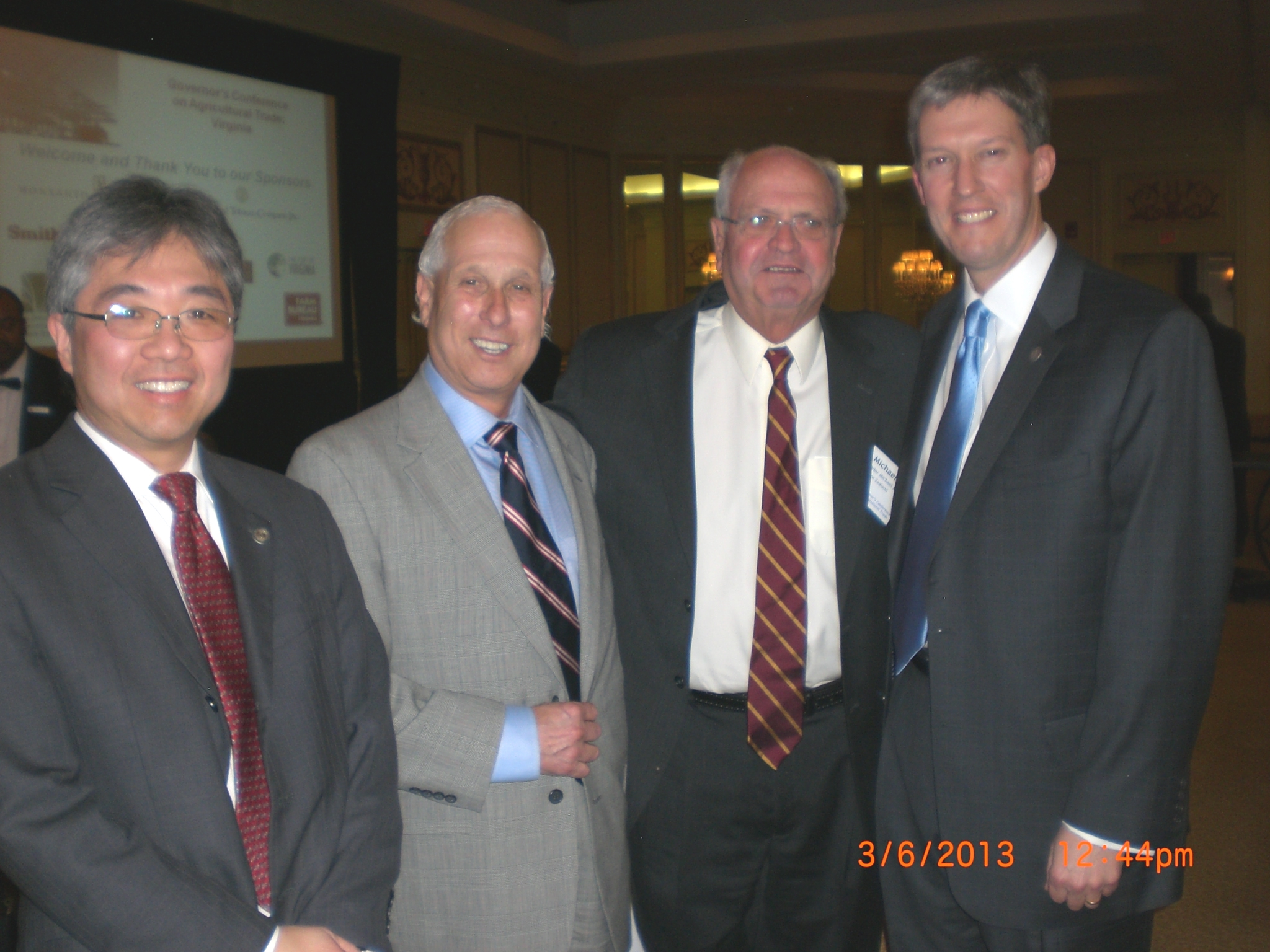
Virginia Agriculture Trade and the WTO — What Does this Evidence About Globalization?

Jim Cheng (Va. Sec. of Trade and Commerce), Stuart Malawer (GMU / Public Policy and VEDP Board), Amb. Mike Moore (former WTO Director-General), Todd Haymore (Va. Sec. of Agriculture)

Jim Cheng (Va. Sec. of Trade and Commerce), Stuart Malawer (GMU / Public Policy and VEDP Board), Amb. Mike Moore (former WTO Director-General), Todd Haymore (Va. Sec. of Agriculture).

The Virginia Governor’s Conference on Agricultural Exports was recently held for two days in Richmond. Who was the luncheon speaker? The former Director-General of the World Trade Organization Mike Moore.
Ambassador Moore followed Virginia Governor McDonnell’s presentation. This simple fact that the former Director-General of the WTO was the keynote speaker at a state level trade conference speaks volumes about the evolving nature of the global trading system.
This conference demonstrates almost more than anything else the growing inter-relationship between the WTO and sub-national units (states).
Who would have thought that a few years back that states would show the slightest interest in the workings of a multilateral trade organization?
In the United States the states remain, but not recognized by many, as important actors in both global trade and foreign relations.
It is the individual state that exercises primary responsibility for promoting both agricultural and non-agricultural exports as well as encouraging direct foreign investment. This is done in order to facilitate local economic development and job creation. States have more than once taken the lead in imposing trading sanctions (including investment restrictions) on foreign countries as they did against South Africa during Apartheid. Recent federal legislation (The Comprehensive Iran Sanctions Act of 2010) explicitly authorizes such actions and there have been calls for coordinated state-level action for pension-fund disinvestments.
To me this recent Virginia conference evidences the growing impact of globalization on all levels of government — international, national and local. There is no escaping this fact.
By the way the agricultural and forestry industries are the largest two industries in the Commonwealth of Virginia. Agriculture exports reached a new all-time high last year and China remains, by far, the top export market. Virginia is known to many as the home of the Internet but agriculture is a mainstay of its economy. It has an economic impact of $79 billion annually.
Agriculture remains the number one issue in global trade. It is the principal area of dispute that has hindered he conclusion of the Doha Round of trade liberalization. The need for removal of trade subsidies and market access restrictions is vital worldwide.
So this is why the WTO is relevant and important to business, states, and international trade relations today.
Virginia Agricultural Exports Reach All-Time High in 2012.” Governor of Virginia Press Release (March 8, 2013).
Posted in Global Trade Relations | Tagged , , , , , , , | Leave a comment

U.S. Energy Revolution and Exports — Need For Updated Laws, Both Domestic and International.

Energy Exports
The energy revolution in the U.S. has gigantic implications for the U.S. economy and its trade relations. It involves major confrontations between interest groups within the United States. It also poses newer problems of domestic and global trade law.
U.S. industry that uses energy, such as the chemical industry, wants this new expanded production of natural gas to stay in the U.S. The energy producers, such as  Exxon Mobil, want to export much of it. This is a trade battle that is going to be fought out primarily in the U.S. Department of Energy and other agencies involved in export licensing. It is going to be a huge battle.
The U.S. Dept. of Energy is clearly in the cross-hairs. A 1938 U.S. law that governs energy export requires it to consider national interest in the licensing process. This includes the interests of all parties which includes the economic and  national security interests of the United States.
The United States is under the legal rules of the WTO. For example, Articles XI of the GATT agreement imposes a condition that national export restrictions must be applied only on a non-discriminatory basis.
While the field of export restrictions is viewed as an undeveloped area of WTO law it is growing as a center piece of global trade disputes today. Both the EU and the U.S. have recently brought actions against China concerning its export restrictions (as to export of raw materials and “rare earth” exports).
I have two points. One, there will be a battle between domestic industry groups within the United States over future export of natural gas. Two, both the domestic law in the United States and global trade law needs to catch up with technological developments inherent in the energy revolution taking place here in the United States and elsewhere.
This should be very interesting.
Energy Exports from the U.S.Wall Street Journal (Feb. 24, 2013).
Posted in Global Trade Relations | Tagged , , , , , , , , , | Leave a comment

Cyber Espionage and Trade Secrets — U.S. Strategy and Global Action.

Cyberespionage
The Obama administration has launched a new comprehensive strategy concerning global theft of U.S. trade secrets, especially when state-sponsored.
The new report released this week  considers “trade-secret theft” as a major issue in the context of economic and national security. It also views it as a major issue in global trade relations.  The report contends that trade secret theft by foreign corporations and state-supported entities (China among others) diminishes  U.S. export prospects and puts the U.S. economy at risk.
The report  proposes among other actions: (i) diplomatic efforts to protect trade secrets overseas; (ii) enhance domestic law enforcement; (iii) improve domestic legislation.
In particular, the report and the Obama administration proposes sustained and coordinated international engagement with trading partners. This includes utilizing trade policy tools to increase international enforcement. This means utilizing the Special §301 process, raising the issue in trade agreement negotiations (such as in the Trans Pacific Partnership), and in all other international trade discussions including TRIPS. (This also includes filing possible legal actions in the WTO under the TRIPS agreement.)
 The new strategy calls for greater international law enforcement and more cooperation with international organizations. It also calls for  greater coordination between the Dept. of Justice, the FBI and the Dept. of Commerce. It  wants enhanced information-sharing by the intelligence and defense communities with the private sector. It concludes with a call for improving domestic legislation. It notes two recent pieces of legislation signed by President Obama — The 2012 Theft of Trade Secret Clarification Act  and The 2012 Foreign and Economic Espionage Enhancement Act. This was a start.
This new strategy is a good beginning, but only a beginning in dealing with the impact of  global theft of trade secrets on U.S. economic competitiveness. The cyber intrusion usually results in theft not destruction of data. It impacts the  trade and national security interests of the U.S. generally. Foreign cyber espionage for commercial gain is only one aspect in the rise of cyber issues in international relations. These issues impact the U.S. military and civilian sectors as well of those of countries around the world.
Tom Donilon, the National Security Advisor to President Obama recently stated, “(Cyber espionage) is not solely a national security concern or a concern of the U.S. government. Increasingly, U.S. businesses are speaking out about their serious concerns about sophisticated, targeted theft of confidential business information and proprietary technologies through cyber intrusions …. (W)e need a recognition of the urgency and scope of this problem and the risk it poses—to international trade …  (W)e need China to engage with us in a constructive direct dialogue to establish acceptable norms of behavior in cyberspace.”
Yes, a new national and global legal architecture is needed to counter cross-border cyber espionage aimed at the private sector and its trade secrets. The real work is yet to be done. This is critical to national security and international trade relations today.
….  Presidential Report — Administration Strategy on Mitigating the Theft of U.S. Trade Secrets. (White House) (February 2013).
….. Brzezinski, “The World Needs New Rules of War for Its Cyber Age.” Financial Times (February 25, 2013).
…. Tom Donilion, “U.S. and Asia – Pacific  in 2013.” (White House March 12, 2013).
…. “Cyber-Spying and U.S. Economic Competitiveness.” Washington Post (Feb. 11, 2013).


Cyber Hackers

Posted in Global Trade Relations | Tagged , , , , , , , , , , , , | Leave a comment

Currency Wars and Multinational Tax Evasion — Time for Real Action.

Currency Wars
The final communique by the G-20 in Moscow implicitly addressed Japan’s recent monetary policies and quantitative easing in the U.S. The G-20 proclaimed the need for global market forces to set exchange rates. It called for resisting monetary policies that can result in trade protectionism.
The G-20 also called for action concerning global tax evasion by multinational corporations.
National monetary and tax policies have a direct impact on trade flows. There is a role for both the IMF and the OECD in advancing a global dialogue on these issues in order to promote a viable framework of multilateral rules.
As the global economy improves, partially through increased government stimulation of demand, the currency issues will undoubtedly become less high-profile. However, the issue of taxation of global transactions has already become target number one by governments around the world.
Just last week the finance ministers of France, Germany and the U.K. co-authored an op / ed piece in the Financial Times calling for coordinated action.
It’s about time. The time for a  serious debate is here and the time for action is now.
 
…. “Group of 20 Vows Markets Set Currency Values.” New York Times (Feb. 17, 2013).
…. “We are Determined that Multinationals Will Not Avoid Tax.” Financial Times (Feb. 16, 2013).
Posted in Global Trade Relations | Tagged , , , , , , , | Leave a comment

Global Cyber-Espionage and U.S. Economic Competitiveness — The Newest Trade Issue?

China Cyberwarf
     There is a global cyber-espionage campaign threatening the U.S. economic competitiveness, a new National Intelligence Estimate states.  The source of this to a great degree is China. The Obama administration is considering filing a complaint in the WTO concerning theft of trade secrets. This has been called “state-led cyberwar.” The U.S. is also raising this cyber issue in the “strategic security dialogue” with China.
     Cyber-espionage for commercial purposes has become the newest global trade issue with grave national security implications. It raises the importance of structuring a new legal architecture, nationally and globally, to address this issue. This is of course in addition to the broader issue of cyber-conflict in a geopolitical context involving both state and non-state actors. 
     The Obama administration should take the lead on this issue and work through multilateral institutions as well as bilateral negotiations. Unilateral actions should be a last resort. But new and measured  U.S. legislation is required now to protect its economic sovereignty.


“Cyber-Spying and U.S. Economic Competitiveness.” Washington Post (Feb. 11, 2013).
Posted in Global Trade Relations | Tagged , , , , | 1 Comment

Extraterritorial Foreign Policy Actions — Drones, Detention,Targeted Killings, Cyberattacks — What About Trade Powers?

Drones
     President Obama seems to have extended the extraterritorial reach of his executive powers by aggressively using drones, staking out a broad cyberstrike policy, targeted killings of Americans abroad, and continued detentions.  This is surprising given that this former constitutional law professor has often expressed the necessity of upholding the rules of the road, American values, and engaging multilateral institutions forcefully.
      I wonder what this exercise of foreign policies means for the unilateral extraterritorial application of U.S. international trade rules to global transactions involving foreign firms and foreign actions.
     Under the Constitution trade powers of the president are more limited than those concerning military and foreign affairs. Law is critical to a democracy. It  provides the foundation for international relation and in particular to international trade relations. 
     Checks and balances were established in the Constitution to reign in actions by the executive when leadership gets carried away in the jungle of global relations. There is an important role for both the Congress and the courts in foreign relations and the use of force by the United States.
….. “Broad Powers Seen for Obama in Cyberstrikes,” New York Times (February 4, 2013).
….. “U.S. Memo on Killing Citizens in Al Qaeda.” New York Times (February 5, 2013).
…. “Dept. of Justice White Paper on Targeted Killings of Americans Abroad.” (released by NBC News) (2.5.13).
….. “Congress and Drones Memo.” Washington Post (February 5, 2013).


Posted in Global Trade Relations | Tagged , , , , , , , , , , , , , | Leave a comment