Politicalization of Trade Continues, Domestically and Internationally.

    
Time Warner
     A great number of recent events have occurred this last month impacting global trade and finance. They include among others: continued aggressive actions of U.S. regulatory agencies concerning foreign banks and auditors, Argentina taking its international bond default case to the U.S. Supreme Court, U.S. investigation of Credit Suisse for promoting tax evasion by U.S. nationals, and continued congressional opposition to granting President Obama ‘Fast Track’ authority in trade negotiations. Yes, trade and international transactions are highly politicized, domestically and internationally. Here are a few of the highlight. 
  • “[A]   revival of the U.S. economy should not be confused with a resurgence   of America’s role … [T]he most important emerging theme in world   politics is America’s slow retreat ….” “Indispensable Americans are Pulling Back.”  Financial Times (Jan. 21, 2014).  This “slow retreat” is certainly evidenced by the      inaction of the Congress to extend “fast-track” authority to  President Obama to the detriment of the U.S. in global trade negotiations.     
  •  The  U.S. regulatory agencies are continuing with aggressive extraterritorial   application of U.S. economic legislation to foreign banks and foreign auditors under the Dodd-Frank legislation. Most recently the Federal  Reserve is about to require foreign banks to increase their capital  requirements and the SEC is about to suspend Chinese auditing affiliates of   U.S. firms for failure to turn over work documents as part of a SEC’s      investigation of Chinese firms. “Exporting U.S. Rules for Banks.”  New York Times (January 23, 2014) and “Judge Suspends Chinese Units  of Auditors.Wall Street Journal (January 23, 2014).      Chinese listed firms  in the U.S. must comply with U.S. audit rules  of the SEC.  China has criticized this ruling and has raised issues    concerning regulation of U.S. multinationals in China. “China Criticizes Auditors   Ruling.Wall Street Journal (Jan. 27, 2104).      
  • The   U.S. Treasury Dept. has released the latest annual report concerning foreign  mergers and national security. CFIUS Annual Report for 2012  December 2013). It shows (p.17) that China is the second-place home   country of an acquiring corporation behind the U.K.  The China-U.S. Trade Law Blog  (Jan. 28, 2014) analyzes the data presented. 
  • The  United States another case  against India in the WTO concerning its      restrictions on the sale of  solar cells and modules to India. “U.S. Files Dispute Against   India (Solar Cells and Solar Modules).WTO News      (Feb. 11, 2014). “U.S. Files Complaint on India  Solar Plans.Wall Street Journal (Feb. 11, 2014).   This case involves U.S. objections to India’s domestic-content      requirements. “New Trade Enforcement Action  Combats Barrier to U.S. Clean Energy Products.” USTR  News (Feb. 19, 2014).
  • A  new book by the WTO “Connecting to Global Markets” (2014)  makes the case that international economic law and international trade rules, especially as they relate to foreign direct investment and   intellectual property rights, impact the ability of developing countries   to engage successfully in the global trading system. “Connecting to Global     Markets” (eds. M. Jansen, M. Sadnia and M. Smeets).WTO  News (Feb. 11, 2014). (PDF of book.)      
  • Argentina   has taken its bond default case under the Foreign Sovereign Immunities  Act to the U.S. Supreme Court. This is a major case concerning   sovereign debt default and debt restructuring in international finance and  global relations. “Argentine Takes Case to U.S.  Supreme Court.New York Times (2.26.14).
  • U.S.   investigations by the U.S. Dept. of Justice and the Congress continue   against Credit Suisse for helping U.S. taxpayers avoid millions of dollars    of taxes by setting up secret bank accounts offshore. (This is a follow up  to earlier issues concerning UBS.) The amendment to the U.S. – Swiss tax  treaty remains unratified. If ratified this would expedite request for  U.S. names for tax evasion (in addition to tax fraud requests) “Credit Suisse and Congress.” Financial   Times (2.26.14); “Credit Suisse Hearing Attacks  Swiss Secrecy.Financial Times (2.27.14).
  •  Some  economists argue that the TPP and TTIP are no big deal. Krugman, “No Big Deal.”  New York Times (Feb. 28, 2014).  This often overlooks some   good economic arguments  to the contrary (job creation and economic  development within states) and certainly overlooks non-economic aspects of   trade and international economic policy. For example, they fail to   acknowledge the importance that multilateral trade negotiations play in  overall U.S. diplomatic and national security policies — they help  maintain the role of the U.S. on the global stage. Often opposition to these agreements are focused on narrow political interest groups within the U.S. and a failure to appreciate the ever-globalization of trade and  public policies. The federal government has an obligation to encourage   greater trade and not withdraw into parochial domestic politics. Malawer,  “Trade: The President and Fast  Track.” Richmond Times-Dispatch (Feb. 16,  2014). 
Posted in Global Trade Relations | Tagged , , , , , , | Leave a comment

Now What? The NSA and WTO Trade Litigation — Is this Really Necessary for National Security?

Data Protection (FT 11.4..13)

     The NSA is now said to be discussing with Australia or at least asked by Australia if it wants information that Australia’s surveillance agency got concerning communications between Indonesia’s government and its American law firm as they pertain to ongoing WTO litigation.  Indonesia and the U.S. are involved in WTO trade litigation. Indonesia is a complainant  against  the U.S. over the U.S. ban of clove cigarette imports into the U.S.
    It is argued  by U.S. officials that  economic espionage is essential to the national interests of the U.S. That economic espionage is not intended to favor  particular U.S. firms. It is also argued that this spying does not involve sharing data with private firms or to benefit particular firms or industries.
     Does this argument of focused economic espionage really  sound totally convincing? Clearly U.S. economic espionage is significantly different from that of China’s but are we coming a bit closer?
      Are clove cigarettes really a matter of national security?  “Spying by NSA Ally Entangled U.S. Law Firm.New York Times (Feb. 17, 2014).
Posted in Global Trade Relations | Tagged , , , , , , , , | Leave a comment

Obama Trade Policy and “Fast Track” — Does the President Need to be More Aggressive?

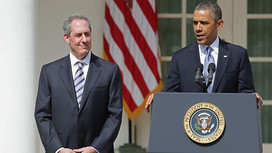
          Froman and Obama (FT 2013)
    Unlike the very broad foreign affairs powers of the president, reinforced by his powers as commander-in-chief, the president’s authority in trade is significantly different and greatly less.
   The Constitution gives the exclusive authority to Congress to regulate international trade. The principles of delegation of authority and separation of powers are at work here. Even though the Reciprocal Trade Agreements legislation of the 1930s and the 1974 Trade Act granted increased delegated authority to the president, and the latter authorized “Fast Track,” Congress still has the last word in trade relations.
   In this century, foreign affairs are now more centered on foreign trade than ever before; certainly more than during the 1780s. This constitutional framework may seem to be a historical anachronism. Nevertheless, this is the situation for the United States as it conducts global trade relations and trade diplomacy today.
   What does this mean for President Obama’s negotiations with Asia and Europe over the TransPacific Partnership (TPP) and the Transatlantic Trade and Investment Partnership (TTIP)? What do these negotiations mean in the broader context of geopolitical and geoeconomic concerns?
   It means very simply that Congress has the absolute authority and thus leverage to grant “Fast Track,” also known as trade promotion authority (TPA), and the president needs to convince Congress to grant it. Otherwise, no country is going to continue to negotiate with the United States over the pending trade agreements. No country is going to put the results of its negotiations in the hands of Congress and have it nitpick the agreement to death. It would be much too uncertain. “Fast Track” allows only an up or down vote with no amendments.
   These trade negotiations can be saved only by the president if he gets out in front and aggressively makes the case to Congress and the American people. Specifically, the president needs to deal with politicians from his own party as well as those from the Tea Party. He needs to explain to all interest groups the benefits of globalization, trade agreements, and trade liberalization in terms of  U.S. business, economics, foreign policy, and national security.
   A vibrant foreign trade policy backed by the administration is essential to states and cities. Governors, mayors, and county officials understand this proposition. States and cities often take the lead in trade promotion. They are the ones directly concerned with promoting economic development and jobs. While the principle of federalism and the corollary doctrine of preemption dictate the primary role in global trade to the federal government, states and local governments have a great amount of leeway in promoting exports and inward investment as long as they are not contrary to federal actions.
   In particular, the TPP and TTIP are important to states. The export-related jobs linked to global trade pay significantly more than other jobs. Most importantly, these newer agreements have new-style provisions related to encouraging foreign direct investment. Older trade treaties, such as the World Trade Organization (WTO) and bilateral trade agreements, do not. Investment is traditionally viewed as an area distinct from trade. But events have challenged that outmoded notion.
   Direct investment leads to establishing foreign-owned companies that produce for both the domestic and international markets. These investments, often called “greenfield investments,” lead to new jobs. Even when foreign direct investments are made into existing corporate operations, they lead to expanded and revitalized economic opportunities. For example, Virginia has over 700 foreign-owned firms. They provide thousands of jobs that would not exist without such foreign investment.
   While the federal government often gets lost in policy, polemics, and political debates, states do not have that luxury. They have to balance budgets and have direct responsibility to their citizens. Trade is an essential aspect of economic development programs. States have grabbed at international trade and investment as crucial to their economic development plans. They need a federal government and administration to effectively implement their obligations and to become effective partners with states. This has not happened in a very long time.
   Trade is an intricate aspect of U.S. foreign policy and national security interests. We need an aggressive president and an aggressive position in global trade for both economic and political reasons, domestically and internationally.
   The United States needs to remain actively engaged in the global arena. This means the United States needs to be actively engaged in global trade negotiations. This would significantly assist states and cities with job creation.
   President Clinton revitalized the role of the United States in global trade relations with his leadership in getting Congress to accept and implement NAFTA and the WTO. President Obama should do this for TTP and TTIP.
     …….. A recent Wall Street Journal editorial supports “Fast Track” and calls for the President to convince his Democratic base. It lists provisions under discussion for inclusion in TPP and TTIP. However, it voices concern over increasing Congress’s role in “Fast Track” by allowing broad review of negotiating documents. “Obama’s Trade Test.” Wall Street Journal (Jan. 28, 2014).
    …….. The Financial Times calls for President Obama “[T]o make a strong case for globalization to the American public …. Failure to secure fast track would be a grievous blow to his presidency.” “Rescuing America’s Global Trade Agenda.Financial Times (Jan. 31, 2014).
    ……… “Democrats Who Back Trade Liberalization Struggle to Make Their Voices Heard.” Financial Times (Feb. 6, 2014).
Posted in Global Trade Relations | Tagged , , , , , , , , , , , , , , , , , | Leave a comment

U.S. Extraterritorial Legislation — Foreign Banks and Auditors, Again

Corruption 1

      The U.S. regulatory agencies are continuing with aggressive extraterritorial application of U.S. economic legislation to foreign banks and foreign auditors under the Dodd-Frank legislation. Most recently the Federal Reserve is about to require foreign banks to increase their capital requirements and the SEC is about to suspend Chinese auditing affiliates of U.S. firms for failure to turn over work documents as part of a SEC’s investigation of Chinese firms. “Exporting U.S. Rules for Banks.New York Times (January 23, 2014) and “Judge Suspends Chinese Units of Auditors.” Wall Street Journal (January 23, 2014).
     The question now is how will this impact U.S. multinationals abroad and their regulation by foreign countries.
      Specifically, as to China, the clash of U.S. and foreign regulation is most stark. This is a clash of sovereignty. The U.S. is attempting to apply its regulations to Chinese firms inside of China. China views this, as most countries would, as a violation of its sovereignty. Unintended consequences of U.S. regulatory actions impacting foreign transactions and actors may mean tougher Chinese regulation of U.S. multinationals in China.
      This most recent episode highlights a critical trade issue of this decade. How to diplomatically and legally manage the clash of different  national regulatory systems. Obviously, this calls for additional rule-making my bilateral, regional or multilateral agreements.
Posted in Global Trade Relations | Tagged , , , , , | Leave a comment

Trade Negotiations & World Politics — Is Congress Restricting the U.S. in World Politics?

    
Obama and Froman (WP 5.3.13)
     A recent op-ed in the Financial Times concludes that “[A] revival of the U.S. economy should not be confused with a resurgence of America’s role … [T]he most important emerging theme in world politics is America’s slow retreat ….” “Indispensable Americans are Pulling Back.”  Financial Times (Jan. 21, 2014). 
      To me this “slow retreat” is certainly evidenced by the inaction of Congress to extend “fast-track” authority to President Obama.  This has been to the detriment of the U.S. in global trade negotiations and world politics generally. However, I would argue that it is not the President that has engineered this slow retreat but it is massive public opinion and a totally dysfunctional Congress.
     To the contrary, the President is attempting to manage both domestic and international politics  and has formulated an aggressive trade strategy to compliment a more comprehensive foreign policy. A foreign policy that recognizes trade as critical to national security. He is attempting to reinvigorate  trade alliances in order to strengthen the overall economic and political standing of the U.S. in the world.
     This approach is, in fact, a more comprehensive foreign policy than merely resorting to military and intelligence operations throughout every corner of the globe, without very   serious reflection. This approach is beneficial to the real national interests of the United States and to the global community. It’s about time that we move off a war footing to a more balanced approach to global affairs.
Posted in Global Trade Relations | Tagged , , , , , , | Leave a comment

Jimmy Beam, Time Warner and Global Trade …. Good News?

     Time Warner

     The first two weeks of January 2014 have seen very interesting developments in global trade relations — the filing of new WTO litigation by Russia, successfully concluding the Bali negotiations, restricting U.S. litigation against multinationals, sparring in Congress over President Obama’s trade policies, trade and income inequality, and renewed foreign investment into the corporate and real estate sectors in the U.S.
The latter is particularly interesting in terms of promoting economic development and jobs in the U.S.  However, this development also raises broader issues concerning foreign investment into the U.S. and the selling of U.S. assets to foreign corporations and foreign sovereign wealth funds — especially from the public’s standpoint. Public policy and public reactions are still unfolding. I suspect better public diplomacy would be beneficial.
  • Russia filed another action (its second) against the EU. This one over the EU’s antidumping measures on import of Russian steel and other products.  “Russia Files Dispute Against the European Union Over Anti-Dumping Measures.WTO News (January 6, 2014).
  • The Director General of the WTO Azevedo discusses the success of the Bali Ministerial, its three pillars (agriculture, trade facilitation, development), and the importance of the multilateral system. “Bali is Just the Start.WTO News (January 6, 2014).
  • The Supreme Court ruled again to restrict actions against multinationals for human rights violations abroad. (Daimler Case). “Justices Raise Bar for Suing Foreign Companies.” New York Times (Jan. 15, 2014). It is also argued that expanding global trade (concluding the TPP and TTIP) would assist in reducing income inequality in the U.S. “The Free-Trade Lift.Washington Post (Editorial 1.17.14).
  • A leading Republican Robert Zoellick has supported granting of Fast Track to President Obama despite concerns of extending labor and environmental protections in a treaty that he could not otherwise do by congressional legislation. “Leading From the Front on Free Trade.”  Wall Street Journal (January 15, 2014).
  • Foreign investment into the U.S. is increasing from Asia.  Foreign Direct Investment (FDI) is a primary means of increasing jobs and economic development here in the U.S. It helps to increase U.S. export opportunities to new markets. (This also allows the foreign firms to increase global activity in light of their own shrinking domestic markets.) “Suntory Enters World Stage (Purchase of Jimmy Beam).” Wall Street Journal (January 15, 2014).
  • Foreign investment into U.S. commercial real estate often frees up U.S. domestic capital for increased domestic operations. It allows U.S. firms to us the proceeds from appreciated real estate and put it into corporate expansion.  “Time Warner Nears a Deal for its Manhattan Building.Wall Street Journal (January 15, 2014).
Posted in Global Trade Relations | Tagged , , , , , , , , , , , , | Leave a comment

Boeing and State Incentives — Update — What Are the Implications?

Boeing Dreamliner
Boeing employees voted today in favor of contract and pension limitations to secure their jobs.  This was against the advice of their union leaders. This vote has convinced Boeing to keep production of the new 777X in the State of Washington.
This vote stops the multistate competition over new state incentives.  Washington, California and South Carolina, among others, were battling it out with the winner gaining Boeing’s new production facility for the 777X.
The vote dramatically highlights that it aren’t only state incentives or favorable regulations that are crucial to retain industries. Retention and expansion of industries already located in a state also involves fostering pragmatic expectations of employees and realistic contract and pension negotiations.
Tax and economic incentives aren’t always the most critical to corporate decisions concerning retention and expansion of corporate activities. Corporate decision-making makers and corporate boards are particularly sensitive to issues relating to corporate – employee contractual relations. This is an exceedingly important factor in retaining firms of all sizes since it has an immediate impact on the bottom line. 
Promoting sensible corporate – employee contractual relations is beneficial to states and is primarily derivative from an overall business-friendly culture in a state and a well-educated and responsible work force. Governors of states who are actually responsible and on the front lines for promoting jobs know this very well. (Sometimes the federal government forgets. But that’s another story.) A state can foster this culture by a myriad of actions. The employees in Washington and the State of Washington have belatedly learned this lesson once again.
Hopefully, states throughout the United States have done so as well.
Previous Blog ……………. Malawer, State Incentives and Jobs (December 29, 2013).
Posted in Global Trade Relations | Tagged , , , , , , | Leave a comment

State Incentives and Jobs — Yes, Incentives are Important.

Jobs (US Chamber) (1.8.12)

      The recent news that Boeing in the state of Washington and ESPN in Connecticut have received or about to receive millions more in state tax breaks have revived the national debate over the merit of state economic incentives to attract and to retain corporate businesses.
     Previously I wrote two blogs on this general subject.  I argued that both tax and economic incentives for economic development and job creation are necessary. They need to be done carefully and are critical to economic competitiveness. They do not amount to corporate welfare or a “beggar-thy-neighbor policy.”  Better metrics and their measurement mean better policies and better implementation. It is important  to distinguish between tax incentives and other economic incentives as we’ll as between foreign corporate investments and domestic relocations. Focusing on attracting foreign direct investment is particularly important in this era of globalization. All competition is global today.
     To me this debate over incentives is one of the most important issues confronting states today. This debate is not just one of theory but of very real consequences. State and corporate officials really need to create a better narrative to garner greater popular support. This is essential. Better public diplomacy is necessary for better public policies.
      Since this is a continuing and very divisive debate the following are some of my earlier comments.
…. “Boeing and State Tax Breaks” Wall Street Journal  (12.10.13)
…. “ESPN and State Incentives.” New York Times (12.27.13)
          [From December 2, 2012] …………..
The New York Times recently published a series of front-page articles on state and local incentives and economic development. This series was the culmination of  a 10-month investigation into economic incentives awarded by hundreds of cities, counties, and states.
Perhaps the most invaluable contribution of the series is its extensive interactive databases about the companies, states, and sectors involved, including per capita expenditures, percentage of state budgets going to incentives, and an extensive listing of the types of incentives (tax refunds, loan guarantees, tax credits, and more).
……Companies Seek Tax Deals.” New York Times (December 2, 2012).
The New York Times investigated several recent high-profile cases from Michigan to Texas. It concluded  that there is a significant  degree of cronyism involved in awarding these incentives, and they  place a large drain on state and local budgets, often without much to show for themselves.
The articles highlight the lack of a national debate on this widely used approach to economic development during the ongoing economic crisis.
While focusing on the political and business aspects of incentives and not as much on economic theory or historical cases, this series emphasizes one  topic that has been argued  over through the years: Whether these incentives represent  “beggar-thy-neighbor” policies, corporate welfare and if  they come at the expense of other priorities, including improving workforce training and developing better employment conditions, such as wages and benefits.
The New York Times series  contend that long-term benefits may be at least as likely to come from investing in public universities and infrastructure projects as from supporting corporate relocations. That large corporations have the ability to lobby for declining tax dollars and then follow the best incentive offers where they may appear.
There is a broad range of state and local incentives, including among others: corporate income tax credit, state tax refunds, various tax exemptions (for example, local personal property and property taxes), cash grants, loans and loan guarantees.
To me state incentives need to be carefully assessed in terms on competing economic interests,  expected outcomes, and measurable metrics.
One needs to delineate between state support of domestic corporate relocations and foreign ones. One needs also to consider state support of export promotion, especially of small and mid-size firms, as distinct from corporate relocation.
Unfortunately, in 2006, the Supreme Court declined an opportunity to rule on the use of state incentives for economic development under the interstate and foreign commerce clause. This, however, really is a major issue of federalism that needs to be decided by the courts.
The extensive interactive data sets  in the New York Times series can let policy makers assess and compare the impact of economic and fiscal incentives on state budgets, taxes, and corporate policies, including relocation and expansion. For example, they make clear the relation of incentives to actual job creation.
It should be emphasized that this debate is particularly important when comparing the value of incentives for corporate relocation within the United States against that of recruiting new foreign direct investment into the United States (“Greenfield investments”).
Is there a more valid reason to offer economic incentives to foreign companies not located here than to firms already located in the United States? Is it preferable to fund export promotion rather than domestic corporate relocation and thus avoid the beggar-thy-neighbor dilemma? 
By the way,  the World Trade Organization (WTO) recently ruled that state and local incentives given to Boeing in the state of Washington are illegal subsidies that violate U.S. global trade obligations.
I look forward to more rigorous assessments of state incentives and economic development in our rapidly globalizing and hyper-competitive world. Taxpayers and society deserve closer government and public scrutiny of these state programs in order to support more sustainable economic development.
From my personal observation, as a board member of the Virginia Economic Development partnership, the range of incentives available in Virginia, at both the state and local levels, are an essential element of economic development. This along with a favorable regulatory business environment constantly drives Virginia to be ranked as one of the most business friendly states in the United States. One that leads in job creation.
Virginia state incentives are definitely free of the political cronyism that The New York Times reported on in TexasVirginia State Economic Incentives (Nov. 2012)
Proper procedures, continuing oversight, specific performance metrics, and constant evaluation are essential to successful state actions in awarding and monitoring  a broad range of state incentives aimed at economic development and job creation.

………………………………………………………………………………………………………………………………….

  [From Jan. 9, 2012]
Weak economic performance over the last decade has prompted states to become more aggressive in their economic development efforts to attract foreign firms, investment, and jobs.
Critics argue that state incentives to attract foreign firms amount to corporate welfare.
These critics point to literature denying the benefits of incentives for attracting any firm, domestic or international. They argue that such efforts lack state accountability of public funds. They draw a parallel to weak corporate governance provided by managers and boards of directors. These objections miss the point.
Let’s start with the last point concerning accountability.
The well-known corporate theory of agency declares that managers and corporate officers are agents of the corporation and working on behalf of widely dispersed shareholders. They along with board members have a fiduciary duty to the corporation. The “Business Judgment Rule” imposes a  strict standard of fiduciary responsibility on boards members. However, managers often do what they want in their own interest without meaningful oversight or restriction.
As we all know when equity ownership is so dispersed corporate executives and bankers with the cooperation of the boards become highly overpaid. Just look at the last ten years, jobs were lost by the millions and income inequality grew dramatically.
The issue of corporate responsibility is different from state accountability.
State officials are not overpaid and are out of office after periodic elections. State officials are directly responsible to the voters. To the contrary, corporate directors are often personally selected by the CEO and senior corporate management with only pro forma board elections.
Voters provide local control over state officials. Board members overseeing state incentives are often subject to confirmation by state legislatures. Elected state officials do not become personally wealthy at the expense of state citizens.
States have an obligation to provide education and training to its residents. You simply cannot say that when states work in partnership with a firm, often through a community college, this is not a public good. This model is followed by other countries, such as Germany, with great success. Investing in the skills of labor for the long-term is critical. Correcting the mismatch between new job openings and the workforce is essential.
The recent report Good Jobs First (2011) criticizes state incentives as not providing sufficient metrics in their incentives. This is certainly not true for the state that I’m most familiar with, Virginia. This report complains that specific wage levels and benefits should be required for state incentives. But the imposition of wage and benefit levels  in this case would amount to excessive government intrusion into the private sector in an uncertain time.
There is a difference when a state attracts a corporation or investment from another state or an international corporation from another country.
Leaving aside the domestic corporate relocation, which often make firms more competitive when locating to a more business-friendly state, attracting foreign firms and investment does not raise in any way the issue of “beggar-thy-neighbor” or race to the bottom. A policy of attracting foreign investment and foreign corporations for economic development is a no-brainer. This is a legitimate function of state government.
States need to become more aggressive globally to survive newer trends in globalization. Providing state incentives to attract foreign firms, trade, and investment is crucial to the revival of the U.S. economy and the creation of new jobs. We all have a stake in it.

Posted in Global Trade Relations | Tagged , , , , , , | 1 Comment

Heightened U.S. Trade Diplomacy — New Rules for Newer Issues in Global Commerce — Maybe.

          Froman and Obama (FT 2013)    The last few days of 2013 have seen two important trade developments. One, Russia filed its first WTO case (against the EU). Two, there is heightened U.S. trade activity in working with Congress to implement President Obama’s trade agenda. The aim of U.S. trade diplomacy is to promote newer rules dealing with new trade issues so as to set a higher standard in global rules compared to those now existing in the WTO. However, some oppose President Obama seeing him as trying to impose a liberal agenda via trade agreements (which he cannot otherwise do by legislation). Here are some more details:
…. Russia filed its first suit in the WTO and it was against the EU for unfair treatment of its energy exports to the EU. The EU previously filed its first action against Russia.  “Russia Targets EU in WTO Suit Over Energy Policy.” Financial Times (December 24, 2013). 
…. The new USTR Mike Froman wants to promote a new political consensus as he deals with global trade negotiations. His goal is to establish a higher standard of new rules  (compared to existing ones) for treating newer trade issues such as national regulation that often act as NTBs. “Mike Froman Upbeat on US Effectiveness in Global Trade Talks.” Financial Times  (December 24, 2013).
…. The U.S. through its trade agreement negotiations via the TPP and TTIP is trying to shape the rules of global commerce as to newer trade issues concerning regulation, specifically concerning the Internet and E-Commerce, pharmaceuticals and intellectual property rights. Hoping to remove newer more restrictive national laws. “U.S. Seeks to Shape Global Trading Rules.Washington Post (December 25, 2013).
…. Some argue that the Obama administration is trying to do by trade agreement what it cannot do by legislation — impose a liberal agenda by including expansive labor and environmental provisions. “Free Trade and Obama Fiat.Wall Street Journal (December 26, 2013).
Posted in Global Trade Relations | Tagged , , , , , | Leave a comment

NSA Spying for Google — Disturbing News — We Need More Info.

Data Protection (FT 11.4..13)

Now it turns out, as reported by the New York Times that the NSA not only spies for economic  reasons relating to national security but  perhaps even for the benefit of specific U.S. multinationals. Thus, questioning the long-standing argument that the NSA spies only for national security (unlike China), but not for commercial benefit of particular companies. The adverse impact of technology on privacy rights has now become glaringly known globally.
The New York Times disclosed that the NSA  intercepted communications with the vice president of the European Commission who has broad oversight of antitrust issues in Europe. The commission has broad authority over local and foreign companies and has been very aggressive in its investigations and in holding U.S. firms responsible under EU law. The EU has been involved in a lengthy standoff with Google over its search engine.
Of course, Google has been one Internet company that has to an unknown degree cooperated with the NSA in its surveillance activities, as well as being unknowingly a target of its activities, as have been other technology and telecom companies.  These companies now seemingly regret their earlier complicity and belatedly propose much tighter corporate and government safeguards.  The adverse impact of technology on privacy rights has now become glaringly known globally.
The most recent news is very disturbing. We really need more information to know what is the full story. We’ll see.
 
…. “NSA Spied on Allies, Aid Groups and Businesses.” New York Times (December 21, 2013).
Posted in Global Trade Relations | Tagged , , , , , , | Leave a comment