One thing is sure — the refund of over $200 billion dollars of illegally collected tariffs is going to be very, very messy, very political and not easy. Actions have been filed by importers (retailers) against the government and by retailers against the initial importers of record (‘consumer suits’). Some suits are asking for class action status.
Trump’s weaponization of tariffs as part of his undisciplined attempt at geopolitics and geoeconomics is truly baffling and harmful to the U.S. consumer and economy. And it continues.
(The Iran war is another story that certainly complicates a great deal and may very well have even a greater impact on the global economy and politics — Than Trump’s ill-conceived global tariffs.)
Most recently states and private firms have sued the Trump administration concerning these refunds. Yet the administration is still seeking delays.
The Appeals Court for the Federal Circuit recently denied a delay and sent the matter back to the Court of International Trade, which has ordered payments to be made immediately. The government has asked for a delay, once again, and it has been granted.
States have now sued the administration concerning the imposition of new tariffs of 15% – 20% under Section 122 of the 1974 Trade Act (‘balance-of-payments’). There is actually a very small deficit in the balance-of-payments compared to balance-of-trade — Which Trump mistakes. The former incorporates the trade balance plus international investment flows.
This messy and prolonged process (involving refunds and the liquidation process) and new administration efforts to circumvent the court decisions — Is starting a whole new legal industry and practice groups within law firms as well as a secondary market for hedge funds snapping up importer’s claims.
This refund issue, new tariffs, uncertain trade agreements, disrupted trade flows and trade policy generally will certainly become a significant issue in the midterms — To the dismay of voters, Trump and his congressional supporters.
………………………………….
“During a roundtable at the White House, President Donald Trump again criticized the Supreme Court, “voicing deep frustration with ‘a number’ of recent decisions that have included the rejection of his signature tariff policy …. “I think the Supreme Court ought to be ashamed of itself for a lot of reasons, ok?” “I got to live with these people. And I say this … and they’ll only vote bad, and I couldn’t care less at this point. They have hurt this country so badly because they haven’t had the guts to do what’s right.” In a filing with the U.S. Court of International Trade, Brandon Lord, executive director of U.S. Customs and Border Protection’s trade policy and programs directorate, explained that “the CBP is working on a new system [for tariff refunds] that will simplify the process. He said it should be ready in 45 days and require ‘minimal submission from importers,” “The filing comes after a judge ordered the government to start paying back all importers the illegal tariffs they paid – with interest.” SCOTUS BLOG (March 9, 2026). (Per the government’s request the CIT granted a short delay recently. SCOTUS BLOG (March 10, 2026).
“The Liberty Justice Center, “[a] libertarian public-interest firm that helped topple Trump’s emergency tariffs at the Supreme Court,” filed a new suit. The firm is representing “a new group of businesses who say they shouldn’t have to pay Trump’s latest tariffs,” including Burlap & Barrel and Basic Fun! The businesses contend that Section 122 of the Trade Act of 1974, which allows for tariffs “addressing balance-of-payments deficits,” cannot be used to impose tariffs “now that the U.S. has moved to a floating exchange rate.” Scotus Blog (3.11.26).
“Trump last month turned to Section 122 to reimpose his border taxes after the Supreme Court struck down his emergency tariffs. Section 122 lets him impose tariffs as high as 15% for up to 150 days to address “large and serious balance-of-payments deficits.” …. But as the AGs’ lawsuit notes, “Section 122 expressly differentiates between ‘balance of payments’ and ‘balance of trade.’” The balance of payments consists of trade as well as foreign capital and financial investment inflows. Including the latter, the U.S. balance of payments deficit was a mere $53 billion in 2024. Section 122 is an artifact of the bygone Bretton Woods fixed-rate exchange system. The U.S. in the early 1970s “had experienced a series of large deficits in its balance of payments related to the fixed-rate exchange system, which obliged foreign central banks to buy dollars to prevent their currencies from appreciating,” the lawsuit accurately recounts …. Because the Constitution grants Congress the power over trade and taxes, the President is “seizing power from Congress unconstitutionally,” the AGs (in their new law suit in the CIT) argue. They are asking the U.S. Court of International Trade to enjoin the tariffs so businesses don’t have to pay them while litigation plays out and later seek refunds if higher courts rule them unlawful.” “The Legal Case Against Section 122 Tariffs.”Wall Street Journal (March 9, 2026).
“The US government has declined to refund tariffs the Supreme Court has ruled illegal …. Trump administration tries to hold on to as much as $150bn in disputed levies. Customs officials are rejecting companies’ attempts to reclaim duties imposed under emergency powers invoked by Trump, leaving businesses in limbo and pushing more cases into court …. Companies submit entries to US Customs and Border Protection detailing products to be imported and relevant tariff codes, among other things. They pay an initial estimated sum, after which CBP finalizes the amount and automatically “liquidates” the entry 314 days later, though it may close entries manually before then …. As part of a process called “Post Summary Correction”, companies can correct submissions to CBP and retroactively amend those that have not been officially closed. Many companies have rushed to submit PSCs to strike IEEPA tariff codes from their shipment entries and receive refunds. But CBP is rejecting their submissions. It is also suspending protests that companies are filing to secure IEEPA tariff repayments the CBP has already liquidated …. Some lawyers have advised their clients to file lawsuits as well as paperwork with the CBP to try and reclaim their tariffs through the administrative process …. But CBP argued in court this week that not finalizing IEEPA tariff payments would be a task of “unprecedented scale and scope” and that it lacked the “functionality” to change this process.” “Refunds Denied.”Financial Times (March 7, 2026).
“A federal judge ordered the Trump administration to take the first steps toward issuing more than $100 billion in potential tariff refunds, ratcheting up a legal battle over a roster of sky-high duties that the Supreme Court deemed illegal. The order, issued by Judge Richard K. Eaton of the United States Court of International Trade, amounted to an early victory for the thousands of businesses that have already sued to recover the taxes they paid, plus interest …. In the initial round of lawsuits over its tariffs, the Trump administration had indicated that it would issue refunds in the event that the president’s tariffs were invalidated. But Trump and his aides have shifted to a more defiant tone since the Supreme Court dealt a decisive blow to one of the most potent, flexible weapons in the president’s trade war. The administration has signaled that it intends to delay or contest repayment of the money, arguing at times that refunds could create a fiscal crisis for the United States …. Generally, tariffs are due when a product enters the United States. But the exact amount that an importer owes is finalized over a roughly yearlong process known as liquidation. Purchasers may file formal protests with the federal government if they dispute what the government says they owe.” “Tariff Refunds Get a Victory.”New York Times (March 6, 2026).
“Democratic attorneys general in two dozen states, including California and New York, are filing a lawsuit to block President Trump’s new tariffs, two weeks after a new round of taxes and duties on imports were issued following a Supreme Court ruling that found the White House had overstepped its authority.” N.Y. Post (3.6.26).
“The Trump administration’s effort to reimpose tariffs struck down by the Supreme Court has prompted a new lawsuit. [S]ome two dozen states challenged” the administration’s “planned 15% tariffs on much of the world,” contending that Section 122 of the Trade Act of 1974 does not give the president the authority to impose “sweeping import taxes.” The states argue that Section 122 “was intended to be used only in specific, limited circumstances” – to address what Section 122 describes as “fundamental international payments problems” related to the U.S. dollar’s relationship to gold. “But the dollar is no longer linked to gold, so critics say Section 122 is obsolete.” Many of the states involved in the new lawsuit were also involved in the successful challenge to Trump’s previous tariffs …. Ongoing battles over tariff refunds have given “[o]ne of the most obscure courts in America … a rare moment in the sun.” “Most lawyers know little, if anything, about the Court of International Trade. Fewer than 300 cases were filed there annually in 2023 and 2024,” “The court generally referees disputes over how imported goods are classified and whether they are being dumped into the U.S. at below fair-market value. Until recently, hot cases at the court focused on issues such as Amazon’s contention that video doorbell cameras should be classified as digital still-image video cameras rather than transmission devices.” But now, “there are more than 2,000 lawsuits on the trade court’s doorstep from businesses suing to recoup what they paid” in tariffs.” SCOTUS Blog (3.6.2026).
“States led by New York sue to block Trump’s latest tariffs, calling them an illegal end-run around Supreme Court …. New York Attorney General and the top prosecutors of 23 other states are once again suing to block President Trump global tariff regime. Their lawsuit, filed in the Court of International Trade, seeks to deem Trump’s latest tariffs illegal and order refunds to states. Last month, the Supreme Court invalidated most of Trump’s sweeping “Liberation Day” tariffs implemented last year, saying that his use of the International Emergency Economic Powers Act to impose duties was improper …. In their lawsuit, the coalition argue that Trump is misusing Section 122 of the 1974 Trade Act, which they say was designed to address specific monetary imbalances possible when the U.S. was under the gold standard, rather than to combat trade imbalances. CNBC (3.5.26).
“If a federal court orders the Trump administration to repay billions of dollars collected from its tariffs, the shipping giant FedEx announced this week that it would return the money to customers who bore the brunt of those charges. The new pledge came days after FedEx sued the U.S. government to secure a refund, part of a rapidly widening roster of businesses that have sought to seize on a recent Supreme Court ruling that struck down many of President Trump’s taxes on imports. FedEx, like other carriers, often acts as an importer of record, but it passes along the duties paid to the customers and companies that purchased the goods …. For now, the legal battle over refunds is only just beginning. The stakes for businesses and the U.S. government are high, given that the Trump administration had collected more than $100 billion under its slate of emergency duties.” “Money to be Returned to Customers. ”New York Times (2.27.26).
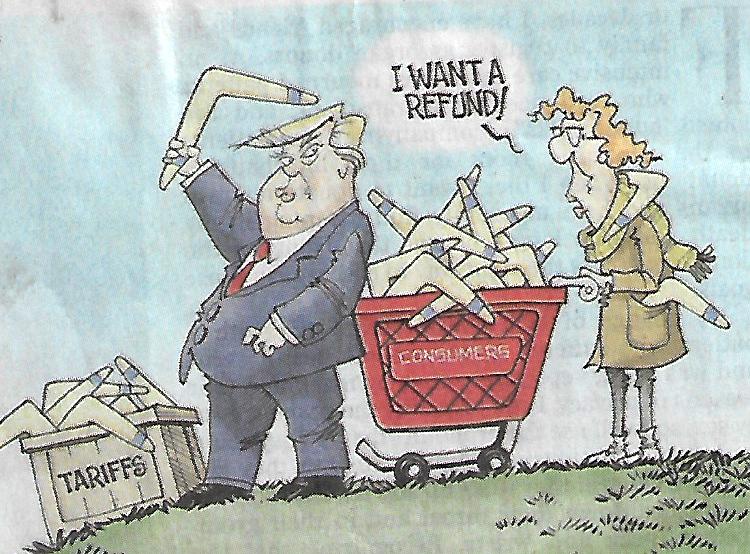
“Trump’s had his fun with tariffs and now it’s payback time. As in: it’s literally time to pay it back. The Supreme Court decision against Trump’s bogusly named emergency duties — as issued under the International Emergency Economic Powers Act — has put his trade policy in disarray. The tariff refund industry is out of the blocks trying to get repayment for businesses of something like $175bn levied over the past year. The exact mechanism for reclaiming tariff payments is mired in legal and administrative uncertainty. It’s possible that companies which paid tariffs that have not yet been “liquidated” — definitively finalized — might be able to get them back quickly. But it is too late for many. It’s pretty clear the administration will struggle to oppose refunds in principle …. It’s pretty clear the administration will struggle to oppose refunds in principle. In a court case brought to the CIT by a group of companies in December, the administration argued against immediately stopping the liquidation of payments but promised to allow refunds later. But Trump can certainly make them difficult and expensive to collect, out of spite if nothing else. Democrats in Congress have already proposed a bill to smooth and expedite the process; no one seems to think it will get enough votes to survive a presidential veto …. The refunds, on top of remaining and forthcoming tariffs, will thus surely become a political issue between now and the midterm elections in November …. Another potential source of friction is the mismatch between who in effect bore the cost of the tariffs and those who will get the refund. The money is handed back to the “importer of record” which paid them, but if that is a consumer-facing company — or indeed a wholesaler — which passed the cost on to its customers.” “Pay Back Time for Tariffs.”Financial Times (2.27.26).
“In Chief Justice Robert’s mere 21 pages (Justice Neil Gorsuch’s concurring opinion, by contrast, clocked in at 46 pages, and Justice Brett Kavanaugh’s dissent at 63), he explained why, as a matter of statutory interpretation and the constitutional separation of powers, President Trump lacked the authority he had claimed, under the International Emergency Economic Powers Act, to impose a hodgepodge of tariffs on countries all over the world …. Chief justice is sending a message not necessarily or not only to Trump but also to the waiting world. Something along the lines of, “People, this is what we’re dealing with.” The point being not that “some fertilizers” are now exempt from reciprocal tariffs but that a reckless president is sowing chaos in America and around the globe …. It’s worth remembering that Chief Justice Roberts is the head of the entire judicial branch. It is in that capacity that his vexation with Trump verges on acute concern. The president has denounced judges who have ruled against him, including by calling for a Federal District Court judge’s impeachment. Trump has helped create an atmosphere in which judges appropriately fear for their personal safety and that of their families.” “Chief Justice and Trump.”New York Times (March 1, 2026).
“At least two retail customers pursuing tariff-related refunds [had] filed proposed class-action lawsuits in U.S. Courts against companies that also sued to recoup costs from the import taxes” that were struck down by the Supreme Court.. The lawsuits against FedEx and “Essilor Luxottica, which makes Ray-Ban sunglasses, seek to ensure that consumers get a share of any refunds the businesses get.” The FedEx lawsuit was filed after the company promised to share any refunds it manages to secure with its customers but noted that the promise is not “legally enforceable.” …. Many more such consumer lawsuits to surface” in the months ahead. “Update.” Scotus Blog (3.2.26).
“A federal appeals court declined to delay implementation of the Supreme Court ruling that invalidated most of President Trump’s tariffs, allowing next steps in processing of tariff refunds to begin swiftly, following the high court’s decision last month. The decision from the U.S. Court of Appeals for the Federal Circuit clears the way for the lower court, the U.S. Court of International Trade, to begin the process of crafting relief for the small businesses that successfully challenged Mr. Trump’s global tariffs. The Trump administration had said it would issue refunds if the duties targeting nearly every U.S. trading partner around the world were ultimately found unlawful by the Supreme Court. “Appeals Court Rejects Trump’s Request to Delay in Refunds.” CBS News (3.3.26).
“Treasury Secretary Scott Bessent said that the recently imposed 10% global tariff will likely rise to 15% sometime this week and that tariff rates will “effectively return to where they stood before the Supreme Court” struck down President Donald Trump’s signature tariffs. “It’s my strong belief that the tariff rates will be back to their old rate within five months,” Bessent said. The current 10% tariff, which will rise to a 15% tariff, was “imposed under Section 122 of the Trade Act of 1974 [and] can last for only 150 days unless Congress approves an extension.” Over the course of those 150 days, “the Office of the U.S. Trade Representative (Section 232) and the Commerce Department (Section 301) will complete trade-related studies that can allow them to impose more tariffs” …. Judge Richard Eaton of the U.S. Court of International Trade ruled that “all importers of record” are “‘entitled to benefit’ from the Supreme Court ruling that struck down” Trump’s tariffs. “Eaton was ruling specifically on a case brought by Atmus Filtration, a Nashville, Tennessee, company that makes filters and other filtration products, claiming a right to a tariff refund,” but his decision is expected to broadly benefit importers and consumers who paid tariffs. Trade lawyers expect the government to appeal or ‘seek a stay to buy more time for U.S. Customs to comply.’” SCOTUS Blog (3.5.26).


 Stuart Malawer
 U.S. LAW & GLOBAL TRADE RELATIONS.
You must be logged in to post a comment.