Trump lost in the Supreme Court. His tariffs were declared illegal. IEEPA did not authorize him to impose tariffs. He immediately slandered the court and justices and humiliated them again during his State of the Union. He has proclaimed new tariffs under Section 122, but they too will be struck down. He promises additional tariffs under Section 232 and Section 301.
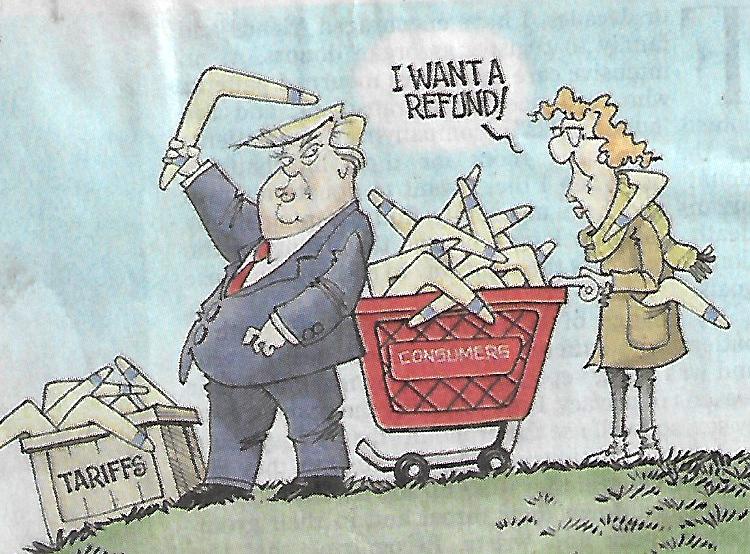
Trump has already declared refunds may take years if ever — even though the Justice Dept. indicated differently during various litigation. He just doesn’t get it. His bizarre focus on tariffs and his contempt of both domestic and international law is a simply a disgrace for the United States — and a grave danger for the international community. His use of tariffs as part of his foreign policy and geopolitics is simply unheard of in American foreign policy.
……………………………………………..
” The never-used provision the White House is relying on, Section 122, says that the president shall impose tariffs or import restrictions, for up to 150 days, whenever “fundamental international payments problems require” restricting imports to deal with, among other things, “large and serious United States balance-of-payments deficits.” Trump has seized on this language, pointing primarily to America’s substantial and persistent trade deficit (around $900 billion last year) …. But the president misreads the statute. The provision is not about trade imbalances. Other parts of the statute address those. It is about financial imbalances — in particular ones that threaten financial stability …. The text and context of the law is clear: A Section 122 “payments problem” involves a flight from the U.S. dollar. At the moment, no such problem exists.” “Trump’s New Tariffs (Section 122) are Illegal.” New York Times (2.25.26).
“Now the Supreme Court has ruled, and the tariffs have been invalidated. Yet Trump and Treasury Secretary Scott Bessent are suggesting that refunds could take years, entangled in further litigation and administrative delay. This is wrong. The government cannot tell courts that refunds are simple and inevitable when seeking relief — and then imply they are complex and distant when the time comes to pay. The rule of law does not operate on shifting premises. If judicial assurances are treated as temporary litigation tactics rather than binding commitments, the institutional credibility of the United States suffers.” “Trump Wants to Delay Refunds.” Washington Post (2.25.26).
“In addition to Section 122, Trump said he would use two other trade statutes — one that allows the president to impose tariffs on specific products and another that allows for tariffs on an entire country …. All of these options are far less nimble than the International Emergency Economic Powers Act, which Trump used to impose — or threaten — tariffs on a whim. And they could also be subjected to a legal challenge …. Section 122 Trump said that he would put in place a 10 percent global tariff using Section 122 of the 1974 Trade Act. Section 232 One powerful option in Trump’s toolbox is Section 232 of the Trade Expansion Act, which allows the president to impose tariffs on foreign products in the interest of national security (Commerce Dept. procedures involved) …. Section 301 The president said he would use another set of powers, Section 301, to open investigations into unfair trade practices, which could yield additional tariffs. Section 301 of the 1974 Trade Act allows Trump to impose duties after conducting an investigation and finding that a country engaged in trade practices that were unfair, unreasonable or violations of previously signed trade deals (USTR procedures involved).” “Other Tariff Statutes Available to President.”New York Times (2.21.26).
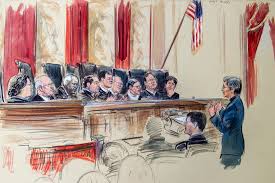
“The Supreme Court’s 6-3 decision wiping out a chunk of Trump’s tariff regime is a triumph for the Constitution’s separation of powers and the individual liberty that it protects …. Congress never approved the worldwide tariffs at issue in the case. Trump told the court they were authorized by a 1977 law, the International Emergency Economic Powers Act. No president has used IEEPA to impose tariffs, but it contains the phrase “regulate … importation” …. This decision was too close, but it underscores that the Supreme Court remains independent. The separation of powers held. If only Congress would also fulfill its role as forcefully.” “Trump’s Tariffs Fall in Supreme Court.” Washington Post (2.21.26).
“The question presented is whether the International Emergency Economic Powers Act (IEEPA) authorizes the President to impose tariffs. See 91 Stat. 1626. Shortly after taking office, President Trump sought to address two foreign threats: the influx of illegal drugs from Canada, Mexico, and China, Presidential Proclamation No. 10886, 90 Fed. Reg. 8327; Exec. Order No. 14193, 90 Fed. Reg. 9113; Exec. Order No. 14194, 90 Fed. Reg. 9117; Exec. Order No. 14195, 90 Fed. Reg. 9121, and “large and persistent” trade deficits, Exec. Order No. 14257, 90 Fed. Reg. 15041. The President determined that the drug influx had “created a public health crisis,” 90 Fed. Reg. 9113, and that the trade deficits had “led to the hollowing out” of the American manufacturing base and “undermined critical supply chains,” id., at 15041. The President declared a national emergency as to both threats, deeming them “unusual and extraordinary,” and invoked his authority under IEEPA to respond. He imposed tariffs to deal with each threat. As to the drug trafficking tariffs, the President imposed a 25% duty on most Canadian and Mexican imports and a 10% duty on most Chinese imports. Id., at 9114, 9118, 9122–9123. As to the trade deficit (“reciprocal”) tariffs, the President imposed a duty “on all imports from all trading partners” of at least 10%, with dozens of nations facing higher rates. Id., at 15045, 15049. Since imposing each set of tariffs, the President has issued several increases, reductions, and other modifications. Petitioners in Learning Resources and respondents in V.O.S. Selections filed suit, alleging that IEEPA does not authorize the reciprocal or drug trafficking tariffs. The Learning Resources plaintiffs—two small businesses—sued in the United States District Court for the District of Columbia. That court denied the Government’s motion to transfer the case to the United States Court of International Trade (CIT) and granted the plaintiffs’ motion for a preliminary injunction, concluding that IEEPA did not grant the President the power to impose tariffs. The V.O.S. Selections plaintiffs—five small businesses and 12 States—sued in the CIT. That court granted summary judgment for the plaintiffs. And the Federal Circuit, sitting en banc, affirmed in relevant part, concluding that IEEPA’s grant of authority to “regulate . . . importation” did not authorize the challenged tariffs, which “are unbounded in scope, amount, and duration.” 149 F. 4th 1312, 1338. The Government filed a petition for certiorari in V.O.S. Selections, and the Learning Resources plaintiffs filed a petition for certiorari before judgment. The Court granted the petitions and consolidated the cases.
Held: IEEPA does not authorize the President to impose tariffs. The judgment in No. 24–1287 is vacated, and the case is remanded with instructions to dismiss for lack of jurisdiction; the judgment in No. 25 250 is affirmed.” “Learning Resources v. U.S.” (S. Ct. 2.20.26).
“Corporate America is beginning to demand tariff refunds. FedEx became perhaps the most prominent company yet to try to reclaim tariff payouts, filing a lawsuit in the U.S. Court of International Trade seeking a “full refund” on tariffs it has paid that have since been ruled unlawful. More than 1,500 companies have already filed legal claims for refunds. Lawyers told DealBook that they predicted that there could be thousands more, eventually pursuing hundreds of billions’ worth of claims ….. Big Law is mobilizing. Quinn Emanuel Urquhart & Sullivan, the powerhouse litigation firm that counts Elon Musk as a client, announced on Monday that it had created a tariff refund litigation task force. Inquiries from clients seeking advice on refunds have “increased dramatically” since the Supreme Court ruling.” “Business Demands Refunds.”New York Times (2.26.26).


 Stuart Malawer
 U.S. LAW & GLOBAL TRADE RELATIONS.
You must be logged in to post a comment.