The Trump administration has issued new tariffs based on Section 232 (National Security) as legal rationale and authorization. (This fucuses on specific sectors rather than specific countries.) This is an obvious attempt to get around the legal challenges to his earlier tariffs based on ‘national emergencies’ — under the IEEPA, which is now before the Supreme Court. It also issued new rules extending export controls under the ‘entity list’ to foreign subsidiaries (under the export administration legislation) — claiming national security and foreign policy reasons.
I guess the administration never heard that that the president may be the commander-in-chief of the armed forces — but not commander-in-chief of the United States. Geopolitics and geoeconomics is the new core of U.S. foreign policy — focusing on all sorts of national security claims — from movies to speed boats on the high seas. To me this is just a mirror of the increasing lawlessness of the Trump administration. We’ll see.
By the way, US farmers (including my home state of Virginia) are losing. This is true of soybean crop and others. Farmers were only saved during Trump’s first term by massive federal government bailouts. Trump is now on the verge of doing the same this time.
Previously, I wrote the following in 2024:
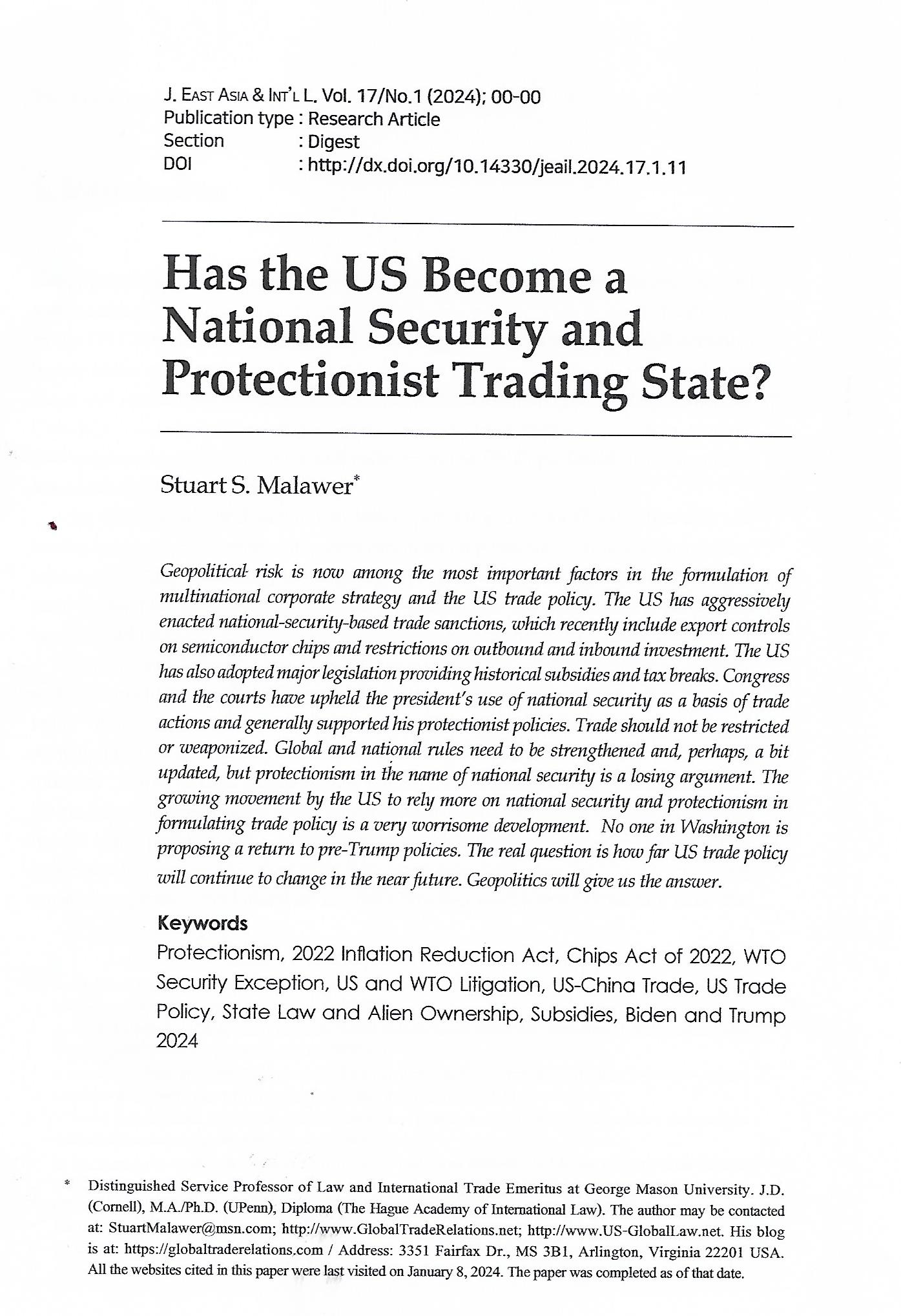
“Geopolitical risk is now among the most important factors in the formulation of multinational corporate strategy and the US trade policy. The US has aggressively enacted national-security-based trade sanctions, which recently include export controls on semiconductor chips and restrictions on outbound and inbound investment. The US has also adopted major legislation providing historical subsidies and tax breaks. Congress and the courts have upheld the president’s use of national security as a basis of trade actions and generally supported his protectionist policies …. The growing movement by the US to rely more on national security and protectionism in formulating trade policy is a very worrisome development.” http://journal.yiil.org/home/archives_v17n1_11
…………………………………………………………..
“The president’s tariffs on foreign drugs and furniture rely on national security laws outside the scope of current lawsuits …. The president expanded the use of the national security law saying he would put tariffs ranging from 25 percent to 100 percent on imports of pharmaceuticals, semi-trucks, kitchen cabinets and furniture …. The Section 232 tariffs give the president a powerful alternative to apply tariffs if the Supreme Court rules against his use of a different law to impose levies. The court cases center on the president’s use of the International Emergency Economic Powers Act.” “Trump’s New Section 232 Tariffs – Beyond Supreme Court’s Reach?” New York Times (Sept. 27, 2025).
“Trump’s “unpredictable” policymaking and immigration crackdown have prompted some multinational businesses to consider relocating staff from the US or diverting activity away from the world’s largest economy …. The chaotic rollout of new rules on visas and moves against his political opponents have reignited boardroom concerns first triggered by Trump’s on-again, off-again tariffs this year …. Executives in different sectors cite different examples of unpredictable policymaking — from curbs on the use of the painkiller paracetamol despite the absence of settled science to shutting down wind farm projects that are already under construction — and say it adds up to a reduction in the attractiveness of the US market. Even a year ago we would have said the US was a safe place to be, and we were very happy to be gaining ground there …. Our vision has completely changed.” “Trump’s Chaotic Policy.|” Financial Times (Sept. 29, 2025).
“Beijing, which traditionally has snapped up at least a quarter of all soybeans grown in the U.S., is in effect boycotting them in retaliation for the high tariffs President Donald Trump has imposed on Chinese goods …. A lot of cash is at stake. In 2023, Virginia farmers sold about $784 million worth of soybeans to China. That year, farmers here grew about 22 million bushels of soybeans on 570,000 acres, according to the Virginia Department of Agriculture and Consumer Services. Soybeans were Virginia’s top agricultural and forestry export in 2023 at over $1.4 billion. Pork came in second at more than $862 million …. Trump’s erratic trade policies pose a direct threat to the livelihood of Virginia’s soybean farmers …. When the first Trump administration imposed tariffs on Chinese goods in 2018, China retaliated with a 25% tariff. The U.S. Department of Agriculture estimates U.S. soybean farmers experienced $9.4 billion in annualized losses during the 2018 trade war. The year before that tariff was imposed, Virginia farmers sold $360 million in soybeans to China. In 2018, that number dropped to $58 million …. And China has been by far the largest foreign buyer. Last year, the U.S. exported nearly $24.5 billion worth of soybeans, and China accounted for more than $12.5 billion. That compared with $2.45 billion by the European Union, the second-largest buyer. This year, China hasn’t bought beans since May …. The only way most farmers survived Trump’s trade war in his first term was with tens of billions of dollars in government payments …. China turned to Brazil when Trump launched his first trade war in 2018. Last year, Brazilian beans accounted for more than 70% of China’s imports, while the U.S. share was down to 21%.” “Virginia’s Soybean Exports to China.” Virginia Business (Sept. 29, 2025).
“Exports of American soybeans to China have collapsed this year, with no new orders logged in recent months ahead of the prime autumn export season …. Beijing also has imposed a 23% retaliatory tariff on American soybeans in response to Trump’s tariffs on Chinese imports this year …. But the plight of America’s farmers is a reminder that the destruction of a trade war is mutually assured, and not inflicted solely by one side on the other.” “Tariffs and Soybeans.” Wall Street Journal (Sept. 29, 2025).
“The Trump administration is clamping down on companies that pose national-security risks by adding them to a trade blacklist, a move that threatens hundreds of Chinese companies and marks the latest salvo in the U.S.-China tech race. Under the new rule, subsidiaries of companies that are on a Commerce Department blacklist known as the entity list would also be subject to trade restrictions.” “Export Controls, Entity List, Subsidiaries and China Tech.” Wall Street Journal (Sept. 30, 2025).
“Washington will continue to hit its trading partners with tariffs even if some are ruled illegal by the Supreme Court later this year …. Details on the administration’s alternative plans to reimpose tariffs should the use of emergency powers be ruled illegal, but referred to other laws the US has previously used to apply duties. These include Section 301 of the US Trade Act of 1974 and Section 232 of the Trade Expansion Act of 1962, which the Trump administration has already activated to apply levies to cars, steel, aluminium, copper and lumber …. A Supreme Court rejection of the use of emergency laws underpinning Trump’s reciprocal tariffs would inject more uncertainty into US policy, following a turbulent six months for global trade.” “Will Trump Follow Supreme Court’s Ruling Against Tariffs? Financial Times (Oct. 1, 2025).
“ Now another drama looms: on November 5, the Supreme Court will start to consider whether Trump’s tariffs, introduced under the 1977 International Emergency Economic Powers Act (IEEPA), are legal — or not. If they are ultimately deemed illegal, there is a chance the White House may have to repay billions of dollars of tariff revenue to businesses, creating trade and fiscal chaos. It could also undermine Trump’s approach to geoeconomics, the use of economic policy for statecraft, since he currently assumes he can act without asking Congress. But if the April 2 tariffs are judged lawful, some legal scholars think that Trump’s powers will then dramatically expand, enabling him to impose taxes or capital controls in a unilateral, almost monarchical, manner without asking Congress. So November 5 could be the start of something momentous. And this creates an unintended irony. That date is also “bonfire night” in Britain, when kids burn effigies of Guy Fawkes, the 17th-century Catholic seditionary who tried to blow up the Houses of Parliament. You could not make it up …. However, a clear majority of the legal scholars think the administration could lose (unless a partisan court is cowed by Trump’s power). One key reason is that conservatives such as John Roberts, chief justice of the Supreme Court, have hitherto supported a “major-questions” doctrine, which posits that executive actions with “vast economic and political significance” must be authorized by Congress or the constitution. Indeed, the case is so wobbly that some conservatives question why the White House team ever invoked IEEPA at all, instead of section 232. The answer probably lies in political anthropology rather than jurisprudence …. Instead, it seems that the administration is racing to substitute IEEPA with other rules, including section 232 . However, section 232 is sector-specific and can only be imposed after a delay. So if IEEPA is struck down, there will be logistical upheaval at best, and policy chaos at worst.” “Bonfire and S. Ct. Trump Tariff Case.” Financial Times (10.4.25).
“Trump is stretching the definition of national security to cover common products …. But the president’s assertion of a national security rationale in discouraging imports with no obvious link to the military or to defense needs …. If the Supreme Court upholds lower-court rulings that invalidated Trump’s country-specific tariffs, the administration could impose additional Section 232 levies as an alternative …. Including his first term, Trump has employed Section 232 19 times, far more than any of his predecessors. The 11 other presidents who have served since 1962 accounted for 27 investigations.” “Trump Uses National Security.” Washington Post (10.4.25).
“Afghanistan reveals that the vision of unbridled power held by the Trump administration has its roots in the lawlessness of the United States’ wars overseas. “Culture of Lawlessness – From Afghanistan to U.S. Today.” Sunday New York Times Magazine (Oct. 5, 2025).
http://journal.yiil.org/home/archives_v17n1_11


 Stuart Malawer
 U.S. LAW & GLOBAL TRADE RELATIONS.
You must be logged in to post a comment.