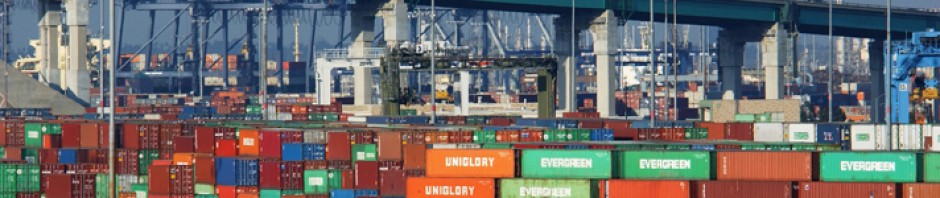
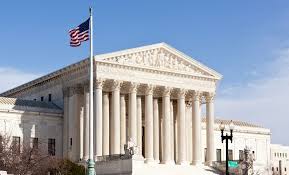
More on the role of courts — the Supreme Court and Trump. Is the Supreme Court Trump’s last and best hope of defense against a myriad of lawsuits? Yes. But success is not certain — over tariffs or other abuse of executive power — including use of illegal force on the high seas — in violation of U.S. and international law. Speculative investors are already buying up potential tariff refund claims 10 cents on the dollar — believing that Trump will lose the tariff case in the Supreme Court.
However, the Trump administration has won a recent appeals decision concerning his China tariffs under Section 301 (‘Retaliation’) from his first term and has recently imposed new Section 232 tariffs (national security) this week, Trump continues to double-down aggressively even in light of increasing opposition. Not unexpected. But surely to increase the chaos for the U.S. and international legal and political systems ……….
……………………………………….
“While President Donald Trump’s aggressive use of executive power has resulted in a flurry of lawsuits, administration officials have won a series of high-profile victories at the Supreme Court …. But only a small number of the more than 300 active lawsuits filed against the Trump administration have made it to the Supreme Court. The White House has won 18 times at the Supreme Court since Trump took office and is on a 15-case winning run …. So far, the Trump administration has asked the Supreme Court to weigh in on an emergency basis 28 times …. It has lost only two …. The Supreme Court has granted Trump administration requests to block lower court rulings in more than 70% of cases brought by the administration that were decided via the shadow docket …. Big cases are on the horizon, including a consequential showdown on Trump’s ability to unilaterally impose tariffs on imported goods.” “Trump’s Supreme Court Victories.” NBC News (Sept. 22, 2025).
“But who will draw that line? …. Before the Gulf of Tonkin, there was Havana Harbor. In 1898, America embraced war and imperialism because, well, “Remember the Maine!” The U.S. battleship supposedly was blown up by a Spanish mine. Its sinking has long since been ascribed to an accidental internal explosion.” “Trump Sinks Boats.” Wall Street Journal ((Sept. 21, 2025).
“The tariffs fall into two buckets. The first, known as the “trafficking” tariffs, apply to goods from Canada, China, and Mexico – countries that, in Trump’s view, have not taken sufficient measures to stop the flow of fentanyl into the United States. The second, known as the “reciprocal” tariffs, impose tariffs ranging from 10% to 50% on products from almost all nations. Three separate challenges followed their imposition. The first, filed in a federal court in Washington, D.C., came from two small, family-owned businesses, Learning Resources and hand2mind, that make educational toys and products. They say that the tariffs will cost them $100 million in 2025 – almost 45 times as much as they paid in tariffs the previous year. Two other challenges to the tariffs were filed in the Court of International Trade, which is in New York. A separate group of five small businesses brought one suit. One of the plaintiffs, Terry Cycling, which makes women’s cycling apparel, says that the tariffs could cost the company as much as $1.2 million in 2026 – “an amount,” it contends, “that is simply not survivable for a business of its size.” The second suit, brought by a group of 12 states, led by Oregon, contends that the tariffs have increased the costs that the states must pay to buy “equipment, supplies and parts, many of which are imported from other countries” – for example, specialized research equipment for their public universities. Both U.S. District Judge Rudolph Contreras and the Court of International Trade agreed with the challengers that the tariffs exceeded Trump’s power under IEEPA. Learning Resources and hand2mind then came to the Supreme Court in June, asking the justices to take up the case without waiting for the U.S. Court of Appeals for the District of Columbia Circuit to rule on the government’s appeal. On Aug. 29, the U.S. Court of Appeals for the Federal Circuit, which hears appeals from the Court of International Trade, ruled that Trump did not have the power to impose the tariffs. By a vote of 7-4, it said that imposing “tariffs of unlimited duration on imports of nearly all goods from nearly every country with which the United States conducts trade” is “both ‘unheralded’ and ‘transformative.’” Reasoning that “[t]he Executive’s use of tariffs qualifies as a decision of vast economic and political significance,” the majority explained that the government was therefore required to “‘point to clear congressional authorization’” for its actions – which, the majority concluded, it could not do. The Trump administration came to the Supreme Court on Sept. 3, asking the justices to take up the case. Both the small businesses and the states maintained that the lower courts’ rulings were correct, but they agreed that the court should grant review – which it did on Sept. 9. The court fast-tracked the case, as well as the case brought by Learning Resources and hand2mind, which it had also granted, and scheduled oral arguments for Nov. 5.” “Tariff Case.” SCOTUS blog (Sept. 19, 2025).
“Wall Street investors are buying up claims to potential tariff refunds, betting that the Supreme Court will strike down Trump’s signature economic policy and require the government to disgorge tens of billions of dollars that companies have paid this year in import taxes …. A handful of hedge funds and specialized investment firms are offering importers around 20 cents for every dollar they paid in Trump’s “reciprocal” tariffs and roughly 5 cents per dollar for levies on Canadian, Mexican or Chinese goods stemming from the president’s ire over fentanyl trafficking …. The Supreme Court within months could join two lower courts in ruling some or all of the IEEPA tariffs illegal, which would deal the White House a major political setback. The nation’s highest court has agreed to hear a pair of related cases with oral argument scheduled for Nov. 5.” “Investors and Trump Tariff Refunds.” Washington Post (9.25.25).
“On September 25, 2025, the U.S. Court of Appeals for the Federal Circuit (“CAFC”) issued its decision upholding tariffs imposed during President Trump’s first administration pursuant to Section 301 on goods imported from China.” “Section 301 Trump Tariffs Upheld from First Term.” Husch Blackwell (Sept. 26, 2025).



 Stuart Malawer
 U.S. LAW & GLOBAL TRADE RELATIONS.
You must be logged in to post a comment.