Click to access Malawer.Trump,_Courts_and_Congrss_RTD_4.13.25_.pdf
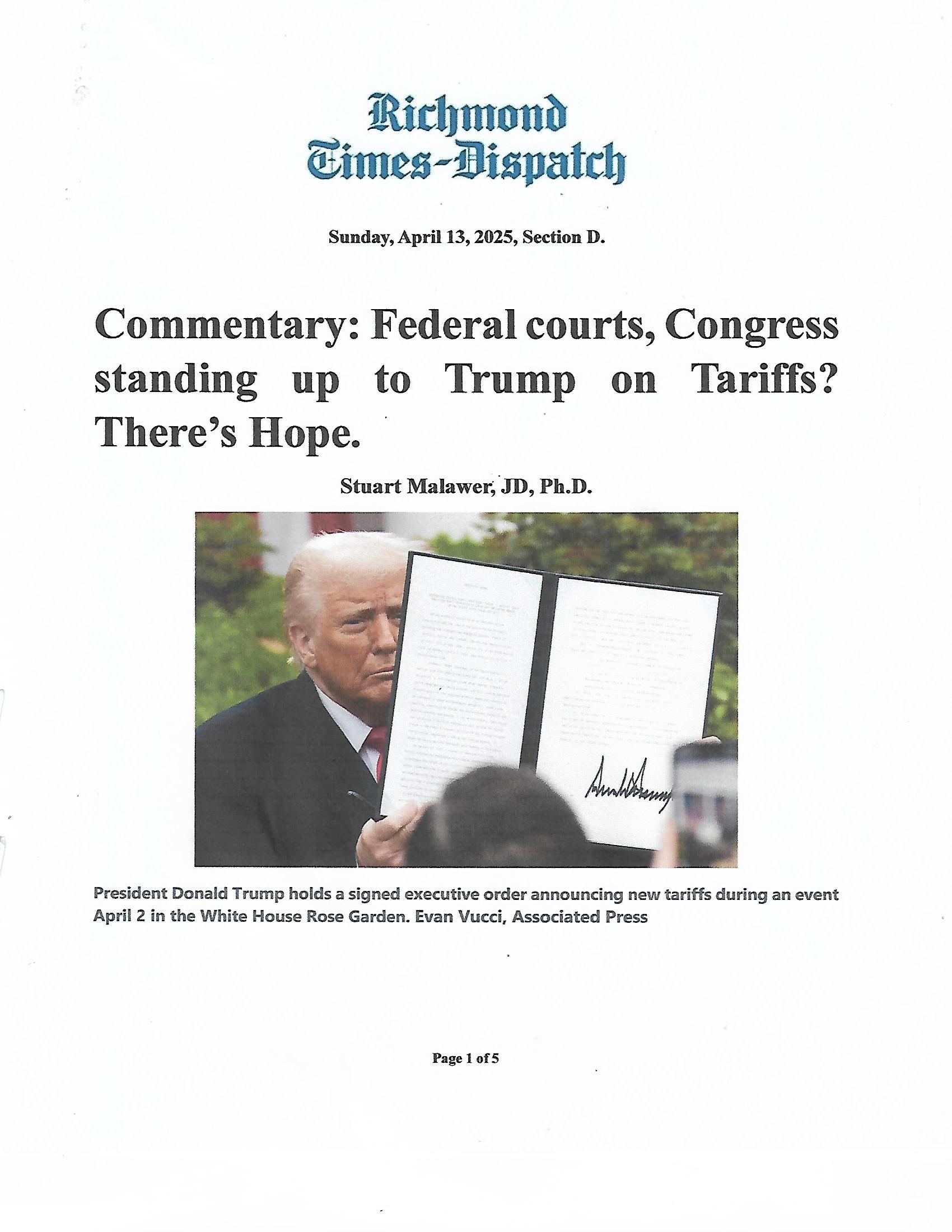
The Supreme Court will be hearing Trump’s tariff case this November. Trump’s tariffs can lead to an additional 100,000 unemployed. His most recent tariff actions have caused total chaos in trade relations with Korea and Japan as well as other countries including India, China and the EU (over Russian oil purchases). They have already amounted to essentially billions of a new sales tax on U.S. firms and consumers. They may need to be refunded if the Supreme Court denies the validity of his tariffs. They have also resulted in significant less employment in various industries and inflation in the U.S.
If Trump’s tariff actions are upheld, this will result in one of the biggest business tax increases ever. The Supreme Court will be reviewing the president’s emergency actio0n within the context of several pieces of legislation, most notably IEEPA (1977). This is probably the most important tariff case ever and crucial to Trump’s outrageous tariff actions this year.
Here’s the two cites to the lower courts and appeals court decisions against Trump and these tariffs. Keep in mind this is actually only one case of many challenging Trump’s historically abusive attempts at extending presidential authority in a broad range of areas. Trump constantly threatens federal judges and courts. (He also berates foreign and international courts — such as the International Criminal Court — but that’s another story.)
His total disdain for the U.S. legal system is further evidenced by his unfounded multi-billion-dollar lawsuits against the New York Times and Wall Street Journal for reporting on his business failures. Keep in mind also that Trump’s limited success on the shadow or emergency docket concerning provisional measures does not mean much in projecting success on the merits in the pending tariff case.
Of course, the Republicans in the House continue to block any actions against Trump’s tariffs, but the Democrats in the Senate have been somewhat successful in bringing resolutions to a vote and passing them. (Led by Senator Kaine of Virginia.) We’ll see more shortly.
………………………………………………….
V.O.S. SELECTIONS, INC.
Trump’s Tariff Case (Court of International Trade) (2025). https://www.cit.uscourts.gov/sites/cit/files/25-66.pdf
Trump’s Tariff Case (U.S. Court of Appeals for the Federal Circuit) (2025). https://www.cafc.uscourts.gov/opinions-orders/25-1812.ERRATA.9-2-2025_2566341.pdf
…………………………………………….
“For the president, the power to issue limitless tariffs is at the heart of his second-term vision, from trade to foreign policy …. When Trump unveiled his initial slate of punishing tariffs he fashioned the announcement as a critical moment in a dawning global trade war …. His gambit could be in peril, after the Supreme Court agreed to hear a case challenging the legality of Trump’s actions. Now his administration is confronting the potential loss of a powerful tool at the heart of his second-term strategy, one that has allowed the president to force concessions from companies, allies and adversaries …. But judges have repeatedly ruled against Trump, with one panel of judges finding that the president did not possess “unbounded authority” to impose tariffs, especially without the approval of Congress. While the courts have not always choked off the emergency powers law as a way of imposing any tariffs, the judges in each of the cases have still found the president’s duties to be a step too far …. Tariffs aren’t free and, contrary to the administration’s persistent claims, Americans pay them.” “Tariffs and the Pending Supreme Court Case.” New York Times (Sept. 11, 2025).
“In the span of 24 hours last week, Trump managed to roil both South Korea and Japan, two longtime allies that less than two months earlier had said they would invest a combined nearly $1 trillion in the United States in exchange for lower tariffs. U.S. immigration officials raided the construction site of a major Hyundai-LG plant in Georgia, a flagship project by two of South Korea’s most prominent companies. Hundreds of South Korean citizens were arrested and detained …. On the same day, Trump signed an executive order enacting a trade deal he had struck with Japan in July, committing Japan to invest $550 billion in the United States. The order codified the reduced automotive tariffs that Tokyo had desperately sought. However, it came with a memorandum of understanding between the two countries stating outright that Trump, not Japanese officials, will select how the $550 billion will be invested in …. In both Japan and South Korea, increasingly vocal leaders in government and business feel their countries were strong-armed and are questioning whether it still made sense to comply with Trump’s demands.” “Japan and Korea Fury Over Tariffs.” New York Times (Sept. 12, 2025).
“Trump has often claimed that foreign exporters, not Americans, pay tariffs. In fact, importers (such as retailers) remit the duty to the government. They can, in theory, persuade exporters to absorb some or all of the tariff, or pass it along to their customers. While who ultimately pays can’t be known precisely, several economists estimate that American businesses paid 50% to 60% of Trump’s tariffs to date, with the balance split roughly between exporters and consumers …. So if the Supreme Court gives Trump what he wants, tariffs could end up as one of the biggest business-tax increases in decades, wiping out the tax benefits for expensing capital investment in this year’s Republican tax and spending law. “Tariffs Case and Massive New Powers.” Wall Street Journal (Sept. 12, 2025).
“The U.S. Constitution doesn’t have a general emergency authority. Instead, we have a web of laws that give the president special powers in specific circumstances. Trump has relied upon that web of laws in a systematic way that none of his peacetime predecessors did …. Trump has used 10 emergency declarations to justify hundreds of actions. Consider: The Alien Enemies Act of 1798 empowers the president to quickly deport foreigners during a war or an invasion — but doesn’t say what an invasion is. The International Emergency Economic Powers Act of 1977 says the president can take action against an “unusual and extraordinary threat.” But the trade deficit Trump cites as the reason for his tariffs is usual and ordinary. An appeals court said last week that tariffs imposed by executive order were illegal, but Trump is appealing to the Supreme Court …. This isn’t like the most naked seizures of power in modern history, such as the Nazi takeover after the Reichstag fire in 1933. “ “Trump’s Declaration of Emergencies.” New York Times (Sept. 12, 2025).
“Trump administration prevailing much more often (in the Emergency or Shadow Docket) than its predecessor had — 84 percent of the time, compared with 53 percent for the Biden administration …. In the 17 cases in which the Biden administration sought emergency relief from the Supreme Court over four years …. By contrast, in the 19 cases in which the court has ruled on applications from the second Trump administration …. Rulings on emergency applications filed by the government, moreover, tend to present the same essential questions: how much deference is due the president and whether temporarily blocking a government program challenged as unlawful would cause more harm than letting it proceed …. The emergency docket presents a different portrait of the court, one in which partisan affiliations map onto voting patterns quite closely, reinforcing the declining public confidence in the court reflected in opinion polls …. It is premature to draw larger conclusions about how the second Trump administration will fare at the Supreme Court. Its many victories arising from its second-term initiatives have so far all been in the context of emergency applications for interim relief, and it may face serious headwinds when the court considers cases on the merits. The justices agreed to hear challenges to Trump’s sweeping tariffs, and legal experts say he could well lose …. Partisan politics plays out far more in the emergency applications than in the merits cases.” “Supreme Courts Emergency Rulings – Show Split.” New York Times (Sept. 14, 2025),
“President Donald Trump’s rebukes of judges and courtroom prosecutors have extended far beyond the United States’ borders in his second term in office, as he and his officials question the fairness of an increasing number of foreign nations’ domestic court systems …. Trump had also invoked sanctions against the International Criminal Court, which the administration has accused of illegitimately asserting jurisdiction and abusing its power …. Trump trying to undermine anything that places limits on what states can do, whether it’s a limit on what a state can do to its own country, or a limit on how states can be judged internationally. Trump wants to undermine the power of institutions that would put a check and balance on a single national leader.” “Trump Opposes Foreign & International Courts Also.” Washington Post (Sept. 14, 2025).
“The federal Court of International Trade (CIT) surprised most of us in May by ruling against the deceitfully named “reciprocal tariffs”, saying that the International Emergency Economic Powers Act (IEEPA) under which they were imposed wasn’t meant for that purpose — though the duties remained in place pending further action. Two weeks ago the Court of Appeals for the Federal Circuit, ignoring Trump’s bizarre warning that striking the tariffs down would destroy the country, upheld the ruling, though again left them in place for now. Last week the Supreme Court decided it would take up the case with great haste and would hold hearings in the first week of November …. It was clear from the beginning of his administration that Trump had little regard for domestic and international trade law …. The specialist Court of International Trade and the appeals court focused precisely on interpretations of statute, and specifically whether the IEEPA was designed to delegate decisions over tariffs to the president. Given that the first section of the US constitution says that the power to impose tariffs is given to Congress …. Both courts decided that IEEPA does not so delegate, and therefore it cannot be used to impose tariffs. At the point the case moves on to the Supreme Court, the trade lawyers shift a bit to the side and the constitutional lawyers edge into the spotlight. The current Supreme Court justices are not collectively a courageous bunch, and Trump has deliberately raised the stakes with his hysterical claims about the judgment destroying the US. More concretely, permanently striking the tariffs down will mean giving up revenue and refunding the money taken in so far. The Committee for a Responsible Federal Budget, a non-profit organisation that analyses US fiscal policy, says that revenue from Trump’s tariffs is now pushing above 1 per cent of GDP. A negative Supreme Court judgment would reduce the projected revenue gains from an estimated $2.8tn by the end of 2034 to $800bn. That’s a big chunk of money to find from somewhere else.” “U.S. Tariff Litigation.” FT—Trade Secrets (Sept. 15, 2025).
“The Republican-led House moved again to relinquish Congress’s power to weigh in on Trump’s tariffs, even as Democrats in the Senate prepared to force votes challenging his trade war …. It was the latest instance in which House Republicans, many of whom have spent much of their career opposing tariffs as a matter of principle, have given up their power over trade …. Democrats in the Senate, where the minority has more tools at its disposal have made more headway in forcing tariff votes through the national emergencies statute. Senator Tim Kaine, Democrat of Virginia, intends to bring forward two resolutions in the coming days to terminate the emergencies Trump declared to justify tariffs on Canada and Brazil.” “Republicans, Congress and Trade – Update.” New York Times (Sept. 19, 2025).


 Stuart Malawer
 U.S. LAW & GLOBAL TRADE RELATIONS.
You must be logged in to post a comment.