The Trump administration continues to erode the power of Congress, trampling on its constitutional prerogatives in ways large and small. Rather than the tariff policy, the key question is how much the courts will serve as a lasting check on an administration committed to materially reshaping the domestic and international economic orders. So far so good. Litigation has proven the only effective response to Trump to date. We’ll see. By the way, domestically, Trump has instituted state-owned corporate shares and profit-sharing with the government and rang in cronyism in economic policy and government actions.
Federal judges are frustrated with the Supreme Court for increasingly overturning lower court rulings involving the Trump administration with little or no explanation. Congress is doing nothing. A few former Republican senators have objected.
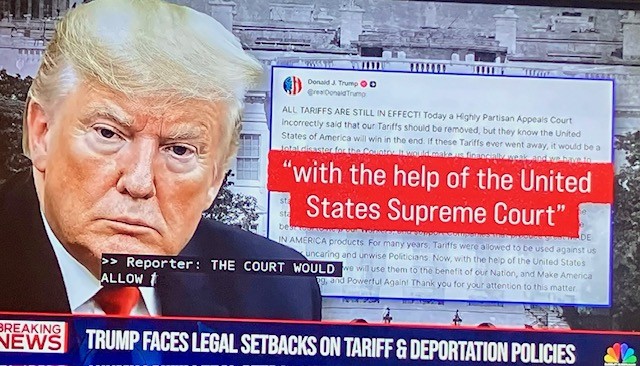
His tariffs are causing domestic harm and more is to come. The billons of questionable tariffs already collected may be ordered refunded. They were really a national sales tax to fund Trump’s bloated budget, tax bill and increased deficits. The Supreme Court will be hearing the historical tariff case in November and a decision may be reached by the end of the year.
Worst of all, countries are not following us. They are moving on.
…………………………………..
“The Supreme Court agreed Tuesday to quickly hear the Trump administration’s bid to save its sweeping global tariffs, setting the stage for a final ruling on a cornerstone of the president’s economic agenda. The court in a brief order said it would hear the case in early November, a schedule that could deliver a ruling before the end of the year. It will be the first time the high court has decided on the legality of a major policy from Trump’s second term …. The trade case raises little-explored questions about the president’s unilateral power over the economy. Trump has said that a 1977 law gives him broad powers to impose baseline levies of 10% on virtually every nation—and much higher rates for countries that don’t cut deals with the U.S., as well as an additional set of tariffs for Canada, China and Mexico …. Several courts so far have found that the law, the International Emergency Economic Powers Act, doesn’t authorize Trump to do these things …. Several cases about Trump’s authority in other spheres could land on the Supreme Court’s docket in the new term that starts in October.” “S.Ct. Fast Tracks Tariff Case.” Wall Street Journal (Sept. 9, 2025).
“The Trump administration continues to erode the power of Congress, trampling on its constitutional prerogatives in ways large and small. Through it all, Republicans in charge have mostly shrugged — and in some cases, outright applauded — as their powers, once jealously guarded, diminish in ways that will be difficult to reverse …. What is different now is the degree of disdain Mr. Trump has shown for Congress — and the willingness of G.O.P. leaders to defer to him even when it means undercutting their coequal branch of government ….. There’s absolutely no question the president doesn’t have the power to take airstrikes on boats outside U.S. waters with no authorization of war …. This president believes he’s above the law. He doesn’t believe the law applies to him. He doesn’t believe the Constitution applies to him, and if we act like that’s normal, then we just encourage the continued illegal constitutional behavior …. The Trump administration also has dismantled government agencies and offices created by Congress.” “Trump Tramples Congress and it Doesn’t Do Anything.” New York Times (Sept. 7, 2025).
“Rather than the tariff policy, the key question is how much the courts will serve as a lasting check on an administration committed to materially reshaping the domestic and international economic orders. This issue is likely to be tested many times in the coming months and years, with an answer that has significant consequences for many around the world and remains uncertain.” “Significance of Tariff Ruling.” Financial Times (Sept. 4, 2025).
“Federal judges are frustrated with the Supreme Court for increasingly overturning lower court rulings involving the Trump administration with little or no explanation, with some worried. In rare interviews with NBC News, a dozen federal judges — appointed by Democratic and Republican presidents, including Trump, and serving around the country — pointed to a pattern they say has recently emerged …. Lower court judges are handed contentious cases involving the Trump administration. They painstakingly research the law to reach their rulings. When they go against Trump, administration officials and allies criticize the judges in harsh terms. The government appeals to the Supreme Court, with its 6-3 conservative majority. And then the Supreme Court, in emergency rulings (Ghost Docket), swiftly rejects the judges’ decisions with little to no explanation. Emergency rulings used to be rare. But their number has dramatically increased in recent years.” “Federal Judges Criticize Supreme Court.” NBC News (Sept. 4, 2025).
“Much of what is blamed on trade these days has more to do with technological changes, inadequate social policies, and macroeconomic imbalances in big nations such as China and the US. But the trading system itself does need reform. Built for interdependence not over-dependence, too many members today are overdependent on the US for market demand and on China for critical supplies. This is not a recipe for global resilience …. Another area where members need more creativity is the WTO’s dispute settlement system. It remains the only trade dispute resolution mechanism with global reach, although its appellate body has been paralyzed since 2019. Under the radar, though, more and more members are still using the system to resolve disputes.” “Stress Test for Global Trade.” Financial Times (Sept. 5, 2025).
“But something else has changed, too. We are no longer in the muzzle velocity stage of this presidency. We are in the authoritarian consolidation stage of this presidency. I want to be very clear about what I am saying here. Donald Trump is corrupting the government — he is using it to hound his enemies, to line his pockets and to entrench his own power. He is corrupting it the way the Mafia would corrupt the industries it controlled. You could still, under Mafia rule, get the trash picked up or buy construction materials. But the point of those industries had become the preservation and expansion of the Mafia’s power and wealth. This is what Trump is doing to the government. “Trump’s Power Grab.” New York Times (Sept. 8, 2025).
“One reason that other nations are not raising their own tariffs is that Trump’s policies are not delivering the promised benefits …. The most telling evidence that countries are not merely putting a brave face on a bad situation is that they are not raising tariffs on other trading partners. They are rejecting Trump’s approach to trade even in relationships in which they hold the upper hand …. Other nations continue to pursue the example established by the United States decades ago because they continue to see trade, managed judiciously, as a path to greater prosperity. The Trump administration, by rejecting this global consensus, has damaged both the American economy and American global leadership.” “On Trade – The World is Moving On.” New York Times (Sept. 8, 2025).
“Reviewing the pending litigation regarding Trump’s use of the International Economic Emergency Powers Act (IEEPA) to impose tariffs on the world. The administration has now lost this argument twice—once in the Court of International Trade (CIT) and once in the Court of Appeals for the Federal Circuit (CAFC), and it is worth looking at those decisions and their implications. Of course, everybody knows that neither decision is the last word, since the administration has appealed to the Supreme Court. Meanwhile, the tariffs stay in effect, so nothing has really changed on the ground and will not change until the Supremes render their verdict. CAFC decision was 7-4, with judges appointed by presidents of both parties on each side. The decisions largely turned on whether IEEPA permits the use of tariffs in addressing an emergency, even though the word “tariffs” is not mentioned in the statute. That absence is sufficient for some people, but the main argument has been over whether other words in the statute, notably “regulate . . . importation,” encompass tariffs. Based in part on the legislative history of IEEPA, the CIT decided that Congress intended to limit presidential power, not expand it, thus confirming “that the words ‘regulate . . . importation’ have a narrower meaning than the power to impose any tariffs whatsoever.” The decision also pointed out that Congress had, prior to IEEPA, included Section 122 in the Trade Act of 1974, which explicitly gave the president limited authority to impose tariffs to deal with trade imbalances—the very emergency Trump cited. The CAFC also determined those words were insufficient, saying, “the statute bestows significant authority on the President to undertake a number of actions in response to a declared national emergency, but none of these actions explicitly include the power to impose tariffs, duties, or the like, or the power to tax.” The CAFC further elaborated that “whenever Congress intends to delegate to the President the authority to impose tariffs, it does so explicitly, either by using unequivocal terms like tariff and duty, or via an overall structure which makes clear that Congress is referring to tariffs. Both courts were careful to say that they were addressing the specific tariffs targeted in the lawsuits—the trafficking tariffs related to fentanyl imposed on Canada, Mexico, and China, and the “Liberation Day” tariffs imposed on everybody else—and were not deciding that IEEPA precluded all tariffs. This was particularly evident in the CAFC decision, where the four dissenting judges concluded the statute did permit tariffs, and the president was properly exercising his authority, and four of the judges in the majority concluded that the statute did not permit any tariffs. The majority, however, agreed with the CIT that IEEPA did not permit the particular tariffs in question. The difference seems to be rooted in how expansive a view one takes of congressional intent and legislative draftsmanship. For some, words like “regulate . . . importation” were sufficient to conclude tariffs were authorized, but for the majority, they were not. Much of the argument turned on how to interpret a previous case, known as Yoshida II, in which the predecessor court to the CAFC affirmed President Nixon’s action imposing tariffs in response to a balance of payments crisis. The government argued that the decision validated Trump’s action, but the courts noted that the tariffs addressed in Yoshida II were limited in time, scope, and amount in contrast to the Trump tariffs, which led both courts to the conclusion that while IEEPA might permit some tariffs, it did not permit these tariffs. That reasoning allowed both courts to largely avoid the messy constitutional question of how and to what extent Congress can delegate its powers under Article I of the Constitution. The argument that Congress cannot delegate its fundamental powers, particularly on what the Supreme Court has called “major questions,” without providing clear guidance and limitations, and whether IEEPA runs afoul of that doctrine remains to be decided.” “Supreme Court and Trump Tariff Litigation.” CSIS (Sept. 8, 2025).
“The United States government has already collected tens of billions of dollars from President Donald Trump’s “reciprocal tariffs.” But that money — and a lot more — could end up being refunded if the Supreme Court agrees with lower courts that many of the levies on imports from other countries are illegal. How much could that end up being? Anywhere between $750 billion to a whopping $1 trillion, warned Treasury Secretary Scott Bessent in a declaration filed with the Supreme Court last week.” “Tariff Refund?” CNBC (Sept. 8, 2025).
“Tariffs are a core Congressional power,” the court wrote in its decision, saying Trump was intruding on the legislature’s prerogatives without clear authorization from lawmakers …. Similar battles are unfolding in courts across the U.S. Challenges to a host of aggressive actions by Trump are being framed largely about the reach—and limits—of presidential power. But in turn, many of the cases are also about the power of Congress, and how they are decided could have long-term ramifications for the legislative branch …. More than 100 lawsuits against the Trump administration involve core questions about congressional authority. In one batch, states, recipients of government grants and fired workers are challenging the White House’s attempts to hollow out the Education Department, the Consumer Financial Protection Bureau and a dozen other government entities. Their cases all have similar central arguments: Trump can’t unilaterally dismantle agencies created and funded by Congress …. The president has already notched some clear wins at the expense of Congress, including in his efforts to fire a range of high-ranking government officials whose jobs Congress had sought to protect from political interference. The Supreme Court in several cases has allowed Trump to proceed with the dismissals for now, a signal that it is likely to overrule past precedent that said such officials could only be fired for cause. In the tariff cases so far, judges have sided firmly with Congress, saying lawmakers never gave the president the broad authority he claims. Cases about the gutting of government agencies remain in early stages …. In the tariff litigation, former Republican Sens. George Allen of Virginia, John Danforth of Missouri and Chuck Hagel of Nebraska urged judges to rein Trump in. Congress’s power over taxation and commerce, they said, was “a structural safeguard of democratic accountability.” “Trump’s Powers and Congress.” Wall Street Journal (Sept. 9, 2025).
“Whether Americans realize it or not, the Trump administration is trying to engineer a radical reconstruction of capitalism in the United States. The new model looks more like China’s, which allows private-sector development but emphasizes government ownership and control …. Commerce Secretary Howard Lutnick has suggested that in addition to Intel and Nippon Steel, Washington could buy into military contractors such as Lockheed Martin, Boeing and Palantir. The White House has pushed chip makers like Nvidia and AMD to give a share of revenue from sales in China to the U.S. government, providing it a stake without formal ownership …. the Trump administration is handing out or imposing deals arbitrarily and retroactively. The danger is evident …. This is how authoritarian economies function. Success depends less on building products that meet people’s needs and more on cultivating connections with the state.” “Trump is Copying China.” New York Times (Sept. 13, 2025).
“A legal resistance led by a patchwork coalition of lawyers, public-interest groups, Democratic state attorneys general, and unions has frustrated Trump’s ambitions. Hundreds of attorneys and plaintiffs have stood up to him, feeding a steady assembly line of setbacks and judicial reprimands for a president who has systematically sought to break down limits on his own power. Of the 384 cases filed through August 28 against the Trump administration, 130 have led to orders blocking at least part of the president’s efforts, and 148 cases await a ruling …. The groundwork for these victories was laid before Trump was even reelected, in a series of summits in 2023 and 2024. Universities hosted symposiums. Organized labor held private meetings. International experts, who had been studying Hungary’s Viktor Orbán, warned that Trump would move quickly and try to overwhelm his opponents. “We needed to flood the zone with rule-of-law shock and awe.” The plan that emerged was not focused on centralizing a response, but on running a barrage of coordinated efforts. Attorneys general would represent states, advocacy groups such as Public Citizen and the ACLU would focus on their areas of expertise, and the unions would gather stories from their members and identify plaintiffs who could show harm. Atop this infrastructure, new organizations took shape, bringing in tens of millions of dollars to pay for it all …. these legal struggles against Trump are just the opening minutes of a much larger battle. “He did not win that round. We did not win either,” he told me, “But we held our own, and that in itself is a victory …. The Supreme Court, which has so far appeared more favorable to Trump than district courts, could ultimately tilt the scorecard in the president’s favor, as the justices begin to consider the substance of the legal questions presented by Trump.” “Legal Resistance Against Trump – So Far Only Viable Resistance.” The Atlantic (Sept. 2025).
“The Alien Enemies Act and the Major Questions Doctrine …. Somin explored whether the Trump administration’s use of the Alien Enemies Act to deport alleged members of the Tren de Aragua drug gang violates the major questions doctrine, which “requires Congress to ‘speak clearly’ when authorizing the executive to make ‘decisions of vast economic and political significance.'” Courts can and should rule against” the administration’s interpretation of the Alien Enemies Act based on the “text and history of the law alone,” but that the major questions doctrine adds further weight to the idea that the administration’s interpretation of the act is wrong.” Scotus Blog (Nov. 14, 2025).
About Stuart Malawer
Distinguished Service Professor of Law & International Trade at George Mason University (Schar School of Public Policy).
This entry was posted in Uncategorized. Bookmark the
permalink.


 Stuart Malawer
 U.S. LAW & GLOBAL TRADE RELATIONS.
You must be logged in to post a comment.