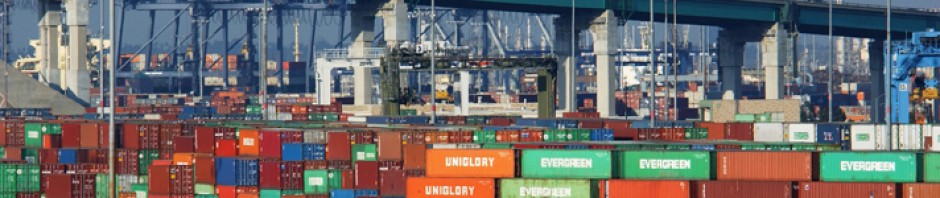
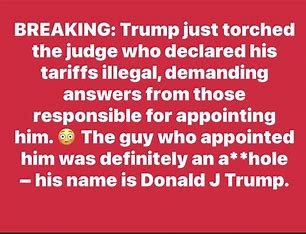
The fate of Trump’s tariffs will now be up to the Supreme Court. It may mindlessly uphold them, but maybe not. I don’t think so. This is the question that will be tested many times over the next few months if not years. Not only as to tariffs but to a wide range of really very questionable and aggressive and ever-expanding executive actions. The use of the ‘ghost docket‘ by the Supreme Court to stay presidential actions has been severely criticized by a large group of federal judges. We’ll see …….
…………………………………………
“The decision is a big blow to President Trump’s trade policies, but the judges left the duties in place for now to allow time for a likely appeal to the Supreme Court …. A federal appeals court ruled on Friday that many of President Trump’s most punishing tariffs were illegal, delivering a major setback to Mr. Trump’s agenda that may severely undercut his primary source of leverage in an expanding global trade war. The ruling, from the U.S. Court of Appeals for the Federal Circuit, affirmed a lower court’s initial finding in May that Mr. Trump did not possess unlimited authority to impose taxes on nearly all imports to the United States. But the appellate judges delayed the enforcement of their order until mid-October, allowing the tariffs to remain in place so that the administration can appeal the case to the Supreme Court …. The adverse ruling still cast doubt on the centerpiece of Mr. Trump’s trade strategy, which relies on a 1970s law to impose sweeping duties on dozens of the country’s trading partners …. Without IEEPA, the president would be limited in the duties he could apply, and the manner and speed in which they could be imposed. Otherwise, he could seek to enact tariffs with the support of Congress …. The administration has no guarantee of success at the Supreme Court. Many leading conservative and libertarian lawyers and scholars have argued that the president’s duties were issued illegally …. Even if Mr. Trump appeals to the Supreme Court and loses, he still retains significant tariff powers. The available tools include a provision of trade law known as “Section 232,” which allows the president to impose duties related to national security. Mr. Trump has used this tool to impose duties on foreign cars and steel, and propose additional tariffs on semiconductors, pharmaceuticals and other products. Other trade laws allow the president to issue more sweeping tariffs for a limited period of time. Section 122 of the Trade Act of 1974, for example, allows a president to impose duties of up to 15 percent globally for up to 150 days, and could be used as a temporary measure. Another provision of that law, known as Section 301, gives the president broad scope to issue tariffs in response to unfair trading practices, as long as the administration first carries out consultations and an investigation.” “U.S. Circuit Court for the Federal Circuit Declares Illegal Trump’s Tariffs.” New York Times (August 30, 2025).
“In his seven months back in office, President Trump has declared nine national emergencies, plus a “crime emergency” in Washington. Those emergency declarations have been used to justify hundreds of actions — including immigration measures, sweeping tariffs and energy deregulation — that would typically require congressional approval or lengthy regulatory review …. Trump’s use of emergency powers in this term has far outpaced what is typical …. Tracking the use of these emergency orders to justify tariff actions is extraordinarily complicated …. Attempts in Congress to block or forestall the tariffs have not been successful, but court challenges remain underway. “Trump Far Outpaces Other Presidents in Calling National Emergencies.” New York Times (Aug. 28, 2025).
“The ruling on Friday from the U.S. Court of Appeals for the Federal Circuit throws a wrench in President Donald Trump’s trade agenda, and leaves his “reciprocal tariffs” in limbo. Trump has said that he will appeal the ruling to the U.S. Supreme Court. Trump’s sector-specific tariffs, including on copper and steel, remain safe from the ruling, potentially foreshadowing a new trade playbook Trump could use if his “reciprocal tariffs” are blocked …. The ruling injects a heavy dose of uncertainty into a central tenet of Trump’s economic agenda, which has rattled the global economy since April. For now, the appeals court ruling states the duties on goods from most countries — as high as 50% for a few countries — will stay in effect until Oct. 14, to allow the Trump administration time to appeal the decision to the U.S. Supreme Court. “Trump’s Tariffs that Have been Voided,” CNBC (9.2.25).
“I suspect the impact will be less on trade policy but could turn out to be more important in the power struggle between the executive and some parts of the judicial system. In reaching its decision, the court ruled that using the 1977 International Emergency Economic Powers Act to justify broad tariffs exceeded the president’s powers, adding that it could “discern no clear congressional authorisation” for putting the levies on imports from countries including Canada and China via a series of executive orders. Historically, the IEEPA has been used for targeted actions rather than broad tariffs. But in delivering a blow to one of the legal arguments for the current trade policy …. I suspect that, ultimately, this ruling will not fundamentally alter the administration’s propensity to use tariffs to pursue multiple objectives. The approach is integral to the efforts to rewire the international trading system and also the domestic economy.” “Significance of Tariff Decision.” Financial Times (Sept. 2, 2025).
“President Trump’s tariffs are one of the broadest claims of executive power in American history, taxing imports from anywhere on his personal whim. The problem is he doesn’t have that power under the law or the Constitution, as the Court of Appeals for the Federal Circuit ruled late Friday in V.O.S. Selections v. U.S. This is a crucial moment for the Constitution’s separation of powers …. More ominously for Mr. Trump, his tariffs run afoul of the Supreme Court’s major questions doctrine, which says that Presidents need clear authority from Congress for significant economic and political actions. The Court applied the doctrine in overturning President Biden’s $400 billion student-loan forgiveness. Mr. Trump’s tariffs certainly qualify as major, since they hit more than $4 trillion of imports annually and some 14% of the nation’s economy …. Trump is bloody-minded on tariffs, and he’ll use whatever other statutes he can. He recently expanded his use of Section 232 national-security power to impose tariffs on “derivative” steel and aluminum products, including bulldozers, furniture, railcars, appliances, air-conditioning parts, butter knives, spray deodorants and strollers. Who knew that baby buggies were a threat to the homeland? “Trump Isn’t Tariff Queen.” Wall Street Journal (Sept. 2, 2025).
“The Supreme Court has flirted with a flurry of Trump administration matters in recent months, but the battle over the president’s sweeping global tariffs will put the justices directly on the spot over a centerpiece of his economic agenda …. Across three different courts, 15 judges have weighed Trump’s tariff maneuvers—and 11 of them, appointed by presidents of both parties, have found he acted without legal support. The most consequential of those decisions came late Friday from the U.S. Court of Appeals for the Federal Circuit, which rejected the tariffs and gave the president a mid-October deadline to appeal to the Supreme Court before the ruling takes effect …. To date, the administration has sought preliminary relief from the Supreme Court in more than 20 cases in which lower court judges temporarily blocked the White House’s plans. In many of them, the high court gave the administration what it asked for, in orders that provided little—if any—explanation …. Not only does Trump’s policy break with longstanding Republican Party orthodoxy in favor of free trade, his choice to implement it unilaterally rather than through legislation has created legal vulnerabilities that plaintiffs have been quick to exploit.” “Trump’s Tariffs and Supreme Court.” (Sept. 2, 2025).
“The president said he would seek expedited review of a federal appeals court’s ruling that found many of his administration’s tariffs to be illegal …. Trump added that a loss could put at stake the billions of dollars that the United States had collected in revenue, which it might be forced to pay back, and undermine his campaign to pressure companies into making more of their products domestically …. The decision enraged Trump, who savaged the appeals court as partisan in a series of posts on social media through the weekend …. Trump does has other tariff tools at his disposal, but they are more limited than the emergency powers that he has invoked to impose levies of between 10 percent and 50 percent on countries across the globe …. Trump does has other tariff tools at his disposal, but they are more limited than the emergency powers that he has invoked to impose levies of between 10 percent and 50 percent on countries across the globe. 232 of the Trade Expansion Act of 1962 typically require consultations and investigations that can take several months to carry out. That would prevent the president from arbitrarily raising and lowering tariffs. Mr. Trump has repeatedly used Section 232 to impose tariffs on specific products on national security grounds, including foreign steel and automobiles. Those duties were unaffected by the court ruling on Friday. The president is exploring taxes on imported pharmaceuticals, semiconductors and other products under the Section 232 authority. Other trade laws allow the president to issue sweeping tariffs, but only for a limited period of time. Section 122 of the Trade Act of 1974, for example, allows a president to impose duties of up to 15 percent globally for up to 150 days. Another provision of that law, Section 301, allows the president to issue broad tariffs in response to unfair trading practices, after first carrying out consultations and an investigation. Yet another long-unused statute, Section 338 of the Tariff Act of 1930, allows the president to impose tariffs of up to 50 percent on countries that have discriminated against the commerce of the United States.” “Trump and Tariff Appeal to Supreme Court.” New York Times (Sept. 3, 2025).
“Rather than the tariff policy, the key question is how much the courts will serve as a lasting check on an administration committed to materially reshaping the domestic and international economic orders. This issue is likely to be tested many times in the coming months and years, with an answer that has significant consequences for many around the world and remains uncertain.” “Significance of Tariff Ruling.” Financial Times (Sept. 4, 2025).
“Federal judges are frustrated with the Supreme Court for increasingly overturning lower court rulings involving the Trump administration with little or no explanation, with some worried. In rare interviews with NBC News, a dozen federal judges — appointed by Democratic and Republican presidents, including Trump, and serving around the country — pointed to a pattern they say has recently emerged …. Lower court judges are handed contentious cases involving the Trump administration. They painstakingly research the law to reach their rulings. When they go against Trump, administration officials and allies criticize the judges in harsh terms. The government appeals to the Supreme Court, with its 6-3 conservative majority. And then the Supreme Court, in emergency rulings (Ghost Docket), swiftly rejects the judges’ decisions with little to no explanation. Emergency rulings used to be rare. But their number has dramatically increased in recent years.” “Federal Judges Criticize Supreme Court.” NBC News (Sept. 4, 2025).
“Much of what is blamed on trade these days has more to do with technological changes, inadequate social policies, and macroeconomic imbalances in big nations such as China and the US. But the trading system itself does need reform. Built for interdependence not over-dependence, too many members today are overdependent on the US for market demand and on China for critical supplies. This is not a recipe for global resilience …. Another area where members need more creativity is the WTO’s dispute settlement system. It remains the only trade dispute resolution mechanism with global reach, although its appellate body has been paralysed since 2019. Under the radar, though, more and more members are still using the system to resolve disputes.” “Stress Test for Global Trade.” Financial Times (Sept. 5, 2025).


 Stuart Malawer
 U.S. LAW & GLOBAL TRADE RELATIONS.
You must be logged in to post a comment.