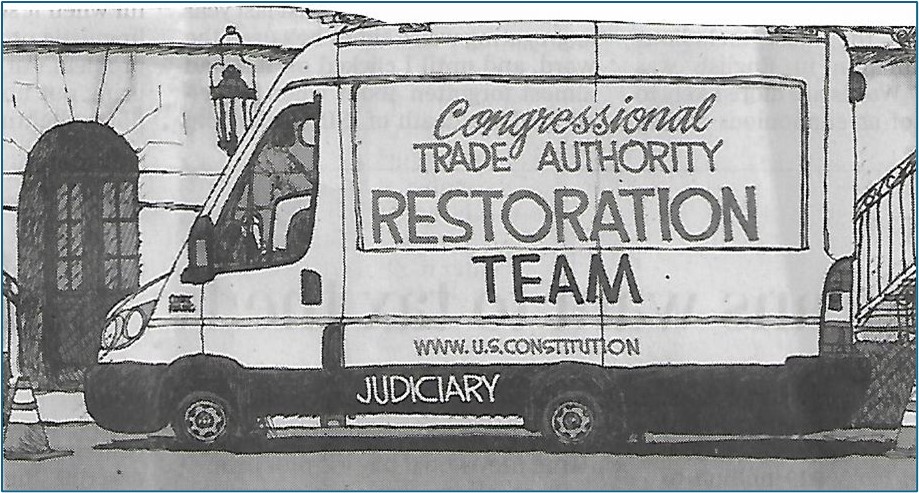
As we wait for the federal courts to rule o the legality of Trump’s tariffs a few concerning voices are now being heard. One argues if the courts rule against Trump somehow that is bad because it will limit future presidents from acting. Of course, that the whole point. Another concern is that Trump has already killed the existing rules-based system. No, he hasn’t. Countries are fighting back as well as a wide range of American plaintiffs. Trump’s egomaniac efforts to destroy domestic and international rules will not stand. His weaponization of trade and outright banditry (often for his personal and family profit) is outrageous. It’s in no one’s interests. Courts need to declare Trump’s tariff actions as contrary to the Constitution. Stay tuned …………….
………………………………………………
“Judicial limits on the executive today will bind the hands of future presidents tomorrow …. We are days away from a major court ruling on a question that could decide the fate of the global economy: is Donald Trump’s trade war on the world legal? The courts are playing with fire …. The courts have repeatedly blessed these arrangements — until Trump, that is …. Among those representing anti-tariff plaintiffs is a Koch-funded law firm dedicated to “cutting the Administrative State down to size”, along with another libertarian outfit that has led attacks on labor unions and gun safety measures. These groups argue that Congress must prescribe in advance, in exhaustive detail, what specific threats presidents should address in the future, and how they should address them …. Yet libertarian legal doctrines like “non-delegation” and “major questions” are being marshalled not only against Trump’s tariffs, but also against labor …. Ultimately, the better resolution is for courts to step back.” “Trump and Tariff Litigation — Caution.” Financial Times (August 15, 2025).
“The global trading system as we have known it is dead. The World Trade Organization has effectively ceased to function, as it fails to negotiate, monitor, or enforce member commitments. Fundamental principles such as “most favored nation” status, or MFN …. If Washington continues on its current course—defined by unilateralism, transnationalism, and mercantilism—the consequences will be grim …. Yet clinging to the old system and pining for its restoration would be deluded and futile. Nostalgia is not a strategy; nor is hope …. Trade policy has gotten both more credit and more blame than it deserves in the economic debates of recent decades. Critics of the system tend to conflate the effects of globalization with those of trade policy …. Yet such arguments have always been a tough sell politically, since the benefits of trade liberalization are broadly shared but largely invisible …. The United States thus finds itself the subject of a grand experiment in which long-standing assumptions about economics and global trade are being questioned, with significant near-term costs and uncertain long-term benefits. The Trump administration has, in effect, turned the political economy of trade on its head …. A key benefit of open plurilateralism is the flexibility it provides. Not being beholden to holdouts in a system.” “Rules-Based Trade System is Dead.” Foreign Affairs (Sept. / Oct. 2025).
“The Trump administration seems to be catching on to what has been clear for some time: The president’s claim of virtually unlimited, unilateral power to impose tariffs at whatever rate he chooses is in serious legal trouble. Hence the blustery letter Justice Department officials sent Monday to the U.S. Court of Appeals for the Federal Circuit, which heard arguments on President Donald Trump’s tariffs last month. The letter warned of a second Great Depression if the court pared back Trump’s tariff authority …. But the administration might be realizing that its constant invocations of foreign affairs aren’t sufficient to wave off judicial review. It should have worked with Congress and put its trade dealings on a stronger legal foundation. There’s still time to do so.” “Bessent and Tariffs.” Washington Post (Aug. 18, 2025).
“The post-American world economy has arrived. U.S. President Donald Trump’s radical shift in economic approach has already begun to change norms, behaviors, and institutions globally …. This means a worse world for almost everyone. Amid this change, however, China’s immediate economic environment will be the least altered …. There will be opportunities in this new landscape. But they will involve the U.S. economy less and less …. The Trump administration has paved paradise and put up a casino, with what will soon be an empty parking lot.” “New Economic Geography.” Foreign Affairs (Sept. – Oct. 2025).
“This new era will be shaped by weapons of economic and technological coercion—sanctions, supply chain attacks, and export measures …. The problem for the United States is that the Trump administration is gutting the very resources that it needs to advance U.S. interests and protect against countermoves …. U.S. President Joe Biden also used weaponization as an everyday tool of statecraft. His administration took Trump’s semiconductor export controls to a new level …. Such institutional decay is the inevitable consequence of Trumpism. In Trump’s eyes, all institutional restraints on his power are illegitimate. This has led to a large overhaul of the apparatus that has served to direct economic security decisions over the last decades …. The main problem is that as national security and economic policy merge, governments have to deal with excruciatingly complex phenomena that are not under their control.” “Weaponized World Economy.” Foreign Affairs (Sept. – Oct. 2025).
“It’s now commonplace to say Trump’s shakedowns of trading partners and corporations for tax revenue (even entirely leaving aside the issue of his personal wealth) resemble a mafia boss or a crony-capitalist dictator in a developing country. It’s actually worse than that …. It will take a long time for Trump’s roving banditry, particularly his trade deals, seriously to weaken he US economy. About half of its economy is made up of small and medium-size businesses. But the direction is clear.” “Trump’s Roving Banditry.” Financial Times (Aug. 21, 2025).
“After a slew of high-profile successes in the U.S. Supreme Court, the Trump administration found key parts of its agenda blocked in federal court this week, with judges criticizing its actions as “unlawful” and “unconstitutional.” Judges issued orders blocking the president’s use of the wartime Alien Enemies Act to speed deportations, the federal deployment of the National Guard for law enforcement purposes in California, the freezing of $2 billion in federal funds to Harvard, and the termination of protected legal status for hundreds of thousands of Haitians and Venezuelans …. The high court has granted the Trump administration’s emergency requests in 17 of 22 cases to date …. The ruling the president has expressed the most concern about was handed down on Aug. 29, when the U.S. Court of Appeals for the Federal Circuit found he had exceeded his authority when he imposed tariffs using an emergency powers statute.” “Courts Push Back on Trump.” NBC News (Sept. 6, 2025).
“Mr. Trump this week asked the Supreme Court to hear the legal challenge to his tariffs on a fast track. The best news for the economy would be if the Court takes up his challenge and finds them unconstitutional.” “Trump’s Tariffs – Unconstitutional.” Wall Street Journal (Sept. 6, 2025).


 Stuart Malawer
 U.S. LAW & GLOBAL TRADE RELATIONS.
You must be logged in to post a comment.