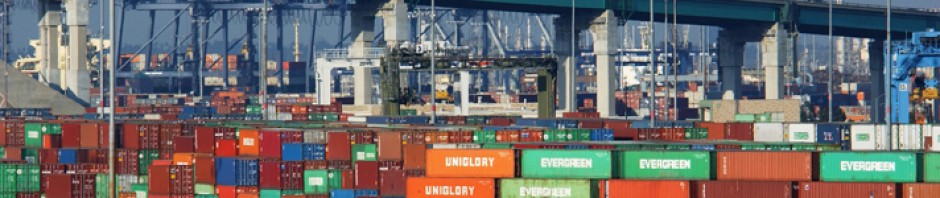
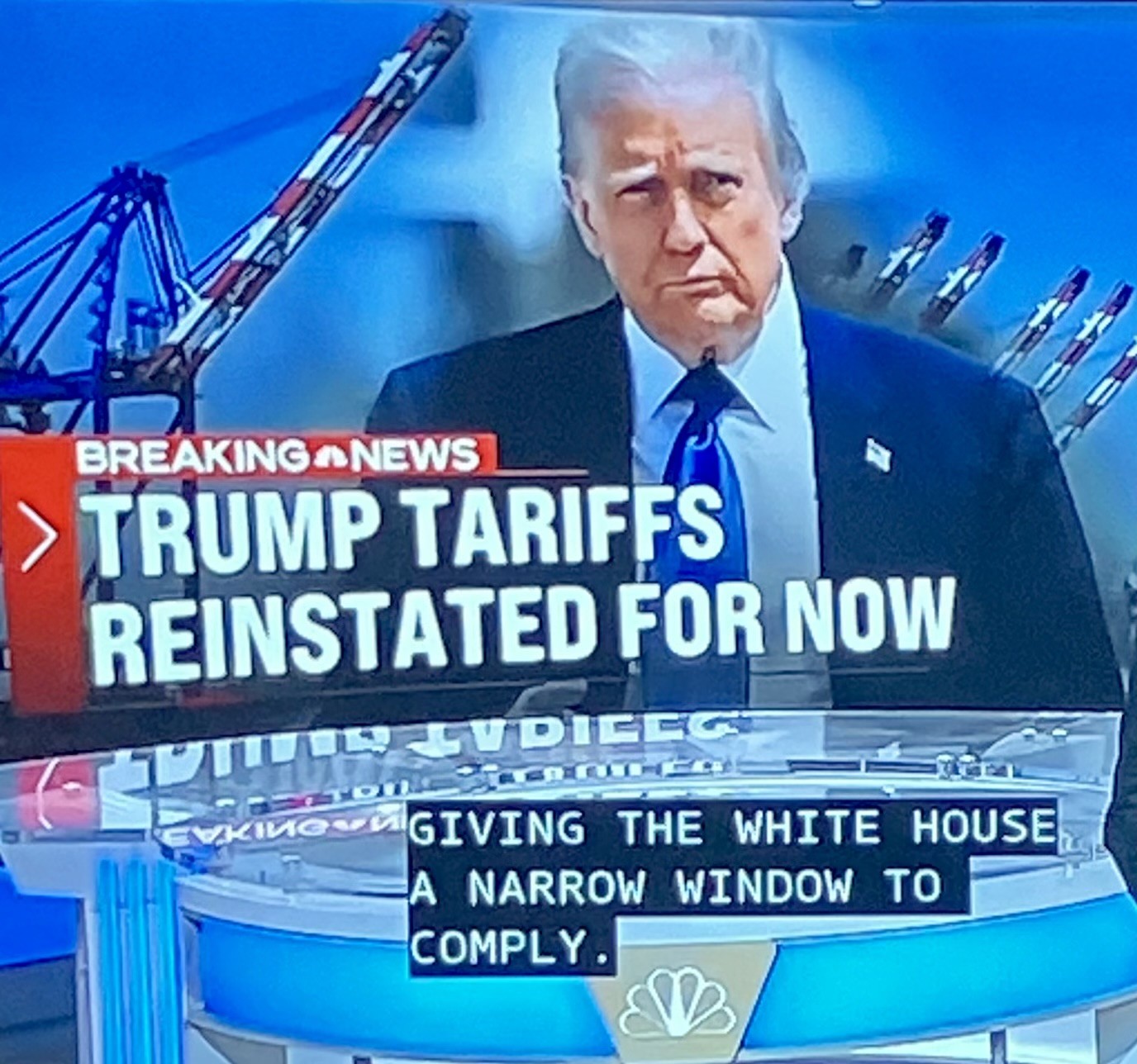
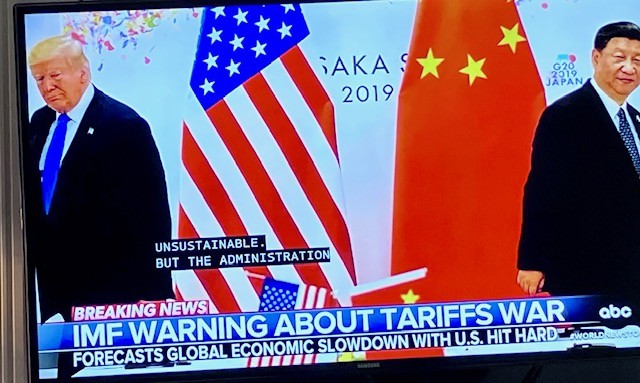
Number of lawsuits are piling up against the Trump administration. They have lost many and have refused to comply with a significant number. All along negotiating new tariff deals and giving support to the U.S. tech industry. Yet, the global economy is doing well and consumers have not really been hurt yet (but some firms have been). However, U.S. container imports are falling sharply, signaling that rising tariffs may be starting to drag on economic momentum.
Trump’s transactional approach to trade is a disaster. The federal courts have a good chance of stopping this, hopefully. A major hearing is set for this week and next and of course the Supreme Court will make the final decision — which may very well go against the administration – – knocking out most tariffs and trade agreements fostered by Trump. But the litigation will take time.
Trump’s tariffs are nothing more than diplomatic shake downs for political gain or just for whim.
………………………………..
“We examined 337 lawsuits filed against the administration since Trump returned to the White House and began a rapid-fire effort to reshape government programs and policy. As of mid-July, courts had ruled against the administration in 165 of the lawsuits. The Post found that the administration is accused of defying or frustrating court oversight in 57 of those cases — almost 35 percent.” “Flouting of Judges Orders.” Washington Post (7.22.25)
“The administration hopes to use the threat of tariffs and access to the U.S. economy to stop multiple countries from imposing new taxes, regulations and tariffs on American tech companies and their products.” “Tariffs Threats to Help Technology Industry.” Wall Street Journal (7.22.25).
“How quickly and completely Trump has transformed the world’s expectations regarding tariffs. In a few short months, the president has normalized tariffs at rates that would have been shocking just months ago. But by threatening even higher levies and holding out the prospect of devastating trade wars, he has somehow made sharply higher tariffs feel like a relief. The reaction is largely due to the incredible uncertainty the president has created with his global trade negotiations. “Highest Tariffs in a Century.” New York Times (7.24.25).
“The Supreme Court says the nondelegation doctrine, which undergirds the separation of powers, “bars Congress from transferring its legislative power to another branch of Government” without providing “an intelligible principle to guide the delegee’s use of discretion.” Today’s president insists that IEEPA grants presidents unbounded discretion in wielding a power that is neither granted to him by the Constitution nor delegable by Congress …. Today’s president is a hare, darting here and there. The judiciary is generally a tortoise, slow because it is deliberative. But you know the fable. And here is a fact: This tariff case could markedly restrain this rampant presidency.” “Tariff Case and Trump Presidency.” Washington Post (7.25.25).
“ Trump has turned the United States into a revisionist power seeking to shatter what remains of the economic order. Thus far, his approach has been needlessly chaotic …. If the Trump administration hopes to salvage a victory from its trade wars, Washington must use tariffs as leverage in pursuit of clear and achievable trade objectives rather than as a blunt tool wielded in pursuit of myriad and mutually incompatible ones …. Trump has demonstrated little interest in adopting a more deliberate, methodical approach to negotiations or to recalibrating his means to meet more achievable ends …. There is an alternative, even more worrisome path the trade wars could take. After tearing up the existing global trade rules, the United States could advance a more nakedly transactional approach in its international economic relations, eschewing any rules or shared norms that might constrain U.S. action.” “Ending the Trade War.”Foreign Affairs (July-August 2025).
“Wall Street analysts are betting hard against Trump’s trade agenda surviving in court. The lawsuits stacking up across the country are gunning straight for the legal base of his tariff powers. And they’re not just hoping to overturn a few decisions; they’re trying to wipe out nearly all of Trump’s recent trade deals by arguing he had no authority to make them in the first place …. At the center of the fight is the V.O.S. Selections v. Trump case, which is about to hit the Federal Circuit this Thursday. That case, along with several others, argues that the POTUS’ use of the International Emergency Economic Powers Act (IEEPA) to impose tariffs is flat-out illegal. The lower trade court already agreed, saying Trump went too far by using a law that doesn’t even mention tariffs. The Court of Appeals paused that decision, but the battle is far from over, since it’s moving toward the Supreme Court …. For months, small businesses and state attorneys have been pushing back against Trump’s trade moves. His administration used IEEPA as the legal shield for a long list of tariffs, including the 10% minimum tariff, the fentanyl-related duties on China, Canada, and Mexico, and the reciprocal tariffs he announced in early April …. The court found multiple instances where Trump had imposed tariffs outside the scope of IEEPA. Another blow came just one day later from a federal court in Washington, D.C. …. And if the Supreme Court does strike the tariffs down, it won’t just be a policy setback. It would take out almost every trade deal announced in the past six months.” “Law Suits Against Trump’s Tariffs.” MSN (7.28.25).
“President Donald Trump’s sweeping tariff powers and recent trade deals could soon run into a legal buzzsaw. A federal appeals court is set to hear oral arguments next week in a high-profile lawsuit challenging Trump’s stated authority to effectively slap tariffs at any level on any country at any time, so long as he deems them necessary to address a national emergency. The Trump administration says that that expansive tariff power derives from the International Emergency Economic Powers Act, or IEEPA …. The U.S. Court of International Trade struck those tariffs down in late May, ruling that Trump exceeded his authority under IEEPA …. But the U.S. Court of Appeals for the Federal Circuit quickly paused that decision, keeping the tariffs in effect while Trump’s legal challenge plays out. The case, known as V.O.S. Selections v. Trump, is the furthest along of more than half a dozen federal lawsuits challenging Trump’s use of the emergency-powers law …. Trump will probably continue to lose in the lower courts, and we believe the Supreme Court is highly unlikely to rule in his favor.” “Trump’s Trade Deals and Tariffs on Chopping Block in Court.” CNBC (July 28, 2025).
“Well, that was painful. For the Trump Administration’s lawyer, that is. The U.S. Court of Appeals for the Federal Circuit on Thursday Aug. 31, 2025) heard oral arguments in a challenge to President Trump’s worldwide tariffs (V.O.S. Selections, Inc. v. Trump). Judge after judge doubted the Administration’s arguments. The Administration says the 1977 International Emergency Economic Powers Act grants a President sweeping authority to impose tariffs. The 11 judges were mostly skeptical. Out of the gate one judge pointed out that no President has ever used the emergency law to impose tariffs …. The High Court’s Loper Bright (2024) landmark says that judges shouldn’t automatically defer to regulators’ interpretations of vague laws. The Court’s major questions doctrine also holds that Congress must give the President express authority for actions with economic and political significance …. But the Constitution gives Congress the power to regulate trade. Congress has delegated to the President limited authorities to impose tariffs that typically entail procedural requirements—for instance, up to 15% for 150 days in response to “large and serious” balance-of-payments deficits (Section 122) and on countries with discriminatory trade practices (Section 301) …. But as the small business plaintiffs argue, the President isn’t a king, and the Constitution doesn’t let him command the trade tides.” “Appeal for Trump’s Tariffs.” Wall Street Journal (August 1, 2025).
“The Post examined 337 lawsuits filed against the administration since Trump returned to the White House and began a rapid-fire effort to reshape government programs and policy. As of mid-July, courts had ruled against the administration in 165 of the lawsuits. The Post found that the administration is accused of defying or frustrating court oversight in 57 of those cases — almost 35 percent.” “Trump and Law Suits.” Washington Post (August 4, 2025).
“We are now in a new world. Even to trade nerds, the complexity of this is just bonkers …. The reciprocal tariffs will raise levies even on economies with new US trade deals, including the EU and Japan. China, the world’s biggest exporter, is separate: its trade war truce with Washington ends on August 12. “Trump’s Tariffs and Global Trade War.” Financial Times (August 7, 2025).
“Several suits claim the president has overstepped his authority …. Trump’s future use of tariffs as a negotiating tool is likely to be determined in the courts, where several states and businesses argue that he lacks the statutory authority to impose sweeping tariffs on all countries that trade with the U.S. …. V.O.S. Selections, Inc. v. Trump On April 14, V.O.S. Selections and four other import companies sued the Trump administration in the USCIT, claiming the president exceeded his statutory authority under the International Emergency Economic Powers Act (IEEPA) by imposing tariffs without congressional authorization …. On April 23, 12 states filed a parallel lawsuit, mainly making the same arguments. So, the USCIT consolidated the two cases, and a three-judge panel ruled on May 28 that the president had no authority to impose across-the-board tariffs under the IEEPA. As a result of the findings, the USCIT issued a permanent injunction against future tariffs. Learning Res., Inc. v. Trump On April 22, Learning Resources Inc. and hand2mind Inc., two small businesses specializing in educational products, filed a lawsuit challenging the legality of Trump’s tariffs under the IEEPA. A judge from the U.S. District Court for the District of Columbia issued a preliminary injunction on May 29, preventing the Trump administration from collecting IEEPA tariffs from the two plaintiffs. However, the U.S. Court of Appeals for the District of Columbia Circuit (CADC) granted the administration’s request for a stay until it could rule on the case’s merits. (Other cases have been filed in federal district courts and they have been stayed and transferred to the U.S. Court of International Trade.) “Five Court Cases and Trump’s Tariffs.” Supply Chain Dive (August 8, 2025).
“President Trump has warned U.S. courts against blocking his tariff policy …. Trump’s comments come as a federal appeals court is hearing arguments on how to handle his tariff policy. Former House Speaker Paul Ryan said that the Supreme Court could end up disqualifying the duties that have been ordered under the International Emergency Economic Powers Act enacted by Congress in 1977.” “Trump’s Tariff Litigation & Trump Warns Courts.” CNBC (August 8, 2025).
“President Trump has warned U.S. courts against blocking his tariff policy …. Trump’s comments come as a federal appeals court is hearing arguments on how to handle his tariff policy. Former House Speaker Paul Ryan said that the Supreme Court could end up disqualifying the duties that have been ordered under the International Emergency Economic Powers Act enacted by Congress in 1977.” “Trump’s Tariff Litigation & Trump Warns Courts.” CNBC (August 8, 2025).
“The uneven outcome of the latest round of trade talks has highlighted how the 79-year-old president is increasingly using tariffs not only to meet economic goals but also to advance geopolitical and diplomatic interests …. Trump had shown an inclination to deploy tariffs as a diplomatic negotiating tool in the past …. But Trump’s willingness to impose commercial punishment on countries for strictly non-economic reasons has increased dramatically during the first six months of his second term. The additional levies on India and Brazil come on top of Trump’s move to place extra tariffs on China, Canada and Mexico …. And while post-second world war global trade rules have historically given countries latitude to impose trade restrictions based on national security considerations, trade experts fear that Trump’s moves are especially brazen and could further break down the international trading system …. While the fresh reciprocal tariffs imposed this week are broadly lower than the aggressive duties set in early April, trade experts warn that the deals reached may well be fragile. “Trump’s Tariffs and Diplomatic Shakedowns.” Financial Times (August 9, 2025).


 Stuart Malawer
 U.S. LAW & GLOBAL TRADE RELATIONS.
You must be logged in to post a comment.