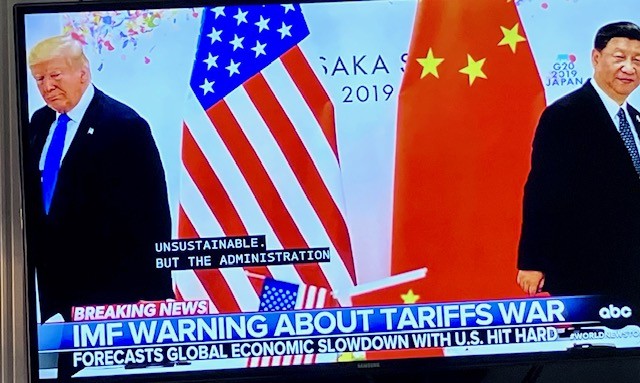
More on the illegality of Trump’s tariffs and recent court cases — Need to realize, tariffs are not going to bring back jobs. Also basic constitutional doctrines are in play here — the “nondelegation doctrine” and the “major question doctrine.” In another words, certain things the Congress cannot delegate without being precise and if they do delegate permissible authorities, they need to be clearly and specifically relied upon by the executive.
Litigation is continuing with appeals and more appeals. Recently the Federal Court for the Federal Circuit has extended a temporary order allowing the tariffs to remain in effect until a further hearing. They raise various issues (in addition to construing IEEPA), including perhaps eventually the ‘national emergency power’ of the president generally as well as ‘non-tariff issues,’ for example, export controls.
However, what is really at stake is aggressive use of executive authority that is unsustainable and unconstitutional.
…………………………………………
“In an unambiguous and unanimous ruling, the U.S. Court of International Trade held that President Trump’s “reciprocal tariffs” and fentanyl tariff actions exceeded his constitutional and statutory authority. We believe the ruling will stand up under Supreme Court review …. The trade court’s ruling states that the International Economic Emergency Powers Act, or IEEPA, can’t authorize sweeping tariffs without violating what is known as the nondelegation doctrine. A three-judge panel ruled that IEEPA doesn’t grant unlimited, unreviewable authority for the president to declare national emergencies unilaterally or impose tariffs arbitrarily. The ruling cited foundational Supreme Court cases such as Youngstown Sheet &Tube v. Sawyer, as well as more recent decisions such as Loper Bright Enterprises v. Raimondo, on improper delegation of authority from Congress to the executive branch. The court also invoked the “major questions doctrine” of the Roberts court as part of the argument against Mr. Trump’s claim of broad trade authority …. In its argument before the trade court, the administration heavily relied on U.S. v. Yoshida International, a 1974 Supreme Court decision that upheld President Nixon’s brief imposition of a 10% across-the-board tariff aimed at addressing a trade deficit spike. But that reliance ultimately undermines the administration’s case for three key reasons …. Yoshida involved presidential authority under the Trading with the Enemy Act, a statute that was later expressly amended to curtail executive power. Second, the Yoshida opinion emphasized the narrow and temporary scope of Nixon’s tariffs …. Existing domestic trade laws—such as the antidumping and countervailing-duty (anti-subsidy) authorities—have worked to prevent unfair competition and could be strengthened by Congress.” “Lawmakers and Trade.” Wall Street Journal (6.7.25).
“Two federal courts recently ruled that Trump lacks authority to impose them, but a specialized federal court with authority over tariff cases, the Court of Appeals for the Federal Circuit, paused the enforcement of those decisions, ordering lawyers to submit legal briefs. One or both cases are likely to land at the Supreme Court in short order ….. One or both cases are likely to land at the Supreme Court in short order …. As presidents of both parties have grown increasingly aggressive about asserting unilateral power rather than attempting to work with Congresses often dominated by the other political party, the Supreme Court has faced other variants on this issue — but never one as stark and consequential as the tariff case …. First is the nondelegation doctrine, which holds that it is unconstitutional for Congress to delegate some legislative power to the executive branch without providing an “intelligible principle” to guide and limit executive discretion. In practice, the court always steps back from actually holding statutes unconstitutional under this doctrine, but it motivates the justices to refuse to interpret statutes in such a way as to amount to a grant of unbridled discretion …. Second, the court employs what has come to be known as the major questions doctrine. This is a canon of statutory interpretation that requires the executive branch to “point to ‘clear congressional authorization’” to justify exercises of “highly consequential power beyond what Congress could reasonably be understood to have granted.” “Danger of Trump’s Tariffs.” New York Times (June 7, 2025).
“Here’s another historical analogy. Beginning in the late 19th century, Americans began to leave farms for cities because of a combination of increased mechanization on farms, which lowered the number of jobs, and the attractiveness of jobs in factories being built in cities. Trying to drag them back to the farm would have been as counterproductive as trying to restore our textile or furniture-making businesses.” “Manufacturing Jobs are Not Going to Rebound.” New York Times (June 8, 2025).
“The Trump administration’s trade policy chaos has already caused harm, slowing growth, raising prices, and sparking dire predictions about the fate of the world economy. Yet there is a kernel of truth in the president’s insistence that the international trade system needs a reset …. At its core, the current trading system prioritizes nondiscrimination and the “most favored nation” principle that trading partners should treat each other alike. But economic and national security concerns differ by trading partners …. Trump has turned the United States into a revisionist power seeking to shatter what remains of the economic order …. Trade policy, after all, does not need to be this chaotic. The president has a variety of legal avenues to pursue his objectives. The administration could use instruments such as Section 301 of the Trade Act of 1974, which addresses unfair trade practices, and Section 232 of the Trade Expansion Act, which allows the United States to impose tariffs or take other remedial actions on national security grounds …. The United States can work with these countries to negotiate a reset of the trading system—one that preserves many of the advantages of the old system while rectifying its shortcomings.” “How Trade War Ends.” Foreign Affairs (June 2025).
“A federal appeals court is closer to ruling on whether to keep most of President Trump’s global tariffs in place longer while the legal battle over them continues. The Justice Department asked the US Court of Appeals for the Federal Circuit to extend its earlier short-term pause on a lower court’s May 28 ruling that most of Trump’s tariffs are illegal. The government said that the ruling harmed the president’s ability to conduct foreign policy …. The Federal Circuit could now rule at any time on whether or not to pause the order for the duration of an appeals process that’s likely to last months. The administration has also indicated that it will go to the US Supreme Court if the appeals court lifts the current hold …. Ruling in a pair of lawsuits brought by a group of small businesses and Democratic-led states, a three-judge panel of the US Court of International Trade last month found that Trump exceeded his authority to impose tariffs under the 1977 International Emergency Economic Powers Act. Tariffs covered by the ruling include Trump’s global 10% levy, his April 2 “Liberation Day” tariffs and measures targeting China, Canada and Mexico over fentanyl trafficking. Other tariffs on steel, aluminum and automobiles were imposed under different laws and were unaffected …. Several other lawsuits challenging Trump’s tariffs have been put on hold until the Federal Circuit rules. Last week, a lower court judge announced that he would let one case go forward over Trump’s decision to end a tariff exemption for small-value packages from China.” “US Asks Appeals Court to Let Trump Tariffs Remain for Longer.” Bloomberg (June 6, 2925).
“Export controls—a major concern for industries worldwide—are moving to the top of the agenda of trade talks between the U.S. and China …. The trade war between Washington and Beijing has in recent weeks veered away from tariffs, focusing instead on each country’s restrictions on material or products the other side desperately needs …. The U.S. side wants to speed up exports of rare-earth minerals and magnets containing them …. The Chinese team, on the other hand, wants Washington to remove recent restrictions on the sale of jet engines and a variety of technology …. The stakes are high for the global economy, as trade restrictions imposed by the two governments are disrupting the worldwide flow of goods, raw materials and components.” “Export Controls and U.S. – China.” Wall Street Journal (June 10, 2025).
“He has declared eight separate emergencies since taking office, far more than other recent presidents …. The National Emergencies Act of 1976, sought to put restraints around a president’s ability to declare emergencies, in part by allowing Congress to terminate them. But it did not define an emergency or limit its duration, and in practice it has done little to rein in such declarations.” “Trump’s Justification of Emergency Powers.” Washington Post (June 10, 2025).
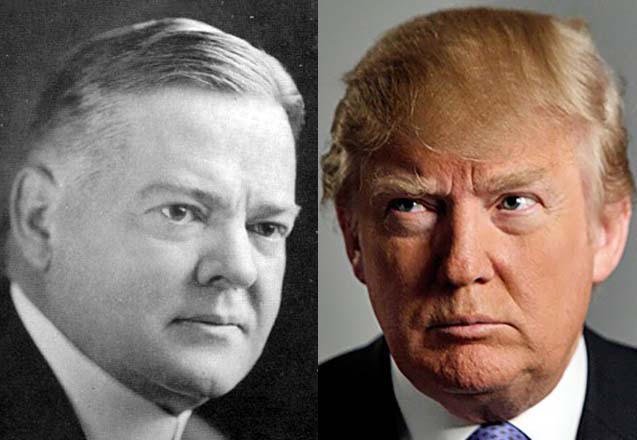
Hoover and Trump — Protectionist and Isolationist?


 Stuart Malawer
 U.S. LAW & GLOBAL TRADE RELATIONS.
You must be logged in to post a comment.