“The court holds for the foregoing reasons that IEEPA does not authorize any of the Worldwide, Retaliatory, or Trafficking Tariff Orders. The Worldwide and Retaliatory Tariff Orders exceed any authority granted to the President by IEEPA to regulate importation by means of tariffs. The Trafficking Tariffs fail because they do not deal with the threats set forth in those orders. This conclusion entitles Plaintiffs to judgment as a matter of law; as the court further finds no genuine dispute as to any material fact, summary judgment will enter against the United States. See USCIT R. 56. The challenged Tariff Orders will be vacated and their operation permanently enjoined.”
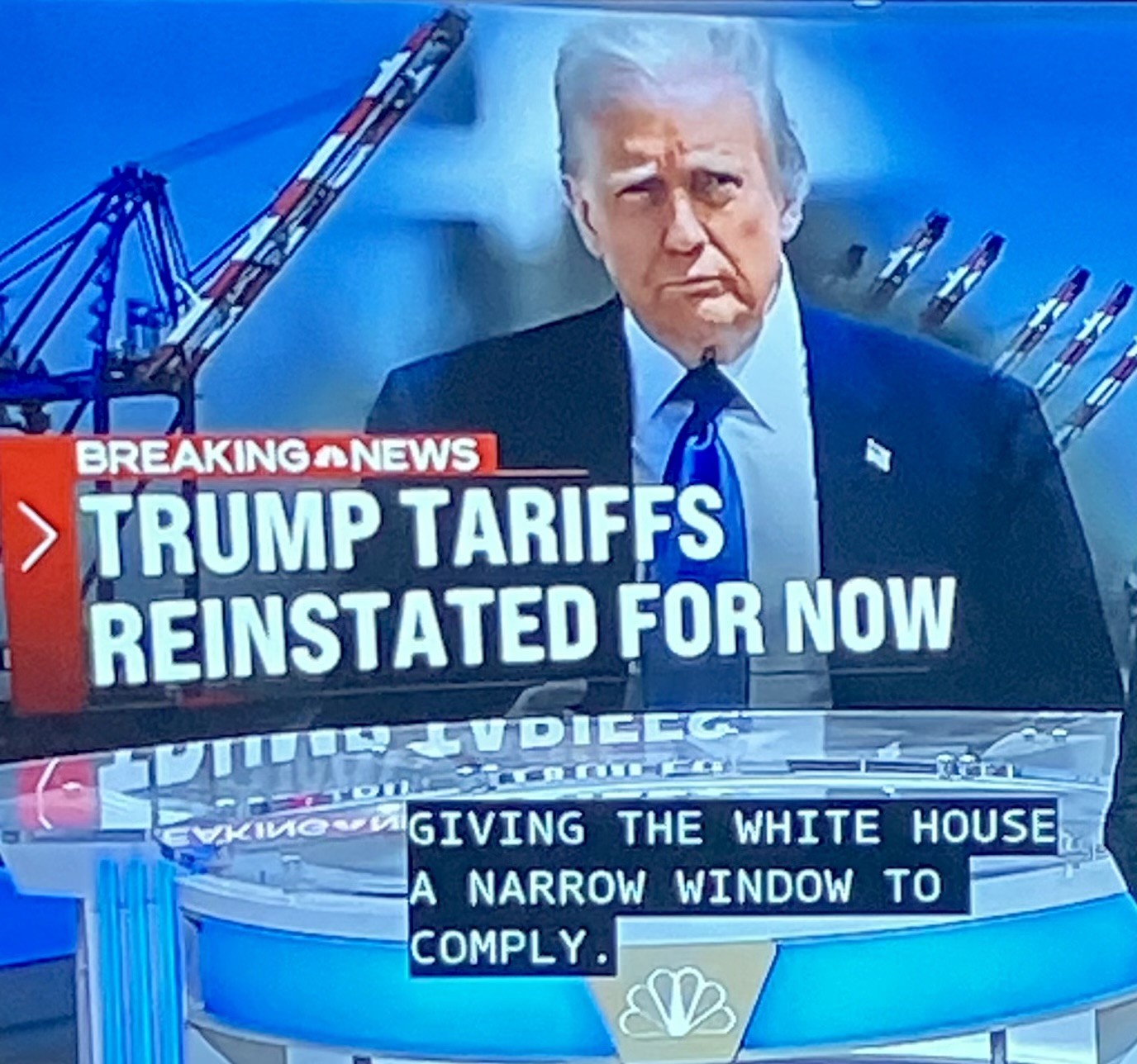
Unfortunately, the decision of the Court of International Trade was stayed the next day when the Trump administration appealed to the U.S. Court of Appeals for the Federal Circuit. Undoubtedly, this will go to the Supreme Court.
A second case decided the same day also declared the tariffs unconstitutional. Of course, Trump can try other statutory avenues such as Section 122 (balance of payments) and Section 301 (retaliation for trade restrictions) of the 1974 Trade Act, as well as imposing additional duties under Section 232(b) of the 1962 Trade Expansion Act, to enact even greater mercantilist and predatory tariffs and trade policies.
This story is far from over. The once obscure issue of tariffs has now morphed into the geopolitical and legal issue of the day — with grave economic and financial consequences. The appeal raises the question of a 50-year-old case from the Nixon era upholding a limited tariff surcharge. The question comes down to the proper interpretation of the statutory language of IEEPA and the willingness of the courts to review excessive executive actions under newer statutory rules of interpretation.
………………………………
“A federal trade court ruled President Trump didn’t have the authority to impose sweeping tariffs on virtually every nation, voiding the levies that have sparked a global trade war and threatened to upend the world economy. The decision on Wednesday from the Court of International Trade blocked one of the Trump administration’s most audacious assertions of executive power, under the International Emergency Economic Powers Act of 1977 …. The order blows a hole in global trade talks, already under way with more than a dozen nations, which began after the reciprocal tariffs were imposed. It also throws into question recent agreements with the U.K. and China …. The panel also said the U.S. trade deficit didn’t fit the law’s definition of an unusual and extraordinary threat. The Trump tariffs led to several challenges in the Court of International Trade and in federal courts around the country. The trade court, which has nationwide jurisdiction over tariffs and trade disputes, was the first to rule on requests for injunctions after holding hearings in two cases. Appeals from the court are heard by the U.S. Court of Appeals for the Federal Circuit and ultimately the Supreme Court …. The plaintiffs said no other president had ever invoked IEEPA to impose tariffs, because nothing in the law authorizes such power. There is also no emergency, they said, noting that the U.S. trade deficit has existed for decades without creating an economic crisis …. National security tariffs imposed on products like steel and aluminum, as well as similar duties planned on sectors like lumber and semiconductors, are justified under a different law and wouldn’t be affected by the ruling.” “Trade Court Strikes Dow Trump’s Global Tariffs.”Wall Street Journal (May 29, 2025).
“A federal appeals court (CAFC) has temporarily put on hold a ruling that voided President Trump’s tariffs while it considers the administration’s challenge to the lower-court decision (CIT). In a brief order Thursday, the U.S. Court of Appeals for the Federal Circuit said it was pausing Wednesday’s decision from the U.S. Court of International Trade until it can hear further legal arguments. The order, known as an administrative stay, didn’t rule on the merits of the litigation. Administrative stays are common in emergency appeals …. A three-judge panel of the Court of International Trade, a tribunal in New York City, ruled Wednesday that Trump lacked authority under IEEPA to impose the levies. The court does not pass upon the wisdom or likely effectiveness of the President’s use of tariffs as leverage, wrote the three-judge panel. That use is impermissible not because it is unwise or ineffective, but because [IEEPA] does not allow it.” “Tariff Ruling Put on Hold.” Wall Street Journal (May 29, 2025).
“The ruling came down in two cases — one filed by a group of small businesses and the other by 12 Democratic state attorneys general. There are at least five other cases challenging the tariffs pending at the Court of International Trade and other courts throughout the country (including one that dealt Trump another defeat Thursday), but Wednesday’s decision was importantly the first ruling on the merits that Trump had exceeded his authority in imposing such sweeping tariffs. It will also likely pave the way for a more definitive resolution — the administration quickly filed notices of appeal and moved to stay the ruling — perhaps going all the way up the Supreme Court …. There were recent signs of desperation on the part of the administration as the court’s skepticism became increasingly evident over the course of lengthy oral arguments in the two cases …. The litigation is not over, but the legal terrain is probably not going to get any better for Trump. In some respects, it may actually get worse as the case moves up on appeal. And although Trump has a Supreme Court that is heavily skewed in his favor — a 6-3 super-majority of Republican appointees that includes three named by Trump — it is far from clear that they will bail him out when all is said and done …. To fully understand the legal headwinds that continue to face the administration, it is helpful to zero in on a 50-year-old decision that quickly emerged as a central point of contention among the parties — and that the Court of International Trade relied upon heavily in ruling against Trump …. The case in question is known as United States v. Yoshida International, which affirmed President Richard Nixon’s power to impose a 10 percent tariff on imports that he announced in August 1971, under a statute known as the Trading with the Enemy Act (TWEA). The TWEA was the predecessor statute to the International Economic Emergency Powers Act (IEEPA), which Trump invoked to support his tariffs …. Nixon justified the tariff by claiming that an overvaluation of the U.S. dollar at the time had contributed to a trade imbalance and a deficit in America’s “balance of payments” (a broader economic measure that includes both trade and capital flows). The tariff was short-lived — Nixon terminated it in December 1971 after negotiating a realignment of exchange rates with a group of developed countries — but in the meantime, U.S. importers that paid the additional tax challenged Nixon’s legal authority …. One of those companies was Yoshida — now known as YKK — which challenged the tariff on zippers imported from Japan. The company filed a lawsuit and won in the lower court, but the decision was overturned on appeal several years later …. Yoshida at first glance appeared to be quite helpful to the Trump administration …. The court concluded that the tariff was legally justified under the TWEA to address the trade imbalance and pointed to language in the statute that authorized the president to “regulate” the “importation” of foreign goods in the event of an emergency …. For starters, the Yoshida decision rejected a key proposition that is at the heart of the government’s defense of Trump’s tariffs — the notion that courts have no power to review a president’s actions under IEEPA …. Nixon’s tariff was fixed at 10 percent and in place for less than five months. Trump’s tariff framework is far more ambitious, open-ended and has been all over the place since his inauguration — with the effective dates and applicable countries, rates, exceptions and concessions under seemingly constant revision …. And if Trump and some of his advisors are to be believed, there would be no end in sight. “If President Trump succeeds like he wants to succeed,” Trump’s trade adviser Peter Navarro said earlier this year, “we are going to structurally shift the American economy from one over-reliant on income taxes and the Internal Revenue Service, to one which is also reliant on tariff revenue and the External Revenue Service.” …. That is a far cry from a five-month, supplemental 10 percent tariff like what Nixon imposed. ….Two other, subtler points in the Yoshida decision made things worse for the administration. ….First, Nixon’s tariff did not apply to all imports — only those that had been the subject of prior concessions under the government’s tariff schedule — and Nixon made clear in announcing the policy that the rates would nevertheless be capped at levels that Congress had previously set for the relevant goods. …. As a footnote in the Yoshida decision notes, Congress later enacted a specific statutory provision to address the problem that attracted the Nixon administration’s attention. That provision authorizes the president to impose tariffs in response to “large and serious … balance-of-payments deficits,” but it caps those tariffs at 15 percent and limits them to a duration of just 150 days unless Congress authorizes an extension …. There is no way to definitively predict how the appellate court — and eventually the Supreme Court — will approach the matter. But there is good reason to question whether Yoshida will spur them to come to Trump’s rescue …. To start, the country’s federal courts — led by the Supreme Court — have become more committed to textualism as a mode of statutory interpretation. That has generally led to more fine-grained and narrower readings of statutes passed by Congress …. It is far from clear, for instance, whether the current Supreme Court would agree with the conclusion in Yoshida that the power to “regulate” the “importation” of foreign property under the relevant U.S. law includes even a limited power to impose tariffs or otherwise tax those goods. The textual analysis of that position was debatable even at the time and, if anything, is even shakier now …. The Supreme Court’s conservatives have also developed and emphasized two broader interpretive doctrines and themes that suggest that the outcome in Yoshida would not be the same today …. Under the so-called major questions doctrine, when an executive action exceeds an undefined threshold of “economic and political significance,” the justices insist on a clear delegation of authority from Congress on the matter. That does not exist in the case of Trump’s claim to sweeping, open-ended and unreviewable tariff powers …. And in overruling the Chevron doctrine last summer, the court’s conservatives emphasized that judges should not simply defer to the executive branch’s interpretation of ambiguous statutes when evaluating legal questions …. Indeed, the Court of International Trade cited — though did not fully rely upon — both of these points in ruling against the administration. …. “Both the nondelegation and the major questions doctrines, even if not directly applied to strike down a statute as unconstitutional,” the court wrote, “provide useful tools for the court to interpret statutes so as to avoid constitutional problems.” The judges went on to explain that those “tools indicate that an unlimited delegation of tariff authority” from Congress to the president — which the Trump administration effectively claims that it has under IEEPA — “would constitute an improper abdication of legislative power to another branch of government.”


 Stuart Malawer
 U.S. LAW & GLOBAL TRADE RELATIONS.
You must be logged in to post a comment.