
What’s really interesting in tariff litigation against Trump’s tariffs? Six very interesting facts.
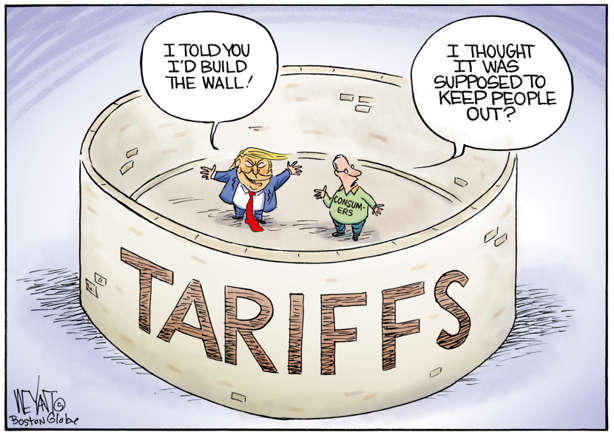
One, there is an expanding legal campaign against these tariffs. Two, litigation has been filed by small firms (not large firms or multinational corporations) and various states — in both federal district courts and the Court of International Trade. Three, most interesting, it’s conservative non-profits funded by Koch and others that have funded many of these cases. Four, states (Oregon and California) have also brought litigation. Five, also to be noted is that attorney-generals of over numerous states have signed off on amicus briefs. Six, needless to say, the administration is claiming reliance on tariffs is a necessary part of carrying out trade negotiations and foreign policy generally.
Need to keep in mind that various presidents got the U.S. involved in wars (Korea, Vietnam, Iraq and Afghanistan) without a declaration of war — contrary to the fact that it’s Congress that has the exclusive right to declare war.
We’ll see how all this plays out in the federal district courts and the Court of International trade and then the Supreme Court.
…………………………………………………………………
“The New Civil Liberties Alliance (NCLA), a nonprofit asked Ley to join a lawsuit challenging the constitutionality of the tariffs. Now in the vanguard of a rapidly expanding legal campaign arguing that the president overstepped his authority and usurped the role of Congress in applying levies to almost all imports entering the United States …. The NCLA describes itself as a nonpartisan organization that addresses violations of Americans’ civil liberties, but it has previously received financial support from conservative donor Charles Koch’s foundation — highlighting how backlash to Trump’s tariffs does not neatly follow traditional political lines …. Many large companies and top business executives have remained silent, in part for fear of drawing Trump’s ire, and no Fortune 500 company has pursued legal action …. Another nonprofit, Liberty Justice Center, has filed a suit in the U.S. Court of International Trade on behalf of a group of small businesses …. The states of Oregon and California have also sued. The complaints argue that no other president has used the International Emergency Economic Powers Act to implement tariffs, and that Trump cannot bypass Congress’s authority to draft tariff laws simply by invoking an emergency …. Tariffs now stand at 30 percent on imports from China after the Trump administration announced a deal Monday to lower tariffs for 90 days.” “Small-Business Owner and Tariff Litigation (Florida Federal Court.” Washington Post (May 20, 2025).
“A ruling that narrows IEEPA would have ripple effects across every domain in which economic instruments are used for strategic effect.” CIT Filing by Administratio (May 23, 2025).
“The starting point in thinking about the government’s power to impose tariffs is that under the US Constitution that power is given exclusively to the Congress, not the president. When the president announced his so-called “Liberation Day” tariffs on April 2 without going to Congress, he needed to have had in hand a pre-existing delegation of authority from the Congress for the tariffs to be legal. His announcement assigned tariff levels to nearly two hundred countries and territories. The grant of authority from Congress, if it occurred, must be very great indeed, nearly co-equal to that first given to Congress by the Constitution. The delegation to the president cannot have happened accidentally or simply be implied …. One would think that the issue is so clear-cut that the government would have no arguments to make, but it does have arguments and has made them. Here it is worth reflecting on the fact that what may appear to be inarguable on its face is often, in courts of law and in public discourse, very arguable. Take for example going to war. The Constitution assigns the sole authority to declare war to the Congress. But in the case of the Korean, Vietnam, and two Gulf Wars, all conflicts that were beyond all doubt “wars,” there was no Congressional declaration of war. Congressional approval was clear, it could be said, by Congress appropriating monies to support US participation in those conflicts. And besides, the president is commander-in-chief. Under the Constitution he has authority to conduct a war, not to declare it …. In a genuine balance of payments crisis in 1971, President Richard Nixon declared a national emergency. Using a World War I statute, the Trading with the Enemy Act (TWEA), in a way it had never been used before, he imposed a 10 percent import surcharge (a tariff) for four months to enable the US to abandon the gold standard and devalue the dollar, the latter with the agreement of America’s major trading partners. An importer of zippers, Yoshida International, challenged the president’s tariff. The CIT ruled that Nixon’s action was beyond what Congress had delegated. On appeal, the surcharge was upheld as an exercise of emergency authority properly delegated …. This did not sit well with the Congress. In 1974 it created a separate 150-day limited authority to deal with future balance of payments crises. In 1976, it enacted legislation to delete non-war situations from the 1917 TWEA and to terminate national emergencies by means of a vote of Congress. In 1977 it enacted the International Emergency Economic Powers Act (IEEPA), in which it provided authority to regulate trade whenever the president finds that an international economic emergency exists. Prior to the second Trump administration, presidents had declared 70 national emergencies but never used IEEPA to impose tariffs. Trump’s lawyers assert that this statute is a sufficiently broad delegation of the power over commerce that it authorizes his imposition of tariffs and his declaration of a national emergency …. The Senate sought to end this emergency, but its effort failed by a vote of 47–52. The Chinese president sought to remove all the tariffs by retaliating against American trade. The financial markets swooned when faced with the high levels of tariffs on both the Chinese and American sides. The resulting pressures appear to have caused President Trump to reduce substantially the tariffs on US imports from China. But the tariffs are suspended, not canceled …. The question of whether Trump’s broad tariffs will remain is therefore in the hands of the US courts …. How strong a bulwark against trade protectionism imposed at the sole discretion of the president will the courts prove to be?”


 Stuart Malawer
 U.S. LAW & GLOBAL TRADE RELATIONS.
You must be logged in to post a comment.