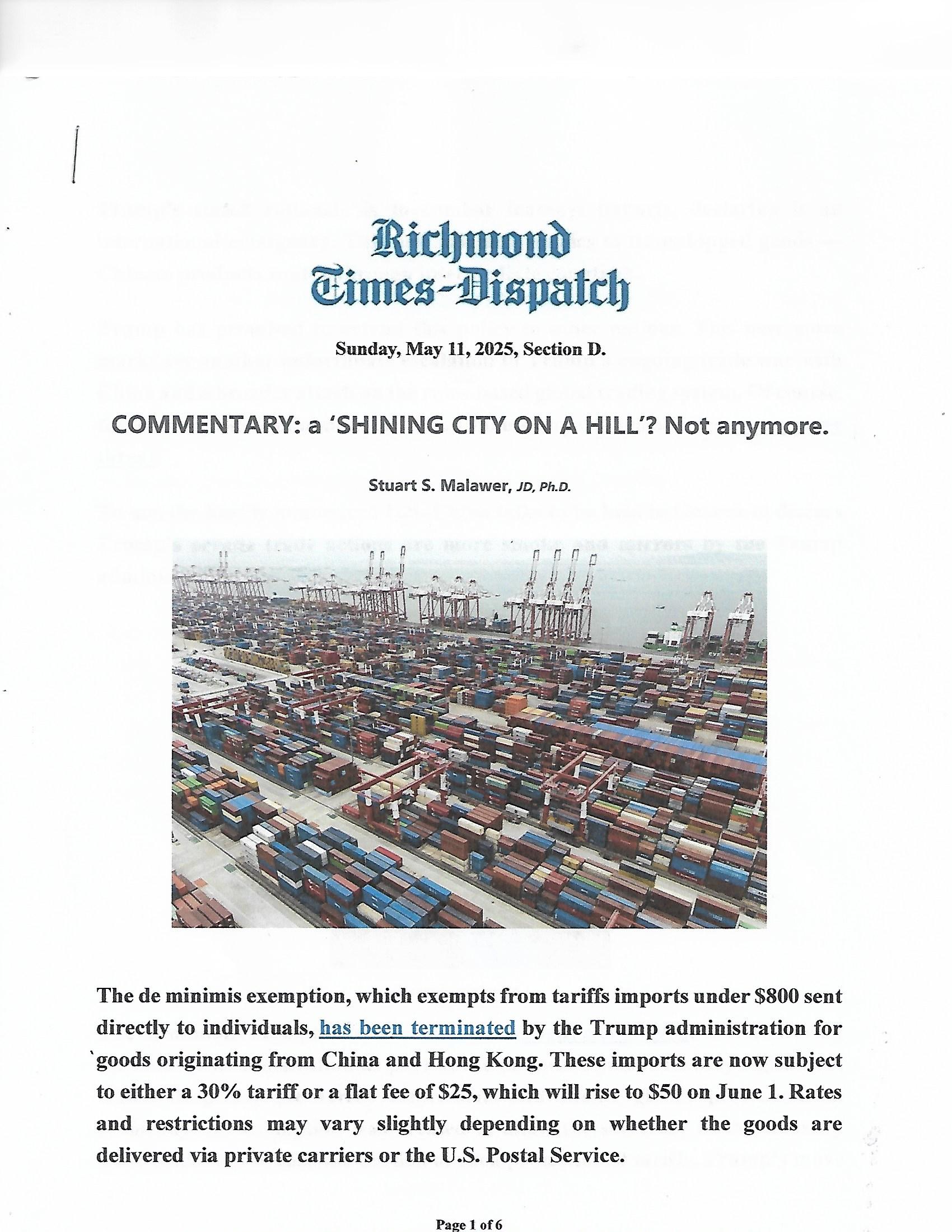
Click to access Malawer.De_Minimis_Exemption_RTD_5.11.25_.pdf
New Op-Ed in the Richmond Times-Dispatch on U.S. – China trade generally and the ‘de minimis exemption.’ The revocation by Trump of this exemption has been somewhat altered pending further negotiations per the U.S.-China ‘trade truce,’ concluded in Geneva, in early May. Many have already called this ‘truce’ a scam.’ Probably, but we’ll see.
Need to remember, the trade war is not really about tariffs or trade — but geopolitics and laws governing trade actions — both domestic and global. For example, whether the presidential determination of international emergency under IEEPA is a political or legal question. To me, and courts have suggested, this is a legal question. Thus, such a presidential determination is reviewable by the federal courts. This goes along with the larger question whether or not the president has violated the exclusive constitutional authority of the Congress to regulate trade and impose taxes.
This challenge to the legal rules — both domestic and global — along with changing geopolitics are the major impediments to formulating global corporate strategies today.
Click to access Malawer.De_Minimis_Exemption_RTD_5.11.25_.pdf
“Rarely has an economic policy been repudiated as soundly, and as quickly, as President Trump’s Liberation Day tariffs—and by Mr. Trump’s own hand …. What remains is his new 10% global base-line tariff, plus the separate 20% levy putatively tied to China’s role in the fentanyl trade, for a total rate of 30%. In exchange …. But a 10% across-the-board tariff is still four times the average U.S. tariff rate before Mr. Trump took office …. Mr. Trump will not want to admit it, but he started a trade war with Adam Smith and lost. He’s not the first President to learn that lesson.” “Trump – China Trade Pause.” Wall Street Journal (5.13.25).
“The 10 percent “reciprocal” tariff Trump imposed on almost every country that day seems now to have become the new minimum — a level from which the United States will not budge. This is three to four times the average U.S. tariff in 2024 — high enough to boost inflation, snag supply chains and put a drag on economic growth …. The 90-day pause — which is meant to give Washington and Beijing a chance to negotiate a lasting trade agreement — does little to relieve the paralyzing uncertainty that is freezing business investment and causing financial markets to worry. The uncertainty derives largely from the lack of any coherent policy to guide the Trump administration’s trade warfare. Actions are taken haphazardly and without warning.” “Uncertainty and Global Economy.” Washington Post (5.13.25).
“Using this emergency framing, Trump has invoked more than a dozen times the International Emergency Economic Powers Act of 1977, which he understands grants him the power to bypass Congress to impose tariffs on imports from any and all countries. Two lawsuits, one filed by California and another by a coalition of a dozen other states, are shining a spotlight on the lengths to which Trump has stretched both the definition of “emergency” and the remedies he has the power to impose …. The act had never before been used by a president to impose tariffs. Indeed, the act never mentions the word tariffs. As the states’ lawsuits argue, the very idea of using import duties to solve, say, the fentanyl crisis or illegal immigration, is unrealistic …. More than 40 ongoing national emergencies remain on the books; the longest-running one dates back to the Iranian hostage crisis of 1979 …. Trump’s use of national emergencies to justify his taking control of everything from trade policy to immigration, and even energy policy, poses its own extraordinary threat to the country …. Congress has the authority to limit this abuse. But Republican lawmakers need the courage to use it. Instead, they chose to short-circuit the provision in the National Emergencies Act that required Congress to vote on resolutions by Democrats to end the emergency tariffs …. A more responsible Congress would mandate that national emergencies declared by the president expire automatically after, say, 30 days unless Congress votes to extend them, and then require annual congressional renewal ….Fortunately, some states are willing to take a stand against the president’s unusual threat to America’s economy and national security.” “Presidential Emergency Powers.” Washington Post (5.15.25).
“The West’s approach to the realities of the post–Cold War world has made a great deal of sense, and it is hard to see how world peace can ever be achieved without replacing geopolitical competition with the construction of a liberal world order. Still, Westerners often forget that this project rests on the particular geopolitical foundations laid in the early 1990s …. A Hegelian view of the historical process today would hold that substantively little has changed since the beginning of the nineteenth century. To be powerful, states must develop the ideas and institutions that allow them to harness the titanic forces of industrial and informational capitalism. There is no alternative; societies unable or unwilling to embrace this route will end up the subjects of history rather than the makers of it.” “Geopolitics Now, Not the Liberal World Order.” Foreign Affairs (May 2025).


 Stuart Malawer
 U.S. LAW & GLOBAL TRADE RELATIONS.
You must be logged in to post a comment.