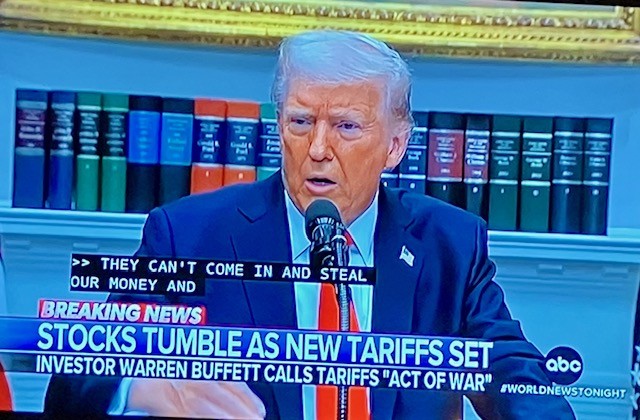
The legality of Trump’s recent tariffs under U.S. statutory law is very questionable. To me, it’s an abuse of the International Emergency Economics Power Act (‘national emergency’) and Section 301 (‘retaliation’). The Congress needs to reclaim its authority under Article 1, Section 8, Clause 3 (exclusive authority to regulate foreign commerce tariffs’. The federal courts need to exercise their authority to review these executive actions impacting trade and taxes. We will undoubtedly see litigation and hopefully congressional action. For the first time, the Congress is now trying to reclaim some of its authority. (Will also see more WTO litigation — China and Canada have recently filed cases before the dispute resolution system. Look for future cases by Mexico and the EU)
Trump’s tariffs are a reversal of decades of American foreign policy. They particularly will hurt U.S. farmers. His explanations for them often have nothing to do with economics but different political and foreign policy objectives and surely for other reasons. Often trying to squeeze his action into foreign policy and national security focused economic legislation (IEEPA and Section 232). Obviously, for Trump the two most beautiful words are ‘tariffs’ and ‘threats.’
Trump’s illegal reversal of years of U.S. tariffs and trade policy mirrors his even more important abrupt change of U.S. foreign policies. From Munich 2, Trump’s apparent sell out of Ukraine (which mirrors Chamberlain’s appeasement of Nazi Germany in 1938) and then the new Trump – Putin relationship (mirroring the German-Russia Alliance of 1939, leading to Germany’s attack on Poland and the start of World War II). It is interesting to note that Trump’s ancestry is German and his actions mirror that of 1930’s Germany and sympathy his parents had for the American Bund in the 1930’s.
“A blanket tariff imposed by the president, without an act of Congress, would be more likely to be found to be unconstitutional than a series of retaliatory measures on varying stated grounds. A piecemeal approach is far more likely to be sustained. The effect may be the same. Negotiations with the four major US trading partners—Mexico, Canada, the EU, and China—would by themselves cover almost half of US imports …. The principal constraints on US trade policy are likely to be a combination of foreign responses, economic forces unleashed by the new US tariffs, and the domestic political fallout from them.” “Constraints on Trump’s Trade Policies?” Petersen Institute.” (March 4, 2025).
“Trump’s executive orders imposing tariffs cited as authorities the US Constitution and several laws. The two key provisions cited are Section 301 of the Trade Act of 1974, which grants authority to retaliate against other countries for unreasonable acts that burden US commerce, and the International Emergency Economic Powers Act, which gives presidents wide latitude to respond to national emergencies. Both were cited in President Trump’s tariff executive orders. The retaliatory authority may have been included because it has been used in the past to deal with China, and the order called for additional 10 percent tariffs on Chinese goods as well. It is likely that the IEEPA is the primary authority included for the tariffs aimed at Canada and Mexico. The IEEPA has never been used for imposing tariffs. However, its language is extraordinarily broad—the enumerated authorities granted to the president by Congress is virtually unlimited—including the seizure of property to deal with a national emergency …. The IEEPA is not being used here to try to halt fentanyl shipments directly (e.g., applying sanctions to the shippers) but to force Canada and Mexico to deploy extra resources to crack down on this illicit trade. Similarly, the law is cited to force Canada and Mexico to stop illegal immigration across the Canadian and Mexican borders into the US. The new tariffs will apply to all products—fruits and vegetables, prepared foodstuffs, lumber, steel, home appliances, fuel, clothing, footwear, electrical machinery and electronic goods, toys and sports equipment, to name a few …. The one precedent related even tangentially to Trump’s Mexico and Canada tariffs is the 10 percent import surcharge that President Richard Nixon levied on August 15, 1971, under the predecessor authority to the IEEPA. “Trade Wars Authorized? Petersen Institute (Feb. 4, 2025).
“Even the trade war, outrageous though it is, pales by comparison with the ambush of Volodymyr Zelenskyy in the Oval Office by the US president and vice-president and the subsequent suspension of military aid to Ukraine (and intelligence sharing).” “Trump’s Global Order Assault.” Financial Times (March 5, 2025).
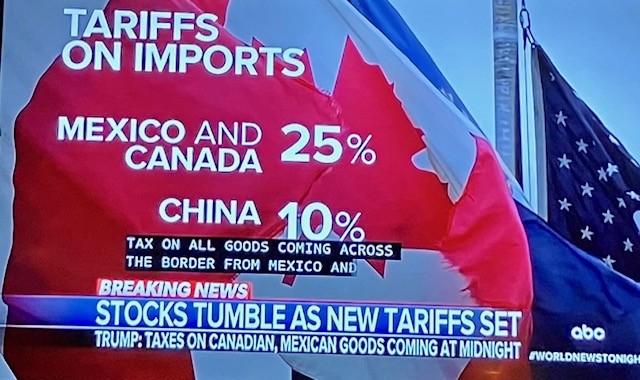
“The U.S. tariffs were a stark turnabout from the free-trade evangelism that has marked much of postwar American foreign policy. The measures amounted to 25 percent tariffs on all imports from Canada and Mexico and a 10 percent tariff on all imports from China. They came on top of a 10 percent tariff on Chinese goods put into effect one month ago and a variety of older levies, including those that remain from the China trade war during Trump’s first term.” “Trump’s Tariffs.” New York Times (March 5, 2025).
“The President also professes to love American farmers, but he apparently loves tariffs more. U.S. farmers are already being squeezed by low crop prices and inflation. The American Farm Bureau Federation (AFBF) says farmers are losing money on almost every major crop planted for the third straight year. Tariffs will increase their pain. About 85% of the U.S. potash supply for fertilizer is imported from Canada. China is hitting U.S. farm exports with a 15% tariff, which will let farmers in Brazil and Australia grab market share.” “Trump’s Tariffs and Trump Voters.” Wall Street Journal (March 5, 2025).
“Trump has offered up a variety of explanations for the tariffs, saying they are punishment for other countries’ failure to stop drugs and migrants from flowing into the United States, a way to force manufacturing back to America and retribution for countries that take advantage of the United States.” “Trump’s Tariffs and Economic Gamble” New York Times (March 5, 2025).
“Trump originally justified the tariffs under an emergency law to combat the alleged threat of fentanyl. But he claimed Tuesday the tariffs are needed because “we pay subsidies to Canada and to Mexico of hundreds of billions of dollars” and have “very large deficits with both of them.” …. That sounds like White House protectionist in chief Peter Navarro. He and his boss love tariffs for their own sake.” “Trump’s Roller Coaster Tariffs.” Wall Street Journal (March 6, 2025).
“It’s doubtful Mr. Trump even has the power to impose these tariffs, and we hope his afflatus gets a legal challenge. The Constitution gives power over trade to Congress, which for most of U.S. history wrote tariff law. That changed after the catastrophe of the 1930 Smoot-Hawley tariff, …. and ceded authority to the President to negotiate bilateral trade deals. It ceded more power after World War II …. The President now has the explicit power to restrict imports, but only for specific reasons. The President may impose tariffs on imports that threaten national security (Section 232) or in response to “large and serious” balance-of-payments deficits (Sec. 122), a surge of imports that harms U.S. industry (Sec. 201), and discriminatory trade practices (Sec. 301) …. During his first term, Trump used Section 232 to impose tariffs on steel and aluminum and 301 on goods from China. Mr. Trump’s executive orders imposing 25% across-the-board tariffs on Canada and Mexico and 10% (now 20%) on China instead invoke the 1977 International Emergency Economic Powers Act (IEEPA), which gives the President authority to address an “unusual and extraordinary threat” if he declares a national emergency. Trump deems fentanyl and other drugs such an emergency …. The bigger problem is that IEEPA doesn’t clearly authorize tariffs. The law lets the President investigate, block, prohibit or regulate any “importation or exportation” or financial transaction involving “property in which any foreign country or a national” has an interest or “any property, subject to the jurisdiction of the United States.” Presidents have used the law to freeze assets of foreign governments and nationals, restrict U.S. companies from doing business with them, limit export of technologies and ban imports from adversaries …. Trump’s tariff doesn’t appear reasonably related to the fentanyl emergency …. Presidents of both parties are now declaring everything to be an emergency to achieve their policy goals without having to deal with a frustrating Congress.” “Trump’s Tariffs are No Emergency.” Wall Street Journal (March 7, 2025).
“Trump’s start-and-stop expansion of tariffs on major trading partners has no analog in modern history. Yet the past can still be instructive. Previous trade disputes over everything from semiconductors to lumber to chickens have sometimes dragged out for decades, rattling international markets and boosting consumer prices. …. Reagan-era tariffs on Japanese semiconductors aimed to shield the U.S. technology sector from a daunting competitor. President Nixon ended short-lived across-the-board tariffs in 1971 soon after the export juggernauts of West Germany and Japan agreed to boost the value of their currencies. Contrary to many trade spats of past decades, the Trump White House has offered conflicting rationales for taxing foreign goods now, a sign that the coming trade wars could be open-ended.” “Trade Clashes Outlive Tariffs.” Wall Street Journal (March 10, 2025).
“Legal Tools of Trump’s Trade Strategy — The Trump administration’s choice legal instruments are Section 232, Section 301, and the International Emergency Powers Act (IEEPA). Section 232 allows the US government to impose trade restrictions under the justification of national security. While this provision has existed for decades, Trump’s use of it has been particularly aggressive, employing it to justify tariffs on steel, aluminum, and potentially automobiles …. Section 301, originally used to counteract unfair trade practices, had been largely dormant since 1995, until Trump revived it to impose tariffs on China under his first administration. The law grants the US government unilateral authority to investigate and penalize foreign trade policies it deems unfair, without requiring international arbitration or approval from the World Trade Organization (WTO). The IEEPA, perhaps the most flexible tool in Trump’s trade arsenal, grants the president sweeping powers to impose economic measures, under the rubric of “international emergency,” without lengthy investigations by other branches of government. Originally intended for national security crises, it has been increasingly invoked to implement economic restrictions, reinforcing Trump’s preference for executive-driven trade policy. “Trump’s American Trade Policy.” Hinrich (March 11, 2025).
“Democrats (are) forcing a vote to terminate Trump’s national emergency declarations for fentanyl and the southern border. The President used the emergency to impose tariffs on Canada and Mexico under the 1977 International Emergency Economic Powers Act (IEEPA). The National Emergencies Act provides fast-track procedures for Congress to end a presidential emergency.” “Congress and Reclaiming Trade Authority,” Wall Street Journal (March 13, 2025).


 Stuart Malawer
 U.S. LAW & GLOBAL TRADE RELATIONS.
You must be logged in to post a comment.