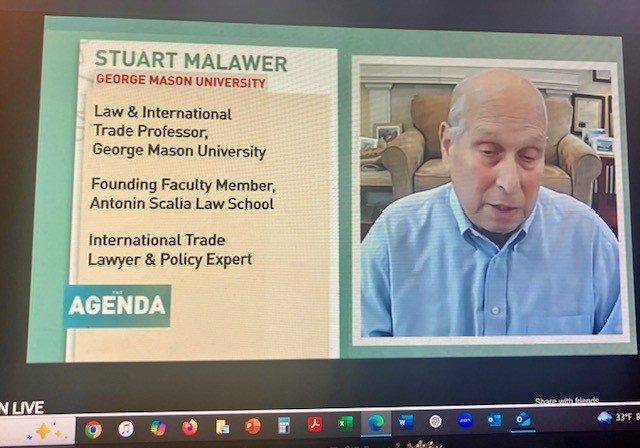
Two recent CGTN interviews (Feb. 2025) ………………….
https://www.youtube.com/watch?v=toarh82Bgfs&t=6s
https://www.youtube.com/watch?v=C1I9hsWLb7k
It’s my belief that the best avenue to restrain Trump’s use of tariffs and other trade actions (sanctions, investment restrictions, sales restrictions) lie within the federal courts and the Congress.
Hopefully, the ‘best avenue’ will be sufficient. Under the Constitution the Congress has the exclusive authority to ‘regulate commerce with foreign nations’ –– tariffs and trade. The federal courts undertake judicial review of executive compliance with trade statutes.
Courts need to review Trump’s specious interpretation of statutes, often relying upon phony ‘national security’ or foreign policy arguments. Congress needs to reassert its exclusive authority to regulate trade and commerce. We’ll see.
“Neither international nor domestic courts on their own will stop the US president’s destructive tariffs …. A great edifice of international law, multilateral and regional, has been built up since the second world war and particularly since the creation of the World Trade Organization in 1995. While Trump’s threat this week to bring back and extend his steel and aluminum tariffs merely violates WTO laws, his reciprocity plan to equalize US tariffs with each trading partner (and apparently to add extra penalties) is a wholesale destruction of the equal treatment “most-favored nation” (MFN) principle that underpins the entire system …. Bringing WTO cases against the US must be part of a wider campaign by governments ….You would hope domestic US trade law might bind Trump’s hands somewhat more. It’s conducted through binding law in established processes, including the non-partisan International Trade Commission (ITC) federal agency whose decisions can be appealed against at the Court of International Trade (CIT). On the legislative side, Congress — although it delegates negotiating authority to the president …. But like the casual invocation of the national security loophole at the WTO, Trump can bypass these constraints by using emergency presidential powers. The 25 per cent tariffs he ordered and then suspended last week on Canada and Mexico relied on the International Emergency Economic Powers Act, which is supposed to be reserved for periods of intense conflict rather than some made-up nonsense about fentanyl crossing the Canadian border. To avoid having to take his reciprocal tariff plan through Congress, Trump could use the IEEPA again, or perhaps the little-known Section 338 of a law from 1930 that predates the MFN principle. The courts could stop this, but the CIT has traditionally deferred to presidential authority, especially when foreign policy issues are involved, and there’s a high bar for federal district courts to issue injunctions against tariffs. Even if they do, the US Supreme Court has shown itself unwilling to inconvenience Trump. “Trade Law & Trump.” Financial Times (2.14.25).


 Stuart Malawer
 U.S. LAW & GLOBAL TRADE RELATIONS.
You must be logged in to post a comment.