
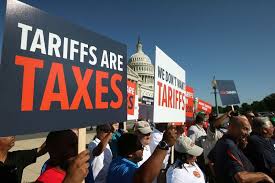
I taught global trade law many years. I must say no one was very interested in actual tariffs and I discussed them very little. Except perhaps trying to figure out the Harmonized Tariff Schedule, and only in passing. This sets out the tariff rates for all imported goods. It’s something like trying to figure out the Internal Revenue Code. You need to figure out the classification of the imported product to determine the tariff rate and tariff (tax on the imported goods that the importer pays). Now of course tariffs are the number one international issue for Trump 2.0. Knowing the history of US. tariffs and U.S. presidents is very illuminating — From McKinley to Hoover to Reagan to Nixon. The question now is will Trump be the new McKinley?
“Displaying a somewhat improbable interest in the intellectual history of taxes on imports, Donald Trump has several times cited the 19th century as an inspiration. Specifically, he’s a fan of William McKinley, president from 1897 to 1901. To free-traders, the McKinley tariff of 1890, is almost as notorious as the Smoot-Hawley one — though Smoot-Hawley kicked off a global surge in protectionism while the McKinley tariff came at a time of enormous industrial expansion …. If Trump is a new McKinley, we’re in for some really quite serious long-term protectionism and a reordering of the US economy. This is unlikely to make the US better off …. Reagan pushed forward the development of the international system through the Uruguay Round of trade talks that ultimately helped to create the World Trade Organization …. If Trump undertakes similar unilateral action, he will be very likely to use the International Economic Emergency Powers Act, a law that grew out of the Trading with the Enemy Act employed by Nixon …. Nixon ran a rambunctious administration with abrasive advisers and enjoyed unsettling other governments to force them into concessions.” “Trump Trade 2.0 – From McKinnley to Reagan to Nixon.” Financial Times (Jan. 20. 2025).


 Stuart Malawer
 U.S. LAW & GLOBAL TRADE RELATIONS.
You must be logged in to post a comment.