

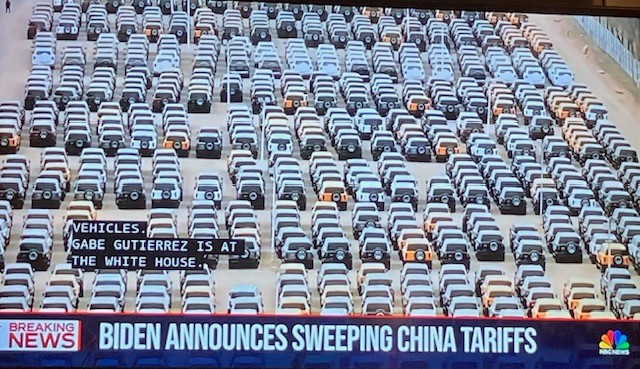
Kamal Harris’ trade policy in not clearly formulated nor stated yet. However, some elements are now coming into focus. Commentaries are just now beginning to appear after the Democratic convention. But both Democrats and Republicans are voicing support for tariffs and greater export controls.
“Having watched Joe Biden retain most of the tariffs he inherited, America’s trading partners have been fond of complaining the US president is “continuity Trump” and wondering whether Kamala Harris will be continuity Biden. The first epithet was never entirely fair: Trump’s focus was on closing trade deficits and gaining negotiating leverage, Biden’s mainly about industrial policy. Now Trump is threatening a massive and damaging escalation of trade protection, Harris only has to keep Biden’s policies in place, as she probably will, and she will look positively free-trade …. Biden’s watchword has been a “worker-centered trade policy”, though in practice that of course means protecting some workers (steel and aluminum, autos) at the expense of others. …. The consumer-focused critique is not new from this administration …. Harris hasn’t repudiated the trade and industrial policy elements of Bidenomics, and is unlikely to. But the Democrats are at least charting a steady course that balances their desire to protect industries they deem strategic with the need to hold down economy-wide inflation …. The idea that second-term Trump trade policy would resemble that of a Harris administration is rapidly receding.” “Harris and Tariffs.” Financial Times.” (August 23, 2024)
“Trade protectionism and industrial policy inevitably lead to calls for more government intervention to mitigate the economic damage. Ms. Harris is trying to contrast her brand of protectionism with Mr. Trump’s by calling for “targeted” tariffs. But these, too, will spur foreign reprisals, and the ultimate targets will be U.S. businesses.” “Harley-Davidson Tariff Backfire.” Wall Street Journal (Augst 21, 2024).
“Both Democrats and Republicans are expressing support for tariffs to protect American industry, reversing decades of trade thinking in Washington …. That view has largely fallen out of fashion in 2024. While Mr. Trump and Vice President Kamala Harris, the Democratic nominee, differ greatly in their campaign proposals, both of their parties are increasingly embracing tariffs as an essential tool in protecting American manufacturers from Chinese and other global competitors …. It has been a sharp reversal from previous decades, when most politicians fought to lower tariffs rather than raise them. But the loss of American manufacturing jobs as a result of globalization and China’s focus on churning out cheap exports have created a bipartisan backlash against more open trade. Given that Mr. Trump’s 2016 win capitalized on such sentiments, Democrats have been striving to avoid losing voters opposed to free trade …. On economic policy and trade issues, you have both major parties moving in the same direction …. Even if tariffs cause certain economic duress, they may still be a winning formula politically.” “Both Parties Embrace Tariffs.” New York Times (Aug. 28, 2024).
“Trump’s broad-brush tariffs frequently evoke comparisons with the destructive global trade war that the United States helped to initiate in the 1930s with the Smoot-Hawley tariffs passed by Congress …. Most economists, though, agree that the overall downsides outweigh the gains. Rounds of tit-for-tat tariffs would ultimately hurt every country by limiting trade, disrupting global supply chains, slowing growth and pushing up prices.” “Trump, Tariffs and Global Trade.” New York Times (8.29.24).


 Stuart Malawer
 U.S. LAW & GLOBAL TRADE RELATIONS.
You must be logged in to post a comment.