
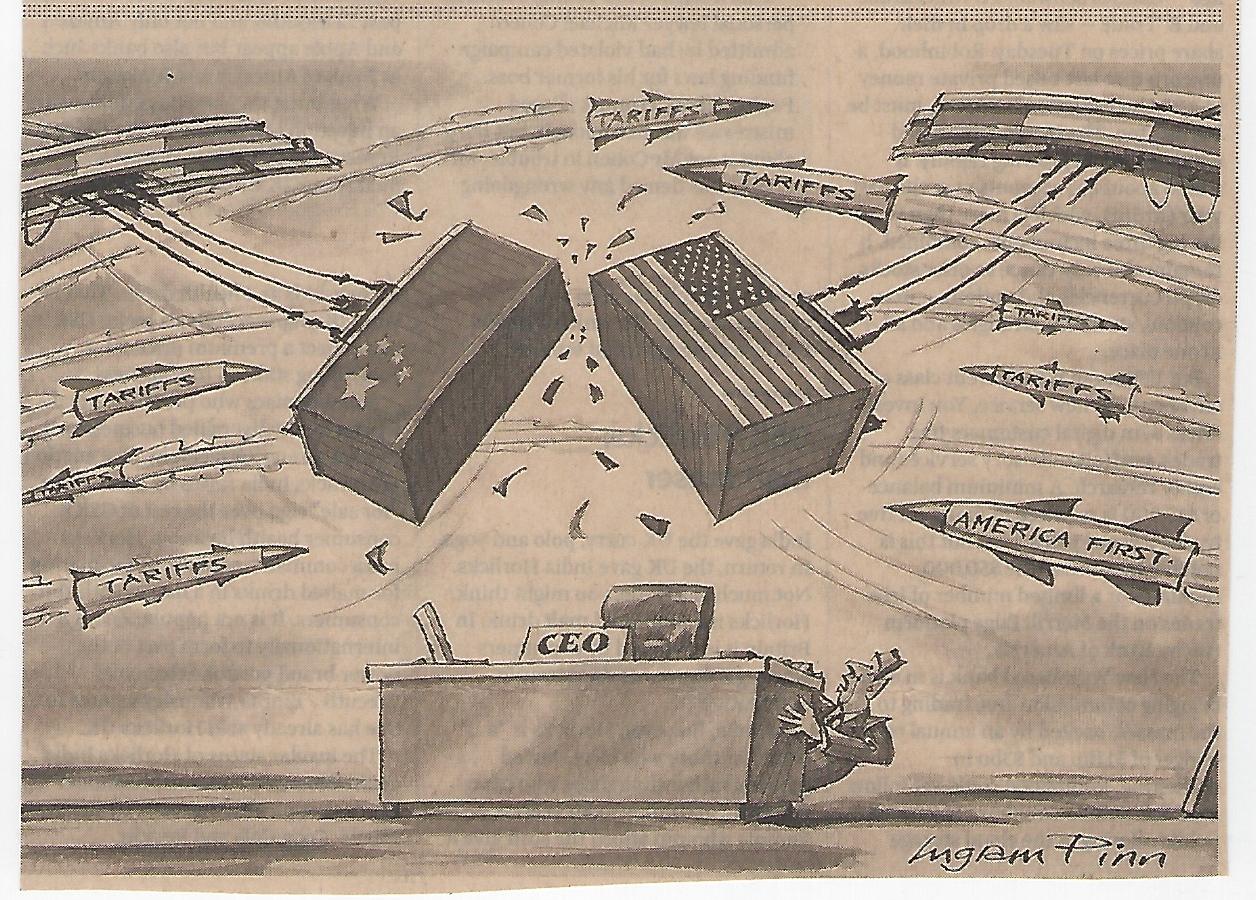
U.S. trade relations continue to be highly politicized as a domestic issue and has seen greater restrictions that are not favorable to expanding trade. These actions are often bipartisan ones and often reflect non-trade concerns. Often they are based upon national security concerns. This has created huge issues for both multinational firms and others trying to navigate both domestic politics and geopolitics. Nevertheless. U.S. economic policy continues to support greater government subsidies (for example, the chip sector) and other issues continue to be pressing such as China’s great export machine and market-status for other countries, among others.
“The administration has drafted new rules that would limit shipments to China of the machinery and software used to make chips from a number of countries if they are made with American parts or technology, as well as some types of semiconductors …. A spokeswoman for the Commerce Department said that it was continually updating export controls to protect U.S. national security …. The revised policy would make it harder for U.S. companies to sidestep restrictions by shipping to China from subsidiaries in countries including Israel, Malaysia and Singapore.” “Tech Controls on Chinese.” New York Times (August 12,2024).
“In American politics, labeling something a matter of “national security” automatically elevates its importance …. Of course, not everyone agrees on which issues fall into the national security bucket. And the American definition of national security has fluctuated wildly over time …. It is true that economic globalization and rapid technological change have increased the number of unconventional threats to the United States …. But if everything is defined as national security, nothing is a national security priority …. With new technologies, new resources become critical and previously vital resources often lose their significance.” “Everything National Security?” Foreign Affairs (Sept. / Oct. 2024).
“The United States now has commitments from all five of the world’s leading-edge semiconductor manufacturers to construct chip plants in the United States with financial assistance from the administration …. Only about 10 percent of the world’s semiconductors are manufactured in the United States, down from about 37 percent in 1990 …. The roughly $30 billion in total public investment has been accompanied by commitments from private companies to invest more than $300 billion in the United States.” “World Chipmakers & New Investment.” New York Times (August 7, 2024)
“A decades-old economic strategy that privileges industrial production over all else, an approach that, over time, has resulted in enormous structural overcapacity. For years, Beijing’s industrial policies have led to overinvestment in production facilities in sectors from raw materials to emerging technologies such as batteries and robots, often saddling Chinese cities and firms with huge debt burdens in the process. Simply put, in many crucial economic sectors, China is producing far more output than it, or foreign markets, can sustainably absorb. As a result, the Chinese economy runs the risk of getting caught in a doom loop of falling prices, insolvency, factory closures, and, ultimately, job losses. Shrinking profits have forced producers to further increase output and more heavily discount their wares in order to generate cash to service their debts.” “China’s Structural Overcapacity.” Foreign Affairs (Sept. / Oct. 2024).
“US rejects Vietnam’s bid for ‘market economy’ status in blow to trade ties Classification would have boosted exports and reduced tariffs on goods from country that is rising supply chain alternative to China The US has classified Vietnam as a ‘non-market economy’ since 2002 …. But as Vietnam has emerged as a critical link in the global manufacturing supply chain for western companies seeking to diversify their operations away from China…. Republican senator Tom Cotton urged commerce secretary Gina Raimondo not to grant Vietnam’s request, citing its “controlled currency, lack of labor rights …. Democrats Elizabeth Warren and Bernie Sanders also opposed the market economy status, citing more than two dozen anti-dumping orders against Vietnam by the US and pending dumping investigations.” “U.S. Denies ‘Market-Economy Status’ to Vietnam.” Financial Times (August 4, 2024).
“It is essential that we invest in American manufacturing to bolster our domestic industrial base and reinvigorate our economy after years of high inflation and economic stagnation. Nippon Steel’s pending acquisition of U.S. Steel is a major step toward this effort, putting domestic steelworkers, their families and American manufacturing first …. Nippon Steel has committed to maintain existing union agreements, share its world-leading technology, and invest $1.4 billion more than what is currently required under union agreements to improve U.S. Steel’s blast furnace operations. …. Far from imperiling our national security, foreign direct investment from our partners and allies amounts to a vote of confidence in the U.S. economy …. This deal puts American workers and their families first, all while empowering domestic manufacturing. Our leaders shouldn’t squander a unique opportunity to strengthen the U.S. steel industry for years to come.” “Nippon Steel.” Wall Street Journal (August 5,2024).


 Stuart Malawer
 U.S. LAW & GLOBAL TRADE RELATIONS.
You must be logged in to post a comment.