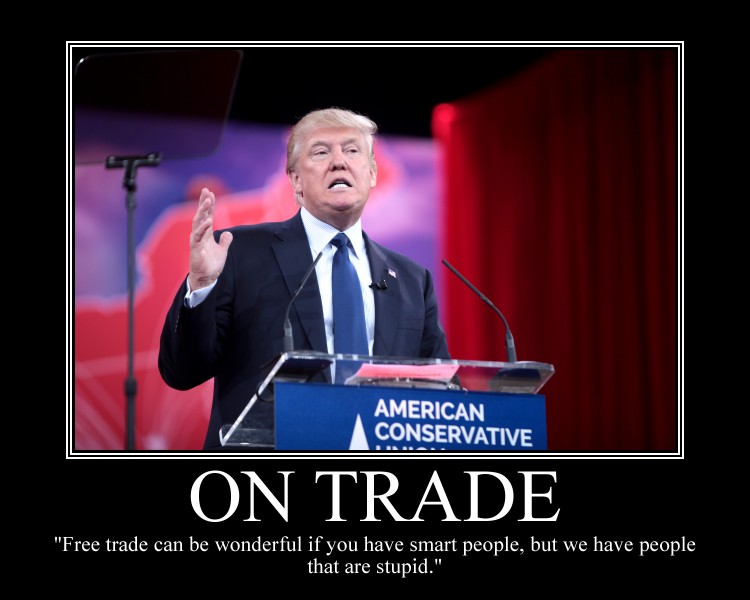
The trade debate in the U.S. is now entering a new stage with the apparent nomination of Kamela Harris and J.D. Vance. So far, the trade debate in the U.S. has been particularly toxic, even though there were significant similarities between Biden and Trump. Vance is fervently a protectionist (as is Trump) and Harris and her yet named running mate — well, we don’t know. The public has become very skeptical of trade and its impact on the U.S. economy. The issue of economic warfare, trade sanctions, tariffs, export controls are now being raised again. Sanctions and tariffs are just not very effective and often cause more problems. But new data and candidates can change the terms of the debate and the formulation of newer and more beneficial trade policies, hopefully.
“If artificial intelligence systems transform the global economy, then the data centres that train them are the factories of the future. Governments around the world see AI-capable data centres as a strategic resource …. All advanced AI systems are developed in data centres full of high-end chips …. It should not therefore come as a surprise that more countries want guaranteed access to AI technology via data centres that are built on their own soil …. Chips, clouds and data centres are intrinsically interlinked, so long as high-end, export-controlled chips give cloud computing companies the ability to deploy AI efficiently.” “Global Chip War and Cloud War.” Financial Times (July 30, 2024).
“Donald Trump’s economic panacea is to impose over-the-top tariffs on all imports …. If enacted, it would return our postmodern economy to that of the Gilded Age of the late 19th century, to economic policies favoring the wealthy over the poor and middle class, when tariffs were the main source of government revenue. That tariff-dominant era ended with the 16th Amendment to the U.S. Constitution in 1913, which facilitated the adoption of a graduated federal income tax. The income tax, not tariffs, has been the main source of federal revenue ever since, and for good reason. Tariffs are a tax on imports, the functional equivalent of a sales tax, imposing a proportionately bigger burden on those with modest incomes …. Following the Revolutionary War, the national government did indeed rely almost entirely on tariffs, as pushed by Treasury Secretary Alexander Hamilton to avoid distasteful excise taxes and encourage the new nation’s infant manufacturing sector. The Civil War quickly proved their inadequacy. To meet the resulting fiscal crisis, Abraham Lincoln persuaded Congress to pass the very first income tax in 1862, essentially a tax on only the very top earners …. That was phased out after the war, returning the United States to its reliance on tariffs and the chaos and class resentment they created …. The Democrats’ defeat after the war brought traditional Republicans with their high-tariffs philosophy back into power and they raised tariffs throughout the 1920s. That culminated in the infamous Smoot-Hawley Tariff Act of 1930, which was enacted in the misplaced belief that tariffs could protect American industries and farmers after the 1929 stock market crash. Instead, they fueled a catastrophic global trade war, strangled commerce, unleashed competitive currency devaluations and intensified a worldwide depression that contributed to the rise of Nazism and worldwide war …. The advent of President Franklin Roosevelt, a free-trader and Cordell Hull went on to become an eloquent postwar champion of international trade to save the world from another global crisis …. American politics have a way of flipping the policies of parties. In the modern era, beginning with President Ronald Reagan, it was Republicans who led the way to lower trade barriers as a boon to economic growth…. Trump is the first major Republican of the modern era to enact sweeping higher tariff barriers to protect American industries and farmers …. For his potential second term, Mr. Trump and his running mate, Senator JD Vance of Ohio, would bring the country back to its protectionist past at a time when large segments of the economy depend on trade and foreign investment, not to mention immigration for high-end tech jobs and low-end jobs in services and agriculture …. A case can be made for selective tariffs to protect national security and sensitive supply chains and encourage green technologies. The Biden administration has pushed for these steps while keeping Trump’s tariffs largely in place, incurring many of the same costs. The long historical record demonstrates these are borne not by other countries, as Trump keeps insisting, but by American consumers and industries.” “Trump and Tariffs.” New York Times (July 28, 2024).
“For over a decade, there has been a widespread myth in US politics that global trade causes American job losses. Yet, two decades of data show that the US economy has largely recovered from the initial impact of the China Shock, grown its resilience to foreign competition, and now in fact thrives on foreign imports. The data reveal the complexity of globalization’s impact on workers, the need to address the US’ investment in its human capital, and the myth that trade is toxic to the American economy …. The US economy was already resilient against imports from China and other low-wage countries prior to the sharp shift in US trade policy and public sentiment, stoked by a bipartisan ongoing political narrative, against globalization …. US manufacturing jobs post-2011 is insignificant, implying that policymakers advocating for nationalist policies are basing their trade policy decisions on outdated evidence …. The research suggests that, rather than solely focusing on reviving lost manufacturing jobs, US policymakers should pivot toward leveraging the country’s comparative advantages in tradable services. This shift in focus holds promise for further enhancing the US economy’s robustness and competitiveness in the global marketplace …. Analysis underlines how reactionary protectionism can worsen economic inequalities and undermine US competitiveness by failing – often deliberately, in the ongoing political narrative – to recognize the benefits that global trade actually brings to the American economy. “Is Trade Really Toxic.” Hinrich (July 2024) (discussing 2024 Georgetown Report).
“In Washington, the swell of sanctions has spawned a multibillion-dollar industry. Foreign governments and multinational corporations spend exorbitant sums to influence the system, while white-shoe law firms and K Street lobbying shops have built booming sanctions practices — in part by luring government officials to cash in on their expertise …. The United States is imposing sanctions at a record-setting pace again this year. The United States is imposing sanctions at a record-setting pace again this year, with more than 60 percent of all low-income countries now under some form of financial penalty, according to a Washington Post analysis …. Treasury officials can impose sanctions on any foreign person, firm or government they deem to be a threat to the U.S. economy, foreign policy or national security. There’s no requirement to accuse, much less convict, anyone of a specific crime. But the move makes it a crime to transact with the sanctioned party …. The number of sanctioned entities appeared to be growing too fast for OFAC to keep up.” “U.S. Sanctions Policy.” Washington Post (July 27, 2024).


 Stuart Malawer
 U.S. LAW & GLOBAL TRADE RELATIONS.
Pingback: TRUMP AND TRADE 2.0 — Worse than Before? | GLOBAL TRADE RELATIONS ……………………… Trade News & Legal Commentary — FOCUS ON U.S. & GLOBAL TRADE LAW.