
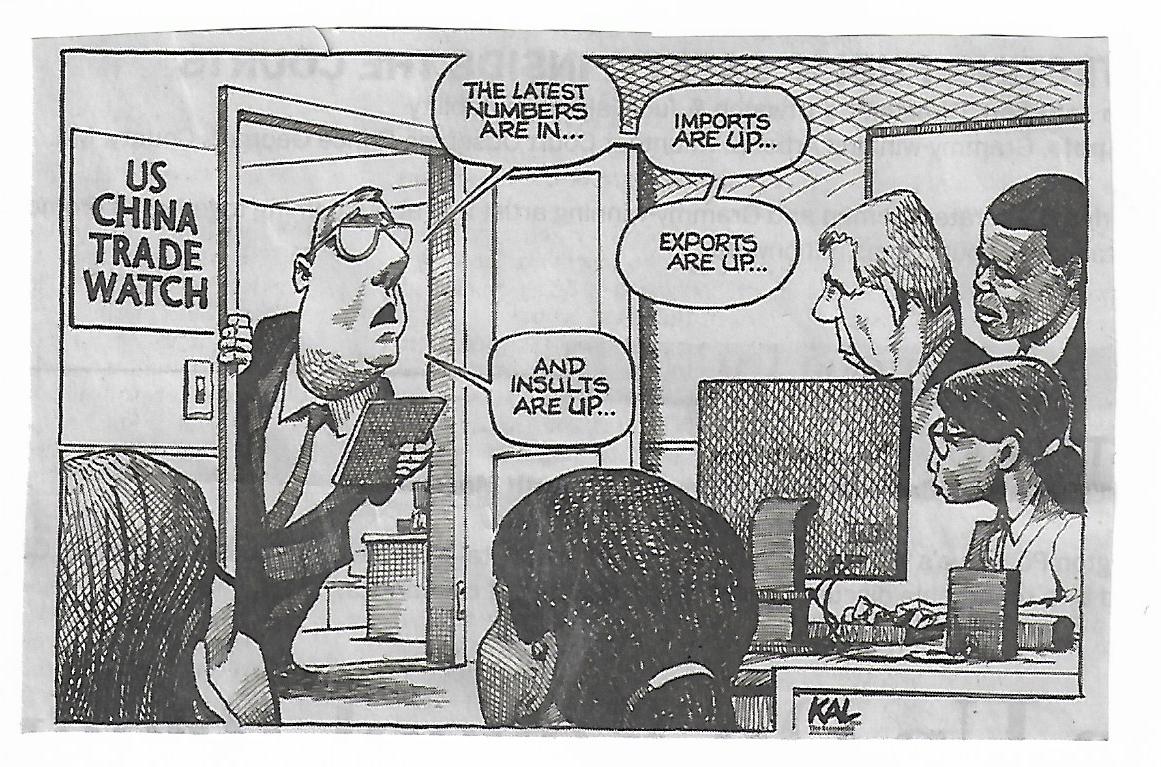
The proposals by the Republican Party and Trump and now Vance concerning trade and international investment can be unfortunately summarized as — The most aggressive rejection of U.S. trade policy since World War II. They propose adopting policies even more harsh than those of ‘Ameriaca First’ that thrived in the 1930s and harsher than those during President Taft’s administration of the ‘Gilded Age.’ (Taft was often referred to as ‘Mr. Tariff’). Trump / Vance proposals further echo those of the early 1800’s. I’ll be reviewing this issue during the campaign and the run up to the November election.
“Trump says that mixing tariffs with tax cuts will revitalize American businesses and manufacturing, boosting jobs and benefiting working-class Americans. And they see tariffs on foreign products as a lucrative source of revenue …. The U.S. government was largely funded by tariffs when the country was in its infancy. But starting around the time of the Civil War, the government introduced other taxes to generate more revenue for the state. The income tax was introduced in 1913 in part to counteract the soaring income inequality of the Gilded Age …. It [Raising tariffs] would also be likely to trigger a trade war, which could prompt Trump to once again use tariff revenue to compensate farmers and other businesses that suffer losses.” “Trump’s Proposed Tariffs and Tax Cuts.” New York Times (July 19, 2024).
“As the World Trade Organization approaches its 30th birthday on New Year’s Day, 2025, the international trading system is in crisis. The world’s largest economic blocs — the US, the EU, and China — are locked in an escalating tripartite tariff war …. The rather rarefied topic of international trade policy affects things many voters actually care about: jobs, national security, climate change, and so on. Protectionism is increasingly touted as a simple solution to complex social and economic strains …. China’s export-driven growth miracle has lifted hundreds of millions of people out of poverty, that the EU built whole industries on the back of the resulting demand for high-value goods and services, and that the US has become the richest and most technologically innovative nation on Earth as a result.” “Understanding Global Trae Crisis.” Financial Times (July 18, 2024).
“The bipartisan momentum for ditching America’s postwar commitment to trade liberalization has come from the right. Mr. Trump isn’t the first self-proclaimed “Tariff Man” to serve as president—that title belongs to William McKinley …. As recently as 2016, it was unthinkable that any president would propose a 60% tariff on all goods from China and a 10% tariff on all imports from every U.S. trading partner. Trump’s decision to make J.D. Vance his running mate underlines the seriousness of the former president’s effort to reverse U.S. trade policy, which began when he withdrew the U.S. from the Trans-Pacific Partnership in 2017. Mr. Vance represents a Midwestern state where, today’s protectionists insist, manufacturing jobs and factories have evaporated thanks to trade liberalization …. Foreigners don’t bear the costs of U.S. tariffs. A tariff is a tax charged to American importers whenever a product they have purchased from abroad enters the U.S. economy …. Unfortunately for Team Trump, and even more so for blue-collar Americans, tariffs don’t work this way.” “Tariffs and American Workers.” Wall Street Journal (July 18, 2024).
“This year’s Republican platform decries “a blind faith in the siren song of globalism,” and says that “the Republican Party must return to its roots as the Party of Industry, Manufacturing, Infrastructure and Workers” …. Some of the pivot away from free-market ideals reflects a bipartisan shift in priorities …. While the Republican platform includes plans to raise tariffs, there is no mention of exports or encouraging trade … Trump added tariffs on more than $400 billion of imports during his first term, and Biden has largely kept those levies intact …. But Trump is promising a much more aggressive agenda on trade if he is re-elected — an about face from the more free-trade orientation of the Republican Party in previous decades …. The new Republican platform calls for broad, “baseline tariffs” on foreign-made goods, and floats the idea of making tariffs with foreign countries reciprocal. It proposes phasing out imports of essential goods, banning companies that outsource jobs from selling goods to the federal government and stopping China from buying American real estate and investing in U.S. industries ….. It also calls for stripping China of its “most favored nation” status, which allows it to trade on similar terms to other members of the World Trade Organization. As that happens, politicians are increasingly embracing tariffs and subsidies as standard tools for managing the economy.” “Protectionism and Republicans.” New York Times (July 15, 2024).


 Stuart Malawer
 U.S. LAW & GLOBAL TRADE RELATIONS.
You must be logged in to post a comment.