
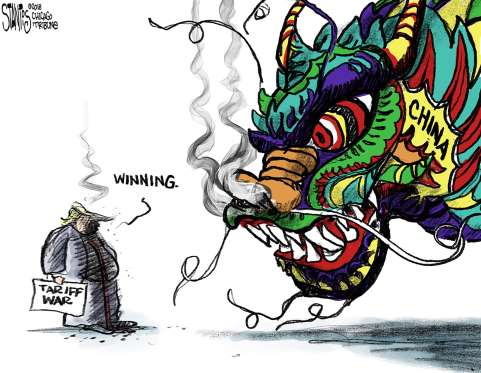
Under Trump and Biden U.S. trade policy has veered away from its traditional approach, developed since World War II, from multilateralism to focusing primarily on national and unliteral concerns. At the center of the newer U.S. approach has been tensions with China. This newer approach includes a renewal of industrial policies, protectionism and reliance on national security — manifested by newer and unexpected geopolitical developments. The discussion of trade policy today has become very toxic. It’s more than just “America First” (which harks back to the protectionism and isolationism of the 1930s) but to an extreme unilateralism and greater espousal of worker rights (as opposed to economic development and furtherance of international business and investment relations). The Heinrich Foundation publishes extensive essays on a broad range of trade issues and in particular U.S. trade policy. Here are a few excerpts from recent essays.
“The USTR of 2024 sees things very differently. Under the leadership of Katherine Tai and the trade skeptics who advise her, USTR sees trade as something to be avoided, ignored, or fashioned into an adjunct useful only as a means of advancing other policy objectives … Trade must be grounded in fair competition, and workers should not have to compete against artificially low wages or unsafe working conditions. Trade negotiations will be used to boost partners’ climate commitments. Close working relationships with labor, civil, and human rights stakeholders will guide the approach to trade enforcement and level the playing field for American workers …. Nowhere does USTR spell out the importance of a close working relationship with business. The stakeholders listed above are all important contributors to the fabric of American society. But they do not trade. Workers are vitally important to production, trade, and the overall economy. But they engage in these activities in their capacity as employees for businesses …. USTR’s unique approach to trade policy has business leaders wringing their hands in frustration. The criticisms encompass USTR’s abhorrence of “traditional” trade agreements that include improving access to foreign markets for US companies or bringing down trade barriers domestically. In almost four years in office, US trade officials have struck exactly zero trade agreements of this nature …. But others say the sharp turn in policy with a focus on social, environmental, and antitrust issues has been a source of frustration. Much of this seems to flow from a lack of clarity of what precisely the administration’s “worker-centric” trade policy is designed to do.” “What Went Wrong With the USTR.” Heinrich (May28, 2024).
“Former President Donald Trump has promised more tariffs if reelected, 60% against Chinese goods, 10% against products from the rest of the world. These are in addition to the tariffs he imposed during his time in office and presumably on top of some noteworthy tariffs added to by President Joseph R. Biden, Jr., including the 100% tariff on Chinese-made electric vehicles (EVs) …. There is no reason to assume that the US tariff would not be met with additional foreign tariffs. The European Union, Canada, and Mexico retaliated immediately when Trump put on the steel and aluminum tariffs in 2018 …. Unlike the Biden tariffs, the Trump plan is for increased tariffs on all products from all countries. It is not just America First; it is America Alone …. Only trade experts can readily tell that the two, Trump and Biden, are not using tariffs in the same way.” “Trump Tariffs and Trade War.” Heinrich (June 18, 2024).
“Trade has become toxic, not just on the campaign trail, but in the way that it is discussed by both Democrats and Republicans …. But the fact that some Americans were hurt by a failure to adjust to foreign competition has become the central grievance of the critics of modern US trade policy and has perhaps overly dominated the debate …. Meanwhile, Jake Sullivan suggests modern US trade policy should move “beyond traditional trade deals to innovative new international economic partnerships focused on the core challenges of our time.” (Both statements, of course, ignore the regressive nature of the US tariff system and its disproportionately negative impact on working families).” “Reciprocity and Trade.” Heinrich (January 20, 2024).


 Stuart Malawer
 U.S. LAW & GLOBAL TRADE RELATIONS.
You must be logged in to post a comment.