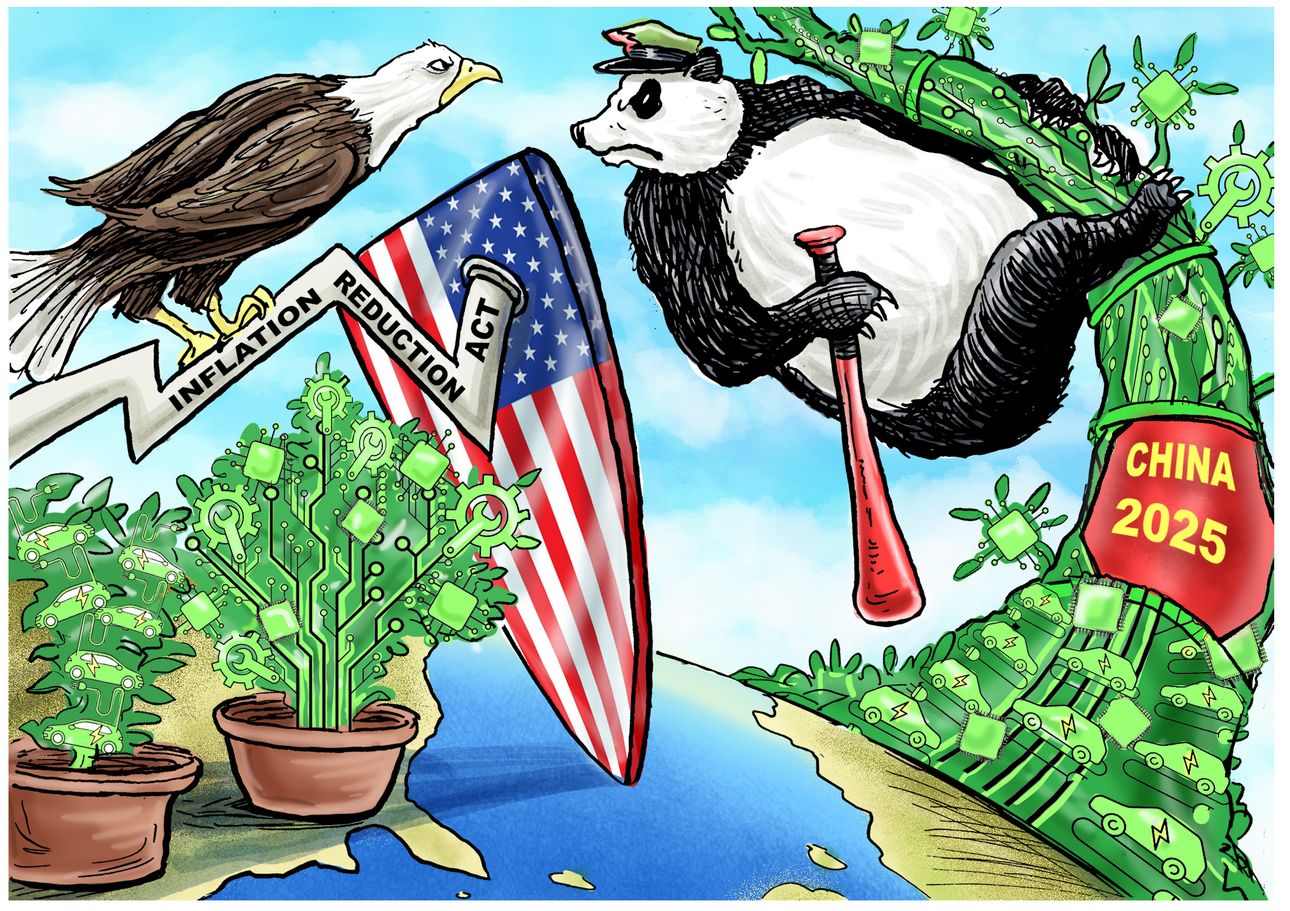
Issues concerning tariffs and supply chains continue to dominate trade issues between China and the U.S. The Biden administration continue to roll out new trade initiative and measures — especially as they relate to and support newer U.S. fiscal tax and subsidy legislation. For example, as they concern EV’s and their batteries. Clearly, many tariffs are not justified and are protectionist.
“The Biden administration outlined its plans to curb new American investment in critical Chinese technology industries …. The proposed Treasury Department rules would prohibit certain U.S. investments in Chinese companies that are developing semiconductors, quantum computers and artificial intelligence systems …. The rules apply to equity investments, debt financing that could be converted to equity, and to joint ventures …. Lawmakers in Congress have also been working on legislation that would make scrutiny of sensitive investments in Chinese technology sectors a fixture of United States law.” “Chinese Tech and New US Rukes.” New York Times (June 22, 2024).
“Unquestioning belief in the free market created a globalism that funneled money to the 1 percent, which has used its wealth to amass political power at the expense of everyone else. It produced free trade agreements that sent too many U.S. factories to China …. She could do for free-market skepticism what Milton Friedman and his allies had done for free-market fundamentalism. “Bidenomics and Trade.” New York Times (June 22, 2024).
“The Biden administration’s new law forcing the sale or ban of TikTok is the unconstitutional result of “political demagoguery” and should be overturned, TikTok attorneys said in a court brief Thursday marking the start of one of the most consequential legal battles in American internet history …. The company included a roughly 100-page draft national security agreement it offered to the government in August 2022 in hopes of resolving its concerns …. TikTok’s proposal had followed years of negotiations with the Committee on Foreign Investment in the United States, a multiagency federal group known as CFIUS that reviews business deals for national security risks …. Because the sale-or-ban law set the appeals court as the “exclusive jurisdiction” for any challenge, the brief offers TikTok one of its only chances to defend itself in court …. TikTok’s proposal was “the most sophisticated and thorough mitigation agreement” … in decades of reviewing similar contracts. ” “Tik Tox Files Suit Against U.S.” Washington Post (June 21, 2024).
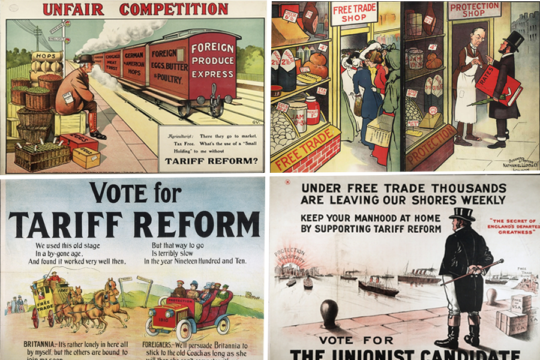
“Industrial policy is back as a powerful motivator for government intervention. This is true in many parts of the world …. Today, the most striking new industrial policy is that of the Biden administration …. Joe Biden’s Inflation Reduction Act has multiple goals, from promoting place-based manufacturing to lowering …. So, how should we assess this shift in US policy towards industrial policies, matched, on the Trumpian right, by a desire to return to the high tariffs of the late 19th and early 20th centuries? …. At the very least, powerful policymakers need to approach the decisions they are making in as rational and careful a way as they can.” “Industrial Policy” Financial Times (June 19, 2024).
“JEAIL Interview with Dr. Malawer on U.S. Tariff History (Historical Stages) and Trump – Biden Tariffs.” (YIJUN Institute of International Law in Korea) (June 2024).
My presentation on “Global Risk and Geopolitics — Changing Trade System and Multinational Corporate Strategies (Focus on Tariff Wars).” (June 18, 2024).
“The European Union said it would impose additional tariffs of up to 38 percent on electric cars built in China …. The Biden administration announced last month that it would impose new tariffs of 100 percent on Chinese electric vehicles. That measure quadrupled the tariffs that the United States previously charged for foreign cars, in an effort to shield the American auto industry from Chinese competition.” “EU Imposes Higher Tariffs on Chinese Electric Vehicles.” New York Times (June 13, 2024).
“We are moving into a protectionist world, led by the US, as in the early 1930s. Donald Trump is of course, a committed protectionist — a true successor of Senator Smoot and Representative Hawley, who instigated the infamous Smoot-Hawley tariff in 1930 …. The point is simple …. But trade policy, especially protection, will rarely be the best way of achieving the objective … Tariffs are rarely the best policy instrument, one needs to understand what they do. Tariffs are taxes on consumers …. Yes, there are perfectly sound arguments for intervention in markets. But returning to the trade policies of the 1930s is quite mad.” “Tariffs are Bad Policy.” Financial Times ( June 12, 2024).
“Washington putting pressure on EV and battery makers to build a new non-Chinese supply chain for graphite anodes, a crucial component in electric vehicle batteries. The US trade representative announced that 25 per cent tariffs on natural and synthetic graphite anodes from China …. While natural graphite — a form of carbon — is relatively abundant, almost all natural graphite processing and 98 per cent of synthetic graphite production for battery-grade anodes is presently conducted in China.” “U.S. Tariffs and China’s Graphite.” Financial Times (June 10th, 2024).
“Trump floated the idea of an all-tariff federal revenue system, large enough to replace the income tax ,,,, reversing more than 100 years of economic policy that encourages free trade.” “Trump & All-Tariff Revenue Model (No Income Tax).” Wall Street Journal (June 14, 2024).
“The trade and tariff war trade war between China and the US is likely to escalate whether Joe Biden or Donald Trump wins the presidency …. The European Union imposed new tariffs on Chinese electric vehicles, following in American footsteps ,,,, Biden’s 100% tariff essentially shuts the door to Chinese EVs — you don’t see them on US streets. Not so in Europe.” “China is Facing Trade Disputes.” Bloomberg (June 14, 2024).


 Stuart Malawer
 U.S. LAW & GLOBAL TRADE RELATIONS.
You must be logged in to post a comment.