
.
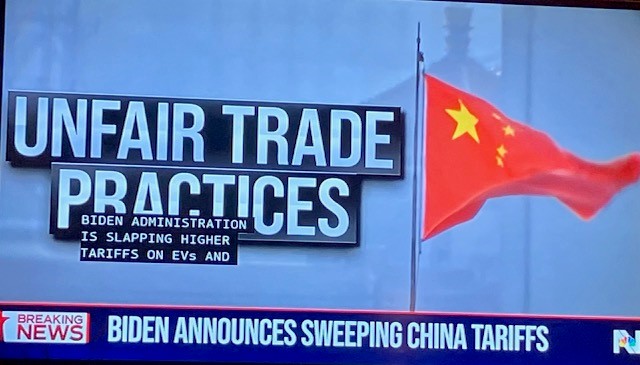
Trade wars and tariffs have become central to U.S. foreign and trade policies under both Trump and Biden— And even more central to this current campaign season. It’s really important to look closely at what has happened over the last eight years and what is currently transpiring during this campaign season. There are differences between Biden and Trump and there are some basic economic factors that are in play, even if both fail to adequately note them. But an integrated U.S. tariff and trade strategy is emerging, for example promoting chip and battery production (and employment growth). A movement away from free trade and more protectionism. The Biden administration is leading the charge with a focus on national security and something of a national industrial policy. With Trump proposing even more extensive policy changes.
“Tariffs aimed at protecting America’s solar industry from foreign competition snapped back into place, ending a two-year pause that President Biden approved as part of his effort to jump-start solar adoption in the U.S. The tariffs, which will apply to certain solar products made by Chinese companies in Southeast Asia.” “Tariffs to Protect Solar Sector.” New York Times (June 7, 2024).
“Both men, as they vie for a second White House term, say that tariffs on imported Chinese goods are needed to promote domestic manufacturing and to clap back at China’s zero-sum trade practices …. Biden’s tariffs on $18 billion in Chinese electric vehicles, batteries and computer chips, announced last month, are likely too small to lift the economy’s overall price level, economists said. But Trump’s plan for 60 percent tariffs on all $427 billion in goods that China ships to the United States each year would almost certainly reshape trade in ways that consumers would notice.” “Biden and Trump Embrace Tariffs.” Washington Post (June 7, 2024).
“Tariff policy has gone through three distinct phases since the 1700s …. From independence until the Civil War the purpose of tariffs was mainly revenue: They accounted for 90% of federal receipts. From the Civil War until the Great Depression, the purpose was restriction: protecting northern manufacturers …. A third era began with the passage of the Reciprocal Trade Agreements Act in 1934 empowering the president to negotiate lower duties if other countries did the same. Reciprocity remained the dominant paradigm after World War II as presidents of both parties sought to knock down other countries’ trade barriers …. The tariffs he imposed on China and to which President Biden just added are a different animal altogether. They are partly about restriction and reciprocity—protecting nascent industries and prodding China to change its ways. But the more fundamental goal is realignment: diversifying U.S. trade away from China …. Tariffs are more than taxes. They are also an instrument of geopolitical competition. Nonetheless, like all taxes, they impose costs that need to be weighed against their benefits.” “Tariffs and Geopolitics (Historical Stages of U.S. Tariffs.” Wall Street Journal (May 31, 2024).
“As an integral part of economic policy, trade must also be a part of any social contract; it must undergo its own transformation …. This is not a call for trickle-down economic policy, but a call for economic policy to serve the interests of working people …. Trade policy has long followed the trickle-down approach that has been so common over the past four decades …. We must also recognise its limits to do the same when it comes to trade. A laissez-faire system has allowed short-term profit-driven businesses to maximise their gains, often by partnering with a non-market autocracy to further that goal …. This is why the Biden-Harris administration’s approach to trade has been to democratise economic opportunity. “Biden’s Newer U.S. Trade Policy – Rejection of ‘Trickle Down’.” Financial Times (May 28, 2024).
“Chinese firms trying to buffer themselves from Washington’s anti-China policies are rebranding and creating U.S.-domiciled businesses to sell their wares as the Biden administration expands the government entity lists that restrict Chinese companies’ business dealings in the U.S., say policymakers and national-security experts.” “Blacklisted Chinese Companies Rebrand.” Wall Street Journal (May 29, 2024).
“{If Trump wins] Economically, an “America first” strategy would feature protectionism and predation. The United States would remain engaged in the global economy. But it would seek to dramatically rebalance the burdens and benefits of that involvement. There would be no more tolerating asymmetric discrimination by trade partners, even democratic allies.“ “Trump’s ‘America First World’ if He Wins.” Foreign Affairs.” (May 27, 2024).
“There are different kinds of tariff strategies …. Trump used tariffs as a blunt tool in a single-prong strategy to reduce the US trade deficit with China, but for Biden they are part of a much broader plan. This aims not only to tackle Chinese mercantilism, the global economic and political fallout from it and the failure of the existing trade system to address it, but also to expand capacity in key areas like semiconductors and clean tech.” “Not all U.S. Tariffs are Equal.” Financial Times (May 20, 2024).
“A new report from the U.S. trade representative’s office finds that President Donald Trump’s tariffs on Chinese products reduced Americans’ real incomes and depressed investment but didn’t increase manufacturing employment (under Section 301 actions). FOUR-YEAR REVIEW OF ACTIONS TAKEN IN THE SECTION 301 INVESTIGATION: CHINA (USTR 2024) …. George W. Bush was one of many presidents who imposed tariffs on imported steel …. Barack Obama placed tariffs on Chinese tires, costing Americans an estimated $900,000 per job saved …. Presidents from Franklin D. Roosevelt to Obama, however, sought to liberalize trade generally, believing that a coordinated opening of markets would boost all economies …. The big change in U.S. trade policy under Trump and Biden is that there’s no longer any big-picture effort to move toward freer trade.” “Trump and Biden Tariffs.” Washington Post (May 22, 2024). See also, “FOUR-YEAR REVIEW OF ACTIONS TAKEN IN THE SECTION 301 INVESTIGATION: CHINA” (USTR 2024).
“The new tariffs President Biden announced last week aren’t economically significant. Symbolically, they are huge. The U.S. buys almost no electric vehicles, steel or semiconductors—all targets of the tariffs—from China …. It signals that the decoupling of the Chinese and U.S. economies is becoming irreversible. More important, the tariffs are the final piece of an economic strategy for competing with China. This strategy is a three-legged stool. The first consists of subsidies to build a viable technology manufacturing sector. The second is tariffs on Chinese imports that threaten those efforts. The third is restrictions on access to money, technology and know-how that could help China compete …. The strategy that has ultimately emerged is largely the work of Sullivan …. He sees trade, domestic economic policy and security as integrated.” “U.S. China Pivot – Tariffs and New Strategy.” Wall Street Journal (May 21, 2024).
“A small increase in prices on goods subject to tariffs suggests that retailers absorbed much of the cost. Absorption by retailers and wholesalers would mean that the tariffs function as a tax on businesses … Even if businesses end up absorbing some or most of the tariff, economists still see that imposing a cost. Firms faced with higher prices might have to lay off workers or hold off on expansions. That could sap overall growth and ultimately still affect consumers …. The primary effect is a regressive tax on consumers.” “Tariffs and Who Pays.” Wall Street Journal (May 20, 2024).


 Stuart Malawer
 U.S. LAW & GLOBAL TRADE RELATIONS.
You must be logged in to post a comment.