
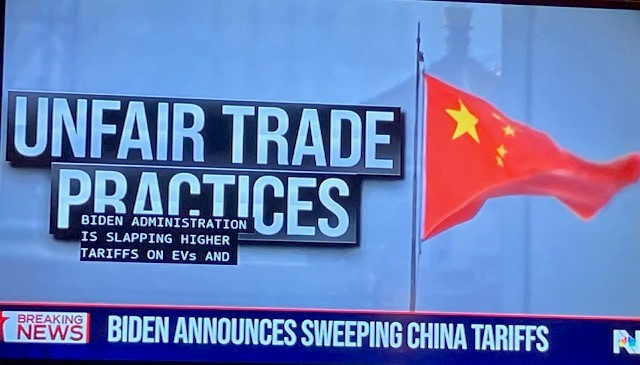
Historically, the United States has flirted with protectio0nism –from its founding, the early 1800’s, from the Civil War in the 1860’s, in the 1930’s, and more recently in the 1980’s (concerning Japan). It is now doing the same (concerning China). The historical assessment of restrictive U.S. tariff policy is that it really hasn’t helped in nation-building or keeping U.S, industry globally competitive. It’s a big negative. It raises costs to consumers, generates ill will, inflationary and fosters inefficiencies. The newest element, concerns over national security (while sometime valid), but often overused, is a development now more warranted by geopolitical developments in the 21st century. And now most important in formulating global business policies and strategies. Geopolitical risks to business are now extraordinary. Here are various comments concerning tariffs and their impact …..
-
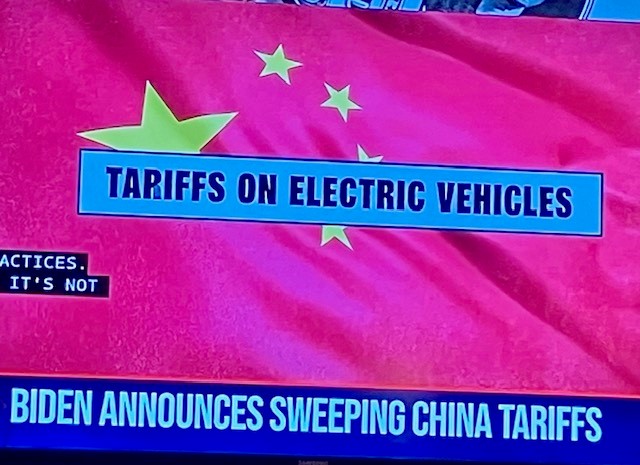
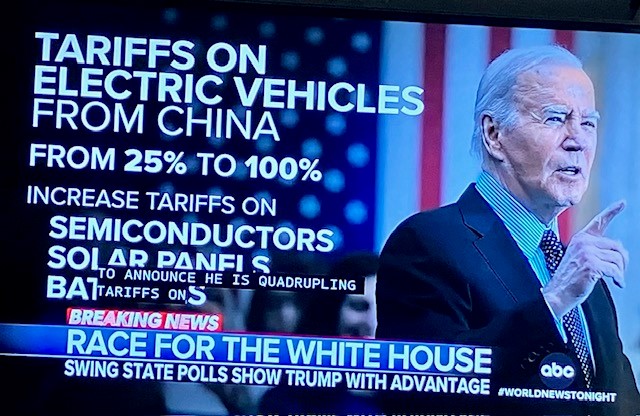
“Biden’s decision to codify and escalate tariffs imposed by Trump made clear that the United States has closed out a decades-long era that embraced trade with China and prized the gains of lower-cost products over the loss of geographically concentrated manufacturing jobs. A single tariff rate embodies that closure: a 100 percent tax on Chinese electric vehicles …. Despite their mutual embrace of forms of protectionism, Biden and Trump are offering voters contrasting views of how the American economy should engage with China …. Some think that consumption is the end, my view is production is the end …. Economists who continue to favor less restricted trade with China have criticized both candidates’ plans and not simply because they risk raising prices for American shoppers …. could slow economic growth.” “New Tariffs on China.” New York Times (May 9, 2024).
- “The 19th century was a time when governments relied on tariffs for a significant portion of their income and free traders did not envisage sweeping away all tariffs. Instead, they wished them to be set at levels designed solely to raise revenue …. The U.S. in 1861 the first major power to buck the free-trade trend with the reintroduction of a draconian tariff regime (which was quickly made harsher still by the need to finance the Civil War). This was also simply reversion to type: In the U.S., some form of nation-building protectionism has, on and off, been part of the policy mix since its experience of war and blockade earlier in the 1800s.” “When Free Trade Was Progressive.” Wall Street Journal (May 18, 2024).
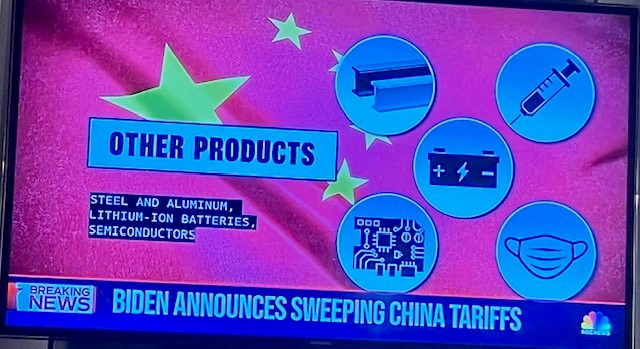
- “President Biden came out swinging this week when he announced a series of steep tariffs on Chinese imports, including 25 percent on certain steel and aluminum products, 50 percent on semiconductors and solar panels and 100 percent on electric vehicles …. We’ve been here before. In the 1980s, the Reagan and Bush administrations worried about the fact that Japan was dumping cheap cars onto our market. The response then was voluntary export quotas, which allowed Japanese entry into the market in a way the new tariffs will not. Japanese competition ultimately forced U.S. car manufacturers to innovate.” “Electric Vehicles Shouldn’t be Luxury Items.” New York Times (May 18, 2024).


 Stuart Malawer
 U.S. LAW & GLOBAL TRADE RELATIONS.
You must be logged in to post a comment.