What we are now seeing in U.S. trade policy is a race to the bottom — Who will come up with the worse trade restrictions? Biden or Trump. Developments the last week or so clearly highlight the wrong direction that trade policy actions and proposals have taken during this disturbing campaign season. Here are a number of recent commentaries.
“Joe Biden unleashed fresh tariffs on billions of dollars of Chinese goods on Tuesday, sharply raising the levies on clean energy imports including solar parts and electric vehicles …. The US president is not only keeping the tariffs on $300bn worth of Chinese goods that his predecessor Donald Trump imposed as part of his trade war against Beijing in 2018 but adding more, targeting strategic industries …. The new tariffs follow other recent moves to protect US manufacturing and blue-collar jobs, including Biden’s opposition to the takeover of Pittsburgh-based US Steel by Japanese company Nippon Steel …. The Biden administration has also enacted billions of dollars of subsidies for green and clean industries, with tax credits designed to unleash a new wave of investment in clean tech manufacturing.” “Biden’s New China Tariffs.” Financial Times (May 16, 2024).
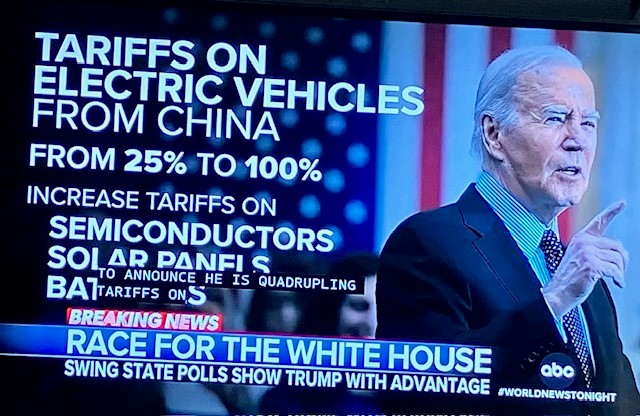
“U.S. President Joe Biden unveiled a new slew of U.S. tariffs on Chinese imports on Tuesday. The White House cited “unacceptable risks” posed by Beijing flooding the global market. Around $18 billions of imported goods will be affected, including electric vehicles, semiconductors, steel and aluminum, critical minerals, medical products, and solar panels. Biden also said he would maintain tariffs, originally established under former U.S. President Donald Trump, on more than $300 billions of Chinese goods …. Among some of the key changes, the White House plans to quadruple electric vehicle duties to more than 100 percent, double taxes on solar cells and semiconductors, and place a 50 percent tariff rate on hospital syringes and needles …. Biden’s announcement signals the latest escalation in a trade war that began under Trump and has since become a key campaign issue ahead of the November U.S. presidential election. Trump routinely raised tariffs on Chinese goods during his tenure. He has since proposed a 10 percent tax on all imports from all countries as well as a tax of at least 60 percent on all Chinese goods, including a 200 percent tax on Chinese vehicles manufactured in Mexico …. Biden has criticized Trump’s “across-the-board tariffs” while also toughening his own economic posturing on China.” “Trade Frictions.” Foreign Policy (May 14, 2024).
“ The biggest increase will be the quadrupling of tariffs on Chinese electric vehicles to 100percent from 25 percent. That move is aimed at shielding a corner of the American automotive industry that is in line to receive hundreds of billions of dollars in federal subsidies to help the United States transition to a clean-energy future …. Mr. Trump has promised to go even further if he wins in November — restricting investment between the two countries and banning some Chinese products from the United States entirely. He has also promised to apply that approach more broadly by subjecting all imports, regardless of their origin, to an additional 10 percent tariff …. The zero-sum game of industrial policy that both countries are engaged in, coupled with the looming U.S. election season, has reached its inevitable culmination in the form of escalating tariffs …. Many economists oppose tariffs because they tend to act as an effective tax on domestic consumers, by raising prices.” “Biden and Higher Tariffs.” New York Times (May 15, 2024).
“Beijing instructs local governments to help the chosen industries. The assistance takes the form of cheap land for factories, new highways for freight trucks, bullet train lines and other infrastructure …. The auto sector is a prime example of how China has been able to move so fast to gain manufacturing dominance ….China’s top leaders have heavily subsidized the research and production of battery electric cars for the past 15 years …. The November election has put political pressure on President Biden to show that he is taking a tough stand toward China. Trade issues have also become enmeshed with security concerns.” “How China Rose to Lad World in Cars and Solar Panels.” New York Times (May 15, 2024).
“The two men, locked in a rematch election this fall, share a rhetorical fondness for beating up on China’s economic practices, including accusing the Chinese of cheating at global trade …. But Mr. Biden’s trade war differs from Mr. Trump’s in important ways. Mr. Trump was trying to bring back a broad swath of factory jobs outsourced to China. Mr. Biden is seeking to increase production and jobs in a select group of emerging high-tech industries — including clean energy sectors, like electric vehicles, that Mr. Trump shows little interest in cultivating. “Biden and Trump Tariffs – Different Aims.” New York Times (May 15, 2024).
“President Biden on Monday ordered a company with Chinese origins to shut down and sell the Wyoming cryptocurrency mine it built a mile from an Air Force base that controls nuclear-armed intercontinental ballistic missiles. The cryptomining facility, which operates high-powered computers in a data center near the F.E. Warren base in Cheyenne, ’presents a national security risk to the United States’ (under CFIUS) …. Cryptomining operations are housed in large warehouses or shipping containers packed with specialized computers that typically run around the clock, performing trillions of calculations per second, hunting for a sequence of numbers that will reward them with new cryptocurrency.” “Biden and Chinese Bitcoin Mines Restricted.” New York Times (May 15, 2024).
“The Administration is using Section 301 of the Trade Act of 1974, the same law Mr. Trump invoked to impose tariffs to cajole Beijing to change its mercantilist behavior …. China does present a special challenge for U.S. trade policy because it’s an adversary that often doesn’t play by global rules. Targeted trade policy that punishes IP and cyber theft and protects national security is justified …. The Biden tariffs are a classic example of how bad industrial policy is compounded by another bad policy in the name of fixing the first mistake.” “Biden Starts a Green Trade War.” Wall Street Journal (May 15, 2024).
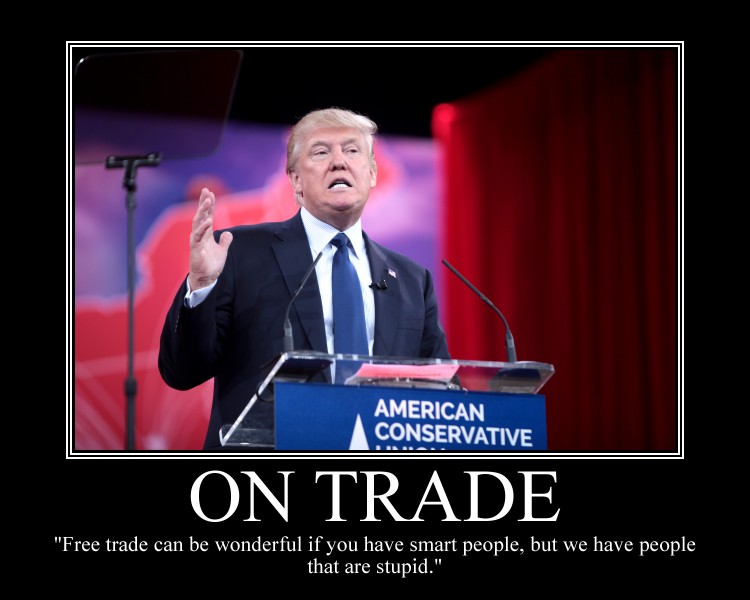
“One day after news broke that President Biden was planning to raise tariffs on Chinese electric vehicles to roughly 100%, Donald Trump moved to one-up his rival for the White House. ‘I will put a 200% tax on every car that comes in from those plants.’ The retort put on display a dynamic now at the heart of U.S. trade policy: The leaders of both political parties are racing each other to impose tough barriers on trade with China. What was once a lone effort by Trump to disrupt the bipartisan faith in free trade has become an establishment consensus of its own …. Biden’s decision caps years of tortured debate within the administration over the tariffs Trump originally put in place on more than $300 billion in imports from China. Those duties, implemented in 2018 and 2019 and augmented by Biden’s new steps, are now a seemingly permanent feature of U.S. policy toward China. Biden also weighed concerns from economic advisers who viewed some of the Trump-era tariffs as unstrategic and potentially inflationary …. The fact is that no one wants to look weak on China …. These tariffs are the culmination of clashing industrial policies between the two countries and also the looming election season in the U.S.” “Trump and Tariffs.” Wall Street Journal (May 14, 2024).


 Stuart Malawer
 U.S. LAW & GLOBAL TRADE RELATIONS.
You must be logged in to post a comment.